
Determine the necessary mass, volume, or concentration for preparing a solution.
| Activity Type | Activity Value -log(M) | Mechanism of Action | Activity Reference | Publications (PubMed IDs) |
|---|
Moligand™, 10mM in DMSO Moligand™ for sensitive chromatographic and analytical workflows requiring minimal baseline interference.
Store at -80°C Ships Dry ice packs + Cold packs Check lot-specific COA for exact specifications.
SDS, COA, datasheet, and spec sheet available for download. Lot-specific COA accessible via lot number lookup.
Cited in 3 peer-reviewed publications across chromatography, organic synthesis, and cross-coupling reactions.
Information
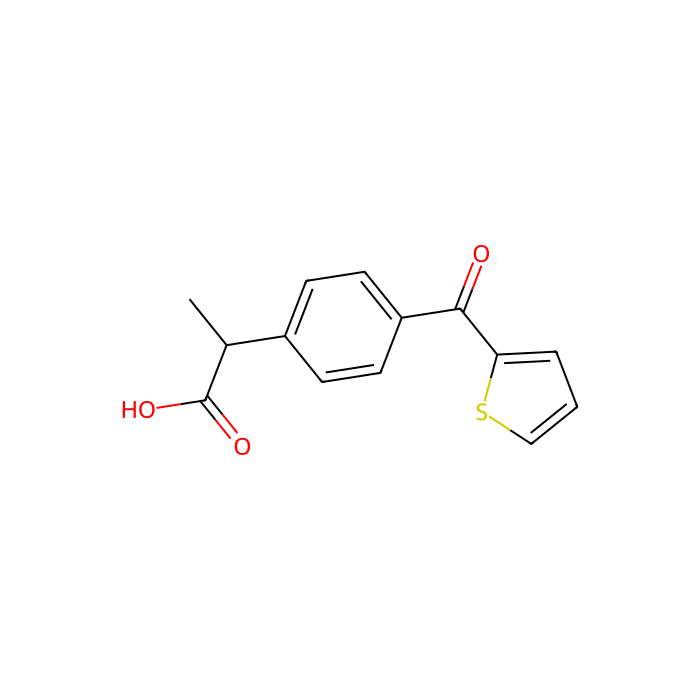
Suprofen is a dualCOX-1/COX-2inhibitor, used as a non-steroidal anti-inflammatory analgesic and antipyretic.
In vitro
Suprofen inactivates the diclofenac-4-hydroxylase activity of baculovirus-expressed P450 2C9 in a time- and concentration-dependent manner, which is consistent with mechanism-based inactivation. Suprofen is a known generator of singlet oxygen whose participation in the reaction is supported by the effects of quenchers and scavengers. Suprofen photosensitizes the production of alkali-labile cleavage sites in DNA much more efficiently than direct strand breaks. Suprofen sensitizes photo-oxidation of cholesterol, producing 7 alpha- and 7 beta-hydroperoxides but not 5 alpha-hydroperoxide of cholesterol. Suprofen-sensitized photo-oxidation of membrane lipids of liposomes increases leakage of trapped glucose, suggesting photosensitized destabilization of the membrane structure. Suprofen incorporation in the phosphatidylcholine (PC) evaporation vesicles (REV) membrane leads to approximately 5% increase in the encapsulation efficiency (34%) in comparison to standard REV (29%).
In vivo
Suprofen combined with PGF2 alpha blocks induction of uterine contractions, suggesting the possibility that Suprofen also antagonizes PGF2 alpha receptor binding. Suprofen are effective at preventing BAB disruption after paracentesis in dogs, indicating their potential usefulness for treatment of prostaglandin-mediated ocular disease. Suprofen (3.7 mg/kg, i.v.) induces a marked decrease in the firing evoked in arthritic rats by ankle mobilization.
Cell Data
cell lines:HCC1806, MDA-MB-231, and T47D cells
Concentrations:
Incubation Time:
Powder Purity:≥99%
| ALogP | 3.3 |
|---|
| Isomeric SMILES | CC(C1=CC=C(C=C1)C(=O)C2=CC=CS2)C(=O)O |
|---|---|
| PubChem CID | 5359 |
| Molecular Weight | 260.31 |
Comprehensive hazard, handling, storage, and regulatory compliance document.
Download SDS →Lot-specific quality data. Enter your lot number to retrieve the exact COA.
Look up COA →Full quality attributes and acceptance criteria for this grade.
View spec sheet →| Activity Type | Activity Value -log(M) | Mechanism of Action | Activity Reference | Publications (PubMed IDs) |
|---|
| Activity Type | Activity Value -log(M) | Mechanism of Action | Activity Reference | Publications (PubMed IDs) |
|---|
| Solubility | Solubility (25°C) In vitro Water: 42 mg/mL (200.35 mM); DMSO: Insoluble; Ethanol: Insoluble; |
|---|---|
| Melt Point(°C) | 123 °C |
| 1. Yuanjing Lin, Jialiang Guo, Hang Lin, Jincai Wang, Govert W. Somsen, Jacques Crommen, Zhengjin Jiang. (2017) Effect of fabrication strategy on the enantioseparation performance of β-cyclodextrin-functionalized polymethacrylate monoliths: A comparative evaluation. JOURNAL OF SEPARATION SCIENCE, 40 (19): (3754-3762). [PMID:28749038] [10.1002/jssc.201700424] |
| 2. Jialiang Guo, Yuan Xiao, Yuanjing Lin, Jacques Crommen, Zhengjin Jiang. (2016) Effect of the crosslinker type on the enantioseparation performance of β-cyclodextrin functionalized monoliths prepared by the one-pot approach. JOURNAL OF CHROMATOGRAPHY A, [PMID:27268520] [10.1016/j.chroma.2016.05.078] |
| 3. Jialiang Guo, Yuan Xiao, Yuanjing Lin, Qiaoxuan Zhang, Yiqun Chang, Jacques Crommen, Zhengjin Jiang. (2016) Influence of the linking spacer length and type on the enantioseparation ability of β-cyclodextrin functionalized monoliths. TALANTA, [PMID:26992519] [10.1016/j.talanta.2016.02.016] |
Our grade selection guide covers purity, stabilizer status, and application suitability for all variants in our catalog.
View Moligand™ grade guide →