
Determine the necessary mass, volume, or concentration for preparing a solution.
| Activity Type | Activity Value -log(M) | Mechanism of Action | Activity Reference | Publications (PubMed IDs) |
|---|
≥99% for sensitive chromatographic and analytical workflows requiring minimal baseline interference.
Store at -20°C Ships Ice chest + Ice pads Check lot-specific COA for exact specifications.
SDS, COA, datasheet, and spec sheet available for download. Lot-specific COA accessible via lot number lookup.
Cited in 0 peer-reviewed publications across chromatography, organic synthesis, and cross-coupling reactions.
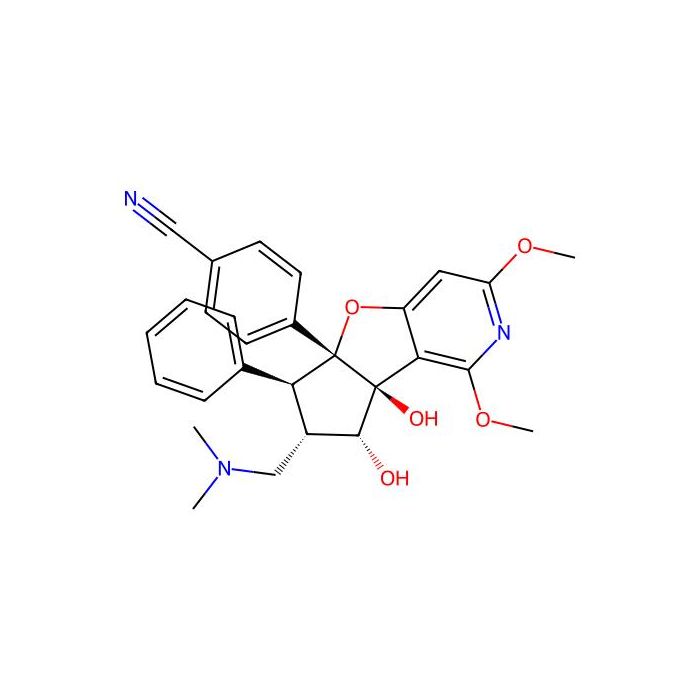
Zotatifin (eFT226) is a potent, selective, and well-tolerated eIF4A inhibitor. Zotatifin promotes eIF4A binding to specific mRNA sequences with recognition motifs in the 5’-UTRs ( IC 50 =2 nM) and interferes with the assembly of the eIF4F initiation complex Zotatifin shows robust antiviral effects, it effectively reduces viral infectivity by inhibiting SARS-CoV-2 NP protein biogenesis ( IC 90 =37 nM) . Zotatifin induces cell apoptosis
In Vitro
Zotatifin induces the formation of a stable ternary complex [eIF4A-RNA-eFT226]. Zotatifin increases the residence time for eIF4A1 binds to an AGAGAG RNA surface, the K d values are 0.021 μM and 8.0 μM, respectively for eFT226 presence or absence. Zotatifin inhibits in vitro translation as a sequence-dependent manner, the IC 50 values are 1.5 nM, 13.8 nM, 92.5 nM, and 217.5 nM, respectively in an MDA-MB-231 cell line with transiently transfected AGAGAG, GGCGGC, CCGCCG and CAACAA 5’-UTRs-containing sequences. Zotatifin (0.0001 μM-1 μM; 72 hours) inhibits tumor cells growth as a dose-dependent manner. It shows a potent anti-proliferative activity (GI 50 <15 nM) in MDA-MB-231 tumor cells, but eIF4A1 F163L mutation rescues eFT226 anti-proliferative activity. Zotatifin (0.0001 μM-1 μM; 72 hours) inhibits tumor cell growth, exhibits GI 50 values for TMD8, SU-DHL-2, HBL1, Pfeiffer, SU-DHL-6, SU-DHL-10, VAL, Carnaval, U2973, Ramos, Jeko1, Mino, and Rec-1 cells are 4.1 nM, 3 nM, 5.6 nM, 3.7 nM, 5.3 nM, 7.3 nM, 6.6 nM, 4.4 nM, 4.2 nM, 4.6 nM, 7.9 nM, 11.2 nM and 11.8 nM, respectively. Zotatifin (30 μM-100 μM; 3 or 24 hours) results in translational regulation of oncogenic protein, decreases MYC,CCND3,BCL2 and MCL1 protein expression as a time- and dose-dependent manner. The anti-viral activity of Zotatifin is demonstrated by various assays : such as TCID50 assay, Plaque assay, NP-staining assay, et al. Zotatifin (10 nM, 100 nM, 200 nM, 500 nM, 2 μM, 10 μM; 1 or 2 hours pre-treatment before virus isolates) decreases the detection of the viral NP protein and reduces viral infectivity in a concentration-dependent matter in Vero E6 cells cells infected with SARS-CoV-2 isolates. MCE has not independently confirmed the accuracy of these methods. They are for reference only. Cell Viability AssayCell Line: MDA-MB-231 tumor cells Concentration: 0.0001 μM, 0.001 μM, 0.01 μM, 0.1 μM, 1 μM Incubation Time: 72 hours Result: Inhibited cell growth with a GI 50 of 15 nM, and F163L mutant rescued anti-proliferative effects. Cell Proliferation AssayCell Line: DLBCL-ABC; DLBCL-GCB; Burkitt; and MCL tumor type cells Concentration: 0.0001 μM, 0.001 μM, 0.01 μM, 0.1 μM, 1 μM Incubation Time: 72 hours Result: Inhibited cell growth with GI 50 values ranging from 3 nM to 20 nM. Cell Proliferation AssayCell Line: TMD8 and Pfeiffer DLBCL tumor cells Concentration: 30 μM; 100 μM Incubation Time: 3 or 24 hours Result: Decreased MYC, CCND3, Bcl2,and MCL1 protein levels.
In Vivo
Zotatifin (intravenous injection; 1 mg/kg; 14-22 days) decreases tumor volume, inhibits the TMD8 xenograft-bearing, HBL1 xenograft-bearing, Pfeiffer xenograft-bearing, SU-DHL-6 xenograft-bearing, SU-DHL-10 xenograft-bearing and Ramos-bearing animals’tumor growth as percentage of 97%, 87%, 70%, 83%, 37% and 75%, respectively . Zotatifin (intravenous injection; 0.001 mg/kg-1 mg/kg; 15 days) inhibits the growth of B-cell lymphoma xenografts and is well-tolerated against B-cell lymphoma xenograft models in vivo . MCE has not independently confirmed the accuracy of these methods. They are for reference only. Animal Model: B-cell lymphoma xenograft model Dosage: 0.001 mg/kg; 0.1 mg/kg; 1 mg/kg Administration: Intravenous injection; 15 days Result: Showed efficacy in B-cell lymphoma xenograft models.
Form:Solid
IC50& Target:eIF4
| Canonical Smiles | CN(C)CC1C(C2(C(C1O)(C3=C(N=C(C=C3O2)OC)OC)O)C4=CC=C(C=C4)C#N)C5=CC=CC=C5 |
|---|---|
| IUPAC Name | 4-[(2S,3R,4S,5S,6R)-4-[(dimethylamino)methyl]-2,3-dihydroxy-10,12-dimethoxy-5-phenyl-7-oxa-11-azatricyclo[6.4.0.02,6]dodeca-1(12),8,10-trien-6-yl]benzonitrile |
| InChIKey | QYCXWOACFWMQFO-WZWZCULESA-N |
| INCHI | 1S/C28H29N3O5/c1-31(2)16-20-23(18-8-6-5-7-9-18)28(19-12-10-17(15-29)11-13-19)27(33,25(20)32)24-21(36-28)14-22(34-3)30-26(24)35-4/h5-14,20,23,25,32-33H,16H2,1-4H3/t20-,23-,25-,27+,28+/m1/s1 |
| Isomeric SMILES | CN(C)C[C@@H]1[C@H]([C@]2([C@@]([C@@H]1O)(C3=C(N=C(C=C3O2)OC)OC)O)C4=CC=C(C=C4)C#N)C5=CC=CC=C5 |
| Alternate CAS | 2098191-53-6 |
| PubChem CID | 129138801 |
| Molecular Weight | 487.55 |
Comprehensive hazard, handling, storage, and regulatory compliance document.
Download SDS →Lot-specific quality data. Enter your lot number to retrieve the exact COA.
Look up COA →Full quality attributes and acceptance criteria for this grade.
View spec sheet →Taxonomy Tree
| Kingdom | Organic compounds |
|---|---|
| Superclass | Phenylpropanoids and polyketides |
| Class | Stilbenes |
| Subclass | Not available |
| Intermediate Tree Nodes | Not available |
| Direct Parent | Stilbenes |
| Alternative Parents | Benzonitriles Aralkylamines Alkyl aryl ethers Pyridines and derivatives Tertiary alcohols Heteroaromatic compounds Trialkylamines Secondary alcohols Cyclic alcohols and derivatives 1,2-diols Oxacyclic compounds Nitriles Azacyclic compounds Organopnictogen compounds Hydrocarbon derivatives |
| Molecular Framework | Aromatic heteropolycyclic compounds |
| Substituents | Stilbene - Benzonitrile - Aralkylamine - Alkyl aryl ether - Benzenoid - Pyridine - Monocyclic benzene moiety - Heteroaromatic compound - Tertiary alcohol - Cyclic alcohol - Tertiary aliphatic amine - Tertiary amine - Secondary alcohol - 1,2-diol - Oxacycle - Azacycle - Organoheterocyclic compound - Nitrile - Carbonitrile - Ether - Organic nitrogen compound - Organic oxygen compound - Organopnictogen compound - Hydrocarbon derivative - Organooxygen compound - Organonitrogen compound - Amine - Alcohol - Aromatic heteropolycyclic compound |
| Description | This compound belongs to the class of organic compounds known as stilbenes. These are organic compounds containing a 1,2-diphenylethylene moiety. Stilbenes (C6-C2-C6 ) are derived from the common phenylpropene (C6-C3) skeleton building block. The introduction of one or more hydroxyl groups to a phenyl ring lead to stilbenoids. |
| External Descriptors | Not available |
| Activity Type | Activity Value -log(M) | Mechanism of Action | Activity Reference | Publications (PubMed IDs) |
|---|
| Activity Type | Relation | Activity value | Units | Action Type | Journal | PubMed Id | doi | Assay Aladdin ID |
|---|
| Activity Type | Relation | Activity value | Units | Action Type | Journal | PubMed Id | doi | Assay Aladdin ID |
|---|
| Activity Type | Relation | Activity value | Units | Action Type | Journal | PubMed Id | doi | Assay Aladdin ID |
|---|
| Activity Type | Relation | Activity value | Units | Action Type | Journal | PubMed Id | doi | Assay Aladdin ID |
|---|
| Solubility | DMSO : 200 mg/mL (410.21 mM; Need ultrasonic) |
|---|---|
| Molecular Weight | 487.500 g/mol |
| XLogP3 | 2.400 |
| Hydrogen Bond Donor Count | 2 |
| Hydrogen Bond Acceptor Count | 8 |
| Rotatable Bond Count | 6 |
| Exact Mass | 487.211 Da |
| Monoisotopic Mass | 487.211 Da |
| Topological Polar Surface Area | 108.000 Ų |
| Heavy Atom Count | 36 |
| Formal Charge | 0 |
| Complexity | 819.000 |
| Isotope Atom Count | 0 |
| Defined Atom Stereocenter Count | 5 |
| Undefined Atom Stereocenter Count | 0 |
| Defined Bond Stereocenter Count | 0 |
| Undefined Bond Stereocenter Count | 0 |
| The total count of all stereochemical bonds | 0 |
| Covalently-Bonded Unit Count | 1 |