
Determine the necessary mass, volume, or concentration for preparing a solution.
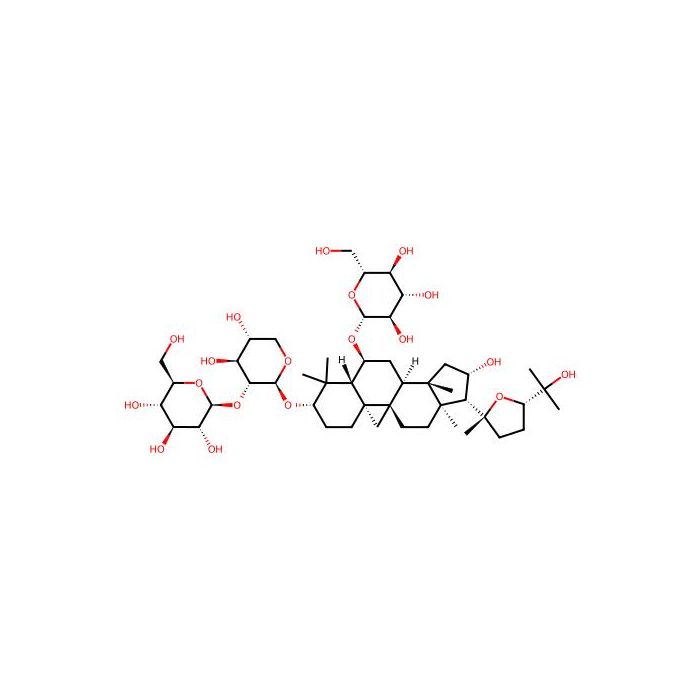
Astragaloside VI - ≥99% , CAS No.84687-45-6
AVAILABLE TO ORDER
GRADE & PURITY ≥99%
Storage
Store at -20°C
Shipped In
Ice chest + Ice pads
≥99% for sensitive chromatographic and analytical workflows requiring minimal baseline interference.
Store at -20°C Ships Ice chest + Ice pads Check lot-specific COA for exact specifications.
SDS, COA, datasheet, and spec sheet available for download. Lot-specific COA accessible via lot number lookup.
Cited in 0 peer-reviewed publications across chromatography, organic synthesis, and cross-coupling reactions.
Astragaloside VI could activate EGFR/ERK signalling pathway to improve wound healing.
In Vitro
Pretreatment with Astragaloside VI (AS-VI) at 1 μM increases EGFR activation in HaCaT cells. Astragaloside VI, a major intestinal metabolite of astragalosides, exerts the strongest EGFR activation. In HaCaT cells, the positive control, EGF expectedly results in 1.5±0.03-fold increase in cell proliferation, compared to the control. Astragaloside VI at the indicated concentrations also significantly promots cell proliferation in both HaCaT and HDF cells. Astragaloside VI promotes neural stem cell proliferation and enhances neurological function recovery in transient cerebral ischemic injury via activating EGFR/MAPK signaling cascades. MCE has not independently confirmed the accuracy of these methods. They are for reference only.
In Vivo
Astragaloside VI improves wound healing, compared to the control. In the simple noninfected wound model, wound healing in mice is accelerated by Astragaloside VI, where in the time required for wound closure is shortened by approximately 2-4 days, compared to that in the control group. Topical treatment with Astragaloside VI reduces the volume of pus produced, compared to the control group. Astragaloside VI treated wounds show an accelerated rate of healing, compared to the control and vaseline groups. By day 22, the Astragaloside VI -treated wounds fully close, whereas the blank and vaseline-treated wounds do not fully close until day 26. Angiogenesis is a crucial step in the formation of granulation tissue and wound healing. Astragaloside VI increases blood vessel formation in both the non-infected and infected wound models . Astragaloside VI could effectively activate EGFR/MAPK signaling cascades, promote NSCs proliferation and neurogenesis in transient cerebral ischemic brains, and improve the repair of neurological functions in post-ischemic stroke rats. MCE has not independently confirmed the accuracy of these methods. They are for reference only.
Form:Solid
IC50& Target:EGFR
| Canonical Smiles | CC1(C(CCC23C1C(CC4C2(C3)CCC5(C4(CC(C5C6(CCC(O6)C(C)(C)O)C)O)C)C)OC7C(C(C(C(O7)CO)O)O)O)OC8C(C(C(CO8)O)O)OC9C(C(C(C(O9)CO)O)O)O)C |
|---|---|
| IUPAC Name | (2R,3R,4S,5S,6R)-2-[[(1S,3R,6S,8R,9S,11S,12S,14S,15R,16R)-6-[(2S,3R,4S,5R)-4,5-dihydroxy-3-[(2S,3R,4S,5S,6R)-3,4,5-trihydroxy-6-(hydroxymethyl)oxan-2-yl]oxyoxan-2-yl]oxy-14-hydroxy-15-[(2R,5S)-5-(2-hydroxypropan-2-yl)-2-methyloxolan-2-yl]-7,7,12,16-tetramethyl-9-pentacyclo[9.7.0.01,3.03,8.012,16]octadecanyl]oxy]-6-(hydroxymethyl)oxane-3,4,5-triol |
| InChIKey | FLPVEPQEIRRVKG-SXCMWBRFSA-N |
| INCHI | 1S/C47H78O19/c1-41(2)26(64-40-35(28(52)21(51)18-60-40)65-39-34(58)32(56)30(54)24(17-49)63-39)9-11-47-19-46(47)13-12-43(5)36(45(7)10-8-27(66-45)42(3,4)59)20(50)15-44(43,6)25(46)14-22(37(41)47)61-38-33(57)31(55)29(53)23(16-48)62-38/h20-40,48-59H,8-19H2,1-7H3/t20-,21+,22-,23+,24+,25-,26-,27-,28-,29+,30+,31-,32-,33+,34+,35+,36-,37-,38+,39-,40-,43+,44-,45+,46-,47+/m0/s1 |
| Isomeric SMILES | C[C@]12CC[C@@]34C[C@@]35CC[C@@H](C([C@@H]5[C@H](C[C@H]4[C@@]1(C[C@@H]([C@@H]2[C@]6(CC[C@H](O6)C(C)(C)O)C)O)C)O[C@H]7[C@@H]([C@H]([C@@H]([C@H](O7)CO)O)O)O)(C)C)O[C@H]8[C@@H]([C@H]([C@@H](CO8)O)O)O[C@H]9[C@@H]([C@H]([C@@H]([C@H](O9)CO)O)O)O |
| PubChem CID | 71448940 |
| MeSH Entry Terms | astragaloside VI |
| Molecular Weight | 947.11 |
Comprehensive hazard, handling, storage, and regulatory compliance document.
Download SDS →Lot-specific quality data. Enter your lot number to retrieve the exact COA.
Look up COA →Full quality attributes and acceptance criteria for this grade.
View spec sheet →Taxonomy Tree
| Kingdom | Organic compounds |
|---|---|
| Superclass | Lipids and lipid-like molecules |
| Class | Steroids and steroid derivatives |
| Subclass | Steroidal glycosides |
| Intermediate Tree Nodes | Steroidal saponins |
| Direct Parent | Cucurbitacin glycosides |
| Alternative Parents | Triterpene saponins Triterpenoids Cycloartanols and derivatives 16-beta-hydroxysteroids O-glycosyl compounds Disaccharides Oxanes Tetrahydrofurans Tertiary alcohols Secondary alcohols Cyclic alcohols and derivatives Acetals Polyols Dialkyl ethers Oxacyclic compounds Primary alcohols Hydrocarbon derivatives |
| Molecular Framework | Aliphatic heteropolycyclic compounds |
| Substituents | Cucurbitacin glycoside skeleton - Triterpene saponin - Triterpene glycoside - Cycloartanol-skeleton - 9b,19-cyclo-lanostane-skeleton - Cycloartane-skeleton - Triterpenoid - 16-hydroxysteroid - 16-beta-hydroxysteroid - Hydroxysteroid - Disaccharide - Glycosyl compound - O-glycosyl compound - Oxane - Tetrahydrofuran - Tertiary alcohol - Cyclic alcohol - Secondary alcohol - Organoheterocyclic compound - Oxacycle - Acetal - Dialkyl ether - Polyol - Ether - Alcohol - Organic oxygen compound - Primary alcohol - Hydrocarbon derivative - Organooxygen compound - Aliphatic heteropolycyclic compound |
| Description | This compound belongs to the class of organic compounds known as cucurbitacin glycosides. These are polycyclic compounds containing a carbohydrate derivative glycosidically linked to a curcubitane nucleus. |
| External Descriptors | Not available |
| Solubility | DMSO : 100 mg/mL (105.58 mM; Need ultrasonic) |
|---|---|
| Molecular Weight | 947.100 g/mol |
| XLogP3 | -0.300 |
| Hydrogen Bond Donor Count | 12 |
| Hydrogen Bond Acceptor Count | 19 |
| Rotatable Bond Count | 10 |
| Exact Mass | 946.514 Da |
| Monoisotopic Mass | 946.514 Da |
| Topological Polar Surface Area | 307.000 Ų |
| Heavy Atom Count | 66 |
| Formal Charge | 0 |
| Complexity | 1770.000 |
| Isotope Atom Count | 0 |
| Defined Atom Stereocenter Count | 26 |
| Undefined Atom Stereocenter Count | 0 |
| Defined Bond Stereocenter Count | 0 |
| Undefined Bond Stereocenter Count | 0 |
| The total count of all stereochemical bonds | 0 |
| Covalently-Bonded Unit Count | 1 |