
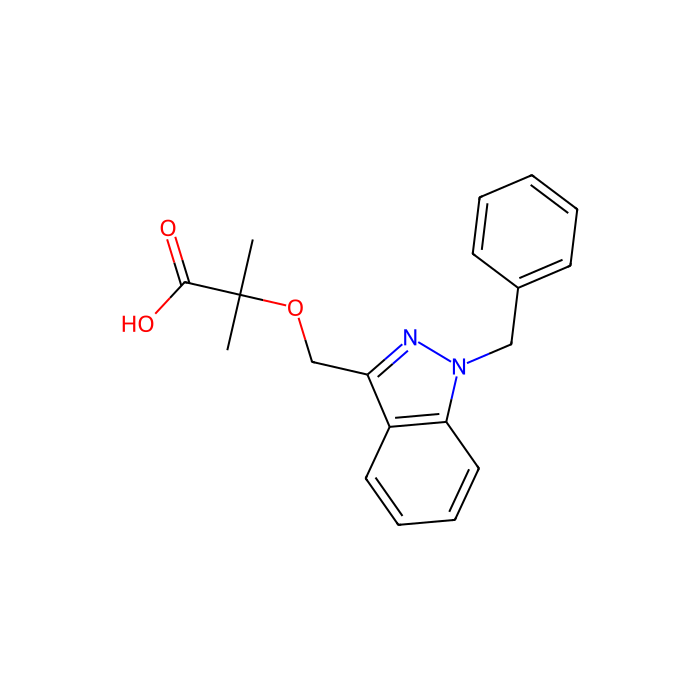
Determine the necessary mass, volume, or concentration for preparing a solution.
| Activity Type | Activity Value -log(M) | Mechanism of Action | Activity Reference | Publications (PubMed IDs) |
|---|
Moligand™, 10mM in DMSO Moligand™ for sensitive chromatographic and analytical workflows requiring minimal baseline interference.
Store at -80°C Ships Dry ice packs + Cold packs Check lot-specific COA for exact specifications.
SDS, COA, datasheet, and spec sheet available for download. Lot-specific COA accessible via lot number lookup.
Cited in 1 peer-reviewed publications across chromatography, organic synthesis, and cross-coupling reactions.
Information
Bindarit (AF 2838) Bindarit (AF 2838) exhibits selective inhibition against monocyte chemotactic proteins MCP-1/CCL2, MCP-3/CCL7 and MCP-2/CCL8.
In vitro
Bindarit treatment causes a dose-dependent inhibition of the capacity of human monocytes to produce monocyte chemotactic protein-1 (MCP-1) in response to bacterial LPS or C. albicans with IC50 of 172 µM and 403 µM, respectively. The inhibition of LP-induced MCP-1 production by Bindarit is associated with reduced levels of MCP-1 mRNA transcripts with IC50 of 75 µM. Bindarit inhibits the production of MCP-1 by LPS-stimulated MM6 cells with IC50 of 425 μM, without affecting the release of IL-8 or IL-6. Bindarit treatment inhibits the release of MCP-1 from IL-1 stimulated osteoblast cell line Saos-2. Bindarit, even at the maximal concentration, does not exhibit a direct in vitro cytotoxic effect on human IIB-MEL-J melanoma or ECs, although it inhibits MCP-1 expression. Bindarit (10-300 μM) reduces rat vascular smooth muscle cell (VSMC) proliferation, migration, and invasion. Bindarit induces the downregulation of the classical NF-κB pathway. Bindarit displays a specific inhibitory effect on the p65 and p65/p50 induced MCP-1 promoter activation, with no effect on other tested activated promoters, indicating that Bindarit acts on a specific subpopulation of NF-κB isoforms and selects its targets within the whole NF-κB inflammatory pathway. Bindarit modulates cancer-cell proliferation and migration, mainly through negative regulation of TGF-β and AKT signaling.
In vivo
Oral administration of Bindarit at 50 mg/kg in NZB/W mice delays the onset of proteinuria, significantly protects from renal function impairment, and prolongs survival of NZB/W mice or lupus mice. Bindarit treatment completely MCP-1 up-regulation during the progression of nephritis. Inhibition of MCP-1 with Bindarit also reduces tumor growth and macrophage recruitment, rendering necrotic tumor masses in human melanoma xenografts. Bindarit is effective in reducing neointima formation in both non-hyperlipidaemic and hyperlipidaemic animal models of vascular injury by a direct effect on VSMC proliferation and migration and by reducing neointimal macrophage content. Administration of Bindarit results in impaired metastatic disease in prostate cancer PC-3M-Luc2 xenograft mice and impairment of local tumorigenesis in Balb/c mice with murine breast cancer 4T1-Luc cells. In addition, Bindarit treatment significantly decreases the infiltration of tumor-associated macrophages and myeloid-derived suppressor cells in 4T1-Luc primary tumors.
Cell Data
cell lines:
Concentrations:
Incubation Time:
Powder Purity:≥99%
| Isomeric SMILES | CC(C)(C(=O)O)OCC1=NN(C2=CC=CC=C21)CC3=CC=CC=C3 |
|---|---|
| Molecular Weight | 324.37 |
| Reaxy-Rn | 14755397 |
| Reaxys-RN_link_address | https://www.reaxys.com/reaxys/secured/hopinto.do?context=S&query=IDE.XRN=14755397&ln= |
Comprehensive hazard, handling, storage, and regulatory compliance document.
Download SDS →Lot-specific quality data. Enter your lot number to retrieve the exact COA.
Look up COA →Full quality attributes and acceptance criteria for this grade.
View spec sheet →| Activity Type | Activity Value -log(M) | Mechanism of Action | Activity Reference | Publications (PubMed IDs) |
|---|
| 1. Chan-juan Chai, Yao Sun, Rui-fang Chi, Hui-yu Yang, Bin Yang, Bao Li. (2023) Astragaloside IV alleviates LPS-induced cardiomyocyte hypertrophy and collagen expression associated with CCL2-mediated activation of NF-κB signaling pathway. BIOCHEMICAL AND BIOPHYSICAL RESEARCH COMMUNICATIONS, [PMID:38091841] [10.1016/j.bbrc.2023.149367] |
Our grade selection guide covers purity, stabilizer status, and application suitability for all variants in our catalog.
View Moligand™ grade guide →