Product Introduction
Caspases (Cysteine-requiring Aspartate Proteases) are a family of proteases that play essential roles in apoptosis. Caspase 4 (also written as caspase-4 or caspase 4) can interact with Apaf-1 and participate in the cytochrome c-mediated activation of caspase 3.
This Caspase 4 Activity Assay Kit is based on the ability of caspase 4 to catalyze the cleavage of the substrate Ac-LEVD-pNA (acetyl-Leu-Glu-Val-Asp p-nitroanilide), resulting in the release of the yellow chromophore pNA (p-nitroaniline). The activity of caspase 4 can thus be determined by measuring the absorbance of pNA, which exhibits strong absorption at approximately 405 nm. The kit includes the yellow pNA product generated by caspase 4 catalysis, which serves as a standard for quantifying caspase 4 enzyme activity.
C1508345 | Component | 20 T | 50 T | 100T | Storage conditions |
C1508345A | Lysis Buffer | 8 mL | 20 mL | 40 mL | -20℃. |
C1508345B | Assay Buffer | 8 mL | 20 mL | 40 mL | -20℃. |
C1508345C | Ac-LEVD-pNA(2 mM) | 200 μL | 500 μL | 1000 μL | -20℃.Store in the dark. |
C1508345D | pNA(10 mM) | 120 μL | 300 μL | 600 μL | -20℃.Store in the dark. |
C1508345E | DTT(100×) | 160 μL | 400 μL | 800 μL | -20℃.Store in the dark. |
C1508345F | Protease Inhibitor Cocktail(100×) | 80 μL | 200 μL | 400 μL | -20℃.Store in the dark. |
Usage Protocol
1. Reagent Preparation
1) Lysis Buffer: Immediately before use, add DTT and Protease Inhibitor Cocktail to the Lysis Buffer. For each 1 mL of Lysis Buffer, add 10 μL of DTT (100×) and 10 μL of Protease Inhibitor Cocktail (100×). Prepare fresh according to the number of experimental samples and keep on ice.
2) Assay Buffer: Immediately before use, add DTT to the Assay Buffer. For each 1 mL of Assay Buffer, add 10 μL of DTT (100×). Prepare fresh according to the number of experimental samples and keep on ice.
3) Ac-LEVD-pNA(2 mM): Aliquot an appropriate amount based on the number of experimental samples to avoid repeated freeze-thaw cycles. Keep on ice before use.
4) pNA (10 mM): Aliquot an appropriate amount based on the number of experimental samples to avoid repeated freeze-thaw cycles. Keep on ice before use.
2. Setup of pNA Standard Curve
Preparation of Standard Diluent: Prepare an adequate volume of standard diluent by mixing 0.9 mL of Assay Buffer with 0.1 mL of Lysis Buffer.
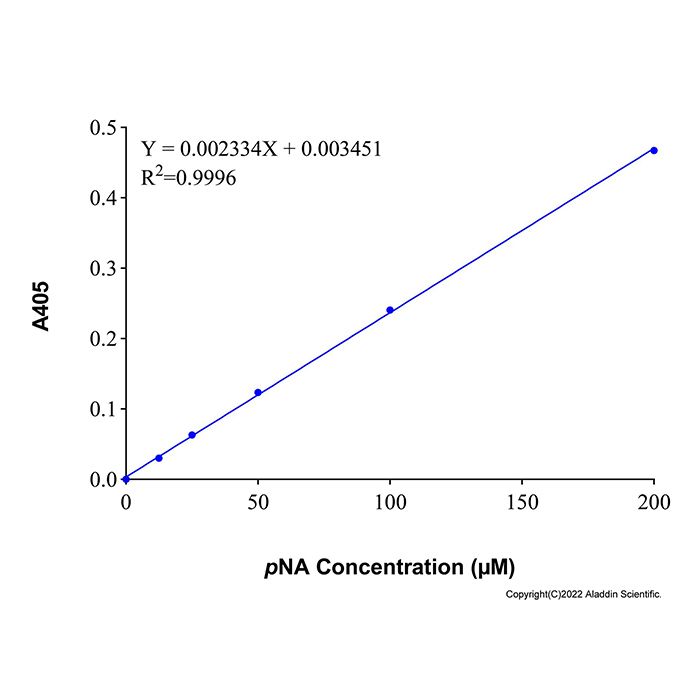
Take six microcentrifuge tubes. Add 294 μL of standard diluent to the first tube and 150 μL to each of the remaining five tubes. Pipette 6 μL from the pNA (10 mM) stock into the first tube and mix thoroughly to prepare a 200 μM pNA standard solution. Then, transfer 150 μL from the first tube to the second tube and mix. Continue this serial dilution by transferring 150 μL from the second tube to the third, and so on. The final tube contains 150 μL of standard diluent only. The resulting pNA standard concentrations are 200, 100, 50, 25, 12.5, and 0 μM.
3. Sample Preparation
1) For Suspension Cells: Collect both non-apoptotic control and apoptotic-induced samples by centrifugation at 600 × g for 5 minutes at 4°C. Carefully aspirate the supernatant. Wash the cell pellet once with PBS. Then, add Lysis Buffer to resuspend the pellet, using 100 μL of Lysis Buffer per 2 × 10⁶ cells (the volume may be increased to 150 or 200 μL if lysis is insufficient). Lyse the cells by incubating on ice for 15 minutes.
2) For Adherent Cells: Detach adherent cells using trypsin and collect them into culture medium. Collect the cells by centrifugation at 600 × g for 5 minutes at 4°C. Carefully aspirate the supernatant. Wash the cell pellet once with PBS. Then, add Lysis Buffer to resuspend the pellet, using 100 μL of Lysis Buffer per 2 × 10⁶ cells (the volume may be increased to 150 or 200 μL if lysis is insufficient). Lyse the cells by incubating on ice for 15 minutes.
3) For Tissue Samples: Add Lysis Buffer at a ratio of 100 μL per 3-10 mg of tissue. Homogenize the tissue using a glass homogenizer on ice. Transfer the homogenate to a 1.5 mL microcentrifuge tube and lyse further on ice for 5 minutes.
Following lysis according to the sample type, centrifuge the lysates at 16,000-20,000 × g for 10-15 minutes at 4°C. Carefully transfer the supernatant to a pre-chilled tube on ice, avoiding the pellet and any viscous layer adjacent to it. If the sample is highly viscous, perform brief pulse sonication on ice, followed by centrifugation at 16,000-20,000 × g for 10-15 minutes at 4°C, and then collect the supernatant for assay.
Determine the caspase-4 enzyme activity immediately, or store the samples at -70°C. A small aliquot of the sample can be taken to determine the protein concentration using the Bradford method; it is recommended to adjust the final protein concentration to 1-3 mg/mL.
4. Activity Assay
Set up the reaction mixture according to the table below. When preparing the reactions, first add the Assay Buffer, followed by the test sample. Mix gently, avoiding bubble formation. Finally, initiate the reaction by adding 10 μL of Ac-LEVD-pNA(2 mM).
| Blank Control | Sample |
Assay Buffer | 40 μL | 40 μL |
Samples | - | 50 μL |
Lysis Buffer | 50 μL | - |
Ac-LEVD-pNA(2 mM) | 10 μL | 10 μL |
Total volume | 100 μL | 100 μL |
Incubate the reaction mixture at 37°C for 60–120 minutes. Measure the absorbance at 405 nm when a significant color change is observed. If the color change is subtle, the incubation time may be extended appropriately, or even carried out overnight if necessary. The net A405 resulting from pNA generated by caspase-4 catalysis is obtained by subtracting the A405 of the blank control from that of the sample. The amount of pNA produced can be quantified by comparing the net A405 to the pNA standard curve.
According to the caspase 4 enzyme activity unit defined by Chemicon: *"One unit is the amount of enzyme that will cleave 1.0 nmol of the colorimetric substrate Ac-LEVD-pNA per hour at 37°C under saturated substrate concentrations."* Thus, one unit of enzyme activity is defined as the amount of caspase-4 required to cleave 1 nmol of Ac-LEVD-pNA, yielding 1 nmol of pNA, per hour under saturated substrate conditions at 37°C. Based on this definition, the number of caspase-4 enzyme activity units present in the sample can be calculated.
Precautions
1. Ac-LEVD-pNA(2 mM) should be aliquoted appropriately to avoid repeated freeze-thaw cycles.
2. A Bradford Protein Assay Kit is required for determining protein concentration. To minimize interference from DTT, it is recommended to dilute the sample with an equal volume of water prior to measurement using the Bradford method.
3. pNA (chemical name: 4-nitroaniline) is toxic to humans. For your safety and health, please wear a lab coat and disposable gloves when handling this reagent.

 ZJ26F0433749