GRADE & PURITYMoligand™?Moligand™ — Aladdin's line of ligands and bioactive small molecules. Use for receptor, pathway, and binding studies needing defined small-molecule tools.≥95%
Synonyms
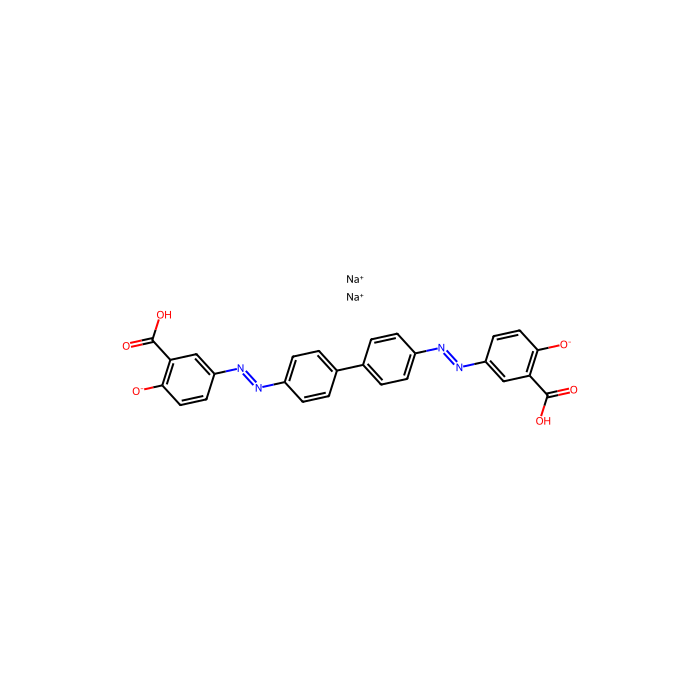
Benzoic acid, 3,3'-((1,1'-biphenyl)-4,4'-diylbis(azo))bis(6-hydroxy-, disodium salt | Chrysamine | DTXSID801023495 | 3,3'-((1,1'-Biphenyl)-4,4'-diylbis(azo))bis(6-hydroxybenzoic acid), disodium salt | direct yellow 1 | disodium;2-carboxy-4-[[4-[4-[(3-carb
Storage
Protected from light,Store at -20°C,Argon charged,Desiccated
Moligand™, ≥95% Moligand™ for sensitive chromatographic and analytical workflows requiring minimal baseline interference.
🌡
Storage & shipping
Protected from light,Store at -20°C,Argon charged,Desiccated Ships Ice chest + Ice pads Check lot-specific COA for exact specifications.
📋
Quality documents
SDS, COA, datasheet, and spec sheet available for download. Lot-specific COA accessible via lot number lookup.
📚
Literature proof
Cited in 0 peer-reviewed publications across chromatography, organic synthesis, and cross-coupling reactions.
Panoramica
Chrysamine G, a carboxylic acid analogue of Congo Red, can be used as a probe of amyloid deposition in Alzheimer's disease. Chrysamine G also can inhibit Aβ-induced toxicity in PC12 cells.
Specifications
Sinonimi
Benzoic acid, 3,3'-((1,1'-biphenyl)-4,4'-diylbis(azo))bis(6-hydroxy-, disodium salt | Chrysamine | DTXSID801023495 | 3,3'-((1,1'-Biphenyl)-4,4'-diylbis(azo))bis(6-hydroxybenzoic acid), disodium salt | direct yellow 1 | disodium;2-carboxy-4-[[4-[4-[(3-carb
Specifiche e purezza
Moligand™, ≥95%
Meccanismi biochimici e fisiologici
Chrysamine G can penetrate the blood-brain barrier. It is useful in quantifying cerebral amyloid β (Aβ) deposition in Alzheimer′s disease (AD) pathological studies.
New probe for β-amyloid aggregates.
Condizioni di conservazione di stoccaggio
Protected from light,Store at -20°C,Argon charged,Desiccated
Spedito in
Ice chest + Ice pads
Questo prodotto richiede spedizione a catena fredda. I servizi di terra e altri servizi economici non sono disponibili.
Grado
Moligand™
Nota
Wherever possible, you should prepare and use solutions on the same day. However, if you need to make up stock solutions in advance, we recommend that you store the solution as aliquots in tightly sealed vials at -20°C. Generally, these will be useable for up to one month. Before use, and prior to opening the vial we recommend that you allow your product to equilibrate to room temperature for at least 1 hour. Need more advice on solubility, usage and handling? Please visit our frequently asked questions (FAQ) page for more details.
This compound belongs to the class of organic compounds known as benzidines. These are organic compounds containing the benzidine skeleton, made up of a biphenyl ring system substituted at the 4- and 4'-positions with a unsubstituted amine group.
External Descriptors
Not available
1. Djoumbou Feunang Y, Eisner R, Knox C, Chepelev L, Hastings J, Owen G, Fahy E, Steinbeck C, Subramanian S, Bolton E, Greiner R, and Wishart DS. ClassyFire: Automated Chemical Classification With A Comprehensive, Computable Taxonomy. Journal of Cheminformatics, 2016, 8:61.
We use cookies to ensure the website functions properly and, where permitted, to improve your experience. You can manage your preferences at any time in Settings. Learn more in our Cookie Policy.
Shall we send you a message when we have discounts available?
Remind me later
Thank you! Please check your email inbox to confirm.
Products are supplied to verified businesses, institutions, and qualified professionals for research and development use only. Not for use in humans, animals, diagnosis, or therapy.