Determine the necessary mass, volume, or concentration for preparing a solution.
It can be used to prepare α-cyclopropylstyrene by the Wittig reaction in dimethyl sulfoxide. It can be used as starting reagent during the (Z)-titanium enolate formation from cyclopropyl ketones via TiCl4-n-Bu4NI-induced ring opening reaction.
| Pubchem Sid | 504755135 |
|---|---|
| Pubchem Sid Url | https://pubchem.ncbi.nlm.nih.gov/substance/504755135 |
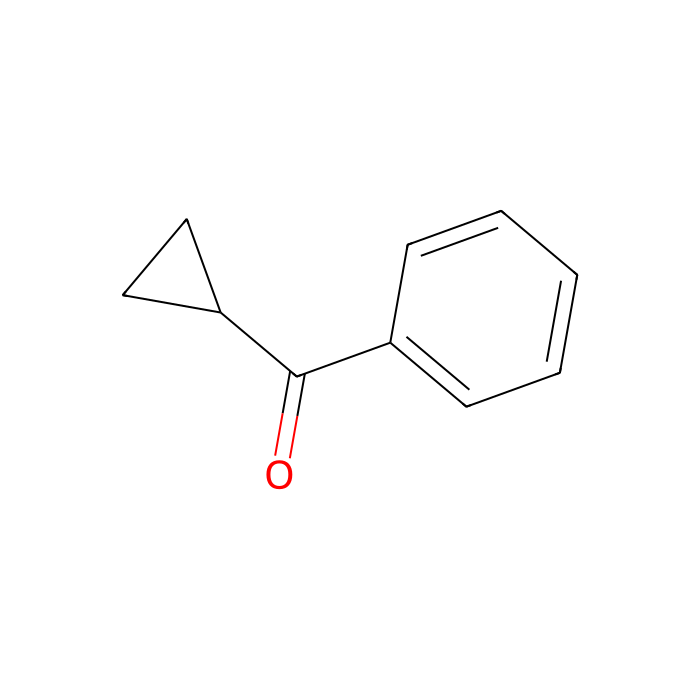
| Canonical Smiles | C1CC1C(=O)C2=CC=CC=C2 |
| IUPAC Name | cyclopropyl(phenyl)methanone |
| InChIKey | PJRHFTYXYCVOSJ-UHFFFAOYSA-N |
| INCHI | 1S/C10H10O/c11-10(9-6-7-9)8-4-2-1-3-5-8/h1-5,9H,6-7H2 |
| Isomeric SMILES | C1CC1C(=O)C2=CC=CC=C2 |
| Molecular Weight | 146.19 |
| Beilstein | 7369 |
| Reaxy-Rn | 1860145 |
| Reaxys-RN_link_address | https://www.reaxys.com/reaxys/secured/hopinto.do?context=S&query=IDE.XRN=1860145&ln= |
Comprehensive hazard, handling, storage, and regulatory compliance document.
Download SDS →Lot-specific quality data. Enter your lot number to retrieve the exact COA.
Look up COA →Full quality attributes and acceptance criteria for this grade.
View spec sheet →Taxonomy Tree
| Kingdom | Organic compounds |
|---|---|
| Superclass | Organic oxygen compounds |
| Class | Organooxygen compounds |
| Subclass | Carbonyl compounds |
| Intermediate Tree Nodes | Ketones - Aryl ketones - Phenylketones |
| Direct Parent | Alkyl-phenylketones |
| Alternative Parents | Benzoyl derivatives Aryl alkyl ketones Organic oxides Hydrocarbon derivatives |
| Molecular Framework | Aromatic homomonocyclic compounds |
| Substituents | Alkyl-phenylketone - Aryl alkyl ketone - Benzoyl - Benzenoid - Monocyclic benzene moiety - Organic oxide - Hydrocarbon derivative - Aromatic homomonocyclic compound |
| Description | This compound belongs to the class of organic compounds known as alkyl-phenylketones. These are aromatic compounds containing a ketone substituted by one alkyl group, and a phenyl group. |
| External Descriptors | Not available |
Find and download the COA for your product by matching the lot number on the packaging.
| Lot Number | Certificate Type | Date | Item |
|---|---|---|---|
| Certificate of Analysis | Jun 09, 2026 | C136569 | |
| Certificate of Analysis | Feb 04, 2026 | C136569 | |
| Certificate of Analysis | Feb 04, 2026 | C136569 | |
| Certificate of Analysis | Feb 04, 2026 | C136569 | |
| Certificate of Analysis | Jun 15, 2023 | C136569 | |
| Certificate of Analysis | Jun 15, 2023 | C136569 | |
| Certificate of Analysis | Jun 15, 2023 | C136569 |
| Solubility | Insoluble in water. |
|---|---|
| Refractive Index | n20/D 1.553 |
| Flash Point(°F) | 90°C |
| Flash Point(°C) | 90°C |
| Boil Point(°C) | 121-123 °C/15 mmHg |
| Melt Point(°C) | 7-9 °C |
| Molecular Weight | 146.190 g/mol |
| XLogP3 | 2.100 |
| Hydrogen Bond Donor Count | 0 |
| Hydrogen Bond Acceptor Count | 1 |
| Rotatable Bond Count | 2 |
| Exact Mass | 146.073 Da |
| Monoisotopic Mass | 146.073 Da |
| Topological Polar Surface Area | 17.100 Ų |
| Heavy Atom Count | 11 |
| Formal Charge | 0 |
| Complexity | 152.000 |
| Isotope Atom Count | 0 |
| Defined Atom Stereocenter Count | 0 |
| Undefined Atom Stereocenter Count | 0 |
| Defined Bond Stereocenter Count | 0 |
| Undefined Bond Stereocenter Count | 0 |
| The total count of all stereochemical bonds | 0 |
| Covalently-Bonded Unit Count | 1 |