
Determine the necessary mass, volume, or concentration for preparing a solution.
| Activity Type | Activity Value -log(M) | Mechanism of Action | Activity Reference | Publications (PubMed IDs) |
|---|
10mM in DMSO for sensitive chromatographic and analytical workflows requiring minimal baseline interference.
Store at -80°C Ships Dry ice packs + Cold packs Check lot-specific COA for exact specifications.
SDS, COA, datasheet, and spec sheet available for download. Lot-specific COA accessible via lot number lookup.
Cited in 4 peer-reviewed publications across chromatography, organic synthesis, and cross-coupling reactions.
Information
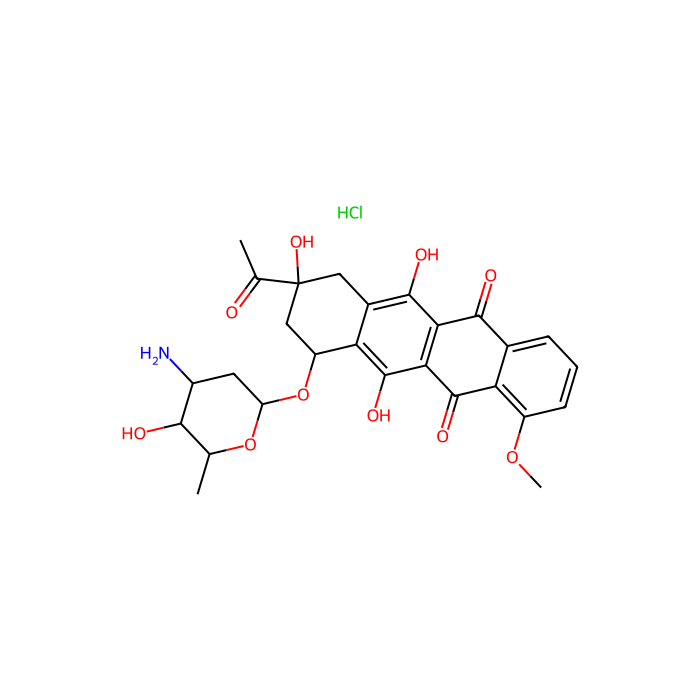
Daunorubicin HCl (Daunomycin, RP 13057, Rubidomycin) inhibits both DNA and RNA synthesis and inhibitsDNAsynthesis withKiof 0.02 μM in a cell-free assay. Daunorubicin is atopoisomerase IIinhibitor that inducesapoptosis.
In vitro
At drug concentrations that reflect the peak plasma concentration after Daunorubicin administration, the primary mechanism is likely to be through interaction with topoisomerase II, which may be a primary triggering event for growth arrest and/or cell killing through a signalling pathway leading to apoptosis, at least in leukemic cells and thymocytes. The quinone structure permits daunorubicin to act as electron acceptors in reactions mediated by oxoreductive enzymes including cytochrome P450 reductase, NADH dehydrogenase, and xanthine oxidase. At Daunorubicin concentrations exceeding approximately 2–4 μM, free radical mediated toxicity and DNA cross-linking may become evident. Daunorubicin inhibits both DNA and RNA syntheses in HeLa cells over a concentration range of 0.2 through 2 μM. Daunorubicin inhibits both DNA syntheses in Ehrlich ascites tumor cells over a concentration range of 4 μM. Daunorubic triggers apoptosis at concentrations of 0.5 and 1 μM in either HL-60 or U-937 human leukemic cells. Daunorubicin stimulates ceramide elevation and apoptosis in P388 and U937 cells through de novo synthesis via activation of the enzyme ceramide synthase. Daunorubicin dose-dependently increases the phosphatidylserine exposure and consequent procoagulant activity of human umbilical vein endothelial cells. Daunorubicin (0.2 mM) significantly enhances the release of endothelial microparticles which are highly procoagulant in human umbilical vein endothelial cells.
In vivo
Cell Data
cell lines:
Concentrations:
Incubation Time:
Powder Purity:≥95%
| Isomeric SMILES | C[C@H]1[C@H]([C@H](C[C@@H](O1)O[C@H]2C[C@@](CC3=C2C(=C4C(=C3O)C(=O)C5=C(C4=O)C(=CC=C5)OC)O)(C(=O)C)O)N)O.Cl |
|---|---|
| WGK Germany | 3 |
| RTECS | HB7878000 |
| Alternate CAS | 20830-81-3 |
| PubChem CID | 62770 |
| UN Number | 2811 |
| Packing Group | I |
| Molecular Weight | 563.98 |
| Beilstein | 4229221 |
Comprehensive hazard, handling, storage, and regulatory compliance document.
Download SDS →Lot-specific quality data. Enter your lot number to retrieve the exact COA.
Look up COA →Full quality attributes and acceptance criteria for this grade.
View spec sheet →| Activity Type | Activity Value -log(M) | Mechanism of Action | Activity Reference | Publications (PubMed IDs) |
|---|
Find and download the COA for your product by matching the lot number on the packaging.
| Lot Number | Certificate Type | Date | Item |
|---|---|---|---|
 J2211495 J2211495 | Certificate of Analysis | May 07, 2026 | D409068 |
| Solubility | Solubility (25°C) In vitro |
|---|---|
| Specific Rotation[α] | 260° |
| Melt Point(°C) | 167 °C |
| 1. Jiezhou Pan, Haotian Liao, Guidong Gong, Yunxiang He, Qin Wang, Lang Qin, Yaoyao Zhang, Hirotaka Ejima, Blaise L. Tardy, Joseph J. Richardson, Jiaojiao Shang, Orlando J. Rojas, Yong Zeng, Junling Guo. (2023) Supramolecular nanoarchitectonics of phenolic-based nanofiller for controlled diffusion of versatile drugs in hydrogels. JOURNAL OF CONTROLLED RELEASE, [PMID:37422124] [10.1016/j.jconrel.2023.07.003] |
| 2. Bo Fu, Can Tao, Nian Chen, Jie-Rou Lin, Ping Zhao. (2021) ZnO QD covalently coated, GSH/pH dual-responsive drug delivery system for chemotherapeutic/ionic synergistic therapy. JOURNAL OF DRUG DELIVERY SCIENCE AND TECHNOLOGY, [PMID:] [10.1016/j.jddst.2021.102908] |
| 3. Zhifeng Xu, Peihong Deng, Junhua Li, Li Xu, Siping Tang. (2017) Molecularly imprinted fluorescent probe based on FRET for selective and sensitive detection of doxorubicin. Materials Science and Engineering B-Advanced Functional Solid-State Materials, [PMID:] [10.1016/j.mseb.2017.02.005] |
| 4. Shule Zhang, Dong Li, Linghong Liu, Qing Shi, Xiuli Ju. (2024) Extracellular vesicles derived from HuMSCs alleviate daunorubicin-induced cardiac microvascular injury via miR-186-5p/PARP9/STAT1 signal pathway. Regenerative Therapy, [PMID:38327716] [10.1016/j.reth.2024.01.011] |