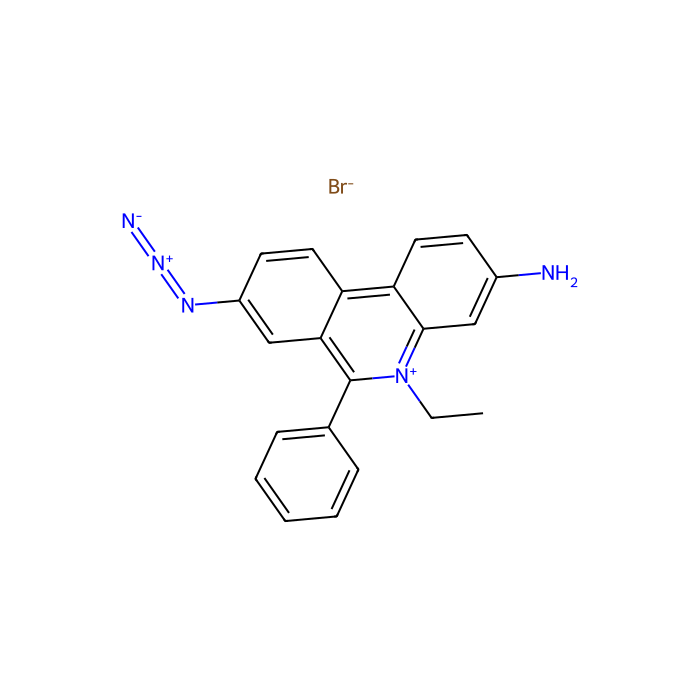
Ethidium Monoazide Bromide (EMA) is a DNA-binding dye with high affinity for deoxyribonucleic acid (DNA). Due to its relatively low permeability to the cell membranes of viable cells, it can specifically label DNA inside dead cells. After the dye acts on the target, photolysis treatment enables the formation of covalent bonds between dead cell DNA and the dye. The core advantage of EMA lies in its low permeability to viable cell membranes; upon photoactivation, it can specifically modify dead bacterial DNA after a 10-minute incubation. It efficiently discriminates between viable and dead cells without interfering with the detection of viable bacteria, is compatible with accurate qPCR quantification, and is widely applicable for bacterial sample detection.
As an early-developed key tool for distinguishing viable and dead cells, EMA provides groundbreaking technical support for microbiological detection and cell biology research. Traditional molecular biology detection techniques have the limitation of a long cycle for distinguishing dead and viable bacteria, which easily leads to overestimation of the number of cells present in samples. Against this backdrop, EMA achieves efficient separation and detection of viable and dead cells in mixed systems through its mechanism of labeling dead cell DNA, simplifying experimental workflows, reducing biosafety risks, and driving the precise development of research related to microbial quality control and clinical diagnostic testing. For in vitro research use only. Not for clinical diagnosis or treatment.
Note: Performance equivalent to Biotium Ethidium Monoazide Bromide (EMA).
Application Scope
Identification of bacterial viability status, qualitative analysis of active microorganisms in simple systems, DNA footprinting, modified plasmid DNA preparation, etc.
Product Features
1. qPCR Compatible: Modifies dead bacterial DNA in 10 minutes, accurately discriminates viable and dead cells without interfering with viable bacteria detection, and avoids false negatives in traditional microscopic examination.
2. High Specificity: Almost impermeable to viable cell membranes, and can specifically bind to nucleic acids in dead cells or cells with damaged cell membranes.
3. High Photoreactivity: Rapidly undergoes photolysis under light irradiation to generate highly reactive nitrene intermediates, which form covalent bonds with nucleic acids and stably label target nucleic acids.
4. Strong Fluorescence Enhancement: Fluorescence intensity increases drastically upon binding to nucleic acids, exhibiting better adaptability than PMA in non-qPCR fluorescence observation scenarios.
5. Wide Application Scenarios: Including plasmid DNA modification, DNA footprinting, discrimination of viable and dead bacteria, etc.
Product Specifications
1. Appearance: Orange solid soluble in ethanol or DMSO
2. Ex (pH3): 458 nm
3. Ex/Em: 510/600 nm (after photocrosslinking to nucleic acid)
4. CAS No.: 58880-05-0
5. Molecular Formula: C₂₁H₁₈BrN₅
6. Molecular Weight: 420.31
Product Components
Component
| 1200 T | | A. Ethidium Monoazide Bromide (EMA) | 5 mg |
|
Note: 1200 T refers to the total number of reactions with Component A of the kit at a concentration of 25 μM.
Precautions
1. Briefly centrifuge the product to the bottom of the tube before use before performing subsequent experiments.
2. The recommended concentration of this product is 10-200 mg/L. It is recommended to conduct a pre-experiment to determine the optimal experimental parameters before the formal experiment.
3. EMA is light-sensitive and should be stored and handled under light-protected conditions. Minimize light exposure time during use to avoid premature activation of EMA and interference with experimental results.
4. Fluorescent dyes are prone to quenching; please pay close attention to light protection to slow down fluorescence quenching.
5. EMA is toxic to a certain extent. Wear protective equipment such as gloves and goggles during operation to avoid skin contact and inhalation.
6. This product is for research use only and must not be stored in ordinary residential premises.
7. For your safety and health, follow the general laboratory safety regulations of your institution.
Instructions for Use
(1) Pre-Experiment Preparation
1. Reagent Preparation
Stock solution preparation: Add 595 μL of ultrapure water to Component A (Ethidium Monoazide Bromide, EMA), vortex thoroughly to mix, and prepare a 20 mM EMA stock solution.
Note: It is recommended to aliquot the stock solution after preparation and store it at -20 ℃ under light-protected conditions to avoid repeated freeze-thaw cycles.
2. Instrument Preparation
RT-qPCR instrument, blue light irradiation lamp
3. Bacterial Suspension Preparation
Bacterial suspension preparation: Inoculate the bacterial suspension into liquid LB medium and culture it in a shaking incubator until the OD₆₀₀ reaches approximately 1.0.
Note: The type of medium and culture duration can be adjusted according to experimental conditions.
4. Control Setting
① Viable bacteria blank control group: No EMA added;
② Viable bacteria control group: EMA added;
③ Dead bacteria control group: EMA added;
④ Dead bacteria blank control group: No EMA added;
⑤ Experimental group: Detection with and without EMA addition respectively.
(2) Operating Procedures
1. Bacterial Treatment
① Take two aliquots of 400 μL viable bacteria and place them in clean centrifuge tubes respectively.
② If dead bacteria are required as a control (optional), place the viable bacteria in a water bath and heat at 95 ℃ for 5 minutes or 58 ℃ for 3 hours (depending on the sample). Dead bacteria are obtained after treatment, and the subsequent operations are the same as those for viable bacteria.
2. Staining
① For the two aliquots of viable bacteria, one is left untreated with EMA, and the other is treated with 25 μM EMA.
Note: The optimal EMA concentration for treating bacteria of different types or sources should be determined by consulting relevant literature and designing pre-experiments.
② Place the EMA-treated samples on a shaker at room temperature and incubate for 10 minutes in the dark to allow sufficient mixing of the dye with the samples.
③ Irradiate the samples with blue light (e.g., 60 W blue light lamp for 15 minutes). If a halogen lamp is used, it is recommended to place the EMA-treated sample tubes on ice at a distance of 20 cm from the light source (the ice is placed in a transparent tray), adjust the light source to irradiate the samples directly, and perform photolysis for 5-15 minutes; if bacteria obtained from the environment are used directly for the experiment, the photolysis time needs to be appropriately extended in view of the complexity and turbidity of environmental samples.
Note: The irradiation duration is for reference only.
3. Genomic DNA Extraction
① Centrifuge the treated and untreated viable bacteria at 5000×g for 10 minutes and discard the supernatant.
② Select a suitable genomic DNA extraction kit according to the sample type, and use the same elution volume for all groups of samples when eluting DNA. Refer to the instruction manual of the used kit for DNA extraction steps.
Note: One of the mechanisms of EMA action is to remove bound DNA from samples through precipitation. Therefore, during genomic DNA extraction, all groups need to perform volume normalization with the same volume of eluent (the concentration of genomic DNA extracted from dead and viable bacteria differs significantly due to different yields).
4. Prepare the Reaction Mixture According to the Following System
Reaction Component
| 20 μL Reaction Volume | Final Concentration
| (Self-prepared) qPCR Mix
| — | 1× | Forward (F) & Reverse (R) Primers
| Appropriate amount
| 0.4 μM each
| Template
| Appropriate amount
| — | | H₂O | Make up to 20 μL
| — |
|
5. Assay Program: Set the program according to the self-prepared qPCR Mix.
Note: It is recommended to verify the applicability of the primers and qPCR program first.
(3) Result Interpretation
Use viable and dead bacteria as controls to analyze and calculate the number of viable cells in the sample.
1. Calculate dCt of Dead and Viable Bacteria Controls
① After the qPCR experiment, calculate the Ct value of each sample using the instrument's built-in software.
② Judge whether EMA has successfully inhibited the amplification of dead bacterial DNA by calculating the dCt of each control bacterium, calculated as follows:
dCt viable =Ct (viable, EMA-treated)-Ct (viable, EMA-untreated)
dCtdead=Ct (dead, EMA-treated)-Ct (dead, EMA-untreated)
③ The expected dCt value of viable bacteria is close to 0±1, which means EMA does not interfere with the amplification of viable cell DNA.
④ The expected dCt value of dead bacteria is greater than 4 (a dCt of 4 represents an approximate 16-fold reduction in dead bacterial DNA, i.e., 94% removal; a dCt of 8 represents an approximate 250-fold reduction, i.e., 99.6% removal).
Note: The dCt of dead bacteria is affected by various factors, including bacterial strain/cell type, bacterial killing method, EMA concentration used, and amplified sequence length.
2. Calculate the Proportion of Viable Bacteria
When the results of the dead and viable bacteria controls are normal, the calculation of the proportion of viable bacteria in the sample can be carried out.
① Calculation of sample dCt value:
dCtsample=Ct (sample, EMA-treated)-Ct (sample, EMA-untreated)
② Convert dCt value to viable bacteria proportion:
EMA inhibition fold = 2sample
Viable bacteria%=100/EMA inhibition fold
3. Calculate the Absolute Number of Viable Bacteria
To calculate the absolute number of viable bacteria in the sample, a standard curve should be plotted using genomic DNA of the target bacteria with a known quantity. It is recommended to dilute several groups of genomic DNA concentrations to the effective range of the qPCR analysis system.
① Generate a standard curve with the number of cells as the abscissa and the Ct value as the ordinate.
② Calculation of the copy number of experimental samples:
Ct=Slope×Cell number+Y-intercept (y=mx+b)
Bacterial countsample=(Ct-Y-intercept)/Slope 朱传侠
Note: No loss of viable bacterial DNA during the purification process.
Example: In the figure below, viable/dead Escherichia coli were incubated with 25 μM EMA followed by photolysis treatment, then gDNA was extracted and amplified with uidA primers.

Note: Detection results may vary with different instruments and bacterial groups; this result is for reference only.
Frequently Asked Questions (FAQs)
1. Q: What may cause the dCt of dead and viable bacteria to be less than 1?
A: The possible reasons are as follows:
a. The Ct values of both samples are low, suggesting that the sterilization conditions adopted may not have achieved the desired effect, resulting in incomplete bacterial inactivation. Under high-temperature heating at 95 ℃, it is almost certain that bacterial cell membranes will be severely disrupted to achieve complete sterilization.
b. The Ct values of both samples are high (Ct value exceeding 30), which may indicate that your bacterial sample has undergone a freezing process, causing damage to the cell membranes of viable bacteria and thus affecting the accuracy of detection results.
2. Q: Why does a double peak appear when EMA is analyzed by HPLC?
A: The special synthetic process of this product often leads to the formation of isomers, which have subtle differences in polarity, thus presenting a unique double peak phenomenon in high-performance liquid chromatography (HPLC) analysis. Nevertheless, through rigorous scientific verification by our company, the two EMA isomers exhibit remarkably consistent biological activity-both can efficiently inhibit dead bacteria with identical inhibition efficiency, ensuring the excellent performance and stability of the product.
3. Q: Why is blue light the best choice for photo-crosslinking?
A: The photolysis efficiency is significantly improved under blue light irradiation. The photoreactive azido group in the EMA molecule is precisely activated by blue light (at a wavelength of approximately 464 nm) and transformed into a group of highly reactive nitrene free radicals. These free radicals, like warriors, actively search for and lock onto the hydrocarbon moieties around DNA binding sites, collide violently with them, and then form strong and stable covalent carbon-nitrogen bonds. This process is undoubtedly the core link for the deep crosslinking of EMA and DNA, which not only reveals the mystery of intermolecular interaction but also opens a new chapter in photoreaction chemistry.

 ZJ26F0333100