
Salting-In and Salting-Out: “Salt” Strategies in Protein Purification
Salting-In and Salting-Out: “Salt” Strategies in Protein Purification
In protein biochemistry, salts appear in nearly every recipe. While their role in buffering is familiar, salts themselves can serve as practical tools for protein separation and purification. By tuning salt species and concentration, one can markedly alter protein solubility to achieve selective dissolution or precipitation for partial purification. “Salting in” increases solubility with moderate salt, whereas “salting out” precipitates proteins at high salt. Understanding the principles behind these phenomena—and the differing effects of various salts—is essential for rational process design.
I. Basic Concepts of Salting-In and Salting-Out
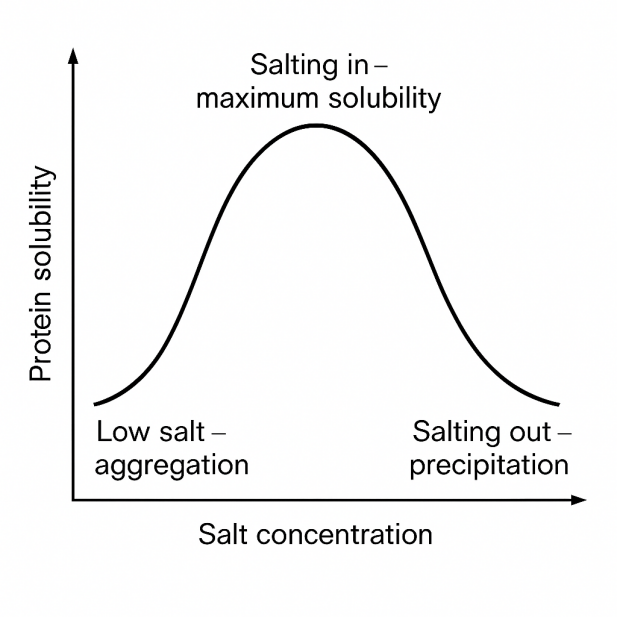
Figure 1. Effect of salt concentration on protein solubility
At zero or very low ionic strength, electrostatic interactions among charged surface groups can drive protein–protein association and precipitation. Adding a moderate amount of salt screens surface charges and weakens attractive electrostatics between proteins, keeping them dispersed and soluble—this is salting in. For many soluble proteins, raising salt from low to moderate levels (e.g., ~0–50 mM up to ~0.5 M) noticeably increases solubility.
As salt concentration increases further, water molecules become increasingly engaged by salt ions. Fewer water molecules are available to effectively solvate hydrophobic protein surfaces. Hydrophobic patches then prefer to interact with each other, promoting aggregation and precipitation—this is salting out. For a given protein, solubility therefore often rises at low–moderate salt and then falls at higher salt, with a maximum around the mid-salt range.
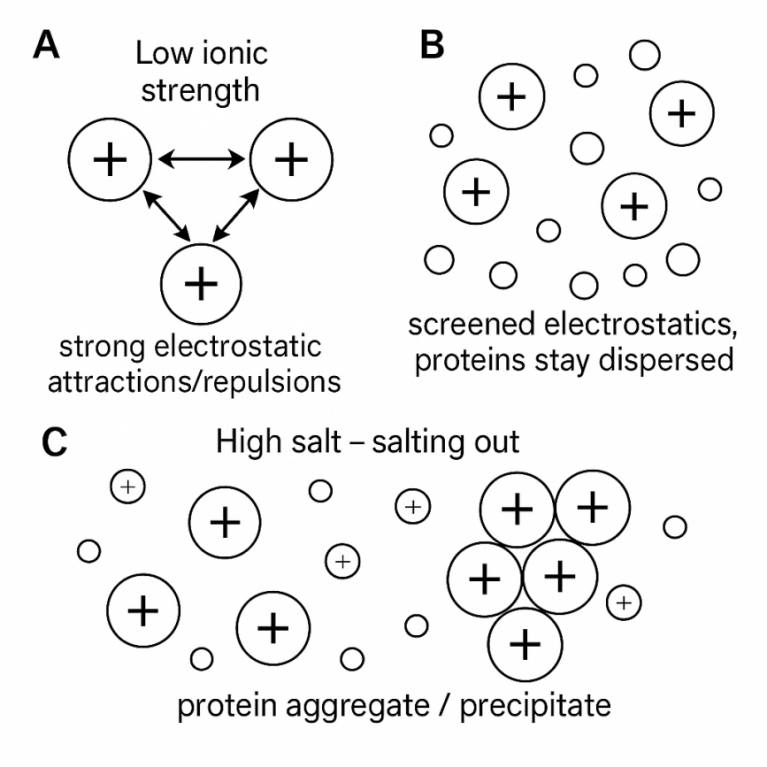
Figure 2. Modes of protein–protein interaction across salt concentrations
II. How Protein Surface Properties Influence Salting-In/Out Behavior
Protein molecules typically have both charged and hydrophobic regions on their surface. Their salting-in and salting-out behaviors are mainly influenced by the following factors:
1.Number and distribution of charged patches
Proteins with many surface charges benefit more from charge screening at moderate salt (stronger salting-in). At very high salt, however, even with screened charges, reduced effective water promotes aggregation and precipitation.
2.Area and location of hydrophobic patches
The more (and larger) hydrophobic patches on the surface, the more prone the protein is to salt-out at high ionic strength. An extreme case is membrane proteins: highly hydrophobic surfaces that, outside the lipid bilayer, often show little salting-in and predominantly salt-out as salt rises.
3.pH modulation of charge states
Surface charge depends on pH, altering interactions with salt ions. Although pH is typically fixed in experiments, fine optimization often co-varies pH with salt concentration.
III. The Hofmeister Series: Why Different Salts Have Different “Strengths”
Beyond the protein itself, salt identity strongly affects salting-in/out. The Hofmeister series orders common cations/anions by their effects on protein solubility, stability, and denaturation, reflecting how different ions perturb protein–water interactions.
1) Ammonium sulfate [(NH₄)₂SO₄]
The most widely used salting-out reagent. By stepping the ammonium sulfate concentration, different proteins can be selectively precipitated (“ammonium sulfate cuts”) for coarse fractionation.
2) Sodium chloride (NaCl) and potassium chloride (KCl)
Ubiquitous buffer salts that set ionic strength and can promote salting-in. Some proteins are less compatible with chloride; acetate or glutamate anions—closer to intracellular conditions—may better preserve stability and activity.
3) Magnesium (Mg²⁺) and calcium (Ca²⁺)
Divalent ions are essential cofactors for many enzymes but can crosslink negative sites and promote aggregation/denaturation at higher levels. Typically kept in the low-millimolar range.
4) Guanidinium salts
Guanidinium chloride is a strong denaturant, used to fully unfold proteins (e.g., dissolving inclusion bodies) prior to refolding.
Salting-in/out demonstrates a simple yet powerful principle: by precisely controlling salt type and concentration, one can modulate protein solubility without complex ligands or costly media. These strategies are valuable for native protein preparations lacking affinity tags, load reduction in early fractionation, and basic studies of protein physicochemical properties.
Aladdin: https://www.aladdinsci.com/