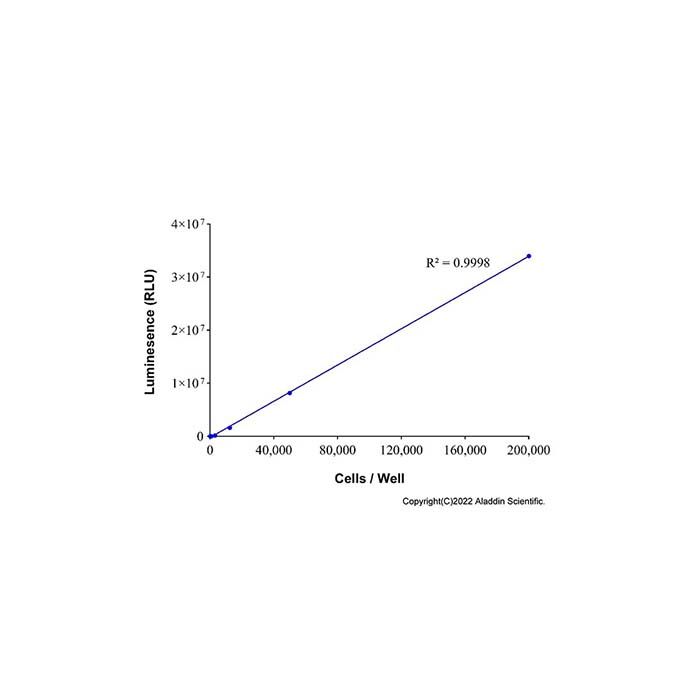
Firefly Luciferase Reporter Gene Assay Kit (Glow) is a glow-type quantitative detection kit characterized by high sensitivity and stable luminescent signals. It is suitable for high-throughput detection of firefly luciferase expression in mammalian cells. This product significantly enhances luminescent signal intensity, effectively improving detection sensitivity. It can be used to detect firefly luciferase reporter gene expression in ADCC Reporter Bioassays or cells.
G1375755
| Component
| 10 mL | 100 mL
| Storage
| G1375755A
| Firefly Luciferase Reaction Buffer (Glow)
| 10 mL
| 100 mL
| -20℃. Store in the dark.
| G1375755B
| Firefly Luciferase Substrate (Glow)
| 1 vial
| 1 vial
| -20℃. Store in the dark. |
|
he main features and differences among three One-Step Firefly Luciferase Reporter Gene Assay Kits from Aladdin are as follows:
For high luminescent signal requirements and detection within 30 minutes: Recommended: Firefly Luciferase Reporter Gene Assay Kit (Glow Bright) (Cat. No. B1375760)
For both luminescent signal and stability requirements, suitable for batch or continuous operation: Recommended: Firefly Luciferase Reporter Gene Assay Kit (Cat. No. F773892)
For standard luminescent signal requirements: Recommended: Firefly Luciferase Reporter Gene Assay Kit (Glow) (Cat. No. G1375755)
For routine laboratory detection, the Firefly Luciferase Reporter Gene Assay Kit (Glow Bright) (Cat. No. B1375760) is the recommended priority.
Product Cat. No.
| Product Name
| Luminescence Type
| Signal Intensity
| Sensitivity
| Half-Life
| Packaging
| Suitable for Batch Samples
| Optimal Use After Mixing & Storing at -20°C
| | F773892 | Firefly Luciferase Reporter Gene Assay Kit
| Glow
| Relatively High
| Relatively Sensitive
| Up to 2h
| 1 bottle Buffer
1 vial Substrate
| Very Suitable
| 1 Month
| G1375755
| Firefly Luciferase Reporter Gene Assay Kit (Glow)
| Glow
| High
| Sensitive
| 25-30min | 1 bottle Buffer
1 vial Substrate
| Very Suitable
| 1 Week
| B1375760
| Firefly Luciferase Reporter Gene Assay Kit (Glow Bright)
| Glow
| Very High
| Highly Sensitive
| 25-30min
| 1 bottle Buffer
1 vial Substrate
| Very Suitable
| 1 Week |
|
Instructions for Use:
1. User-Supplied Materials
2. Preparation Before Assay
(1) Initial Reconstitution: Upon first use, transfer the entire contents of the Firefly Luciferase Reaction Buffer (Glow) bottle into the Firefly Luciferase Substrate (Glow) vial. Mix thoroughly until the substrate is completely dissolved. Aliquot the reconstituted detection reagent as needed. For long-term storage, aliquot and store at -70°C. For short-term storage, store aliquots at -20°C for no longer than one month. Use reconstituted reagent promptly.
(2) Pre-assay: Before each experiment, equilibrate the aliquoted, frozen detection reagent to room temperature.
3. Procedure
(1) Equilibrate Plates: Remove the cell culture plate from the incubator and allow it to stand at room temperature for 5-15 minutes.
Note: Use white or black opaque cell culture plates to minimize signal interference between wells.
(2) Add Detection Reagent: Using a multichannel pipette, add the equilibrated Firefly Luciferase Reaction Buffer (Glow) containing the substrate to each cell culture well. The volume added should be equal to the volume of the culture medium in the well. For example:
* 96-well plate: Typically add 80-100 µL culture medium; add 80-100 µL detection reagent.
* 384-well plate: Typically add 20-30 µL culture medium; add 20-30 µL detection reagent.
(3) Mix to Lyse Cells: To ensure complete cell lysis, place the plate on an orbital shaker or an instrument with shaking capability. Shake at medium to high speed at room temperature for 5 minutes.
Note: A shaking time of 5 minutes is recommended. This can be adjusted based on cell density to ensure complete lysis and stable luminescent results.
(4) Detection: Following the shaking step, immediately measure firefly luciferase reporter gene activity using a luminometer or microplate reader.
Note: For optimal results, perform the detection as soon as possible after adding the detection reagent.
Precautions
Instrument Selection: Any instrument capable of detecting chemiluminescence is suitable for use with this kit. However, background signal levels and measured values for identical samples may vary between different detectors. Values obtained from different instruments for the same sample are not directly comparable. To prevent well-to-well interference, the use of opaque white or black cell culture plates is strongly recommended.
Consistent Conditions: Luminescent signals can be influenced by environmental factors such as medium components and temperature. Ensure consistent detection conditions across all samples within an experiment.
Temperature Sensitivity: The enzymatic reaction is temperature-sensitive. It is essential to equilibrate both the detection reagent and the cell culture plate to room temperature before adding the reagent and performing the assay.
Reagent Stability: To maintain the stability of the luciferase assay reagent, aliquot it appropriately after reconstitution. For long-term storage, store aliquots at -70°C protected from light. For short-term storage, store at -20°C for no longer than one month. Use aliquots promptly and avoid repeated freeze-thaw cycles.
Multiple Plate Assay: If detecting multiple cell culture plates simultaneously, strive to maintain consistent incubation time after adding the detection reagent to each plate before reading. This ensures optimal and comparable results across plates.
Emission Wavelength: The bioluminescence catalyzed by firefly luciferase exhibits a peak emission wavelength of 560 nm.

 ZJ25F0926937