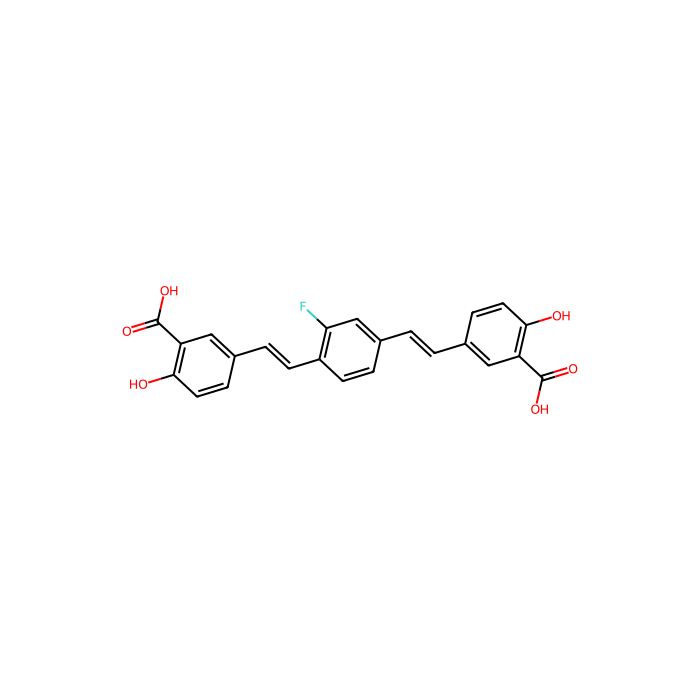
FSB is a fluorine analog of the amyloidophilic fluorescent probe BSB that crosses the blood-brain barrier and displays low toxicity (LD|50|> 80 mg/kg). Also useful for staining plaques and neurofibrillary tangles in brain tissue sections.
Specifiche
Sinonimi
1-fluoro-2,5-bis(3-carboxy-4-hydroxystyryl)benzene | 5,5'-((1E,1'E)-(2-Fluoro-1,4-phenylene)bis(ethene-2,1-diyl))bis(2-hydroxybenzoic acid) | 5-[(E)-2-[4-[(E)-2-(3-carboxy-4-hydroxyphenyl)ethenyl]-3-fluorophenyl]ethenyl]-2-hydroxybenzoic acid | FSB | (1-fluoro-2,5-bis[(e)-3-carboxy-4-hydroxystyryl]benzene) | 1-Fluoro-2,5-bis[(E)-3-carboxy Mostra altro
Specifiche e purezza
≥95%
Condizioni di conservazione di stoccaggio
Store at -20°C
Spedito in
Ice chest + Ice pads
Questo prodotto richiede spedizione a catena fredda. I servizi di terra e altri servizi economici non sono disponibili.
This compound belongs to the class of organic compounds known as stilbenes. These are organic compounds containing a 1,2-diphenylethylene moiety. Stilbenes (C6-C2-C6 ) are derived from the common phenylpropene (C6-C3) skeleton building block. The introduction of one or more hydroxyl groups to a phenyl ring lead to stilbenoids.
External Descriptors
Not available
1. Djoumbou Feunang Y, Eisner R, Knox C, Chepelev L, Hastings J, Owen G, Fahy E, Steinbeck C, Subramanian S, Bolton E, Greiner R, and Wishart DS. ClassyFire: Automated Chemical Classification With A Comprehensive, Computable Taxonomy. Journal of Cheminformatics, 2016, 8:61.
Determine the necessary mass, volume, or concentration for preparing a solution.
Dilution Calculator
Determine the dilution needed to prepare a stock solution.
Reconstitution Calculator
Recensioni
Recensioni dei clienti
Application Protocols
No manufacturer-validated protocols are provided for this SKU. The following is general literature guidance to help design experiments; optimize for your system.
Example: Staining amyloid plaques in fixed brain sections (literature)
Prepare a 1–10 mM FSB stock in anhydrous DMSO; protect from light.
Dilute to 1–5 μM in PBS or TBS, optionally with 0.01–0.05% Tween‑20 and 0.1% BSA.
Incubate sections for 15–30 min at room temperature in the dark.
Wash 3× with buffer (5–10 min each). Optionally counterstain nuclei (e.g., DAPI) if spectra permit.
Mount with an antifade medium compatible with your emission window; image by epifluorescence or confocal microscopy.
Verify biocompatibility and excitation/emission compatibility. Use low μM concentrations and brief exposures. Thoroughly wash to minimize background.
Controls and validation:
Include dye-only, tissue-negative, and competition controls. Consider orthogonal validation (antibody co‑stain) to confirm plaque identity.
Safety: Handle in a fume hood, avoid light exposure, and dispose of waste properly.
Note: These protocols are not item-specific validations. For batch-specific recommendations, Not specified for this item; refer to CoA/Spec Sheet.
Biological Roles
FSB has no endogenous biological role; it is an exogenous small-molecule fluorescent probe used in research settings.
Mode of interaction (literature): Binds preferentially to cross‑β structures present in amyloid fibrils. Binding typically enhances or shifts fluorescence, enabling detection.
Selectivity considerations: Binding reflects supramolecular β‑sheet architecture rather than a single protein sequence, which permits labeling of diverse amyloid types but may also label non-target β‑sheet aggregates if present.
Utility in model systems: Enables visualization of amyloid deposits in cells, tissue sections, and animal models. Frequently combined with immunostaining (e.g., anti‑Aβ antibodies) to confirm colocalization and plaque identity.
Photophysics: Extended conjugation supports strong absorption in the near‑UV/blue and emission in the green region (qualitative literature note); spectral properties can be environment-dependent.
Caveats:
No therapeutic use is implied or claimed. This material is for research use only, and any biological observations should be validated with orthogonal methods.
Uptake and distribution in live systems depend on permeability, protein binding, and ionization state; optimize dosing and wash steps empirically under approved institutional protocols.
Buffer Applications
FSB is not a buffer reagent. However, suitable buffers are essential for reliable staining and imaging results with this dye.
Practical buffer guidance (general, literature):
Common buffers: PBS (pH 7.2–7.6), Tris (pH 7.4–8.0), or HEPES (pH 7.2–7.6). Maintain ionic strength to mimic physiological conditions and reduce nonspecific interactions.
pH considerations: Slightly basic pH can increase aqueous solubility (carboxylate/phenolate formation) but may shift spectral properties; verify spectra and binding at your chosen pH.
Additives: 0.01–0.1% Tween‑20 may reduce nonspecific surface binding; 0.1–1% BSA can block nonspecific protein interactions. Avoid high concentrations that elevate background.
Co‑solvent: Include ≤1% DMSO from stock additions to maintain solubility. Mix thoroughly and avoid local supersaturation.
Rinse/wash: After incubation with FSB, wash with buffer (3× 5–10 min) to reduce background fluorescence.
Recipes (examples; adapt as needed):
PBS 1×: 137 mM NaCl, 2.7 mM KCl, 10 mM phosphate, pH 7.4.
Tris-buffered saline (TBS): 20–50 mM Tris, 150 mM NaCl, pH 7.6.
Always confirm compatibility of your buffer with mounting media and imaging modality (widefield vs. confocal) to avoid refractive index or autofluorescence issues.
Green Alternatives
As a specialized fluorescent probe, FSB does not have a direct “green chemistry” substitute in the way commodity solvents do. However, you can incorporate greener practices in its use and consider alternative probes where appropriate.
Greener practice with FSB (general):
Use minimal DMSO volumes and prepare concentrated stocks to reduce solvent waste.
Favor aqueous buffers and biodegradable surfactants to maintain solubility where possible.
Alternative probes (contextual comparison; literature):
Thioflavin T (ThT): Water-soluble, well-characterized amyloid reporter; strong fluorescence turn-on but lower in vivo plaque specificity compared to stilbene-based probes.
Congo Red: Classic amyloid dye; limited by toxicity and spectral overlap; less favored for modern fluorescence imaging.
Methoxy-X04 and related X‑04/PIB analogs: Brain-penetrant stilbene/benzothiazole derivatives with strong plaque labeling in vivo; may require specialized handling and regulatory oversight.
Trade-offs:
Stilbene-based dyes (incl. FSB) often provide higher affinity and photostability for plaques but may require DMSO and careful light protection.
ThT is greener from a solvent/aqueous-use perspective but can suffer from nonspecific interactions and environmental sensitivity.
Select the probe that best aligns with data quality, safety profile, and solvent footprint for your experiment.
Pharmaceutical Uses
No clinical or therapeutic use is claimed or supported for this product. It is supplied strictly for research use only.
Preclinical imaging reagent: In animal model studies, stilbene‑based amyloid dyes (including FSB) have been formulated in DMSO/saline or other biocompatible vehicles for optical imaging. Such work requires institutional approvals and is outside the scope of routine lab use.
Quality attributes if used in regulated studies: Identity (NMR/LC‑MS), assay purity (HPLC area %), residual solvents, and photostability may be required. This catalog entry does not provide such specifications; Not specified for this item; refer to CoA/Spec Sheet.
Excipients: For ex vivo staining solutions, typical excipients include buffers (PBS/TBS), protein blockers (BSA), and surfactants (Tween‑20) to minimize nonspecific binding. For any in vivo work, formulation must be justified and approved by relevant oversight committees.
Regulatory: Not pharmacopeial, not GMP, not sterile unless explicitly stated on CoA. No claims are made regarding diagnostic suitability.
Physical Properties
Item-specific physical property specifications were not provided; see CoA/Spec Sheet for definitive values for this SKU.
Melting point: Not specified for this item; refer to CoA/Spec Sheet.
Boiling point: Not applicable; decomposes before boiling (general for polyaromatic dyes; literature note).
Density: Not specified for this item; refer to CoA/Spec Sheet.
Solubility (general, literature):
Sparingly soluble in neutral water as the free acid; improved solubility at basic pH via carboxylate/phenolate formation.
Readily solubilized in polar aprotic organic solvents such as DMSO and DMF; stock solutions are commonly prepared in anhydrous DMSO (literature practice).
logP/logD: Not specified for this item; refer to CoA/Spec Sheet. (Literature suggests amphiphilic behavior due to acidic groups on a conjugated hydrophobic core.)
pKa values: Not specified for this item; refer to CoA/Spec Sheet. (Phenolic and carboxylic acid pKa’s expected in typical ranges; literature generalization.)
Refractive index: Not applicable (solid dye); Not specified for this item.
Spectral properties (general, literature): Exhibits environment-sensitive absorption/emission associated with extended stilbene chromophores; excitation/emission maxima can shift with solvent polarity, pH, and binding to amyloid aggregates. For precise spectra, consult primary literature and measure under your exact conditions.
Practical notes (general): Filter stock solutions (0.2 μm PTFE) to remove particulates; protect from light to prevent photobleaching and E/Z isomerization typical of stilbene motifs.
Quality and Grades
Item-specific grade/purity and stabilizer information were not provided in the Product Data; consult the CoA/Spec Sheet for batch-specific details for SKU F345596.
Context and implications (general guidance for research dyes):
Research grade vs. analytical grade: Research-use dyes are typically qualified by identity (NMR/MS/UV‑Vis), purity (HPLC/LC‑MS), and performance attributes (absorbance/emission profile), but may not carry low-UV or low-water guarantees associated with chromatography solvents.
Purity metrics: For imaging probes, HPLC area % and residual solvent levels are commonly reported. Absence of these metrics here means they are Not specified for this item; refer to CoA/Spec Sheet.
Stabilizers: None stated for this product. If stabilizers (e.g., antioxidants) are present in some lots, they will appear on the CoA; otherwise assume neat solid dye.
Light sensitivity: Not a formal grade, but a critical quality attribute for stilbene dyes. Protect from light during storage and shipment; the item is shipped cold, aligning with preserving photostability and minimizing degradation.
How to qualify in your lab (practical):
Verify identity by UV‑Vis/fluorescence in a reference solvent (e.g., DMSO) and by LC‑MS. Record batch-specific λmax/ϵ under your assay conditions.
Check for polymeric/aggregated impurities by fluorescence quantum yield or fluorescence lifetime changes versus literature expectations.
Reaction and Applications
This product is supplied as a life‑science research dye rather than a synthetic reagent. It is not typically used as a stoichiometric reactant or catalyst in preparative organic synthesis.
Relevant applications (general, literature):
Amyloid research: FSB is widely reported as a fluorescent probe that binds β‑sheet–rich amyloid aggregates (e.g., Aβ plaques) for histology and in vivo imaging in animal models.
Tissue and section staining: Fluorescent labeling of fixed brain sections to visualize plaque morphology in combination with immunohistochemistry.
In vivo labeling (preclinical): Optical imaging of amyloid deposits in transgenic animal models (literature); ensure appropriate ethical approvals and institutional guidelines.
Assay development: Screening for inhibitors of amyloid aggregation by monitoring dye fluorescence changes upon binding.
Practical considerations:
Binding is driven by planar π‑stacking and hydrophobic interactions with β‑sheet grooves (literature rationale). Ionic state (pH) and co‑solvent fraction can modulate binding and background.
Validate concentration: Typical working ranges are in the low μM for tissue staining; optimize for your sample, imaging system, and background autofluorescence.
If you require a reagent for chemical synthesis, see the Synthetic Utility and Reaction Conditions tabs, which are generally not applicable to this dye.
Reaction Conditions
Not typically applicable. FSB is supplied for use as a fluorescent probe, not as a reactant. No item-specific reaction conditions are provided.
General handling for experimental use (literature guidance):
Stock preparation: Dissolve in anhydrous DMSO (e.g., 1–10 mM). Vortex and, if needed, warm gently (≤40 °C) in the dark to aid dissolution. Filter through 0.2 μm PTFE.
Working concentration: Often low micromolar for tissue staining; optimize empirically for your sample and imaging setup.
Incubation: Typical staining times range from 10–60 minutes for fixed sections; temperature and time influence penetration and background.
For chemical reaction conditions (catalysts, yields, etc.), there is no applicable content for this product.
Safety and Handling
Authoritative hazard classification for this SKU is not provided; defer to the product SDS for definitive information.
GHS classification: Not specified for this item; refer to SDS.
Signal word / H-statements / Pictograms: Not specified for this item; refer to SDS.
General laboratory precautions (good practice for synthetic organic dyes):
PPE: Lab coat, nitrile gloves, splash goggles; handle powders in a fume hood to avoid inhalation of dust and to control solvent vapors when preparing stocks.
Avoid generating dust; wet-down with solvent before transfer when feasible.
Incompatibilities: Strong oxidizers; strong bases/acids may cause hydrolysis or salt formation (which can alter spectral properties). Avoid prolonged exposure to light; protect solutions and solids with amber glass/foil wrapping.
First aid (overview; consult SDS):
Inhalation: Move to fresh air; seek medical attention if symptoms persist.
Skin/eye contact: Rinse with copious water for ≥15 minutes; remove contaminated clothing; obtain medical advice.
Ingestion: Rinse mouth; do not induce vomiting; seek medical attention.
Spill response: Avoid dust, collect with inert absorbent, dispose per institutional and local regulations.
Waste: Treat as organic dye waste; segregate from halogenated solvents where required; follow institutional hazardous waste procedures.
Special risks (general): Many stilbene dyes can undergo photobleaching and E/Z isomerization under strong light; minimize light exposure during handling and experiments.
Solvent Selection
FSB behaves as an amphiphilic, highly conjugated organic dye. Solvent choice strongly influences solubility, aggregation state, and spectral characteristics.
Polarity/miscibility (general, literature):
Highly soluble in DMSO and DMF; moderate solubility in ethanol/methanol; limited solubility in water at neutral pH as the free acid.
Aqueous solubility increases at basic pH (formation of carboxylate/phenolate salts) or with co-solvents/surfactants.
Recommended stock solvent: Anhydrous DMSO at 1–10 mM (literature practice). Filter sterilize through 0.2 μm PTFE if needed and store aliquots protected from light at −20 °C.
Working buffers: Phosphate-buffered saline (PBS), Tris, or HEPES with 0.05–0.1% carrier (e.g., FBS or BSA) can help limit surface adsorption. Include ≤1% DMSO as co‑solvent to maintain solubility if required.
Comparison (general):
DMSO vs. ethanol: DMSO better maintains monomeric dye and consistent spectra; ethanol is acceptable for rapid dilutions but may permit aggregation on further aqueous dilution.
Aqueous basic vs. neutral pH: Basic buffer improves solubility but may shift spectra and ionization state; neutral pH better preserves physiological relevance but may need co-solvent.
Practical tips:
Add dye stock last, with rapid mixing, to minimize local supersaturation.
Validate spectral properties in the exact solvent/buffer system you plan to use, as λmax and quantum yield are environment dependent.
Storage and Reconstitution
Item-specific storage: Store at −20 °C (Product Data). Shipped in an ice chest with ice pads. Protect from light during storage and handling.
General best practices for this dye class:
Solid form: Keep tightly closed in an amber vial under dry conditions. Allow vial to warm to room temperature before opening to minimize condensation. Reseal promptly; consider desiccant in secondary containment.
Reconstitution: Prepare concentrated stocks in anhydrous DMSO (e.g., 1–10 mM). Mix until fully dissolved; if needed, brief sonication or gentle warming (≤40 °C) helps dissolution. Filter through 0.2 μm PTFE if particulate is observed.
Aliquoting: Dispense single‑use aliquots into amber microtubes to avoid repeated freeze‑thaw and light exposure.
Storage of solutions: Store aliquots at −20 °C, protected from light. Avoid >3–4 freeze–thaw cycles. For working solutions in buffer, prepare fresh and use the same day where possible.
Stability: Specific shelf life and stability constants are Not specified for this item; refer to CoA/Spec Sheet. In general, stilbene dyes are susceptible to photodegradation; minimize light and oxygen exposure.
Before use: Inspect for visible changes (color shift, precipitation). Verify spectral properties (UV‑Vis/fluorescence) in your solvent system prior to critical experiments.
Research Use Note: For research use only.
Structure and Identity
Brief overview: FSB is a life‑science research dye commonly used as an amyloid-binding fluorescent probe (literature). Specific item identifiers are limited in the provided Product Data; consult certificate of analysis (CoA) for definitive structural identifiers tied to this SKU.
SKU: F345596 (Aladdin Scientific)
Product name: FSB (research dye)
CAS: 760988-03-2 (literature identity for the amyloid-binding dye commonly abbreviated FSB)
PubChem CID: 11486945 (literature)
InChIKey: Not specified for this item; refer to CoA/Spec Sheet. (Product Data lists "77221", which is not a standard InChIKey string; authoritative key not provided here.)
SMILES: Not specified for this item; refer to CoA/Spec Sheet.
Molecular formula: Not specified for this item; refer to CoA/Spec Sheet.
Molecular weight: Not specified for this item; refer to CoA/Spec Sheet.
Structural features (general, literature):
Stilbene-like conjugated core with two styryl segments appended to a central benzene ring (extended π-system)
Phenolic and carboxylic acid substituents on the terminal aryl rings (acidic and H‑bonding sites)
A single fluoro substituent on the central ring (modulates electronics and photophysics)
Planar, highly conjugated scaffold favorable for amyloid aggregate binding via π–π and hydrophobic interactions
2D structure in words (literature): A central benzene bearing one fluoro and two trans‑vinylene linkers, each terminating in a phenyl ring that is para‑hydroxy and meta‑carboxy substituted.
Synthetic Utility
This compound is provided as a finished fluorescent probe rather than a building block. It is not typically used as a synthon in multi‑step organic synthesis.
General notes (contextual, literature):
Functional groups: Phenolic OH and carboxylic acid groups are present in stilbene‑based amyloid dyes like FSB. While those functionalities are, in principle, derivatizable (esterification, amidation, etherification), such transformations change photophysical and binding properties and are generally used to create analogs rather than to use FSB itself as a reagent.
Retrosynthetic origin (literature): These dyes are commonly assembled via double Knoevenagel or Wittig‑type olefinations between appropriately substituted benzaldehydes and a difunctionalized central arene, yielding trans‑stilbene linkages.
If your goal is to modify photophysical properties or pharmacokinetics, consider ordering appropriate intermediates (e.g., aldehydes or acids) rather than repurposing this catalog item.
Target Specificity
No product-specific target validation data are provided for SKU F345596.
Contextual note (literature, not product verification): Stilbene-based dyes abbreviated as FSB are reported to bind β‑sheet–rich amyloid aggregates (e.g., Aβ plaques). This information is provided as general background only and is not a specification or certification of target specificity for this item.
Item-specific details such as antigen/epitope, species reactivity, clone, and isotype do not apply to small-molecule dyes and are not available for this product.
Domande frequenti
What is the purity of this product?
This product is supplied at ≥95% purity (chemical assay). Lot-specific values are stated on the Certificate of Analysis.
How should this product be stored?
Store at ?20 °C. Freezer storage is required to maintain the specified shelf life.
How is this product shipped?
This product ships in an insulated container with ice pads. Unpack on arrival and transfer it to the storage condition stated above.
What are the CAS number, molecular formula and molecular weight?
The CAS Number is 760988-03-2, the molecular formula is C24H17FO6, and the molecular weight is 420.39 g/mol. InChIKey DZXZHGCGNRRJEG-WMWQKROPSA-N.
What documentation is provided?
Available product documentation, including Certificates of Analysis (COA), Safety Data Sheets (SDS), and specification sheets, is shown in the product document area. Document availability and access follow the current site policy.
Utilizziamo i cookie per garantire il corretto funzionamento del sito web e, ove consentito, per migliorare la tua esperienza. Puoi gestire le tue preferenze in qualsiasi momento nelle Impostazioni. Per saperne di più, consulta la nostra Cookie Policy.
Desidera che le inviamo un messaggio quando avremo sconti disponibili?
Ricordamelo più tardi
Grazie! Controlli la sua casella di posta per confermare.
Products are supplied to verified businesses, institutions, and qualified professionals for research and development use only. Not for use in humans, animals, diagnosis, or therapy.