Product Introduction
Gelatin is a natural macromolecular material whose molecular backbone contains cell-adhesive RGD sequences and enzyme-degradable sites, which are beneficial for cell adhesion, proliferation, and differentiation.
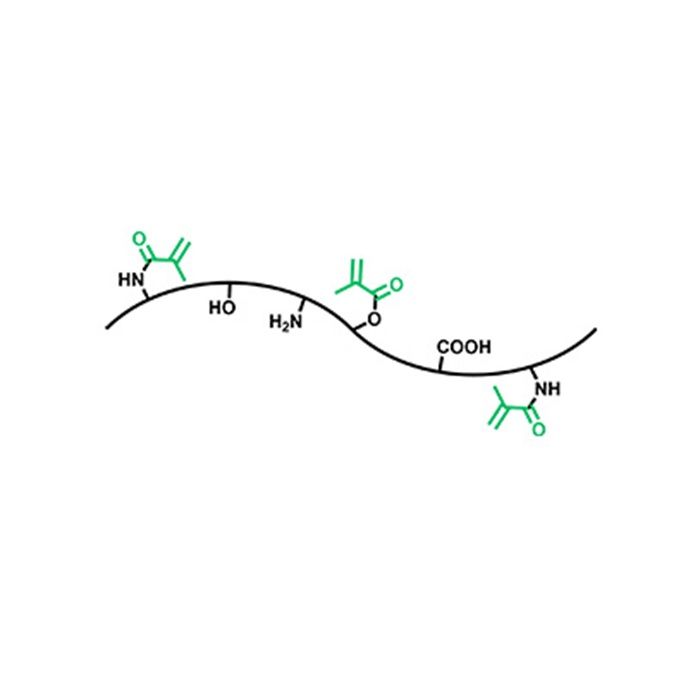
GelMA is a photosensitive polymer obtained by modifying gelatin with methacrylic anhydride (MA). It can be used in combination with blue light or UV photoinitiators to crosslink and solidify under blue light or UV irradiation. This polymer exhibits excellent biocompatibility; its backbone contains cell-adhesive RGD sequences and enzyme-degradable sites, which facilitate cell adhesion, proliferation, and differentiation. Additionally, its simple curing process has led to its wide application in fields such as 2D/3D cell culture, tissue engineering, regenerative medicine, organoid chips, 3D bioprinting, and biosensors.
Product Specifications
| Component | Appearance | Specification | Remarks |
| GelMA | Pale yellow to yellow powder or granules | 1 g/bottle, 5 g/bottle | Store in the dark |
Usage Recommendations
1. GelMA can be used in combination with o-nitrobenzyl alcohol-modified polymers, such as HANB and GelNB. Both can be polymerized and crosslinked by photoinitiators LAP or NAP under light irradiation, yielding high-strength hydrogel materials in just a few seconds.
2. GelMA can be used in combination with methacryloyl-modified polymers, such as CMCMA, HAMA, CSMA, and ChMA, and polymerized under light irradiation with photoinitiators to construct hydrogel materials with different physicochemical properties.
3. GelMA can be used alone, polymerized and crosslinked under light irradiation with photoinitiators.
Preparation Method
1. Prepare a photoinitiator stock solution: Dissolve a specific mass of NAP or LAP to prepare a solution with a concentration in the range of 0.1 wt%–0.25 wt%, and store at 2–8 ℃ away from light.
2. Transfer the required mass of GelMA into a centrifuge tube, and add the required volume of the initiator stock solution to the tube.
3. Incubate the sample in a 37 ℃ shaker in the dark with shaking until completely dissolved; alternatively, heat it in a hot water bath in the dark until completely dissolved, with vortexing or shaking several times during the process.
Precautions
1. The higher the degree of methacryloylation of GelMA and the higher the concentration of the prepared solution, the greater the modulus of the cured gel and the shorter the curing time.
2. The recommended working concentration of GelMA should not exceed 30 wt%.
3. The higher the concentration of the photoinitiator stock solution, the faster the curing speed of the GelMA solution and the more brittle the resulting cured gel.
Product Applications
2D/3D cell culture, tissue engineering, regenerative medicine, organoid chips, 3D bioprinting, biosensors, and other fields.
Sterilization Methods
1. Filtration sterilization (recommended): Sterilize the solution by filtration using a 0.22 μm sterile syringe filter while the solution is still warm. This method is only applicable to low-viscosity solutions. For solutions with high viscosity, use pasteurization or autoclaving.
2. Pasteurization: Heat the solution to 80 ℃ and hold for 30 min; then quickly transfer it to an ice-water mixture to cool to room temperature. Repeat this cycle three times.
3. Autoclaving: Sterilize the solution in an autoclave at 121 ℃ for 8 min. After manual pressure release, quickly transfer the solution to an ice-water mixture to cool to room temperature. Note that high temperatures can reduce gel performance, so strict adherence to the above steps is required when using this method.
Note: Sterile solutions can be stored temporarily at 2–8 ℃ away from light and are recommended for use within 7 days. Non-sterile solutions can be stored temporarily at 2–8 ℃ away from light and are recommended for use within 48 hours.
Product Features
1. Provides cell adhesion sites to enable directed cell growth and differentiation.

2. Exhibits photocrosslinking properties, suitable for 3D printing of complex tissue structures.

Typical Applications
1. Vascular regeneration: Cells align and organize within micro-patterned structures and assemble to form organized actin fibers and umbilical cord-like structures with circular/oval cross-sections.

2. Bone repair: Combined with microfluidic technology to rapidly prepare high-strength cell-laden microgels for bone defect repair.

3. 3D printing: Combined with nanoclay to print complex scaffolds with high shape fidelity.

Product Advantages
1. Batch-to-batch stability: Standardized production processes ensure high repeatability and controllability of GelMA in composition, physicochemical properties, and biological performance across different batches.
2. Ultra-high purity: Unique production processes effectively remove methacrylic acid small molecules and process impurities, achieving ultra-low impurity levels and ensuring the safety of GelMA in biomedical applications.
3. Reliable safety: GelMA has undergone biocompatibility evaluation by third-party institutions, confirming its safety and non-toxicity, accelerating the translation of downstream products from the laboratory to the clinic. Each batch is released only after strict, standardized testing to ensure safety in biomedical applications.
4. High stability: In accordance with the Guiding Principles for Stability Studies of Non-Invasive Implantable Medical Devices, real-time and accelerated stability tests have demonstrated that GelMA maintains stable quality under the indicated storage conditions.

 ZJ26F0434408