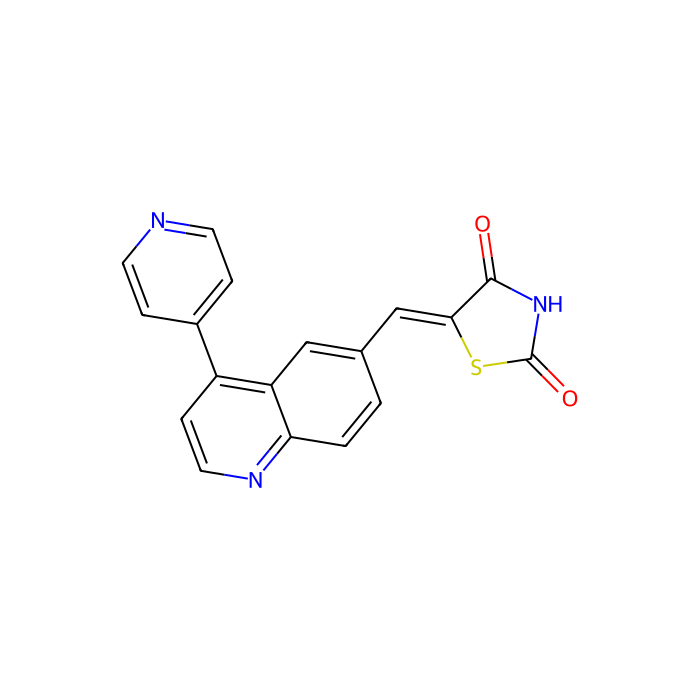
GSK1059615 - Moligand™, ≥98% , PI3-kinase class I inhibitor, CAS No.958852-01-2, PI3-kinase class I inhibitor

CAS: 958852-01-2 Cat. No.: G127955 Formula: C18H11N3O2S Peso molecolare: 333.36
Disponibile su ordine
QUALITÀ & PUREZZA Moligand™ ? Moligand™ — Aladdin's line of ligands and bioactive small molecules. Use for receptor, pathway, and binding studies needing defined small-molecule tools. ≥98%
Synonyms
Thiodiphenylamin [German] | D70652 | OXIRANE,2-[(PHENYLMETHOXY)METHYL]- | BRD-K06750613-001-01-6 | HY-12036 | NCGC00346509-02 | (Z)-5-((4-(pyridin-4-yl)quinolin-6-yl)methylene)thiazolidine-2,4-dione | GSK 1059615 sodium salt hydrate | GSK1059615 | GSK-105
Storage
Store at 2-8°C
Shipped In
Wet ice
★
Dimensione
Germania (EU)
USA*
Prezzo
Qtà
5mg
G127955-5mg
—
3 Disponibile
78,88€
25mg
G127955-25mg
—
3 Disponibile
244,62€
100mg
G127955-100mg
—
2 Disponibile
719,27€
Enter a quantity for the sizes you want to add.
🧪
Perché questa qualità

Moligand™, ≥98% Moligand™ per flussi di lavoro cromatografici e analitici sensibili che richiedono un'interferenza minima della linea di base.

🌡

Stoccaggio e spedizione

Store at 2-8°C Spedizione Wet ice. Consultare il COA specifico del lotto per le specifiche esatte.

📋

Documenti di qualità

SDS, COA, scheda tecnica e scheda delle specifiche disponibili per il download. COA specifico del lotto accessibile tramite ricerca per numero di lotto.

📚

Prova documentale

Citato in 0 pubblicazioni peer-reviewed su cromatografia, sintesi organica e reazioni di accoppiamento incrociato.

Panoramica

GSK1059615 is a dual inhibitor of PI3Kα/β/δ/γ (reversible) and mTOR with IC50 of 0.4 nM/0.6 nM/2 nM/5 nM and 12 nM, respectively.
A potent inhibitor of PI 3-kinase and FRAP (mTOR)

Specifiche

Sinonimi
Thiodiphenylamin [German] | D70652 | OXIRANE,2-[(PHENYLMETHOXY)METHYL]- | BRD-K06750613-001-01-6 | HY-12036 | NCGC00346509-02 | (Z)-5-((4-(pyridin-4-yl)quinolin-6-yl)methylene)thiazolidine-2,4-dione | GSK 1059615 sodium salt hydrate | GSK1059615 | GSK-105
Specifiche e purezza
Moligand™, ≥98%
Meccanismi biochimici e fisiologici
Potent inhibitor of PI 3-kinaseα(PI3Kα) (IC50= 2 nM). Inhibits proliferation in BT474 cells and attenuates MAPK signaling.
Condizioni di conservazione di stoccaggio
Store at 2-8°C
Spedito in
Wet ice
Questo prodotto richiede spedizione a catena fredda. I servizi di terra e altri servizi economici non sono disponibili.
Grado
Moligand™
Tipo di azione
INHIBITOR
Meccanismo d'azione
PI3-kinase class I inhibitor
Purezza
≥98%
Proprietà del prodotto
ALogP
3
Nomi e identificatori
Pubchem Sid
Pubchem Sid Url
https://pubchem.ncbi.nlm.nih.gov/substance/488200355
Sorrisi canonici
C1=CC2=NC=CC(=C2C=C1C=C3C(=O)NC(=O)S3)C4=CC=NC=C4
IUPAC Name
(5Z)-5-[(4-pyridin-4-ylquinolin-6-yl)methylidene]-1,3-thiazolidine-2,4-dione
InChIKey
QDITZBLZQQZVEE-YBEGLDIGSA-N
INCHI
1S/C18H11N3O2S/c22-17-16(24-18(23)21-17)10-11-1-2-15-14(9-11)13(5-8-20-15)12-3-6-19-7-4-12/h1-10H,(H,21,22,23)/b16-10-
Isomeri SMILES
C1=CC2=NC=CC(=C2C=C1/C=C\3/C(=O)NC(=O)S3)C4=CC=NC=C4
Peso molecolare
333.36
Reaxy-Rn
20875363
Reaxys-RN_link_address
https://www.reaxys.com/reaxys/secured/hopinto.do?context=S&query=IDE.XRN=20875363&ln=

Documentazione

📋 Scheda di dati di sicurezza (SDS)

Documento completo su pericoli, manipolazione, stoccaggio e conformità normativa.

<<<<<<< HEAD Scarica SDS → ======= Scarica SDS → >>>>>>> release248-p3

✅ Certificato di analisi (COA)

Dati di qualità specifici del lotto. Inserisci il numero di lotto per recuperare il COA esatto.

Cerca COA →

📊 Scheda tecnica

Riepilogo di riferimento rapido delle specifiche e applicazioni del prodotto.

Visualizza scheda tecnica →

🔬 Scheda delle specifiche

Attributi di qualità completi e criteri di accettazione per questa qualità.

Visualizza scheda delle specifiche →

Dati avanzati

Taxonomic Classification

Taxonomy Tree

KingdomOrganic compounds
SuperclassOrganoheterocyclic compounds
ClassePyridines and derivatives
SubclassBipyridines and oligopyridines
Intermediate Tree Nodes Not available
Direct ParentBipyridines and oligopyridines
Alternative Parents Quinolines and derivatives  Thiazolidinediones  Benzenoids  Heteroaromatic compounds  Dicarboximides  Thiocarbamic acid derivatives  Azacyclic compounds  Organonitrogen compounds  Organic oxides  Hydrocarbon derivatives  Carbonyl compounds  
Molecular FrameworkAromatic heteropolycyclic compounds
Substituents Bipyridine - Quinoline - Thiazolidinedione - Benzenoid - Dicarboximide - Thiazolidine - Heteroaromatic compound - Thiocarbamic acid derivative - Carboxylic acid derivative - Azacycle - Organic nitrogen compound - Organic oxide - Organic oxygen compound - Organooxygen compound - Organonitrogen compound - Hydrocarbon derivative - Carbonyl group - Aromatic heteropolycyclic compound
DescrizioneThis compound belongs to the class of organic compounds known as bipyridines and oligopyridines. These are organic compounds containing two pyridine rings linked to each other.
External Descriptors Not available
Struttura 3D
Modello di struttura chimica interattiva


Obiettivi associati (umani)
CSNK2A2 Tchem Casein kinase II subunit alpha' (1 Activities)
Activity TypeActivity Value -log(M)Mechanism of ActionActivity ReferencePublications (PubMed IDs)
TAOK1 Tchem Serine/threonine-protein kinase TAO1 (1 Activities)
Activity TypeActivity Value -log(M)Mechanism of ActionActivity ReferencePublications (PubMed IDs)
PIK3CA Tclin Phosphatidylinositol 4,5-bisphosphate 3-kinase catalytic subunit alpha isoform (1 Activities)
Activity TypeActivity Value -log(M)Mechanism of ActionActivity ReferencePublications (PubMed IDs)
Tchem Uncharacterized protein FLJ45252 (1 Activities)
Activity TypeActivity Value -log(M)Mechanism of ActionActivity ReferencePublications (PubMed IDs)
CLK1 Tchem Dual specificity protein kinase CLK1 (1 Activities)
Activity TypeActivity Value -log(M)Mechanism of ActionActivity ReferencePublications (PubMed IDs)
CLK2 Tchem Dual specificity protein kinase CLK2 (1 Activities)
Activity TypeActivity Value -log(M)Mechanism of ActionActivity ReferencePublications (PubMed IDs)
ABL1 Tclin Tyrosine-protein kinase ABL (18331 Activities)
Activity TypeRelationActivity valueUnitsAction TypeJournalPubMed IddoiAssay Aladdin ID
EGFR Tclin Epidermal growth factor receptor erbB1 (33727 Activities)
Activity TypeRelationActivity valueUnitsAction TypeJournalPubMed IddoiAssay Aladdin ID
INSR Tclin Insulin receptor (5558 Activities)
Activity TypeRelationActivity valueUnitsAction TypeJournalPubMed IddoiAssay Aladdin ID
TOP2A Tclin DNA topoisomerase II alpha (6317 Activities)
Activity TypeRelationActivity valueUnitsAction TypeJournalPubMed IddoiAssay Aladdin ID
PDGFRB Tclin Platelet-derived growth factor receptor beta (5195 Activities)
Activity TypeRelationActivity valueUnitsAction TypeJournalPubMed IddoiAssay Aladdin ID
IGF1R Tclin Insulin-like growth factor I receptor (8605 Activities)
Activity TypeRelationActivity valueUnitsAction TypeJournalPubMed IddoiAssay Aladdin ID
KIT Tclin Stem cell growth factor receptor (10667 Activities)
Activity TypeRelationActivity valueUnitsAction TypeJournalPubMed IddoiAssay Aladdin ID
DCK Tchem Deoxycytidine kinase (530 Activities)
Activity TypeRelationActivity valueUnitsAction TypeJournalPubMed IddoiAssay Aladdin ID
MAPK11 Tchem MAP kinase p38 beta (2785 Activities)
Activity TypeRelationActivity valueUnitsAction TypeJournalPubMed IddoiAssay Aladdin ID
LCK Tclin Tyrosine-protein kinase LCK (9212 Activities)
Activity TypeRelationActivity valueUnitsAction TypeJournalPubMed IddoiAssay Aladdin ID
NQO2 Tchem Quinone reductase 2 (885 Activities)
Activity TypeRelationActivity valueUnitsAction TypeJournalPubMed IddoiAssay Aladdin ID
MAPK14 Tchem MAP kinase p38 alpha (12866 Activities)
Activity TypeRelationActivity valueUnitsAction TypeJournalPubMed IddoiAssay Aladdin ID
GSK3B Tclin Glycogen synthase kinase-3 beta (11785 Activities)
Activity TypeRelationActivity valueUnitsAction TypeJournalPubMed IddoiAssay Aladdin ID
PRKACB Tchem cAMP-dependent protein kinase beta-1 catalytic subunit (589 Activities)
Activity TypeRelationActivity valueUnitsAction TypeJournalPubMed IddoiAssay Aladdin ID
PRKCZ Tchem Protein kinase C zeta (2414 Activities)
Activity TypeRelationActivity valueUnitsAction TypeJournalPubMed IddoiAssay Aladdin ID
MAP2K6 Tchem Dual specificity mitogen-activated protein kinase kinase 6 (1284 Activities)
Activity TypeRelationActivity valueUnitsAction TypeJournalPubMed IddoiAssay Aladdin ID
MYLK Tchem Myosin light chain kinase, smooth muscle (1267 Activities)
Activity TypeRelationActivity valueUnitsAction TypeJournalPubMed IddoiAssay Aladdin ID
CSNK1G1 Tchem Casein kinase I gamma 1 (2496 Activities)
Activity TypeRelationActivity valueUnitsAction TypeJournalPubMed IddoiAssay Aladdin ID
FGFR1 Tclin Fibroblast growth factor receptor 1 (9149 Activities)
Activity TypeRelationActivity valueUnitsAction TypeJournalPubMed IddoiAssay Aladdin ID
STK3 Tchem Serine/threonine-protein kinase MST2 (3069 Activities)
Activity TypeRelationActivity valueUnitsAction TypeJournalPubMed IddoiAssay Aladdin ID
PRKAG1 Tchem AMP-activated protein kinase, gamma-1 subunit (254 Activities)
Activity TypeRelationActivity valueUnitsAction TypeJournalPubMed IddoiAssay Aladdin ID
CSNK1D Tchem Casein kinase I delta (4546 Activities)
Activity TypeRelationActivity valueUnitsAction TypeJournalPubMed IddoiAssay Aladdin ID
MAP2K5 Tchem Dual specificity mitogen-activated protein kinase kinase 5 (650 Activities)
Activity TypeRelationActivity valueUnitsAction TypeJournalPubMed IddoiAssay Aladdin ID
SRC Tclin Tyrosine-protein kinase SRC (10310 Activities)
Activity TypeRelationActivity valueUnitsAction TypeJournalPubMed IddoiAssay Aladdin ID
MAP2K3 Tchem Dual specificity mitogen-activated protein kinase kinase 3 (632 Activities)
Activity TypeRelationActivity valueUnitsAction TypeJournalPubMed IddoiAssay Aladdin ID
CDK6 Tclin Cyclin-dependent kinase 6 (1724 Activities)
Activity TypeRelationActivity valueUnitsAction TypeJournalPubMed IddoiAssay Aladdin ID
PRKAG2 Tchem AMP-activated protein kinase, gamma-2 subunit (243 Activities)
Activity TypeRelationActivity valueUnitsAction TypeJournalPubMed IddoiAssay Aladdin ID
AKT2 Tchem Serine/threonine-protein kinase AKT2 (4301 Activities)
Activity TypeRelationActivity valueUnitsAction TypeJournalPubMed IddoiAssay Aladdin ID
AKT3 Tchem Serine/threonine-protein kinase AKT3 (3157 Activities)
Activity TypeRelationActivity valueUnitsAction TypeJournalPubMed IddoiAssay Aladdin ID
GRK2 Tchem G-protein coupled receptor kinase 2 (1019 Activities)
Activity TypeRelationActivity valueUnitsAction TypeJournalPubMed IddoiAssay Aladdin ID
PYGB Tchem Brain glycogen phosphorylase (474 Activities)
Activity TypeRelationActivity valueUnitsAction TypeJournalPubMed IddoiAssay Aladdin ID
AURKB Tchem Serine/threonine-protein kinase Aurora-B (6805 Activities)
Activity TypeRelationActivity valueUnitsAction TypeJournalPubMed IddoiAssay Aladdin ID
RPS6KA4 Tchem Ribosomal protein S6 kinase alpha 4 (2104 Activities)
Activity TypeRelationActivity valueUnitsAction TypeJournalPubMed IddoiAssay Aladdin ID
ROCK1 Tclin Rho-associated protein kinase 1 (4723 Activities)
Activity TypeRelationActivity valueUnitsAction TypeJournalPubMed IddoiAssay Aladdin ID
PIM1 Tchem Serine/threonine-protein kinase PIM1 (9629 Activities)
Activity TypeRelationActivity valueUnitsAction TypeJournalPubMed IddoiAssay Aladdin ID
PKN2 Tchem Protein kinase N2 (1991 Activities)
Activity TypeRelationActivity valueUnitsAction TypeJournalPubMed IddoiAssay Aladdin ID
CSK Tchem Tyrosine-protein kinase CSK (2395 Activities)
Activity TypeRelationActivity valueUnitsAction TypeJournalPubMed IddoiAssay Aladdin ID
RPS6KA5 Tchem Ribosomal protein S6 kinase alpha 5 (3355 Activities)
Activity TypeRelationActivity valueUnitsAction TypeJournalPubMed IddoiAssay Aladdin ID
PRKD3 Tchem Protein kinase C nu (2315 Activities)
Activity TypeRelationActivity valueUnitsAction TypeJournalPubMed IddoiAssay Aladdin ID
PRKCI Tchem Protein kinase C iota (2821 Activities)
Activity TypeRelationActivity valueUnitsAction TypeJournalPubMed IddoiAssay Aladdin ID
SYK Tclin Tyrosine-protein kinase SYK (7372 Activities)
Activity TypeRelationActivity valueUnitsAction TypeJournalPubMed IddoiAssay Aladdin ID
PLK1 Tchem Serine/threonine-protein kinase PLK1 (28605 Activities)
Activity TypeRelationActivity valueUnitsAction TypeJournalPubMed IddoiAssay Aladdin ID
JAK1 Tclin Tyrosine-protein kinase JAK1 (8569 Activities)
Activity TypeRelationActivity valueUnitsAction TypeJournalPubMed IddoiAssay Aladdin ID
RPS6KA1 Tchem Ribosomal protein S6 kinase alpha 1 (2796 Activities)
Activity TypeRelationActivity valueUnitsAction TypeJournalPubMed IddoiAssay Aladdin ID
JAK2 Tclin Tyrosine-protein kinase JAK2 (12915 Activities)
Activity TypeRelationActivity valueUnitsAction TypeJournalPubMed IddoiAssay Aladdin ID
RPS6KA6 Tchem Ribosomal protein S6 kinase alpha 6 (2027 Activities)
Activity TypeRelationActivity valueUnitsAction TypeJournalPubMed IddoiAssay Aladdin ID
PFKP Tbio Phosphofructokinase platelet type (224 Activities)
Activity TypeRelationActivity valueUnitsAction TypeJournalPubMed IddoiAssay Aladdin ID
CSNK1E Tclin Casein kinase I epsilon (1412 Activities)
Activity TypeRelationActivity valueUnitsAction TypeJournalPubMed IddoiAssay Aladdin ID
CAMK4 Tbio CaM kinase IV (2116 Activities)
Activity TypeRelationActivity valueUnitsAction TypeJournalPubMed IddoiAssay Aladdin ID
GSK3A Tclin Glycogen synthase kinase-3 alpha (3764 Activities)
Activity TypeRelationActivity valueUnitsAction TypeJournalPubMed IddoiAssay Aladdin ID
Obiettivi associati (non umani)
Cdk4 Cyclin-dependent kinase 4 (3 Activities)
Activity TypeRelationActivity valueUnitsAction TypeJournalPubMed IddoiAssay Aladdin ID
Pygl Liver glycogen phosphorylase (81 Activities)
Activity TypeRelationActivity valueUnitsAction TypeJournalPubMed IddoiAssay Aladdin ID
Prkcd Protein kinase C delta (192 Activities)
Activity TypeRelationActivity valueUnitsAction TypeJournalPubMed IddoiAssay Aladdin ID
Prkcb Protein kinase C beta (2 Activities)
Activity TypeRelationActivity valueUnitsAction TypeJournalPubMed IddoiAssay Aladdin ID
Mapk1 MAP kinase ERK2 (650 Activities)
Activity TypeRelationActivity valueUnitsAction TypeJournalPubMed IddoiAssay Aladdin ID
Hdac6 Histone deacetylase 6 (222 Activities)
Activity TypeRelationActivity valueUnitsAction TypeJournalPubMed IddoiAssay Aladdin ID
Camk2g CaM kinase II gamma (1 Activities)
Activity TypeRelationActivity valueUnitsAction TypeJournalPubMed IddoiAssay Aladdin ID
Tec Tyrosine-protein kinase TEC (25 Activities)
Activity TypeRelationActivity valueUnitsAction TypeJournalPubMed IddoiAssay Aladdin ID
AIRC Multifunctional protein ADE2 (8 Activities)
Activity TypeRelationActivity valueUnitsAction TypeJournalPubMed IddoiAssay Aladdin ID
rep Replicase polyprotein 1ab (378 Activities)
Activity TypeRelationActivity valueUnitsAction TypeJournalPubMed IddoiAssay Aladdin ID
Septin9 Septin-9 (1 Activities)
Activity TypeRelationActivity valueUnitsAction TypeJournalPubMed IddoiAssay Aladdin ID
Acadvl Very long-chain specific acyl-CoA dehydrogenase, mitochondrial (1 Activities)
Activity TypeRelationActivity valueUnitsAction TypeJournalPubMed IddoiAssay Aladdin ID
Meccanismi d'azione
Certificati (CoA, COO, BSE/TSE e tabella di analisi)
C of A & Other Certificates(BSE/TSE, COO):
Analytical Chart:

Find and download the COA for your product by matching the lot number on the packaging.

8 results found

Lot NumberCertificate TypeDataOggetto
C2316751C2316751Certificate of AnalysisSep 01, 2026 G127955
C2316753C2316753Certificate of AnalysisSep 01, 2026 G127955
C2316754C2316754Certificate of AnalysisSep 01, 2026 G127955
C2316755C2316755Certificate of AnalysisSep 01, 2026 G127955
C2316756C2316756Certificate of AnalysisSep 01, 2026 G127955
C2316762C2316762Certificate of AnalysisSep 01, 2026 G127955
C2313754C2313754Certificate of AnalysisDec 09, 2022 G127955
C2313756C2313756Certificate of AnalysisDec 09, 2022 G127955
Proprietà chimiche e fisiche
SolubilitàSolvent:DMSO, Max Conc. mg/mL: 3.33, Max Conc. mM: 10
Indice di rifrazione1.76
Peso molecolare333.400 g/mol
XLogP33.000
Hydrogen Bond Donor Count1
Hydrogen Bond Acceptor Count5
Rotatable Bond Count2
Exact Mass333.057 Da
Monoisotopic Mass333.057 Da
Topological Polar Surface Area97.300 Ų
Heavy Atom Count24
Formal Charge0
Complexity544.000
Isotope Atom Count0
Defined Atom Stereocenter Count0
Undefined Atom Stereocenter Count0
Defined Bond Stereocenter Count1
Undefined Bond Stereocenter Count0
The total count of all stereochemical bonds1
Covalently-Bonded Unit Count1
Calcolatori di soluzioni
Recensioni

Recensioni dei clienti

Application Protocols

No tested application protocols (e.g., WB, IHC, IF, FC) or recommended conditions are provided in the Product Data for this item. The compound is a small-molecule ligand rather than an antibody or reagent validated for those modalities.

General small-molecule handling protocols (informational, not item-specific specs):

  • Stock solution: Prepare 10–20 mM in DMSO; verify complete dissolution by visual inspection and LC–MS. Store aliquots to avoid repeated freeze–thaw.
  • Assay dilution: Add DMSO stocks to assay buffer with thorough mixing; maintain consistent final DMSO across wells/conditions.
  • Concentration–response: Use at least 10–12 points (e.g., 3-fold serial dilution) to derive robust IC50/EC50 values; include vehicle controls.
  • Quality control: Confirm identity and purity of the working lot before critical studies; document lot number and preparation details in ELN/LIMS.

For detailed, assay-specific protocols, consult your internal SOPs and the scientific literature relevant to your biological system.

Biological Roles

Scope limitation: No biological mechanism, target assignment, or potency data are specified in the Product Data for this item. The following notes provide general guidance for handling small-molecule research ligands in discovery biology; they are not claims about this specific compound.

General considerations for small-molecule ligands in chemical biology:

  • Ligands intended for pathway interrogation are often designed to interact with protein active sites (e.g., kinases, enzymes) via heteroatom-mediated H-bonding and hydrophobic contacts.
  • Off-target interactions and polypharmacology are common; use orthogonal assays (biochemical, biophysical, and cellular) to confirm on-target engagement.
  • Validate activity windows by constructing full concentration–response curves in the intended assay matrix; monitor for aggregation or redox interference using appropriate counterscreens.
  • Determine stability in the chosen biological milieu (buffered saline, serum-containing media) and track potential binding to proteins or plastics (nonspecific adsorption).

Documentation:

  • For any biological interpretation, cite the lot-specific CoA and, where applicable, peer-reviewed literature or public databases (e.g., PubChem entry CID 23582824) to confirm identity and mechanism before drawing conclusions.

Research Use Note (from Product Data): For research use only.

Buffer Applications

This product is a small-molecule ligand and is not a buffering agent. Consequently, classic buffer system guidance (pKa ranges, buffer capacity, formulation recipes) is not applicable.

Practical notes for assay buffers (general guidance, not item-specific):

  • Prepare concentrated DMSO stocks and dilute into assay buffers (e.g., HEPES, phosphate) while keeping final DMSO ≤0.1–1% v/v as permitted by the assay.
  • To mitigate precipitation upon dilution, add stock slowly under mixing and allow brief equilibration; consider mild surfactant (e.g., 0.01–0.05% Tween-20) if compatible.
  • Verify compound stability across the assay pH and ionic strength by pre-incubation and analytical confirmation (HPLC/UPLC).
Green Alternatives

Context: As a screening ligand, GSK1059615 is not a process solvent or commodity reagent; green chemistry considerations mainly concern solvent choices for dissolution, analytics, and waste minimization.

Greener solvent considerations (general guidance):

  • Prefer water-buffered systems with minimal DMSO where assay-tolerated.
  • For chromatography, optimize with water–ethanol or water–MeCN over more hazardous options (e.g., avoid chlorinated eluents). Ethanol can substitute for MeCN in some preparative workflows but may reduce resolution.
  • For solid-phase handling, minimize solvent volumes via high-concentration DMSO stocks and microplate dispensing to reduce waste.

Illustrative comparison (general; not item-specific):

  • DMSO vs DMF: DMSO offers lower volatility and better EHS profile; select DMSO whenever compatible with assay and analytics.
  • MeCN vs MeOH/EtOH in LC: MeCN gives sharper peaks, but EtOH or MeOH may be acceptable greener alternatives; verify pressure/viscosity limits and selectivity changes.

Operational tips:

  • Implement miniaturized assays (384/1536-well) to reduce solvent usage.
  • Consolidate analytical runs and use automated fraction collection to limit one-time-use glassware and waste.

Note: No item-specific synthesis route or solvent-intensive process is associated with this catalog use; therefore, green chemistry primarily targets downstream handling.

Pharmaceutical Uses

No pharmaceutical or clinical use is claimed or supported by the Product Data. This product is provided strictly for research use only.

Relevant non-clinical contexts (general):

  • May be employed as a reference ligand or tool compound in preclinical discovery research, including SAR benchmarking, comparative profiling, and mechanistic pathway studies.
  • Can serve as a calibration or system-suitability control in analytical methods where its retention and ionization are appropriate, after verifying identity and purity via CoA.

Not applicable to this item:

  • No pharmacopeial monograph, excipient role, dosage form guidance, or clinical manufacturing specifications are provided. Do not use in diagnostics, therapeutics, or human/animal consumption.
Physical Properties

Item-specific properties from Product Data:

  • Appearance: Not specified for this item; refer to CoA/Spec Sheet.
  • Molecular Formula: Not specified for this item; refer to CoA/Spec Sheet.
  • Molecular Weight: Not specified for this item; refer to CoA/Spec Sheet.
  • Melting point (mp): Not specified for this item; refer to CoA/Spec Sheet.
  • Boiling point (bp): Not applicable/unknown for a non-volatile research solid; specific value not specified for this item; refer to CoA/Spec Sheet.
  • Density, refractive index, pKa, logP, UV cut-off: Not specified for this item; refer to CoA/Spec Sheet.

Literature/general expectations for this compound class (labeled as such; not item-specific specs):

  • Small-molecule kinase ligands are commonly solids with moderate-to-high aromatic content and limited aqueous solubility; they are often prepared as DMSO stock solutions (e.g., 10–20 mM) for screening.
  • Many members exhibit UV absorbance in the 250–350 nm region due to conjugated aromatic/heteroaromatic systems, enabling concentration determination by UV–Vis once an extinction coefficient is known (compound-specific validation required).

Practical notes:

  • If solubility is uncertain, assess by a small-scale cosolvent titration (DMSO → aqueous buffer) and confirm by HPLC/UPLC.
  • Record lot-specific properties from the Certificate of Analysis (CoA) for method development and QC tracking.
Quality and Grades

Item-specific grade:

  • Grade/Purity: Moligand™ (as listed in Product Data). No numeric purity is specified for this item; refer to CoA/Spec Sheet.

What Moligand™ generally indicates (informational, not a specification):

  • A research-grade, small-molecule ligand suitable for screening, target validation, and chemical biology workflows, typically accompanied by identity verification (e.g., LC–MS, NMR) and chromatographic purity data on the CoA.

How to use the grade information in method development:

  • Consult the CoA for lot-specific purity, residual solvents, and identity data prior to critical assays (e.g., biochemical IC50 determinations or cell-based phenotypic screens).
  • If UV-based quantitation is planned, verify that the purity and chromophore are appropriate and confirm the extinction coefficient for the solvent system used.

Additional guidance:

  • If trace impurities could confound biological readouts, consider a secondary purification (analytical-to-prep HPLC) and re-characterization prior to SAR or mechanism studies.
  • Maintain chain-of-custody and lot tracking for reproducibility across screening campaigns.

Not provided for this item (consult CoA):

  • Numeric purity (%), residual water/solvents, stabilizers, counter-ions/salt form, and metal limits are not specified for this item; refer to CoA/Spec Sheet.
Reaction and Applications

Primary use case: GSK1059615 is supplied as a ready-to-use research ligand for discovery workflows rather than as a synthetic reagent.

Research and screening applications (general, non-clinical):

  • Biochemical assays: Target-engagement and enzyme inhibition assays; determine IC50/Ki values after validating concentration by analytical methods.
  • Cell-based assays: Phenotypic profiling, pathway modulation studies, and probe benchmarking (DMSO ≤0.1–0.5% v/v typical), pending solubility and cytotoxicity pre-screens.
  • Chemoproteomics/affinity workflows: If derivatizable, can inform on-target vs off-target binding after appropriate linker/probe design (structure confirmation from CoA/literature required).
  • In vitro ADME profiling: Solubility, stability (plasma/microsomes), and permeability tests as part of comparative ligand assessment.

Not typically applicable:

  • This product is not generally used as a building block or coupling partner in synthesis; reaction optimization content (catalysts, bases, temperatures) is therefore not applicable. If derivatization is intended, first obtain the full structure and functional-group map from the CoA or primary literature to design compatible transformations.
Reaction Conditions

Not typically applicable: GSK1059615 is offered as a completed research ligand, not a reaction substrate or catalyst. No item-specific reaction conditions are provided in the Product Data.

General notes if analytical handling or limited derivatization is required (not item-specific specs):

  • For salt exchange or micro-purification: Reverse-phase prep HPLC, water–acetonitrile (0.05–0.1% formic acid or volatile buffer), ambient temperature; monitor by UV (254–300 nm) and MS.
  • For stock preparation: Dissolve in anhydrous DMSO at 10–20 mM, vortex/sonicate as needed; filter through 0.22 µm PTFE prior to microplate dispensing if particulate is observed.
  • Stability scouting: Assess under ambient light vs dark, 4 °C vs room temperature, and varying pH if aqueous work is anticipated, using LC–MS to track degradation.

For any true synthetic transformation, consult the compound’s validated structure and functional groups from the CoA or literature before selecting reagents, catalysts, or temperatures.

Safety and Handling

Authoritative safety information must be taken from the product’s SDS. The following summarizes available catalog details and prudent laboratory practice.

From Product Data:

  • GHS Classification / Pictograms / Signal Word / H-Statements: Not specified for this item; refer to SDS.
  • Storage Conditions: Store at 2–8 °C.
  • Shipped In: Wet ice.

General laboratory precautions (not item-specific; follow SDS):

  • Handle in a fume hood or well-ventilated area; avoid inhalation of dust/aerosols and contact with skin or eyes.
  • Wear appropriate PPE: lab coat, safety glasses, and suitable chemical-resistant gloves.
  • Avoid incompatible operations such as uncontrolled heating, strong oxidizers/reductants, and moisture-sensitive procedures unless supported by CoA/SDS guidance.
  • Prevent cross-contamination of screening libraries by handling with clean, dry tools and labeled, chemically compatible containers.

First-aid overview (general):

  • Skin/eye contact: Rinse with water for several minutes; remove contaminated clothing; seek medical attention per SDS.
  • Inhalation: Move to fresh air; seek medical attention if symptoms occur.
  • Ingestion: Rinse mouth; do not induce vomiting; obtain medical advice.

Waste and spills:

  • Collect solid residues and solvent rinses in organic hazardous waste. For spills, contain with inert absorbent and clean per institutional SOPs. Defer to SDS for disposal codes and local regulatory requirements.
Solvent Selection

Applicability: As a small-molecule research ligand, solvent selection is typically driven by dissolution for stock solutions and compatibility with bioassays, analytics, and storage. No item-specific solubility data are provided; verify empirically.

General solvent guidance for kinase-directed heteroaromatics (literature/practice-based):

  • Primary stock solvent: DMSO (anhydrous) is the standard due to broad solvating power and assay compatibility at ≤0.1–1% v/v final.
  • Co-solvent strategies: For aqueous buffers, add DMSO stock to buffer under vigorous mixing; acceptable cosolvents include DMF or acetonitrile in analytical contexts.
  • Aqueous media: Limited intrinsic solubility is common; incorporate surfactant (e.g., 0.01–0.05% Tween-20) or serum proteins only if assay-tolerated and after stability checks.
  • Analytical chromatography: Reverse-phase HPLC/UPLC with water–acetonitrile (0.05–0.1% formic acid or ammonium formate) is typical. Confirm retention and ionization behavior by scouting gradients.

Small comparison (general):

  • DMSO: maximal solubility, good freeze–thaw stability; may affect some enzyme assays at >0.5%.
  • DMF: similar solvency, higher toxicity/odor; less preferred for bioassays.
  • MeCN: excellent for LC; limited capacity for concentrated stocks.

Note: Determine solubility and stability for your lot via LC–MS recovery and short-term stress (light/heat) before committing to large screens.

Storage and Reconstitution

From Product Data:

  • Storage Conditions: Store at 2–8 °C.
  • Shipped In: Wet ice.

General reconstitution guidance for small-molecule ligands (not item-specific specifications):

  • Upon receipt, allow the container to equilibrate to room temperature in a desiccator before opening to prevent moisture condensation.
  • Prepare a concentrated DMSO stock (e.g., 10–20 mM) in an amber vial; confirm dissolution by inspection and, if critical, by HPLC/LC–MS.
  • Aliquot into single-use volumes (e.g., 10–50 µL) to avoid repeated freeze–thaw; store tightly sealed. If freezing is used (e.g., −20 °C), verify stability after thaw by analytical check.
  • Protect from light and moisture during storage and handling; use inert gas backfill if long-term storage is anticipated.

Not specified for this item; refer to CoA/Spec Sheet:

  • Exact long-term temperature limits beyond 2–8 °C, hygroscopicity, photosensitivity, and solution stability window in DMSO or aqueous buffer.

Always defer to the item’s CoA and SDS for authoritative storage, reconstitution, and stability guidance for the specific lot supplied.

Structure and Identity

Brief overview: GSK1059615 is a cataloged small-molecule research ligand (Moligand grade) provided for screening and chemical biology applications.

Item-specific identifiers (from Product Data):

  • SKU: G127955
  • Product Name: GSK1059615
  • CAS: 958852-01-2
  • PubChem CID: 23582824
  • InChIKey: 293986 (as provided)
  • SMILES: Not specified for this item; refer to CoA/Spec Sheet.
  • Molecular Formula: Not specified for this item; refer to CoA/Spec Sheet.
  • Molecular Weight: Not specified for this item; refer to CoA/Spec Sheet.

Structural features (general, literature-level context for this compound class):

  • GSK-series research ligands are typically heteroaromatic, kinase-directed scaffolds featuring multiple H-bond acceptors/donors and heteroatoms (N, O) configured for ATP-site interactions. Specific functional groups and stereochemistry for GSK1059615 should be confirmed from the CoA/Spec Sheet or primary literature.

2D structure description (general guidance):

  • Expect a polycyclic/aryl–heteroaryl framework with polar functionality positioned to engage enzyme active sites; however, definitive ring systems, substitution patterns, and stereochemical elements are not specified for this item and should be verified against the CoA/Spec Sheet or authoritative databases before structural analyses or modeling.
Synthetic Utility

This catalog item is supplied as a finished small-molecule ligand and is not primarily intended as a synthetic building block.

If derivatization is contemplated (general guidance only):

  • Obtain the full structure (SMILES/InChI, functional-group map) from the CoA or literature before planning transformations.
  • Typical modifications of heteroaromatic ligands may include bioisosteric replacements, linker installation (e.g., amide coupling, click handles), or solubilizing group introduction; each requires confirmation that reactive handles exist and that the core tolerates the chemistry.
  • Maintain compound integrity by monitoring with LC–MS, and confirm identity/purity after each step with orthogonal methods (1H/13C NMR, HRMS).

Limitations:

  • Without item-specific structural disclosure in the Product Data, specific reagents, protecting-group strategies, or conditions cannot be recommended. Consult primary literature or the PubChem record (CID 23582824) for structural details prior to any synthetic work.
Target Specificity

No target, epitope, or binding specificity is provided in the Product Data for this item. The following applies:

  • Target assignment, binding mode, and selectivity profiles are not specified for this item; refer to CoA/Spec Sheet and primary literature if available.
  • If employing this compound as a tool ligand, confirm on-target engagement using multiple orthogonal assays (e.g., enzymology, thermal shift/DSF, CETSA, SPR/ITC) and appropriate negative controls.

Note: Any target-related statements should be supported by peer-reviewed references and validated with the lot in hand before use in decision-making workflows.

Domande frequenti

What are the CAS number, molecular formula and molecular weight?
The CAS Number is 958852-01-2, the molecular formula is C18H11N3O2S, and the molecular weight is 333.36 g/mol. InChIKey QDITZBLZQQZVEE-YBEGLDIGSA-N.
What is the purity of this product?
This product is supplied at ≥98% purity (chemical assay). Lot-specific values are stated on the Certificate of Analysis.
What is Moligand??
Moligand? is one of Aladdin Scientific's premium product lines, formulated for high-purity applications across multiple workflows. Compared to standard grades in the same workflow, Moligand? products typically offer tighter specifications, more rigorous QC, and stronger lot-to-lot consistency.
How should this product be stored?
Store at 2–8 °C. Refrigerated storage is required to maintain the specified shelf life.
How is this product shipped?
This product ships chilled on wet ice. Unpack on arrival and transfer it to the storage condition stated above.
What documentation is provided?
Available product documentation, including Certificates of Analysis (COA), Safety Data Sheets (SDS), and specification sheets, is shown in the product document area. Document availability and access follow the current site policy.

Hai bisogno di aiuto per scegliere la qualità?

La nostra guida alla selezione delle qualità copre purezza, stato dello stabilizzatore e idoneità all'applicazione per tutte le varianti del nostro catalogo.

Visualizza la guida alle qualità Moligand™ →

Desidera che le inviamo un messaggio quando avremo sconti disponibili?

Ricordamelo più tardi

Grazie! Controlli la sua casella di posta per confermare.

Ops! Le notifiche sono disabilitate.