≥99% for sensitive chromatographic and analytical workflows requiring minimal baseline interference.
🌡
Storage & shipping
Store at 2-8°C,Protected from light,Desiccated Ships Wet ice Check lot-specific COA for exact specifications.
📋
Quality documents
SDS, COA, datasheet, and spec sheet available for download. Lot-specific COA accessible via lot number lookup.
📚
Literature proof
Cited in 0 peer-reviewed publications across chromatography, organic synthesis, and cross-coupling reactions.
Panoramica
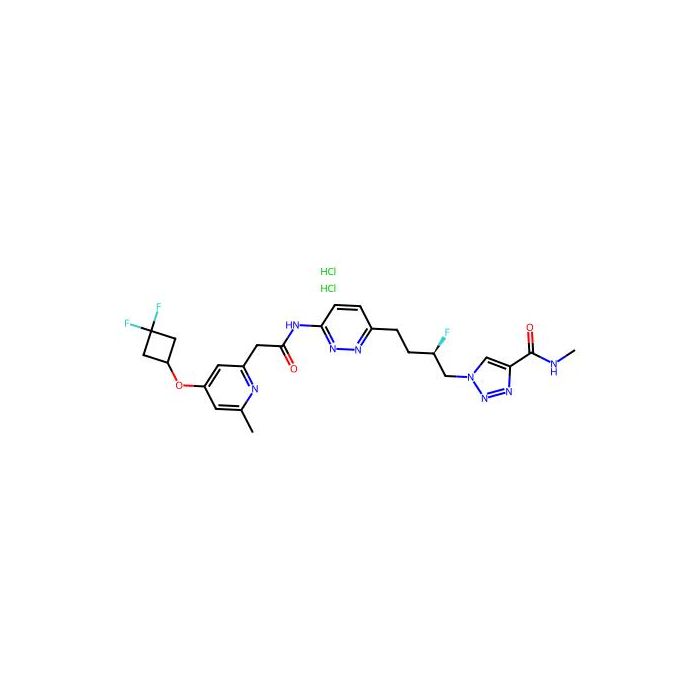
IPN-60090 dihydrochloride is an orally active and highly selective inhibitor of glutaminase 1 ( GLS1 ; IC 50 =31 nM), with no activity observed against GLS-2. IPN-60090 dihydrochloride exhibits excellent physicochemical and pharmacokinetic properties in vivo . IPN-60090 dihydrochloride can be used for solid tumors research, such as lung and ovarian cancers
In Vitro
There are two known isoforms of glutaminase: GLS-1 (also called kidney-type or KGA), and GLS-2 (also called liver-type or LGA). GLS-1 is ubiquitous and GLS-2 expression appears limited primarily to the liver. In a dual-coupled enzyme assay, IPN60090 dihydrochloride inhibits purified recombinant human GLS-1 (GAC isoform) with an IC 50 of 31 nM, and has no activity against GLS-2, with an IC 50 of >50000 nM. IPN60090 dihydrochloride inhibits the proliferation of A549 cells with an IC 50 of 26 nM. MCE has not independently confirmed the accuracy of these methods. They are for reference only.
In Vivo
IPN60090 dihydrochloride (3 mg/kg for i.v.; 10 mg/kg for p.o.) has excellent pharmacokinetic properties, with CL=4.1 mL/min/kg, t 1/2 =1 hour, C max =19 μM, F%=89%. IPN-60090 dihydrochloride (oral administration; 100 mg/kg; twice daily; 30 days) shows similar efficacy and target engagement to CB-839 dosed orally at 250 mg/kg twice daily. And the 100 mg/kg BID dose of IPN-60090 is a tolerated dose for the following model study. IPN-60090 dihydrochloride (oral administration; 100 mg/kg; twice daily; 30 days; monotherapy or in combination with TAK228 ) causes tumor growth inhibition. IPN-60090 alone demonstrates robust in vivo target engagement in a dose-dependent manner. The glutamate/glutamine ratios and the free plasma concentrations of IPN-60090 at 4 hours post-dose on both day 4 and day 28 are all decreased. Furthermore, IPN-60090 dihydrochloride in combination with TAK228 strongly causes an 85% tumor growth inhibition, IPN-60090 alone causes a 28% tumor growth inhibition in vivo. MCE has not independently confirmed the accuracy of these methods. They are for reference only. Animal Model: Female CD-1 miceDosage: 3 mg/kg for i.v.; 10 mg/kg for p.o. (Pharmacokinetic Analysis) Administration: Intravenous injection and oral administration Result: CL (4.1 mL/min/kg), t 1/2 (1 hour) for i.v.; C max (19 μM), F% (89%) for p.o.. Animal Model: Ru337 non-small cell lung cancer patient-derived xenograft (PDX) subcutaneous mouse model as monotherapy or in combinationDosage: 100 mg/kg Administration: Oral administration; 100 mg/kg; twice daily; 30 days; monotherapy or in combination with TAK228 Result: Exhibited an improvement in the combination regimen group over either single agent.
Form:Solid
IC50& Target:IC50: 31 nM (GLS1)
Specifications
Specifiche e purezza
≥99%
Meccanismi biochimici e fisiologici
IPN-60090 dihydrochloride is an orally active and highly selective inhibitor of glutaminase 1 ( GLS1 ; IC 50 =31 nM), with no activity observed against GLS-2. IPN-60090 dihydrochloride exhibits excellent physicochemical and pharmacokinetic properties in v
Condizioni di conservazione di stoccaggio
Store at 2-8°C,Protected from light,Desiccated
Spedito in
Wet ice
Questo prodotto richiede spedizione a catena fredda. I servizi di terra e altri servizi economici non sono disponibili.
Tipo di azione
INHIBITOR
Purezza
≥99%
Nomi e identificatori
Peso molecolare
605.44
Documentazione
📋 Safety Data Sheet (SDS)
Comprehensive hazard, handling, storage, and regulatory compliance document.
Determine the necessary mass, volume, or concentration for preparing a solution.
Dilution Calculator
Determine the dilution needed to prepare a stock solution.
Reconstitution Calculator
Recensioni
Recensioni dei clienti
Domande frequenti
What is the purity of this product?
This product is supplied at ≥99% purity (chemical assay). Lot-specific values are stated on the Certificate of Analysis.
How should this product be stored?
Store at 2–8 °C, protected from light, desiccated. Keep the container tightly closed with desiccant — the material is moisture-sensitive.
How is this product shipped?
This product ships chilled on wet ice. Unpack on arrival and transfer it to the storage condition stated above.
What are the CAS number, molecular formula and molecular weight?
The CAS Number is 2102101-72-2, the molecular formula is C24H29Cl2F3N8O3, and the molecular weight is 605.44 g/mol.
What documentation is provided?
Available product documentation, including Certificates of Analysis (COA), Safety Data Sheets (SDS), and specification sheets, is shown in the product document area. Document availability and access follow the current site policy.
We use cookies to ensure the website functions properly and, where permitted, to improve your experience. You can manage your preferences at any time in Settings. Learn more in our Cookie Policy.
Shall we send you a message when we have discounts available?
Remind me later
Thank you! Please check your email inbox to confirm.
Products are supplied to verified businesses, institutions, and qualified professionals for research and development use only. Not for use in humans, animals, diagnosis, or therapy.