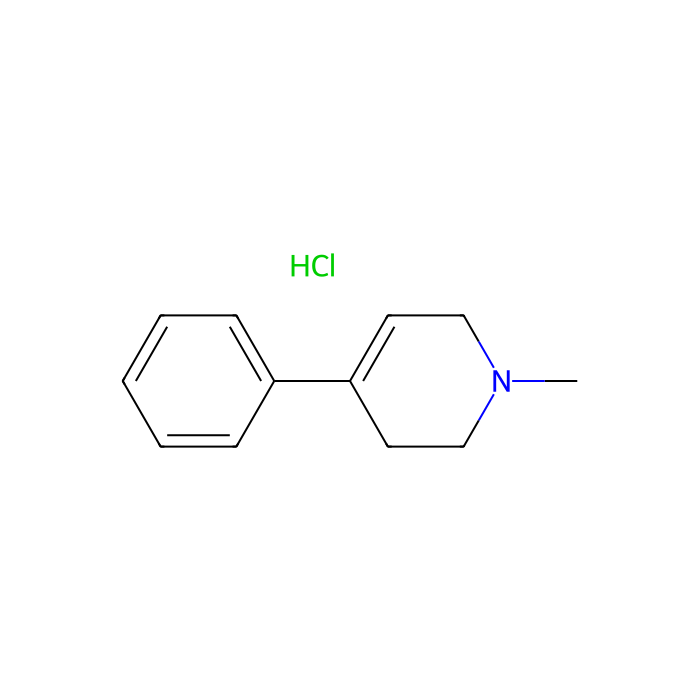
MPTP hydrochloride - 10mM in DMSO , CAS No.23007-85-4

CAS: 23007-85-4 Cat. No.: M408440 Molecular Weight: 209.715 Beilstein Registry Number: 3707310 EC Number: 622-416-7
AVAILABLE TO ORDER
GRADE & PURITY 10mM in DMSO
Storage
Store at -80°C
Shipped In
Dry ice packs + Cold packs
 ·  off list, applied to all prices below.
Size
Status
Price
Qty
1ml
M408440-1ml
1
$29.90
Enter a quantity for the sizes you want to add.
🧪

Why this grade

10mM in DMSO for sensitive chromatographic and analytical workflows requiring minimal baseline interference.

🌡

Storage & shipping

Store at -80°C Ships Dry ice packs + Cold packs Check lot-specific COA for exact specifications.

📋

Quality documents

SDS, COA, datasheet, and spec sheet available for download. Lot-specific COA accessible via lot number lookup.

📚

Literature proof

Cited in 10 peer-reviewed publications across chromatography, organic synthesis, and cross-coupling reactions.

Overview

Information

MPTP hydrochloride is a dopaminergicneurotoxinand cause selective destruction of dopaminergic neurons in animal models of parkinsonism. MPTP hydrochloride inducesapoptosis.
In vitro

The morphology of N2AB-1 and glioma cells was unaltered when these cells were exposed to all doses of MPTP. And, C6 glioma cell proliferation was also unaffected by MPTP treatment[3]. MPTP Promotes Apoptosis and Tau Phosphorylation in Human Neuroblastoma M17 Cells. MPTP significantly promotes Tau phosphorylation at Ser262 in human neuroblastoma M17 cells. MPTP caused a dose-dependent increase in the intracellular α-synuclein level in our M17 human neuroblastoma cells. MPTP appears to promote Tau phosphorylation in the brain by activating both PKA and GSK3β[4].\n

In vivo

The number of tyrosine hydroxylase-positive neurons was decreased in the substantia nigra pars compacta of MPTP-treated mice. MPTP decreased thioredoxin reductase 1 expression and thioredoxin reductase activity in the mouse midbrain, reduced the number of thioredoxin reductase 1-positive cells in the substantia nigra pars compacta of mice. Administration of the toxin MPTP can cause neurochemical, behavioral and histopathological alterations in human and nonhuman primates that are similar to those observed in Parkinsonian patients. Compared with primates, rodents are insensitive to MPTP. MPTP can be administered by various routes, such as gavage and stereotactic injection, but the most common and reproducible route is systemic administration, including subcutaneous, intravenous, intraperitoneal and intramuscular injection. MPTP is a lipophilic protoxin that can rapidly cross the blood-brain barrier following systemic injection. Once it enters the brain, MPTP is converted to 1-methyl-4-phenylpyridine by monoamine oxidase B[1]. MPTP has been shown to be toxic to dopaminergic neurons of the nigrostriatal system in humans, monkeys, and mice and to produce long-lasting depletion of DA and its metabolites in the striatum[2].
Cell Data

cell lines:

Concentrations:', 'Concentrations': '

47.7, 4.77 and 0.477 μM

Incubation Time:

Powder Purity:

Specifications

Specifications & Purity
10mM in DMSO
Biochemical and Physiological Mechanisms
1-Methyl-4-phenyl-1, 2, 3, 6-tetrahydropyridine (MPTP) is a piperidine derivative and dopaminergic neurotoxin, useful in neurological research. MPTP is metabolized to 1-methyl-4-phenylpyridine (MPP+), which in turn can cause free radical production in vivo a
Storage
Store at -80°C
Shipped In
Dry ice packs + Cold packs
This product requires cold chain shipping. Ground and other economy services are not available.
Names and Identifiers
Isomeric SMILES CN1CCC(=CC1)C2=CC=CC=C2.Cl
WGK Germany 3
RTECS UT8358950
Molecular Weight 209.715
Beilstein 3707310
Reaxy-Rn 3707312
Reaxys-RN_link_address https://www.reaxys.com/reaxys/secured/hopinto.do?context=S&query=IDE.XRN=3707312&ln=

Documentation

📋 Safety Data Sheet (SDS)

Comprehensive hazard, handling, storage, and regulatory compliance document.

Download SDS →

✅ Certificate of Analysis (COA)

Lot-specific quality data. Enter your lot number to retrieve the exact COA.

Look up COA →

📊 Datasheet

Quick-reference summary of product specifications and applications.

View datasheet →

🔬 Specification Sheet

Full quality attributes and acceptance criteria for this grade.

View spec sheet →

Advanced Data

Certificates(CoA,COO,BSE/TSE and Analysis Chart)
C of A & Other Certificates(BSE/TSE, COO):
Analytical Chart:
Chemical and Physical Properties
Melt Point(°C)249.0 - 254.0 °C
Documents & Articles
Citations of This Product
References
1. Chao Guo, Junrong Zhu, Jingwen Wang, Jialin Duan, Shanbo Ma, Ying Yin, Wei Quan, Wei Zhang, Yue Guan, Yi Ding, Aidong Wen, Yingdong Zhang.  (2019)  Neuroprotective effects of protocatechuic aldehyde through PLK2/p-GSK3β/Nrf2 signaling pathway in both in vivo and in vitro models of Parkinson's disease.  Aging-US,      [PMID:31697645] [10.18632/aging.102394]
2. Shuang Li, Jiaxin Liu, Ge Li, Xueyan Zhang, Fei Xu, Zhijiang Fu, Lesheng Teng, Youxin Li, Fengying Sun.  (2019)  Near-infrared light-responsive, pramipexole-loaded biodegradable PLGA microspheres for therapeutic use in Parkinson's disease.  EUROPEAN JOURNAL OF PHARMACEUTICS AND BIOPHARMACEUTICS,      [PMID:31100429] [10.1016/j.ejpb.2019.05.013]
3. Ziliang He, Yeye Hu, Ying Zhang, Jing Xie, Zhiqiang Niu, Guigui Yang, Ji Zhang, Zixuan Zhao, Shuai Wei, Haifeng Wu, Weicheng Hu.  (2024)  Asiaticoside exerts neuroprotection through targeting NLRP3 inflammasome activation.  PHYTOMEDICINE,      [PMID:38471370] [10.1016/j.phymed.2024.155494]
4. Xiaomei Wu, Renxiang Yuan, Yichong Xu, Kai Wang, Hong Yuan, Tingting Meng, Fuqiang Hu.  (2024)  Functionalized lipid nanoparticles modulate the blood-brain barrier and eliminate α-synuclein to repair dopamine neurons.  Asian Journal of Pharmaceutical Sciences,      [PMID:38601010] [10.1016/j.ajps.2024.100904]
5. Guo Qinglong, Wang Yi, Yu Liangchen, Guan Liao, Ji Xuefei, Li Xiaohui, Pang Gang, Ren Zhenhua, Ye Lei, Cheng Hongwei.  (2024)  Nicotine restores olfactory function by activation of prok2R/Akt/FoxO3a axis in Parkinson’s disease.  Journal of Translational Medicine,  22  (1): (1-21).  [PMID:38609979] [10.1186/s12967-024-05171-1]
6. Ao Sun, Yu-fei Li, Yang Miao, Hong-xia Wang, Lin-lin Zhang.  (2024)  Research on the mechanism of Ursolic acid for treating Parkinson's disease by network pharmacology and experimental verification.  Heliyon,      [PMID:39108896] [10.1016/j.heliyon.2024.e34113]
7. Yi Wang, Xuemei Liao, Qinglong Guo, Heng Zhang, Lei Ye, Liangchen Yu, Xiaoming Kong, Yicheng Jiang, Peng Zhao, Kaiyong Cai, Hongwei Cheng.  (2025)  Dual-pathway targeted therapy for Parkinson's disease: Biomimetic nanosomes inhibit ferroptosis and pyroptosis through NLRP3 inflammasome regulation.  Bioactive Materials,      [PMID:40678266] [10.1016/j.bioactmat.2025.06.033]
8. Hua Jiang, Xiaotian Zhang, Shengyu Feng, Wei Feng.  (2025)  Integrated Single-Cell and Spatial Transcriptomic Analysis Identifies ISR-Related Genes Driving Immune Regulation in Parkinson’s Disease.  Journal of Inflammation Research,      [PMID:40687147] [10.2147/JIR.S521744]
9. Limeng Zhu, Yuyu Wu, Yingjie Chen, Xiyi Chen, Xingjie Zan, Yanlong Liu, Wujun Geng.  (2026)  Microenvironment Self-Adaptive Nanoarmor to Address Adhesion- and Colonization-Related Obstacles in Impaired Intestine Promote Bacteriotherapy Against Parkinson's Disease.  Advanced Science,      [PMID:41532497] [10.1002/advs.202510628]
10. Wenyu Xie, Ke Wu, Lin Zhang, Xiyu Feng, Shangshen Yang, Siyu Jia, Yutong Li, Xiaoming Wang.  (2026)  The H2S donor sulforaphane inhibits NLRP3 inflammasome activation by inducing mitochondrial autophagy and mitigating CBS-H2S axis damage in in-vitro and in-vivo models of Parkinson's disease.  BIOORGANIC CHEMISTRY,      [PMID:] [10.1016/j.bioorg.2026.109708]
Solution Calculators
Reviews

Customer Reviews

Shall we send you a message when we have discounts available?

Remind me later

Thank you! Please check your email inbox to confirm.

Oops! Notifications are disabled.