GRADE & PURITYAnimal Free?Animal-free — produced without animal-derived components to reduce contamination risk. Use in biomanufacturing and culture avoiding animal-origin material.Carrier Free?Carrier-free — supplied without added carrier protein/stabilizer. Use when carriers (e.g. BSA) would interfere with conjugation or sensitive assays.Bioactive?Bioactive grade — verified to retain biological activity in functional assays. Use when the molecule must be functionally active, not just pure.ActiBioPure™?ActiBioPure™ — Aladdin's premier line for bioactive and recombinant products. Use when both high purity and preserved biological activity are required.His Tag?His tag grade — recombinant protein bearing a His tag for affinity purification/detection. Use to purify, immobilize, or detect the tagged protein.≥95%(SDS-PAGE)
Expression System
HEK293
Accession #
P35546
Protein Tag
C-His
Expression system
HEK293
Endotoxin Concentration
<0.1 EU/μg
Bioactivity
Measured by its binding ability in a functional ELISA. Serial dilution of immobilized rmRet (100 µL/well) was tested for binding with the GDNF-GFR alpha -1 complex using 4 ng/mL rhGDNF and 1 µg/mL rrGFR alpha -1/Fc Chimera. The concentration of immobilized Ret that produces 50% of the optimal binding response is found to be approximately 2-5 µg/mL.
Animal Free,Carrier Free,Bioactive,ActiBioPure™,His-Tag,≥95%(SDS-PAGE) ActiBioPure™,Animal Free,Bioactive,Carrier Free,His Tag for sensitive chromatographic and analytical workflows requiring minimal baseline interference.
🌡
Storage & shipping
Store at -20°C,Avoid repeated freezing and thawing Ships Ice chest + Ice pads Check lot-specific COA for exact specifications.
📋
Quality documents
SDS, COA, datasheet, and spec sheet available for download. Lot-specific COA accessible via lot number lookup.
📚
Literature proof
Cited in 0 peer-reviewed publications across chromatography, organic synthesis, and cross-coupling reactions.
Overview
Function Receptor tyrosine-protein kinase involved in numerous cellular mechanisms including cell proliferation, neuronal navigation, cell migration, and cell differentiation in response to glia cell line-derived growth family factors (GDNF, NRTN, ARTN, PSPN and GDF15). In contrast to most receptor tyrosine kinases, RET requires not only its cognate ligands but also coreceptors, for activation. GDNF ligands (GDNF, NRTN, ARTN, PSPN and GDF15) first bind their corresponding GDNFR coreceptors (GFRA1, GFRA2, GFRA3, GFRA4 and GFRAL, respectively), triggering RET autophosphorylation and activation, leading to activation of downstream signaling pathways, including the MAPK- and AKT-signaling pathways. Acts as a dependence receptor via the GDNF-GFRA1 signaling: in the presence of the ligand GDNF in somatotrophs within pituitary, promotes survival and down regulates growth hormone (GH) production, but triggers apoptosis in absence of GDNF. Required for the molecular mechanisms orchestration during intestine organogenesis via the ARTN-GFRA3 signaling: involved in the development of enteric nervous system and renal organogenesis during embryonic life, and promotes the formation of Peyer's patch-like structures, a major component of the gut-associated lymphoid tissue. Mediates, through interaction with GDF15-receptor GFRAL, GDF15-induced cell-signaling in the brainstem which triggers an aversive response, characterized by nausea, vomiting, and/or loss of appetite in response to various stresses. Modulates cell adhesion via its cleavage by caspase in sympathetic neurons and mediates cell migration in an integrin (e.g. ITGB1 and ITGB3)-dependent manner. Also active in the absence of ligand, triggering apoptosis through a mechanism that requires receptor intracellular caspase cleavage. Triggers the differentiation of rapidly adapting (RA) mechanoreceptors. Involved in the development of the neural crest. Regulates nociceptor survival and size. Phosphorylates PTK2/FAK1.
Specifications
Product Name
Recombinant Mouse Ret Protein
Synonyms
Proto-oncogene Tyrosine-protein Kinase Receptor Ret | CDHF12MTC1 | CDHR16 | EC 2.7.10 | Hirschsprung disease 1 | Hirschsprung disease) | MEN2A | MEN2B | multiple endocrine neoplasia and medullary thyroid carcinoma 1 | ret proto-oncogene | RET transforming
Grade
ActiBioPure™, Animal Free, Bioactive, Carrier Free, His Tag
Measured by its binding ability in a functional ELISA. Serial dilution of immobilized rmRet (100 µL/well) was tested for binding with the GDNF-GFR alpha -1 complex using 4 ng/mL rhGDNF and 1 µg/mL rrGFR alpha -1/Fc Chimera. The concentration of immobilized Ret that produces 50% of the optimal binding response is found to be approximately 2-5 µg/mL.
Reconstitute in sterile water to a concentration of 0.1-0.5 mg/ml.
Storage
Store at -20°C,Avoid repeated freezing and thawing
Shipped In
Ice chest + Ice pads
Stability And Storage
Store at -20~-80℃ for more than 1 year. Upon delivery aliquot. Avoid freeze/thaw cycle.
Images
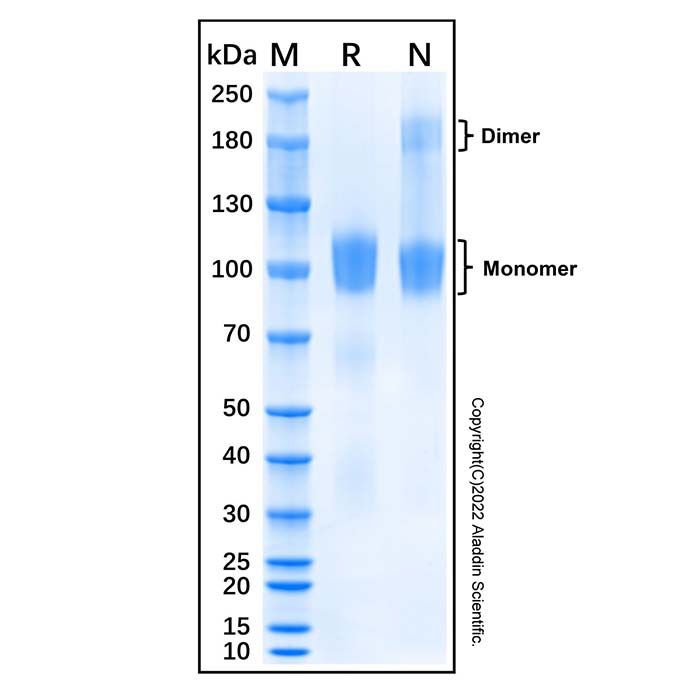
Recombinant Mouse Ret Protein (rp168533) - SDS-PAGE 2 μg/lane of Recombinant Mouse Ret Protein was resolved with SDS-PAGE under reducing (R) and non-reducing (N) conditions and visualized by Coomassie® Blue staining, showing the band at 90 - 110 kDa under reducing conditions and 90 - 110 & 180 - 220 kDa under non-reducing conditions.
Documentation
📋 Safety Data Sheet (SDS)
Comprehensive hazard, handling, storage, and regulatory compliance document.
We use cookies to ensure the website functions properly and, where permitted, to improve your experience. You can manage your preferences at any time in Settings. Learn more in our Cookie Policy.
Shall we send you a message when we have discounts available?
Remind me later
Thank you! Please check your email inbox to confirm.
Products are supplied to verified businesses, institutions, and qualified professionals for research and development use only. Not for use in humans, animals, diagnosis, or therapy.

 ZJ25F0927489