Determine the necessary mass, volume, or concentration for preparing a solution.
| Activity Type | Activity Value -log(M) | Mechanism of Action | Activity Reference | Publications (PubMed IDs) |
|---|

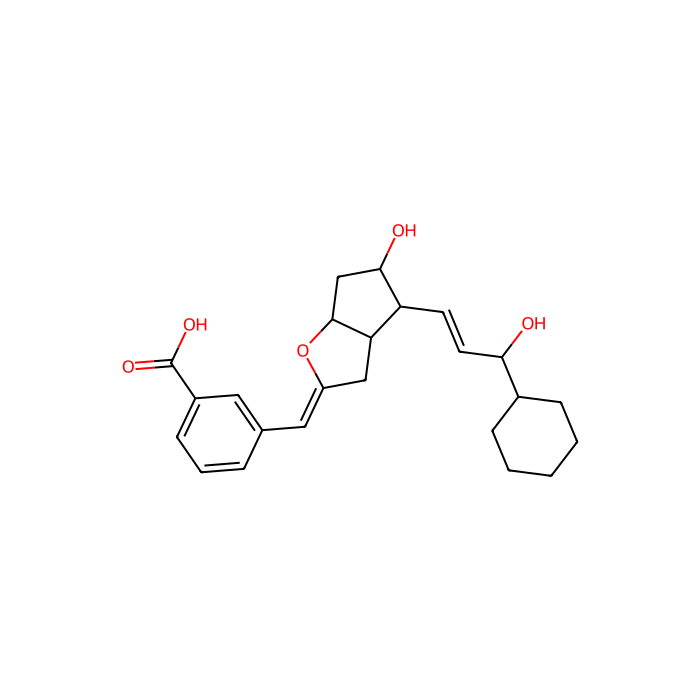
Taprostene is a highly selective agonist to the IP|1|prostanoid receptor. It is a stable prostacyclin (PGI|2|) analog.
Taxonomy Tree
| Kingdom | Organic compounds |
|---|---|
| Superclass | Benzenoids |
| Classe | Benzene and substituted derivatives |
| Subclass | Benzoic acids and derivatives |
| Intermediate Tree Nodes | Not available |
| Direct Parent | Benzoic acids |
| Alternative Parents | Benzoyl derivatives Tetrahydrofurans Secondary alcohols Cyclic alcohols and derivatives Oxacyclic compounds Monocarboxylic acids and derivatives Carboxylic acids Organic oxides Hydrocarbon derivatives |
| Molecular Framework | Aromatic heteropolycyclic compounds |
| Substituents | Benzoic acid - Benzoyl - Cyclic alcohol - Tetrahydrofuran - Secondary alcohol - Carboxylic acid derivative - Carboxylic acid - Monocarboxylic acid or derivatives - Oxacycle - Organoheterocyclic compound - Hydrocarbon derivative - Organic oxygen compound - Organooxygen compound - Organic oxide - Alcohol - Aromatic heteropolycyclic compound |
| Descrizione | This compound belongs to the class of organic compounds known as benzoic acids. These are organic Compounds containing a benzene ring which bears at least one carboxyl group. |
| External Descriptors | Not available |
| Activity Type | Activity Value -log(M) | Mechanism of Action | Activity Reference | Publications (PubMed IDs) |
|---|
| Solubilità | Soluble in Water: 26 mg/mL |
|---|---|
| Peso molecolare | 398.500 g/mol |
| XLogP3 | 4.000 |
| Hydrogen Bond Donor Count | 3 |
| Hydrogen Bond Acceptor Count | 5 |
| Rotatable Bond Count | 5 |
| Exact Mass | 398.209 Da |
| Monoisotopic Mass | 398.209 Da |
| Topological Polar Surface Area | 87.000 Ų |
| Heavy Atom Count | 29 |
| Formal Charge | 0 |
| Complexity | 635.000 |
| Isotope Atom Count | 0 |
| Defined Atom Stereocenter Count | 5 |
| Undefined Atom Stereocenter Count | 0 |
| Defined Bond Stereocenter Count | 2 |
| Undefined Bond Stereocenter Count | 0 |
| The total count of all stereochemical bonds | 2 |
| Covalently-Bonded Unit Count | 1 |
No tested applications, recommended dilutions, or protocol specifics are provided in the Product Data for this item.
General protocol framework for small-molecule ligands (non-specification)
Always adapt to your specific assay and consult the SDS/CoA for restrictions.
Item-specific biological targets or mechanisms are not provided in the Product Data. This product is supplied for research use only.
General background (literature-based, non-specification)
Good practices for biological experiments
Note: No clinical or therapeutic claims are made for this product; it is intended solely for laboratory research.
This product is a small-molecule ligand and is not a buffering agent. Conventional buffer system guidance (e.g., phosphate, HEPES, Tris) is not directly applicable.
Practical handling notes
As a research ligand listed in a compound library, Taprostene itself does not have a direct “green alternative.” However, greener choices can be made in solvent and handling.
Greener solvent choices (general guidance)
Comparison (general, non-specification)
Operational green practices
No pharmacopeial status, excipient role, or formulation designation is provided for this item. It is supplied strictly for research use only.
General formulation considerations for research materials (non-specification)
No therapeutic claims are made for this product, and it is not intended for any clinical or diagnostic use.
Literature/general notes (non-specification)
What Moligand™ implies (general guidance)
Item-specific details
Recommendations to users
Manufacturer-provided application notes are not specified for this item. The product is listed within a small-molecule/compound library category and is intended for research use only.
General research applications for small-molecule ligands (non-specification)
If using in chemical synthesis
Always confirm application scope and limits from the CoA/SDS and perform pilot experiments to establish working concentrations and stability under your conditions.
No item-specific reaction conditions or transformation guidance are provided for this product, which is listed as a small-molecule research ligand.
If performing chemical modifications (general, non-specification)
All conditions must be optimized empirically once the molecule’s functional groups are confirmed from the CoA and analytical data.
General laboratory precautions (non-SDS guidance)
First-aid overview (consult SDS for authoritative guidance)
Waste and spill response
Item-specific solubility data are not provided for this product; consult the CoA/SDS before preparing solutions.
General solvent guidance for lipophilic small-molecule ligands (literature-based, non-specification)
Comparison notes (general)
Practical tips
General reconstitution guidance (non-specification)
Stability testing
For authoritative instructions on reconstitution and long-term storage, consult the batch-specific CoA/SDS.
Structural features
Identity verification best practices
This product is offered as a research ligand rather than as a synthetic building block; item-specific functional group information and reactivity are not provided.
General guidance if derivatization is contemplated (non-specification)
Note: Without item-specific specifications, all synthetic manipulations should be piloted on sub-milligram scale to assess stability and purity outcomes.
Target, pathway, or receptor specificity is not provided in the Product Data for this item.
User guidance
For any definitive claims of target specificity, rely on primary literature data and the batch CoA; no such claims are made here.
La nostra guida alla selezione delle qualità copre purezza, stato dello stabilizzatore e idoneità all'applicazione per tutte le varianti del nostro catalogo.
Visualizza la guida alle qualità Moligand™ →