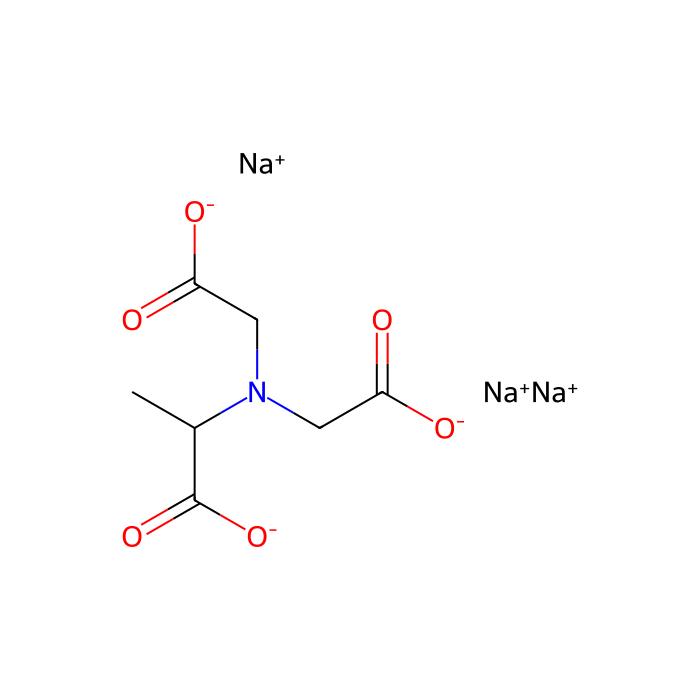
Trisodium N-(1-Carboxylatoethyl)iminodiacetate Hydrate - ≥75% , CAS No.164462-16-2

CAS: 164462-16-2 Cat. No.: T414578 Molecular Weight: 271.11 EC Number: 605-362-9 PubChem CID: 11021984
AVAILABLE TO ORDER
GRADE & PURITY ≥75%
Synonyms
784K2O81WY | Alanine, N,N-bis(carboxymethyl)-, sodium salt (1:3) | Sodium2,2'-((1-carboxylatoethyl)azanediyl)diacetate | MGDA | UNII-784K2O81WY | T2202 | TrisodiuM N-(1-Carboxylatoethyl)iMinodiacetate Hydrate | DL-Alanine-N,N-diacetic acid trisodium salt
Storage
Room temperature
Shipped In
Normal
 ·  off list, applied to all prices below.
Size
Status
Price
Qty
5g
T414578-5g
6
$10.90
25g
T414578-25g
3
$26.90
100g
T414578-100g
6
$79.90
500g
T414578-500g
2
$264.90
Enter a quantity for the sizes you want to add.
🧪

Why this grade

≥75% for sensitive chromatographic and analytical workflows requiring minimal baseline interference.

🌡

Storage & shipping

Room temperature Ships Normal Check lot-specific COA for exact specifications.

📋

Quality documents

SDS, COA, datasheet, and spec sheet available for download. Lot-specific COA accessible via lot number lookup.

📚

Literature proof

Cited in 1 peer-reviewed publications across chromatography, organic synthesis, and cross-coupling reactions.

Specifications

Synonyms
784K2O81WY | Alanine, N, N-bis(carboxymethyl)-, sodium salt (1:3) | Sodium2, 2'-((1-carboxylatoethyl)azanediyl)diacetate | MGDA | UNII-784K2O81WY | T2202 | TrisodiuM N-(1-Carboxylatoethyl)iMinodiacetate Hydrate | DL-Alanine-N, N-diacetic acid trisodium salt
Specifications & Purity
≥75%
Storage
Room temperature
Shipped In
Normal
Purity
≥75%
Names and Identifiers
Pubchem Sid504765899
Pubchem Sid Urlhttps://pubchem.ncbi.nlm.nih.gov/substance/504765899
Canonical SmilesCC(C(=O)[O-])N(CC(=O)[O-])CC(=O)[O-].[Na+].[Na+].[Na+]
IUPAC Nametrisodium;2-[bis(carboxylatomethyl)amino]propanoate
InChIKeyOHOTVSOGTVKXEL-UHFFFAOYSA-K
INCHI1S/C7H11NO6.3Na/c1-4(7(13)14)8(2-5(9)10)3-6(11)12;;;/h4H,2-3H2,1H3,(H,9,10)(H,11,12)(H,13,14);;;/q;3*+1/p-3
Isomeric SMILES CC(C(=O)[O-])N(CC(=O)[O-])CC(=O)[O-].[Na+].[Na+].[Na+]
PubChem CID 11021984
Molecular Weight 271.11
Reaxy-Rn 15031757

Documentation

📋 Safety Data Sheet (SDS)

Comprehensive hazard, handling, storage, and regulatory compliance document.

Download SDS →

✅ Certificate of Analysis (COA)

Lot-specific quality data. Enter your lot number to retrieve the exact COA.

Look up COA →

📊 Datasheet

Quick-reference summary of product specifications and applications.

View datasheet →

🔬 Specification Sheet

Full quality attributes and acceptance criteria for this grade.

View spec sheet →

Advanced Data

Taxonomic Classification

Taxonomy Tree

KingdomOrganic compounds
SuperclassOrganic acids and derivatives
ClassCarboxylic acids and derivatives
SubclassAmino acids, peptides, and analogues
Intermediate Tree Nodes Amino acids and derivatives - Alpha amino acids and derivatives
Direct ParentAlanine and derivatives
Alternative Parents Alpha amino acids  Tricarboxylic acids and derivatives  Trialkylamines  Carboxylic acid salts  Amino acids  Carboxylic acids  Organic zwitterions  Organic sodium salts  Organic oxides  Hydrocarbon derivatives  Carbonyl compounds  
Molecular FrameworkAliphatic acyclic compounds
Substituents Alanine or derivatives - Alpha-amino acid - Tricarboxylic acid or derivatives - Carboxylic acid salt - Tertiary amine - Amino acid - Tertiary aliphatic amine - Carboxylic acid - Organic alkali metal salt - Organic zwitterion - Organic nitrogen compound - Hydrocarbon derivative - Organic oxide - Organooxygen compound - Organonitrogen compound - Organic oxygen compound - Carbonyl group - Amine - Organic salt - Organic sodium salt - Aliphatic acyclic compound
DescriptionThis compound belongs to the class of organic compounds known as alanine and derivatives. These are compounds containing alanine or a derivative thereof resulting from reaction of alanine at the amino group or the carboxy group, or from the replacement of any hydrogen of glycine by a heteroatom.
External Descriptors Not available
3D Structure
Interactive Chemical Structure Model


Certificates(CoA,COO,BSE/TSE and Analysis Chart)
C of A & Other Certificates(BSE/TSE, COO):
Analytical Chart:

Find and download the COA for your product by matching the lot number on the packaging.

5 results found

Lot NumberCertificate TypeDateItem
E2204257Certificate of AnalysisFeb 04, 2026 T414578
E2204258Certificate of AnalysisFeb 04, 2026 T414578
E2204259Certificate of AnalysisFeb 04, 2026 T414578
E2204263Certificate of AnalysisFeb 04, 2026 T414578
E2204266Certificate of AnalysisFeb 04, 2026 T414578
Chemical and Physical Properties
SolubilitySoluble in water
Molecular Weight271.110 g/mol
XLogP3
Hydrogen Bond Donor Count0
Hydrogen Bond Acceptor Count7
Rotatable Bond Count3
Exact Mass271.004 Da
Monoisotopic Mass271.004 Da
Topological Polar Surface Area124.000 Ų
Heavy Atom Count17
Formal Charge0
Complexity218.000
Isotope Atom Count0
Defined Atom Stereocenter Count0
Undefined Atom Stereocenter Count1
Defined Bond Stereocenter Count0
Undefined Bond Stereocenter Count0
The total count of all stereochemical bonds0
Covalently-Bonded Unit Count4
Documents & Articles
Why Is EDTA So Widely Used?
Why LABSA (Sulfonic Acid) Is Commonly Used in Household Cleaning Formulations: Neutralization Mechanism, Detergency Action, and Formulation Application Points
From Structure to Performance: Conditioning, Film-Forming, Thickening, and Chelating Applications of Functional Ingredients in Personal Care and Home Care
Application of Fatty Acid Methyl Ester Sulfonate (MES) in Household Detergent and Cleaning Formulations: Detergency, Hard-Water Tolerance, and Selection Criteria
Differences, Mechanisms of Action, and Selection of Sodium Metasilicate and Sodium Tripolyphosphate in Detergent and Cleaning Formulations
The Role, Selection, and Validation of Chelating Agents in Daily Chemical Formulations
Why Daily Chemical Formulations Need Alkaline Ingredients: From pH Adjustment and Saponification to Detergency Boosting and Selection Logic
Xiao Fang Bai, Da Fang Bai, PnB and DPnB: Mechanisms and Selection of Butyl Glycol Ethers in Hard-Surface Cleaning Formulations
Degreasing Agents from a Molecular-Structure Perspective: How AEO, APG, and Related Surfactants Can Replace Nonylphenol Ethoxylates (NPE)
How Can Sodium Tripolyphosphate (STPP) Be Replaced? From Detergency Mechanisms to Formulation Choices for Low-Phosphorus/Phosphorus-Free Builder Systems
More Than a pH Adjuster: Mechanisms, Selection Logic, and Alternative Acid Source Analysis of Citric Acid in Home-Care Cleaning
From Structure to Selection: Mechanisms and Application Assessment of Low-Foam Oil and Wax Removal with Fatty Acid Methyl Ester Ethoxylates (FMEE)
Sodium Metasilicate in Cleaning Applications: Hydration-Form Differences, Mechanisms of Action, and Selection Logic
Citations of This Product
References
1. Yang Wan, Pan Tengfei, Yang Guang, Zhu Jianbing, Ran Xueqin, Ren Biyun, Zuo Mengnan, Chao Lingfeng, Xia Yingdong, Chen Yonghua.  (2025)  Tailoring interface-anchoring molecules for efficient and stable perovskite solar cells.  Nature Communications,      [PMID:41381432] [10.1038/s41467-025-66225-6]
Solution Calculators
Reviews

Customer Reviews

Shall we send you a message when we have discounts available?

Remind me later

Thank you! Please check your email inbox to confirm.

Oops! Notifications are disabled.