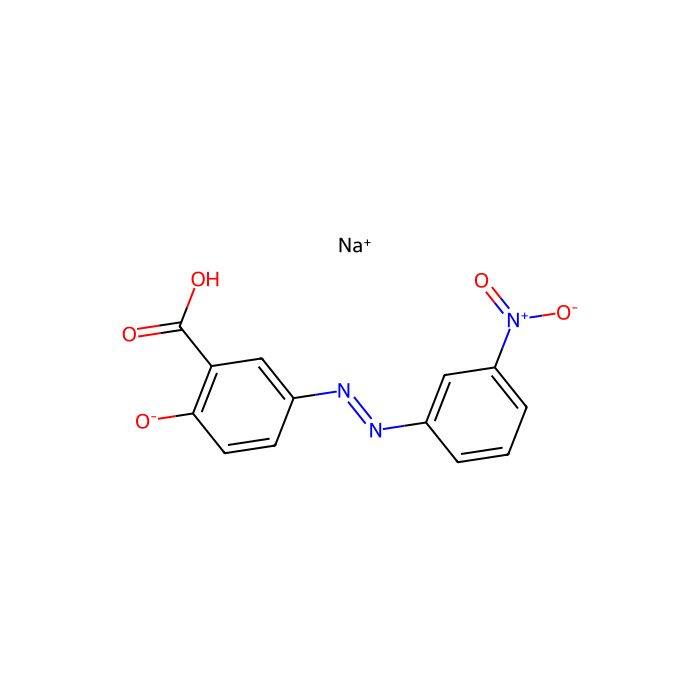
Alizarin yellow GG indicator - 0.1% , CAS No.584-42-9

CAS: 584-42-9 Cat. No.: A299263 Molecular Weight: 309.21 EC Number: 209-536-1 PubChem CID: 135442953
AVAILABLE TO ORDER
GRADE & PURITY 0.1%
Synonyms
A0123 | DTXSID8060402 | MFCD00044746 | AMY22366 | X-0950 | A0096 | Alizarine Yellow AGP | Showa Chrome Yellow GG | Hispacrom Yellow 2GR | Pontachrome Yellow GS | Calcochrome Yellow 2G | Y1YL31LOKF | Alizarine Yellow 2G | RV 1 | Alizarine Yellow GG | Sodiu
Storage
Room temperature
Shipped In
Normal
 ·  off list, applied to all prices below.
Size
Status
Price
Qty
100ml
A299263-100ml
3

$21.90

$31.90
Save $10.00 (31.35%)
Enter a quantity for the sizes you want to add.
🧪

Why this grade

0.1% for sensitive chromatographic and analytical workflows requiring minimal baseline interference.

🌡

Storage & shipping

Room temperature Ships Normal Check lot-specific COA for exact specifications.

📋

Quality documents

SDS, COA, datasheet, and spec sheet available for download. Lot-specific COA accessible via lot number lookup.

📚

Literature proof

Cited in 3 peer-reviewed publications across chromatography, organic synthesis, and cross-coupling reactions.

Specifications

Synonyms
A0123 | DTXSID8060402 | MFCD00044746 | AMY22366 | X-0950 | A0096 | Alizarine Yellow AGP | Showa Chrome Yellow GG | Hispacrom Yellow 2GR | Pontachrome Yellow GS | Calcochrome Yellow 2G | Y1YL31LOKF | Alizarine Yellow 2G | RV 1 | Alizarine Yellow GG | Sodiu
Specifications & Purity
0.1%
Biochemical and Physiological Mechanisms
Acid-base indicator for nutrient media preparation. pH range 10.1 (yellow) to 12.0 (red).
Storage
Room temperature
Shipped In
Normal
Note
Wherever possible, you should prepare and use solutions on the same day. However, if you need to make up stock solutions in advance, we recommend that you store the solution as aliquots in tightly sealed vials at -20°C. Generally, these will be useable for up to one month. Before use, and prior to opening the vial we recommend that you allow your product to equilibrate to room temperature for at least 1 hour. Need more advice on solubility, usage and handling? Please visit our frequently asked questions (FAQ) page for more details.
Names and Identifiers
Canonical SmilesC1=CC(=CC(=C1)[N+](=O)[O-])N=NC2=CC(=C(C=C2)[O-])C(=O)O.[Na+]
IUPAC Namesodium;2-carboxy-4-[(3-nitrophenyl)diazenyl]phenolate
InChIKeyZHFPEICFUVWJIS-UHFFFAOYSA-M
INCHI1S/C13H9N3O5.Na/c17-12-5-4-9(7-11(12)13(18)19)15-14-8-2-1-3-10(6-8)16(20)21;/h1-7,17H,(H,18,19);/q;+1/p-1
Isomeric SMILES C1=CC(=CC(=C1)[N+](=O)[O-])N=NC2=CC(=C(C=C2)[O-])C(=O)O.[Na+]
PubChem CID 135442953
Molecular Weight 309.21

Documentation

📋 Safety Data Sheet (SDS)

Comprehensive hazard, handling, storage, and regulatory compliance document.

Download SDS →

✅ Certificate of Analysis (COA)

Lot-specific quality data. Enter your lot number to retrieve the exact COA.

Look up COA →

📊 Datasheet

Quick-reference summary of product specifications and applications.

View datasheet →

🔬 Specification Sheet

Full quality attributes and acceptance criteria for this grade.

View spec sheet →

Advanced Data

Taxonomic Classification

Taxonomy Tree

KingdomOrganic compounds
SuperclassOrganoheterocyclic compounds
ClassAzobenzenes
SubclassNot available
Intermediate Tree Nodes Not available
Direct ParentAzobenzenes
Alternative Parents Nitrobenzenes  Benzoic acids  Nitroaromatic compounds  Benzoyl derivatives  Phenoxides  Vinylogous acids  Azo compounds  Propargyl-type 1,3-dipolar organic compounds  Organic oxoazanium compounds  Carboxylic acids  Organooxygen compounds  Organic zwitterions  Organic sodium salts  Organic oxides  Hydrocarbon derivatives  
Molecular FrameworkAromatic homomonocyclic compounds
Substituents Azobenzene - Benzoic acid or derivatives - Benzoic acid - Nitrobenzene - Nitroaromatic compound - Benzoyl - Phenoxide - Monocyclic benzene moiety - Benzenoid - Vinylogous acid - Azo compound - Organic nitro compound - C-nitro compound - Allyl-type 1,3-dipolar organic compound - Carboxylic acid - Propargyl-type 1,3-dipolar organic compound - Organic 1,3-dipolar compound - Carboxylic acid derivative - Organic alkali metal salt - Organic oxoazanium - Organic nitrogen compound - Organonitrogen compound - Organooxygen compound - Organic zwitterion - Organic salt - Organic sodium salt - Hydrocarbon derivative - Organic oxide - Organic oxygen compound - Aromatic homomonocyclic compound
DescriptionThis compound belongs to the class of organic compounds known as azobenzenes. These are organonitrogen aromatic compounds that contain a central azo group, where each nitrogen atom is conjugated to a benzene ring.
External Descriptors Not available
3D Structure
Interactive Chemical Structure Model


Mechanisms of Action
Certificates(CoA,COO,BSE/TSE and Analysis Chart)
C of A & Other Certificates(BSE/TSE, COO):
Analytical Chart:
Chemical and Physical Properties
Molecular Weight309.210 g/mol
XLogP3
Hydrogen Bond Donor Count1
Hydrogen Bond Acceptor Count7
Rotatable Bond Count3
Exact Mass309.036 Da
Monoisotopic Mass309.036 Da
Topological Polar Surface Area131.000 Ų
Heavy Atom Count22
Formal Charge0
Complexity423.000
Isotope Atom Count0
Defined Atom Stereocenter Count0
Undefined Atom Stereocenter Count0
Defined Bond Stereocenter Count0
Undefined Bond Stereocenter Count0
The total count of all stereochemical bonds0
Covalently-Bonded Unit Count2
Documents & Articles
Citations of This Product
References
1. Han-Qing Zhao, Nannan Hou, Yi-Ran Wang, Wen-Qiang Li, Qi Liu, Peili Lu, Yang Mu.  (2022)  Carbon nanotubes mediated chemical and biological decolorization of azo dye: Understanding the structure-activity relationship.  ENVIRONMENTAL RESEARCH,      [PMID:35151661] [10.1016/j.envres.2022.112897]
2. Yanqing Xu, Suyang Yu, Guibin Peng, Arcadio Sotto, Huimin Ruan, Jiangnan Shen, Congjie Gao.  (2020)  Novel crosslinked brominated polyphenylene oxide composite nanofiltration membranes with organic solvent permeability and swelling property.  JOURNAL OF MEMBRANE SCIENCE,      [PMID:] [10.1016/j.memsci.2020.118784]
3. Siqi Liu, Xiaolin Xu, Yanshun Kang, Yingtian Xiao, Huan Liu.  (2020)  Degradation and detoxification of azo dyes with recombinant ligninolytic enzymes from Aspergillus sp. with secretory overexpression in Pichia pastoris.  Royal Society Open Science,  (9):   [PMID:33047030] [10.1098/rsos.200688]
Solution Calculators
Reviews

Customer Reviews

Shall we send you a message when we have discounts available?

Remind me later

Thank you! Please check your email inbox to confirm.

Oops! Notifications are disabled.