10mM in Water for sensitive chromatographic and analytical workflows requiring minimal baseline interference.
🌡
Storage & shipping
Store at -80°C Ships Dry ice packs + Cold packs Check lot-specific COA for exact specifications.
📋
Quality documents
SDS, COA, datasheet, and spec sheet available for download. Lot-specific COA accessible via lot number lookup.
📚
Literature proof
Cited in 1 peer-reviewed publications across chromatography, organic synthesis, and cross-coupling reactions.
Overview
Information
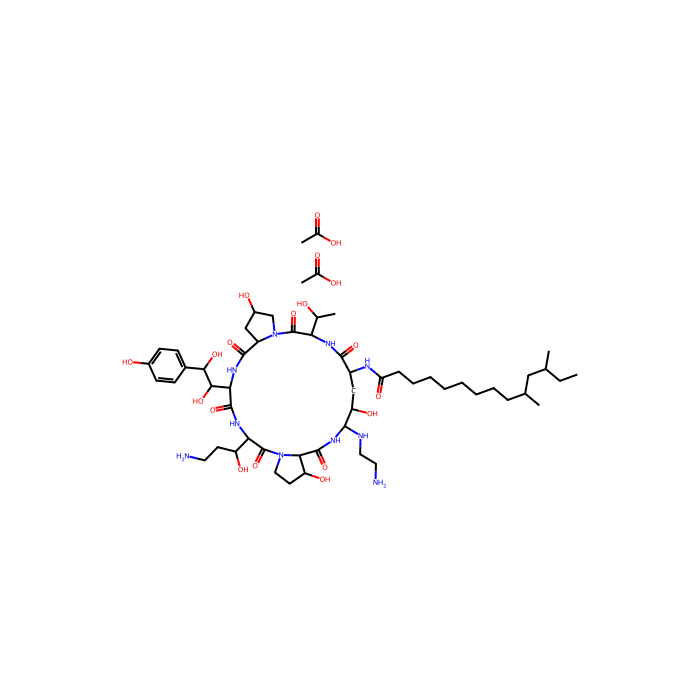
Caspofungin (MK-0991) Acetate Caspofungin Acetate (MK-0991, L-743872) is an lipopeptide antifungal β-1,3-glucan synthase inhibitor. In vitro
Caspofungin acetate is the first in a new class of antifungals that inhibits the synthesis of beta (1, 3)-d-glucan, an essential component of the cell wall of filamentous fungi. Prior studies have shown in vitro activity of caspofungin acetate using the reference methods, broth microdilution or macrodilution, for antifungal susceptibility testing of Candida species established by the National Committee for Clinical Laboratory Standards 1997 guidelines against a variety of Candida species including Candida krusei. Although caspofungin acetate is only Food and Drug Administration-approved for the treatment of aspergillosis, there is information showing that many Candida species are susceptible. The minimal inhibitory concentration for 90% inhibition of Candida species by caspofungin acetate are as follows:C. albicans 0.5 μg/mL (range, 0.25-0.5), C. glabrata 1.0 μg/mL (range, 0.25-2.0), C. tropicalis 1.0 μg/mL (range, 0.25-1.0), C. parapsilosis 0.5 μg/mL (range, 0.25-1.0), and C. krusei 2.0 μg/mL (range, 0.5-2.0)
We use cookies to ensure the website functions properly and, where permitted, to improve your experience. You can manage your preferences at any time in Settings. Learn more in our Cookie Policy.
Shall we send you a message when we have discounts available?
Remind me later
Thank you! Please check your email inbox to confirm.
Products are supplied to verified businesses, institutions, and qualified professionals for research and development use only. Not for use in humans, animals, diagnosis, or therapy.