
Determine the necessary mass, volume, or concentration for preparing a solution.
| Activity Type | Activity Value -log(M) | Mechanism of Action | Activity Reference | Publications (PubMed IDs) |
|---|
Moligand™, 10mM in DMSO Moligand™ for sensitive chromatographic and analytical workflows requiring minimal baseline interference.
Store at -80°C Ships Dry ice packs + Cold packs Check lot-specific COA for exact specifications.
SDS, COA, datasheet, and spec sheet available for download. Lot-specific COA accessible via lot number lookup.
Cited in 0 peer-reviewed publications across chromatography, organic synthesis, and cross-coupling reactions.
Information
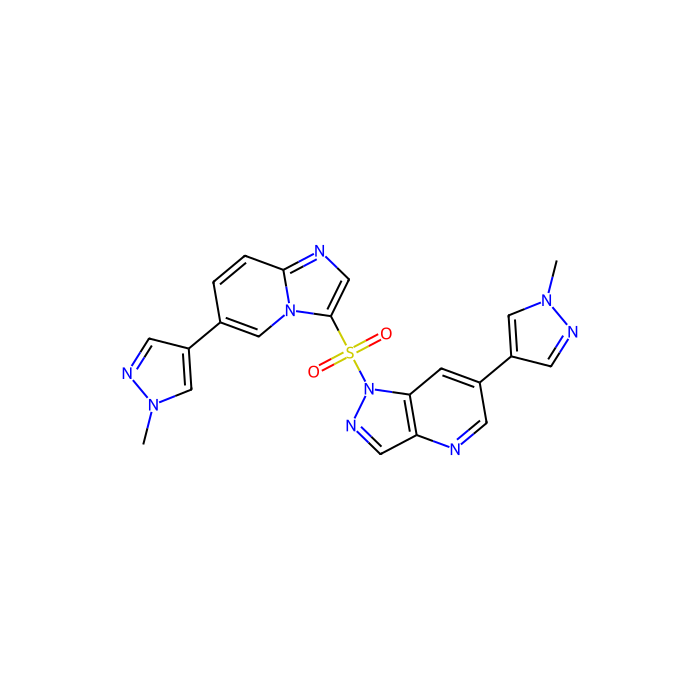
Glumetinib (SCC244) Glumetinib (SCC244) is a potent and highly selective c-Met inhibitor with an IC50 of 0.42 ± 0.02 nmol/L. Glumetinib has greater than 2,400-fold selectivity for c-Met over those 312 kinases evaluated, including the c-Met family member RON and highly homologous kinases Axl, Mer, and TyrO3.
Targets
c-Met (Cell-free assay) 0.42 nM
In vitro
SCC244 strongly inhibits c-Met phosphorylation as well as AKT and ERK phosphorylation in EBC-1, MKN-45 cells harboring an amplified MET gene and U87MG cells responsive to HGF stimulation. SCC244 elicits selective and profound effects against c-Met-driven cancer cell proliferation. It inhibits c-Met-dependent neoplastic phenotypes of metastasis and angiogenesis.
In vivo
In xenografts of human tumor cell lines or non-small cell lung cancer and hepatocellular carcinoma patient-derived tumor tissue driven by MET aberration, SCC244 administration exhibits robust antitumor activity at the well-tolerated doses. In addition, the in vivo antitumor activity of SCC244 involves the inhibition of c-Met downstream signaling via a mechanism of combined antiproliferation and antiangiogenic effects.
Cell Research(from reference)
Cell lines:U87MG cells
Concentrations:5, 10, 20 nM
Incubation Time:2 h
| ALogP | 1.725 |
|---|---|
| hba_count | 7 |
| Rotatable Bond | 4 |
| Canonical Smiles | CN1C=C(C=N1)C2=CN3C(=NC=C3S(=O)(=O)N4C5=C(C=N4)N=CC(=C5)C6=CN(N=C6)C)C=C2 |
|---|---|
| IUPAC Name | 6-(1-methylpyrazol-4-yl)-1-[6-(1-methylpyrazol-4-yl)imidazo[1,2-a]pyridin-3-yl]sulfonylpyrazolo[4,3-b]pyridine |
| InChIKey | RYBLECYFLJXEJX-UHFFFAOYSA-N |
| INCHI | 1S/C21H17N9O2S/c1-27-11-16(7-24-27)14-3-4-20-23-10-21(29(20)13-14)33(31,32)30-19-5-15(6-22-18(19)9-26-30)17-8-25-28(2)12-17/h3-13H,1-2H3 |
| Isomeric SMILES | CN1C=C(C=N1)C2=CN3C(=NC=C3S(=O)(=O)N4C5=C(C=N4)N=CC(=C5)C6=CN(N=C6)C)C=C2 |
| Molecular Weight | 459.48 |
| Reaxy-Rn | 27905098 |
| Reaxys-RN_link_address | https://www.reaxys.com/reaxys/secured/hopinto.do?context=S&query=IDE.XRN=27905098&ln= |
Comprehensive hazard, handling, storage, and regulatory compliance document.
Download SDS →Lot-specific quality data. Enter your lot number to retrieve the exact COA.
Look up COA →Full quality attributes and acceptance criteria for this grade.
View spec sheet →Taxonomy Tree
| Kingdom | Organic compounds |
|---|---|
| Superclass | Organoheterocyclic compounds |
| Class | Pyridines and derivatives |
| Subclass | Pyrazolylpyridines |
| Intermediate Tree Nodes | Not available |
| Direct Parent | Pyrazolylpyridines |
| Alternative Parents | Pyrazolopyridines Imidazopyridines Imidazo[1,2-a]pyridines N-substituted imidazoles Sulfonyls Pyrazoles Organosulfonic acids and derivatives Heteroaromatic compounds Azacyclic compounds Organopnictogen compounds Organonitrogen compounds Organic oxides Hydrocarbon derivatives |
| Molecular Framework | Aromatic heteropolycyclic compounds |
| Substituents | 3-pyrazolylpyridine - Imidazo[1,2-a]pyridine - Pyrazolopyridine - Imidazopyridine - N-substituted imidazole - Heteroaromatic compound - Sulfonyl - Organosulfonic acid or derivatives - Organic sulfonic acid or derivatives - Pyrazole - Imidazole - Azole - Azacycle - Organic nitrogen compound - Organic oxygen compound - Organopnictogen compound - Organic oxide - Hydrocarbon derivative - Organosulfur compound - Organonitrogen compound - Aromatic heteropolycyclic compound |
| Description | This compound belongs to the class of organic compounds known as pyrazolylpyridines. These are compounds containing a pyrazolylpyridine skeleton, which consists of a pyrazole linked (not fused) to a pyridine by a bond. |
| External Descriptors | Not available |
| Activity Type | Activity Value -log(M) | Mechanism of Action | Activity Reference | Publications (PubMed IDs) |
|---|
| DMSO(mg / mL) Max Solubility | 11 |
|---|---|
| DMSO(mM) Max Solubility | 23.9401062070166 |
| Water(mg / mL) Max Solubility | <1 |
| Molecular Weight | 459.500 g/mol |
| XLogP3 | 1.900 |
| Hydrogen Bond Donor Count | 0 |
| Hydrogen Bond Acceptor Count | 7 |
| Rotatable Bond Count | 4 |
| Exact Mass | 459.123 Da |
| Monoisotopic Mass | 459.123 Da |
| Topological Polar Surface Area | 126.000 Ų |
| Heavy Atom Count | 33 |
| Formal Charge | 0 |
| Complexity | 825.000 |
| Isotope Atom Count | 0 |
| Defined Atom Stereocenter Count | 0 |
| Undefined Atom Stereocenter Count | 0 |
| Defined Bond Stereocenter Count | 0 |
| Undefined Bond Stereocenter Count | 0 |
| The total count of all stereochemical bonds | 0 |
| Covalently-Bonded Unit Count | 1 |
Our grade selection guide covers purity, stabilizer status, and application suitability for all variants in our catalog.
View Moligand™ grade guide →