Poly-D-lysine hydrobromide - Molecular weight ≥ 300000 , CAS No.27964-99-4

CAS: 27964-99-4 Cat. No.: P477773 Fórmula: D-Lys-(D-Lys)n-D-Lys·xHBr Número CE: 959-037-4 PubChem CID: 87493163
Disponível para encomenda
GRADE & PURITY Molecular weight ≥ 300000
Synonyms
PDL
Storage
Store at -20°C,Desiccated
Shipped In
Ice chest + Ice pads
★
Size
Alemanha (EU)
USA*
Price
Qty
10mg
P477773-10mg
—
3 Em stock
86,69€
50mg
P477773-50mg
—
1 Em stock
308,83€
100mg
P477773-100mg
—
1 Em stock
555,27€
Enter a quantity for the sizes you want to add.
🧪
Why this grade

Molecular weight ≥ 300000 for sensitive chromatographic and analytical workflows requiring minimal baseline interference.

🌡

Storage & shipping

Store at -20°C,Desiccated Ships Ice chest + Ice pads Check lot-specific COA for exact specifications.

📋

Quality documents

SDS, COA, datasheet, and spec sheet available for download. Lot-specific COA accessible via lot number lookup.

📚

Literature proof

Cited in 1 peer-reviewed publications across chromatography, organic synthesis, and cross-coupling reactions.

Visão geral

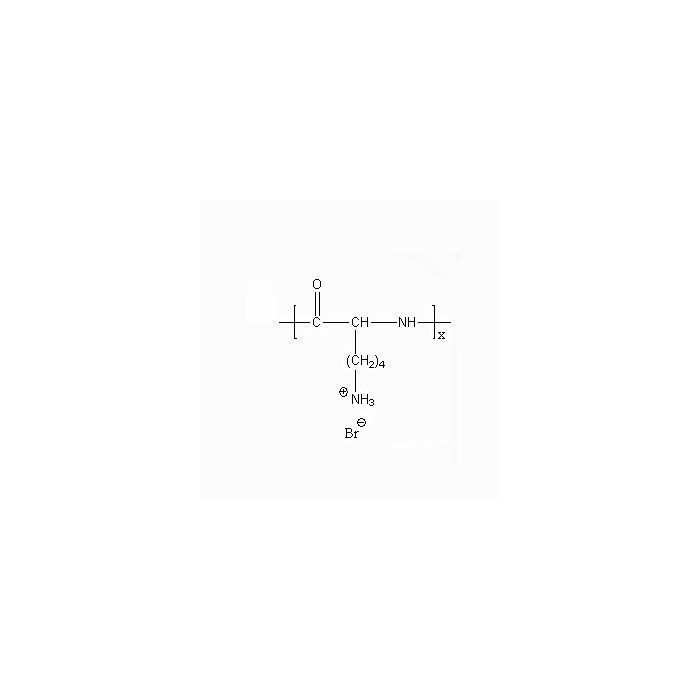
Poly-D-lysine polymers can be used in preparing surfaces for cell attachment. The D-lysine polymers can also be used with cells that digest poly-L-lysine polymers and cause an excessive uptake of L-lysine.
This product is recommended as a cell culture substratum when using 0.5 - 1.0 mL of a 0.1 mg/mL solution to coat 25 cm2. Lower molecular weight versions of the product are less viscous, but high more molecular weight versions provide more attachment sites per molecule.
Biochem/physiol Actions
Poly-D-lysine (PDL) hydrobromide is a nonspecific attachment factor for cells useful in promoting cell adhesion to solid substrates by enhancing electrostatic interaction between negatively charged ions of the cell membrane and the culture surface. After absorption to the culture surface, poly-D-lysine increases the number of positively charged cell binding sites.
Preparation Note
This product has a molecular weight >300,000. To remove the HBr, dissolve this product in a neutral buffer and dialyze to remove the salts. In general, to use this product as an attachment factor, add 50 mL of sterile tissue culture grade water to 5 mg of poly-lysine, and aseptically coat the surface with 1 mL per 25 cm2 of solution. After 5 minutes, remove the solution through aspiration and thoroughly rinse the surface. Let dry for two hours before introducing cells and medium.
Other Notes
Poly-D-lysine is a positively charged amino acid polymer with approximately one HBr per lysine residue. The hydrobromide allows the poly-D-lysine to be in a crystalline form soluble in water. A small amount of product may be found in the β structure because the HBr interferes with hydrogen bonding between amino and either the carboxyl groups or N or O containing moieties.
Disclaimer

Sterile solutions are stable for up to 2 years when stored at 2-8°C. It should be stored desiccated at -20°C.

Specifications

Sinónimos
PDL
Especificações e pureza
Molecular weight ≥ 300000
Mecanismos bioquímicos e fisiológicos
Poly-D-lysine (PDL) hydrobromide is a nonspecific attachment factor for cells useful in promoting cell adhesion to solid substrates by enhancing electrostatic interaction between negatively charged ions of the cell membrane and the culture surface. After
Condições de armazenamento de armazenamento
Store at -20°C,Desiccated
Enviado em
Ice chest + Ice pads
Este produto requer transporte de cadeia fria. Serviços terrestres e outros serviços econômicos não estão disponíveis.
Nomes e identificadores
Pubchem Sid
Pubchem Sid Url
https://pubchem.ncbi.nlm.nih.gov/substance/488202440
Sorrisos canónicos
C(CCN)CC(C(=O)O)N.Br
IUPAC Name
(2R)-2,6-diaminohexanoic acid;hydrobromide
InChIKey
MEXAGTSTSPYCEP-NUBCRITNSA-N
INCHI
1S/C6H14N2O2.BrH/c7-4-2-1-3-5(8)6(9)10;/h5H,1-4,7-8H2,(H,9,10);1H/t5-;/m1./s1
SMILES isoméricas
C(CCN)C[C@H](C(=O)O)N.Br
PubChem CID
87493163

Documentation

📋 Safety Data Sheet (SDS)

Comprehensive hazard, handling, storage, and regulatory compliance document.

Download SDS →

✅ Certificate of Analysis (COA)

Lot-specific quality data. Enter your lot number to retrieve the exact COA.

Look up COA →

📊 Datasheet

Quick-reference summary of product specifications and applications.

View datasheet →

🔬 Specification Sheet

Full quality attributes and acceptance criteria for this grade.

View spec sheet →

Advanced Data

Taxonomic Classification

Taxonomy Tree

KingdomOrganic compounds
SuperclassOrganic acids and derivatives
ClasseCarboxylic acids and derivatives
SubclassAmino acids, peptides, and analogues
Intermediate Tree Nodes Amino acids and derivatives - Alpha amino acids and derivatives - Alpha amino acids
Direct ParentD-alpha-amino acids
Alternative Parents Medium-chain fatty acids  Amino fatty acids  Amino acids  Monocarboxylic acids and derivatives  Carboxylic acids  Organic oxides  Monoalkylamines  Hydrocarbon derivatives  Hydrobromides  Carbonyl compounds  
Molecular FrameworkAliphatic acyclic compounds
Substituents D-alpha-amino acid - Medium-chain fatty acid - Amino fatty acid - Fatty acid - Fatty acyl - Amino acid - Carboxylic acid - Monocarboxylic acid or derivatives - Amine - Hydrobromide - Hydrocarbon derivative - Primary amine - Organooxygen compound - Organonitrogen compound - Organic oxide - Primary aliphatic amine - Organic oxygen compound - Carbonyl group - Organic nitrogen compound - Aliphatic acyclic compound
DescriçãoThis compound belongs to the class of organic compounds known as d-alpha-amino acids. These are alpha amino acids which have the D-configuration of the alpha-carbon atom.
External Descriptors Not available
Estrutura 3D
Modelo de Estrutura Química Interativa


Certificados(CoA,COO,BSE/TSE e Mapa de Análise)
C of A & Other Certificates(BSE/TSE, COO):
Analytical Chart:

Find and download the COA for your product by matching the lot number on the packaging.

13 results found

Lot NumberCertificate TypeDataItem
G2616308Certificate of AnalysisJul 09, 2026 P477773
G2616313Certificate of AnalysisJul 09, 2026 P477773
G2616314Certificate of AnalysisJul 09, 2026 P477773
G2620599Certificate of AnalysisJul 09, 2026 P477773
D23241089Certificate of AnalysisFeb 05, 2026 P477773
D23241107Certificate of AnalysisFeb 05, 2026 P477773
D23241140Certificate of AnalysisFeb 05, 2026 P477773
B2423038Certificate of AnalysisMar 24, 2023 P477773
C2408109Certificate of AnalysisMar 24, 2023 P477773
D23241093Certificate of AnalysisMar 24, 2023 P477773
D23241119Certificate of AnalysisMar 24, 2023 P477773
D23241124Certificate of AnalysisMar 24, 2023 P477773
D23241125Certificate of AnalysisMar 24, 2023 P477773
Propriedades químicas e físicas
SolubilidadeH2O: soluble 50 mg/mL, clear, colorless
SensibilidadeSterile solutions can be stably stored for 2 years at 2-8 ℃. Dehydrate and store at -20 ° C.Moisture sensitive
Ponto de inflamação (°F)Not applicable
Ponto de inflamação (°C)Not applicable
FAQs e artigos
Citations of This Product
Calculadoras de soluções
Revisões

Avaliações dos Clientes

Deseja que lhe enviemos uma mensagem quando tivermos descontos disponíveis?

Lembrar-me mais tarde

Obrigado! Por favor, verifique a sua caixa de entrada de e-mail para confirmar.

Ops! As notificações estão desativadas.