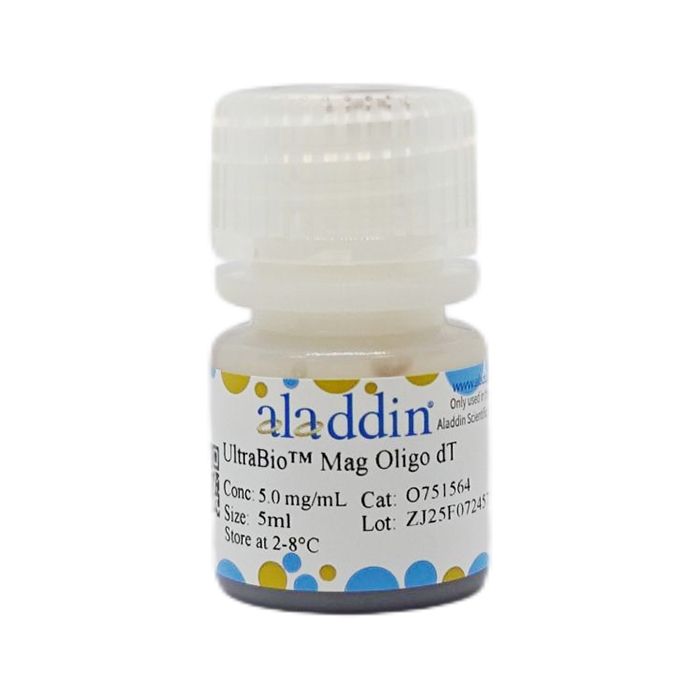
Oligo(dT)-coated magnetic beads enable the isolation and extraction of mRNA from a wide range of samples for applications including RT-PCR, cDNA library construction, cDNA microarray analysis, affinity purification, primer extension, and subtractive hybridization. UltraBio™ Oligo(dT) magnetic beads feature a large specific surface area, high binding affinity and superior specificity to recover high-purity mRNA. Under standard hybridization conditions, polyadenylated RNA (poly-A⁺ RNA) readily binds to oligo(dT). Other RNA species such as rRNA and tRNA lack poly-A⁺ sequences and thus do not interact with Oligo(dT) magnetic beads.
Product Properties
Matrix
| Polymeric magnetic beads
|
Ligand
| Oligo dT
|
Average particle size
| 1 μm
|
Magnetic type
| Superparamagnetic
|
Application
| mRNA isolation and purification
|
Operation mode
| Manual / Automated
|
mRNA binding capacity
| ~2 μg/mg of beads
|
Bead concentration
| 5 mg/mL
|
Storage buffer
| PBS, 0.05% ProClin 300, pH7.4
|
Storage conditions and shelf life
| 2–8°C, 2 years
|
Instructions for Use
I. Required Additional Materials and Reagents
Binding Buffer
| 20 mM Tris-HCl, pH 7.5, 1.0 M LiCl, 2 mM EDTA
|
Lysis/Binding Buffer
| 100 mM Tris-HCl, pH 7.5, 500 mM LiCl, 10 mM EDTA, 1% LiDS, 5 mM dithiothreitol (DTT)
If precipitate forms, warm and shake until the solution becomes clear.
|
Washing Buffer A
| 10 mM Tris-HCl, pH 7.5, 0.15 M LiCl, 1 mM EDTA, 0.1% LiDS
|
Washing Buffer B
| 10 mM Tris-HCl, pH 7.5, 0.15 M LiCl, 1 mM EDTA |
Note: For long-term storage of eluted mRNA, supplement with RNase inhibitor during the elution step.
II. Washing Magnetic Beads
1. Resuspend the magnetic beads in the reagent bottle (vortex for more than 30 s or rotate for more than 5 min).
2. Transfer the required volume of magnetic beads to a new EP tube or PCR tube. Recommended bead dosage: use 20 μL beads for total RNA ≤ 25 μg. Increase bead volume proportionally with higher total RNA input; the bead dosage can be adjusted based on preliminary tests.
3. Add an equal volume of Binding Buffer and vortex to mix thoroughly.
4. Place the EP tube or PCR tube on a magnetic stand and incubate for 1 min. Aspirate and discard the supernatant once the solution turns clear.
5. Remove the tube from the magnetic stand, then resuspend the beads with Binding Buffer at the same initial volume.
III. Sample Preparation
1. Prepare lysates (animal tissues, plant tissues, cells) Recommended sample amounts: 20–50 mg animal tissue, 100 mg plant tissue, 1–4 × 10⁶ cells. The amounts can be scaled up or down as required.
2. Preparation of lysates from solid animal and plant tissues
(1) Weigh the recommended amount of animal or plant tissue. Excess tissue will reduce the yield and purity of mRNA.
(2) Grind frozen tissue in liquid nitrogen. Keep the tissue frozen at all times to prevent RNA degradation.
(3) Transfer the ground frozen sample to an EP tube, add 1 mL Lysis/Binding Buffer, and homogenize for 1–2 min until the tissue is fully lysed.
Note: Complete homogenization promptly to avoid RNA degradation. A homogenizer is recommended if the sample is highly viscous.
(4) Centrifuge the lysate for 30–60 s to remove residual tissue debris. The resulting lysate can be used directly for mRNA isolation or stored at −80 °C for later use.
3. Preparation of lysates from cell suspensions
(1) Wash the cell suspension with PBS, centrifuge to collect the cell pellet, and immediately store the pellet in liquid nitrogen at −80 °C for later use.
(2) Add 1 mL Lysis/Binding Buffer to the above cells (1–4 × 10⁶ cells) and pipette up and down several times to achieve complete cell lysis. Cell lysis releases genomic DNA, which increases solution viscosity; this viscosity indicates full lysis.
(3) Shear genomic DNA to reduce viscosity using mechanical force: draw and eject the lysate 3 times with a 1–2 mL syringe fitted with a 21-gauge needle. If bubbles form, centrifuge for 30 s to eliminate them. Bubbles do not interfere with mRNA yield.
(4) The resulting lysate can be used directly for mRNA isolation or stored at −80 °C for later use.
IV. Isolation of mRNA from Crude Lysate
1. Discard the supernatant after bead washing (see section "Washing Magnetic Beads"), then add the prepared lysate.
2. Mix the magnetic beads with lysate by shaking on a shaker at room temperature for 3–5 min. Extend the incubation time if the solution is highly viscous. This step allows mRNA to bind to the oligo(dT) sequences.
3. Place the centrifuge tube on a magnetic stand and let it stand for 2 min, then aspirate and discard the supernatant.
4. Add 1 mL Washing Buffer A to the tube to resuspend the beads. Place the tube on the magnetic stand for 2 min and completely remove the supernatant.
5. Wash the beads once with 1 mL Washing Buffer B following the same procedure described above.
6. Select one of the two procedures below:
a. If bead-bound mRNA will be used for downstream enzymatic reactions (e.g., solid-phase cDNA synthesis), perform an additional wash with 500 μL Washing Buffer B, followed by one wash with the enzymatic reaction buffer to be used in subsequent experiments.
b. Elute mRNA from magnetic beads: Add 10–20 μL 10 mM Tris-HCl, incubate at 75–80 °C for 2 min. Immediately place the tube on a magnetic stand. Once the solution clears, transfer the supernatant to a new RNase-free tube right away. The final mRNA yield varies slightly depending on sample type.
V. Purification of mRNA from Total RNA
1. Adjust the volume of 0.01–25 μg high-purity total RNA to 50 μL with DEPC-treated Water (Aladdin Cat. No. W293452).
2. Add 50 μL Binding Buffer. Note: If the adjusted volume of total RNA exceeds 50 μL, add an equal volume of Binding Buffer accordingly.
3. Transfer the resulting 100 μL total RNA solution to pre-washed magnetic beads (refer to the section "Washing Magnetic Beads"). Pipette up and down more than six times to mix thoroughly.
4. Place the sample in a thermal cycler and run the program: 65 °C for 5 min, 25 °C for 5 min, hold at 4 °C to facilitate binding between mRNA and beads.
5. Place the sample tube on a magnetic stand for 1–2 min. Aspirate and discard the supernatant once the solution turns clear.
6. Remove the tube from the magnetic stand, add 200 μL Washing Buffer B, and gently pipette up and down several times to mix. Place back on the magnetic stand for 1–2 min, then aspirate and discard the supernatant after clarification.
7. Take the tube off the magnetic stand, add 50 μL DEPC-treated Water (Aladdin Cat. No. W293452) to resuspend the beads, and pipette up and down over six times for full mixing.
8. Incubate the sample in the thermal cycler at 80 °C for 2 min to elute bound mRNA, then hold at 25 °C.
9. After incubation, add 50 μL Binding Buffer and pipette thoroughly to homogenize. Incubate at room temperature for 5 min to allow re-binding.
10. Place the tube on the magnetic stand for 1–2 min and discard the clarified supernatant.
11. Remove the tube from the magnetic stand, add 200 μL Washing Buffer B, and pipette several times to mix. Set on the magnetic stand for 1–2 min, aspirate the clear supernatant, and repeat this wash step one more time.
12. Select the subsequent processing method according to downstream experiments:
a. For reverse transcription: Remove the tube from the magnetic stand, add 10–15 μL DEPC-treated Water (Aladdin Cat. No. W293452), and pipette vigorously six times to mix completely. Elute mRNA at 80 °C for 2 min, then place the tube on the magnetic stand for 1–2 min. Carefully transfer the clear supernatant to a new nuclease-free PCR tube.
b. For RNA library construction: Add the corresponding volume of Frag/Prime Buffer as instructed in the matching library construction kit manual. c. The purified RNA product can be kept on ice for immediate NGS library preparation or other analytical assays. Downstream reactions are recommended to be performed right away; alternatively, the RNA can be stored at −80 °C.
Precautions
1. Prepare all required materials in advance to slow down RNA degradation.
2. Change gloves frequently during RNA extraction to minimize RNase contamination.
3. Use clean disposable RNase-free pipette tips when handling all buffers.
4. Where possible, isolate mRNA from separately purified total RNA.
5. Hybridization can be performed at temperatures ranging from room temperature to 40 °C, with incubation time controlled between 5 and 15 min.