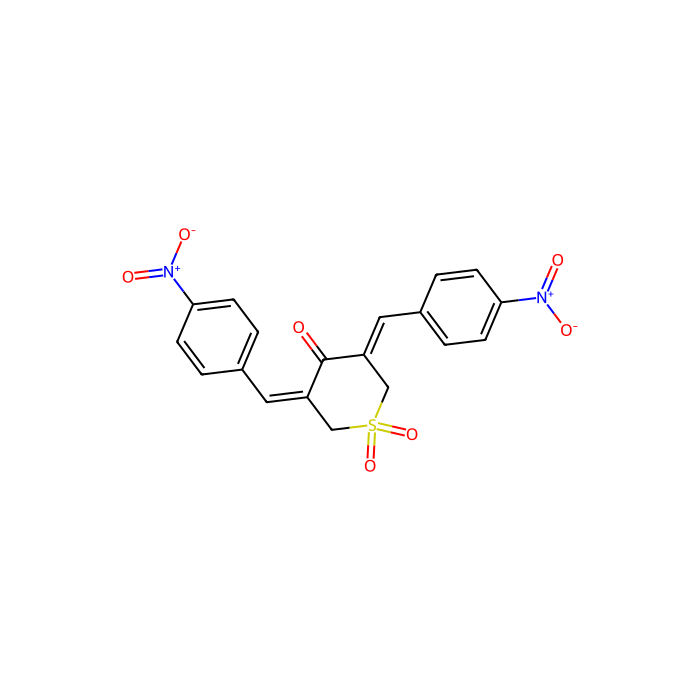
≥98% for sensitive chromatographic and analytical workflows requiring minimal baseline interference.
🌡
Storage & shipping
Protected from light,Store at -20°C Ships Ice chest + Ice pads Check lot-specific COA for exact specifications.
📋
Quality documents
SDS, COA, datasheet, and spec sheet available for download. Lot-specific COA accessible via lot number lookup.
📚
Literature proof
Cited in 0 peer-reviewed publications across chromatography, organic synthesis, and cross-coupling reactions.
Overview
A cell-permeable cross-conjugated α,β-unsaturated dienone compound that induces caspase activation and apoptosis (IC50 = 1.76 and 1.6 µM in E1A and E1A/C9DN cells, respectively) via the apoptosome-independent mitochondrial pathway by selectively inhibiting ubiquitin isopeptidase activity (IC50 ~30 µM). The cellular expression of Bax and Bak is essential for G5-activated apoptosis, while Bcl-2 appears to protect cells against the effect of G5. G5 is more potent than, but otherwise exhibits similar pharmacological effects as, Ubiquitin Isopeptidase Inhibitor II, F6. At higher concentrations (5-10 µM), shown to induce necrosis in apoptosis-resistant MEFs-DKO. A cell-permeable cross-conjugated α,β-unsaturated dienone compound that induces caspase activation and apoptosis (IC50 = 1.76 and 1.6 µM in E1A and E1A/C9DN cells, respectively) via the apoptosome-independent mitochondrial pathway by selectively inhibiting ubiquitin isopeptidase activity (IC50 = ~ 30 µM). The cellular expression of Bax and Bak is essential for G5-activated apoptosis, while Bcl-2 appears to protect cells against the effect of G5. G5 is more potent than, but otherwise exhibits similar pharmacological effects as, Ubiquitin Isopeptidase Inhibitor II, F6 . At higher concentrations (5-10 µM), shown to induce necrosis in apoptosis-resistant MEFs-DKO.
Cell permeable: yes
Primary Target
Ubiquitin isopeptidase activity
Product does not compete with ATP.
Reversible: no
Target IC50: ~ 30 µM against ubiquitin isopeptidase activity; 1.76 and 1.6 µM for the induction of caspase activation and apoptosis in E1A
Storage
Protected from light,Store at -20°C
Shipped In
Ice chest + Ice pads
This product requires cold chain shipping. Ground and other economy services are not available.
Note
For maximum solubility we recommend this compound be dissolved in DMSO and then diluted with aqueous buffer of choice. This compound has a solubility of approximately 0.25 mg/ml in a 1:3 solution of DMSO:PBS (pH 7.2) using this method. We do not recommend storing the aqueous solution for more than one day. Also, DMSO solution needs to be purged with an inert gas for stability. Need more advice on solubility, usage and handling? Please visit our frequently asked questions (FAQ) page for more details.
This compound belongs to the class of organic compounds known as nitrobenzenes. These are compounds containing a nitrobenzene moiety, which consists of a benzene ring with a carbon bearing a nitro group.
External Descriptors
Not available
1. Djoumbou Feunang Y, Eisner R, Knox C, Chepelev L, Hastings J, Owen G, Fahy E, Steinbeck C, Subramanian S, Bolton E, Greiner R, and Wishart DS. ClassyFire: Automated Chemical Classification With A Comprehensive, Computable Taxonomy. Journal of Cheminformatics, 2016, 8:61.
Soluble in a 1:3 solution of DMSO:PBS. Please see Handling instructions.
Sensitivity
light sensitive
Molecular Weight
414.400 g/mol
XLogP3
2.600
Hydrogen Bond Donor Count
0
Hydrogen Bond Acceptor Count
7
Rotatable Bond Count
2
Exact Mass
414.052 Da
Monoisotopic Mass
414.052 Da
Topological Polar Surface Area
151.000 Ų
Heavy Atom Count
29
Formal Charge
0
Complexity
767.000
Isotope Atom Count
0
Defined Atom Stereocenter Count
0
Undefined Atom Stereocenter Count
0
Defined Bond Stereocenter Count
2
Undefined Bond Stereocenter Count
0
The total count of all stereochemical bonds
2
Covalently-Bonded Unit Count
1
Solution Calculators
Molarity Calculator
Determine the necessary mass, volume, or concentration for preparing a solution.
Dilution Calculator
Determine the dilution needed to prepare a stock solution.
Reconstitution Calculator
Reviews
Customer Reviews
Frequently Asked Questions
What is the purity of this product?
This product is supplied at ≥98% purity (chemical assay). Lot-specific values are stated on the Certificate of Analysis.
How should this product be stored?
Store at ?20 °C, protected from light. The material is light-sensitive — keep it in its original opaque or amber container.
How is this product shipped?
This product ships in an insulated container with ice pads. Unpack on arrival and transfer it to the storage condition stated above.
What are the CAS number, molecular formula and molecular weight?
The CAS Number is 108477-18-5, the molecular formula is C19H14N2O7S, and the molecular weight is 414.4 g/mol. InChIKey SSAMIOWVUGBIJK-KAVGSWPWSA-N.
What documentation is provided?
Available product documentation, including Certificates of Analysis (COA), Safety Data Sheets (SDS), and specification sheets, is shown in the product document area. Document availability and access follow the current site policy.
We use cookies to ensure the website functions properly and, where permitted, to improve your experience. You can manage your preferences at any time in Settings. Learn more in our Cookie Policy.
Shall we send you a message when we have discounts available?
Remind me later
Thank you! Please check your email inbox to confirm.
Products are supplied to verified businesses, institutions, and qualified professionals for research and development use only. Not for use in humans, animals, diagnosis, or therapy.