
Determine the necessary mass, volume, or concentration for preparing a solution.
| Activity Type | Activity Value -log(M) | Mechanism of Action | Activity Reference | Publications (PubMed IDs) |
|---|
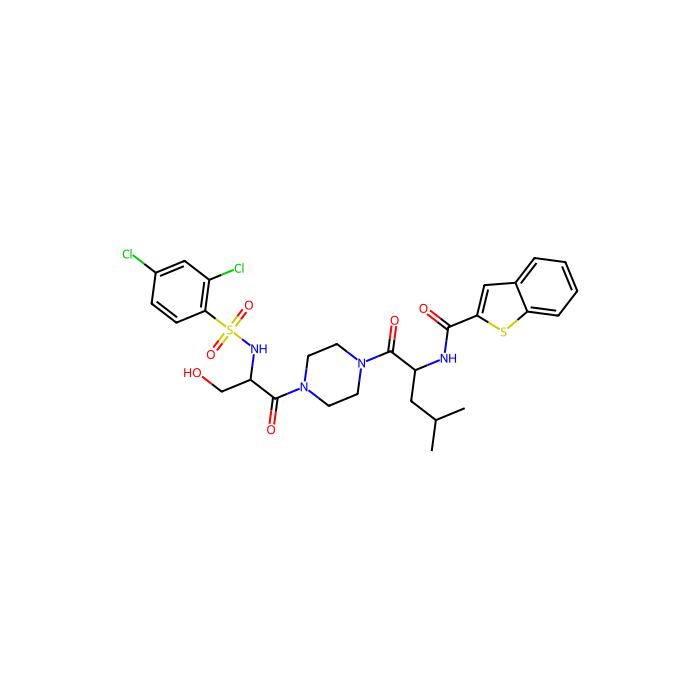
GSK1016790A is a potent and selective transient receptor potential vanilloid 4 (TRPV4) channel agonist. GSK1016790A can elicit Ca2+ influx and elevate intracellular Ca2+ in HEK cells。
Taxonomy Tree
| Kingdom | Organic compounds |
|---|---|
| Superclass | Organic acids and derivatives |
| Class | Carboxylic acids and derivatives |
| Subclass | Amino acids, peptides, and analogues |
| Intermediate Tree Nodes | Amino acids and derivatives - Alpha amino acids and derivatives |
| Direct Parent | Leucine and derivatives |
| Alternative Parents | N-acyl-alpha amino acids and derivatives Alpha amino acid amides Benzenesulfonamides 1-benzothiophenes Benzenesulfonyl compounds Thiophene carboxamides 2,3,5-trisubstituted thiophenes 2-heteroaryl carboxamides Dichlorobenzenes Piperazines Organosulfonamides Aryl chlorides Tertiary carboxylic acid amides Aminosulfonyl compounds Heteroaromatic compounds Secondary carboxylic acid amides Azacyclic compounds Organic oxides Organochlorides Organonitrogen compounds Hydrocarbon derivatives Carbonyl compounds Primary alcohols |
| Molecular Framework | Aromatic heteropolycyclic compounds |
| Substituents | Leucine or derivatives - N-acyl-alpha amino acid or derivatives - Alpha-amino acid amide - Benzenesulfonamide - Benzothiophene - 1-benzothiophene - Benzenesulfonyl group - 2-heteroaryl carboxamide - 1,3-dichlorobenzene - Thiophene carboxamide - 2,3,5-trisubstituted thiophene - Thiophene carboxylic acid or derivatives - Chlorobenzene - Halobenzene - Aryl chloride - Aryl halide - Monocyclic benzene moiety - 1,4-diazinane - Piperazine - Organosulfonic acid amide - Benzenoid - Thiophene - Aminosulfonyl compound - Tertiary carboxylic acid amide - Sulfonyl - Organosulfonic acid or derivatives - Heteroaromatic compound - Organic sulfonic acid or derivatives - Secondary carboxylic acid amide - Carboxamide group - Organoheterocyclic compound - Azacycle - Organic oxygen compound - Alcohol - Hydrocarbon derivative - Organohalogen compound - Carbonyl group - Organic oxide - Organonitrogen compound - Organooxygen compound - Organosulfur compound - Organic nitrogen compound - Primary alcohol - Organochloride - Aromatic heteropolycyclic compound |
| Description | This compound belongs to the class of organic compounds known as leucine and derivatives. These are compounds containing leucine or a derivative thereof resulting from reaction of leucine at the amino group or the carboxy group, or from the replacement of any hydrogen of glycine by a heteroatom. |
| External Descriptors | Not available |
| Activity Type | Activity Value -log(M) | Mechanism of Action | Activity Reference | Publications (PubMed IDs) |
|---|
| Activity Type | Relation | Activity value | Units | Action Type | Journal | PubMed Id | doi | Assay Aladdin ID |
|---|
| Activity Type | Relation | Activity value | Units | Action Type | Journal | PubMed Id | doi | Assay Aladdin ID |
|---|
| Activity Type | Relation | Activity value | Units | Action Type | Journal | PubMed Id | doi | Assay Aladdin ID |
|---|
| Activity Type | Relation | Activity value | Units | Action Type | Journal | PubMed Id | doi | Assay Aladdin ID |
|---|
| Activity Type | Relation | Activity value | Units | Action Type | Journal | PubMed Id | doi | Assay Aladdin ID |
|---|
Find and download the COA for your product by matching the lot number on the packaging.
| Lot Number | Certificate Type | Date | Item |
|---|---|---|---|
 C2527057 | Certificate of Analysis | Oct 13, 2026 | G275374 |
| C2331455 | Certificate of Analysis | May 21, 2026 | G275374 |
| C2331444 | Certificate of Analysis | Apr 15, 2026 | G275374 |
| C2331427 | Certificate of Analysis | Apr 15, 2026 | G275374 |
| C2331426 | Certificate of Analysis | Apr 15, 2026 | G275374 |
| C2331423 | Certificate of Analysis | Apr 03, 2026 | G275374 |
| C2331450 | Certificate of Analysis | Apr 03, 2026 | G275374 |
| C2331454 | Certificate of Analysis | Apr 03, 2026 | G275374 |
| C2331456 | Certificate of Analysis | Apr 03, 2026 | G275374 |
| Solubility | DMSO: >10 mg/mL |
|---|---|
| Molecular Weight | 655.600 g/mol |
| XLogP3 | 4.400 |
| Hydrogen Bond Donor Count | 3 |
| Hydrogen Bond Acceptor Count | 8 |
| Rotatable Bond Count | 10 |
| Exact Mass | 654.114 Da |
| Monoisotopic Mass | 654.114 Da |
| Topological Polar Surface Area | 173.000 Ų |
| Heavy Atom Count | 42 |
| Formal Charge | 0 |
| Complexity | 1070.000 |
| Isotope Atom Count | 0 |
| Defined Atom Stereocenter Count | 2 |
| Undefined Atom Stereocenter Count | 0 |
| Defined Bond Stereocenter Count | 0 |
| Undefined Bond Stereocenter Count | 0 |
| The total count of all stereochemical bonds | 0 |
| Covalently-Bonded Unit Count | 1 |
Only Product Data may be used in this section.
General advice:
For detailed, lot-specific handling or any in-house validated procedures, refer to the CoA/Spec Sheet or contact Technical Support.
Scope note: The following describes literature/general knowledge about GSK-1016790A as a research tool. It does not constitute medical or clinical claims and is not item-specific performance data.
Reminder: Always confirm target engagement and concentration–response relationships under your exact assay conditions, as expression level and cell context can significantly modulate observed potency.
Not typically applicable. GSK-1016790A is a bioactive small-molecule ligand rather than a buffering agent.
Practical notes for assay buffers (general guidance):
Item-specific buffer compositions or pH ranges:
Context:
Greener handling strategies (general guidance):
Solvent alternatives comparison (general; not item-specific):
| Use case | Conventional | Greener/Lower-impact option | Trade-offs | |---|---|---|---| | Stock solution | DMSO | Keep DMSO but reduce volume via higher-concentration stocks and microscale aliquots | DMSO remains best-in-class solvency; goal is reduction, not replacement | | HPLC mobile phase | Acetonitrile | Ethanol or methanol blends when compatibility allows | Higher backpressure/viscosity; may affect resolution | | Extraction/sample prep | Dichloromethane/DMF | Ethyl acetate, 2-MeTHF, CPME where chemically compatible | Solubility may be lower; validate recovery |
Operational choices:
Note: Any solvent substitutions must be validated for chemical compatibility and assay performance with your specific workflow.
This product is provided strictly for research use only and is not intended for human or veterinary use, diagnostics, or as an API.
Formulation/processing context (general, non-clinical):
Excipient status, dosage forms, and regulatory designations:
If preclinical formulation studies are conducted in research settings:
Item-specific pharmaceutical information:
Item-specific (from Product Data):
Literature/general values (not item specifications; verify against CoA before use):
Analytical considerations (general guidance):
Key physical constants such as boiling point, melting point, density, logP, pKa, refractive index, and UV cutoff are:
Practical tip:
Item-specific (from Product Data):
What Moligand™ implies (general description of grade):
How to use this grade information:
Stabilizers/inhibitors:
Quality control suggestions (general):
Applicability note:
Biological research applications (literature/general; not item-specific claims):
Practical considerations (general):
If your intended use is chemical synthesis:
Not a typical synthetic reagent. Therefore, there are no standardized “reaction conditions” for using GSK-1016790A in chemical transformations.
Assay conditions (biological; literature/general guidance only):
Controls:
Item-specific reaction/assay parameters:
Item-specific (from Product Data):
General laboratory safety (defer to SDS as authoritative):
Incompatibilities and stability (general):
First-aid overview (general guidance—consult SDS):
Spill/accidental release:
Note: Absence of specific hazard codes in this listing does not imply benign hazard—always consult the current SDS before use.
Purpose-built guidance for preparing working solutions of a research ligand such as GSK-1016790A.
Literature/general practices for similar TRP-channel tool compounds:
Solvent selection comparison (general, not item-specific):
Tips to prevent precipitation on dilution:
Item-specific (from Product Data):
Item-specific reconstitution details:
General guidance for research ligands (literature/practice; verify compatibility):
Stability/expiration:
Brief description: GSK-1016790A is a cataloged small-molecule research ligand in our Moligand series. Structural identifiers are limited in the current Product Data.
Item-specific (from Product Data):
Literature/general context (for orientation only; not item-specific specs):
2D structure description (general):
Notes:
Applicability note:
General medicinal chemistry context (literature/general):
Route and derivatization considerations:
Analytical utility:
Conclusion:
Only Product Data may be used in this section.
Guidance:
Our grade selection guide covers purity, stabilizer status, and application suitability for all variants in our catalog.
View Moligand™ grade guide →