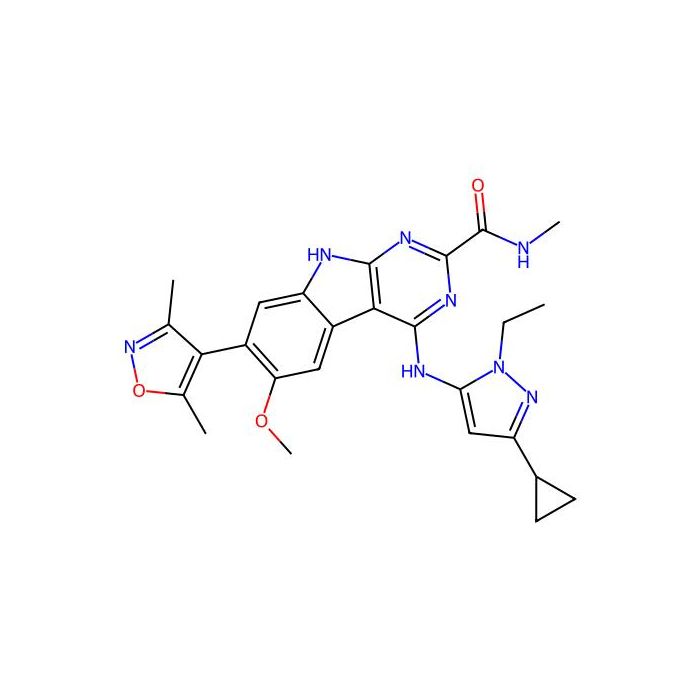
10mM in DMSO for sensitive chromatographic and analytical workflows requiring minimal baseline interference.
🌡
Storage & shipping
Store at -80°C Ships Dry ice packs + Cold packs Check lot-specific COA for exact specifications.
📋
Quality documents
SDS, COA, datasheet, and spec sheet available for download. Lot-specific COA accessible via lot number lookup.
📚
Literature proof
Cited in 0 peer-reviewed publications across chromatography, organic synthesis, and cross-coupling reactions.
Overview
HJB97 is a high-affinity BET inhibitor with K i s of 0.9 nM ( BRD2 BD1 ), 0.27 nM ( BRD2 BD2 ), 0.18 nM ( BRD3 BD1 ), 0.21 nM ( BRD3 BD2 ), 0.5 nM ( BRD4 BD1 ), 1.0 nM ( BRD4 BD2 ), respectively. HJB97 is employed for the design of potential PROTAC BET degrader and has antitumor activity
In Vitro
HJB97 is a highly potent and efficacious bomodomain and extra terminal (BET) inhibitor with IC 50 s of 3.1 nM (BRD2 BD1), 3.9 nM (BRD2 BD2), 6.6 nM (BRD3 BD1), 1.9 nM (BRD3 BD2), 7.0 nM (BRD4 BD1), 7.0 nM (BRD4 BD2). HJB97 (10-1000 nM, 4 days) potently inhibits cell growth in RS4;11 and MOLM-13 acute leukemia cell lines with IC 50 s of 24.1 nM and 25.6 nM. HJB97 can effectively down-regulate the level of c-Myc at concentrations of 300-1000 nM in the RS4;11 cell line (treated for 24 h). MCE has not independently confirmed the accuracy of these methods. They are for reference only. Cell Viability AssayCell Line: The human acute leukemia RS4;11 cell line; The human acute leukemia MOLM-13 cell line Concentration: 10-1000 nM Incubation Time: 4 days Result: Achieved IC 50 s value of 24.1±5.3 nM and 25.6±1.9 nM in inhibition of the RS4;11 cell and MOLM-13 cell growth. Western Blot AnalysisCell Line: RS4;11 cells Concentration: 30, 100, 300, 1000 nM Incubation Time: 24 h Result: Down-regulated the level of c-Myc but at concentrations of 300-1000 nM in the RS4;11 cell line.
HJB97 is a high-affinity BET inhibitor with K i s of 0.9 nM ( BRD2 BD1 ), 0.27 nM ( BRD2 BD2 ), 0.18 nM ( BRD3 BD1 ), 0.21 nM ( BRD3 BD2 ), 0.5 nM ( BRD4 BD1 ), 1.0 nM ( BRD4 BD2 ), respectively. HJB97 is employed for the design of potential PROTAC BET d
Storage
Store at -80°C
Shipped In
Dry ice packs + Cold packs
This product requires cold chain shipping. Ground and other economy services are not available.
Determine the necessary mass, volume, or concentration for preparing a solution.
Dilution Calculator
Determine the dilution needed to prepare a stock solution.
Reconstitution Calculator
Reviews
Customer Reviews
Application Protocols
No validated application protocols are provided for this item in the product data.
General handling protocols for small-molecule library members (not item-specific):
Stock preparation: If supplied as a solid, prepare a concentrated primary stock (e.g., 10–50 mM) in anhydrous DMSO; vortex and sonicate briefly if needed; filter through 0.2 µm PTFE for particulate removal. If supplied as a DMSO solution, equilibrate to room temperature before opening to minimize moisture condensation.
Working solutions: Dilute into assay buffer to the desired concentration, keeping final DMSO at or below the tolerance of your system (commonly 0.1–1% v/v). Include matched vehicle controls.
Stability: Minimize light and heat exposure; prepare aliquots to avoid repeated freeze–thaw. Verify stability by LC–MS at intended storage and assay conditions.
Note: These are general practices; consult the item’s CoA/SDS for any specific instructions once structural and purity data are available.
Biological Roles
Biological function, pathways, and target engagement for HJB97 are not provided in the product data, and no structure is supplied to infer likely roles.
General guidance for research compounds (not item-specific):
If evaluating biological activity, confirm identity and purity for the exact lot tested and perform dose–response with orthogonal assays to detect artifacts (fluorescence interference, redox cycling, colloidal aggregation). Use detergents (e.g., 0.01% Tween-20) or dynamic light scattering to flag aggregates where relevant.
Establish stability in the relevant medium (buffer, serum, culture media) and monitor for degradation via LC–MS.
Report all vehicle controls (e.g., DMSO at matching concentrations) and preincubation times, and document solubilization steps.
Note: This product is designated For research use only and is not intended for diagnostic, therapeutic, or clinical use.
Buffer Applications
This product is a small-molecule library member; it is not a buffering reagent. No buffer system parameters are provided for this item.
General notes (not item-specific):
If the compound is used in biochemical assays, dissolve first in a suitable cosolvent (commonly DMSO) and then dilute into the assay buffer (e.g., HEPES, phosphate, Tris) maintaining acceptable final cosolvent levels.
Verify compound stability in chosen buffers (pH, ionic strength, presence of nucleophiles or metals) using LC–MS or HPLC. Adjust pH only if the compound is known to be stable under those conditions (consult CoA/structure).
Green Alternatives
Item-specific solvent and process data are not available. Below are general green chemistry considerations for handling small-molecule library compounds (not item-specific):
Prefer greener solvents for workup and analytics when compatible with the compound:
Water, ethanol, isopropanol, ethyl acetate, and 2‑MeTHF are typically preferable to chlorinated or highly toxic solvents when performance allows.
Stock solutions and assays:
DMSO is standard for stocks but has environmental and safety burdens; consider ethanol or aqueous cyclodextrin formulations for suitable chemotypes. Validate solubility and stability first.
Miniaturization and waste reduction:
Use microplate-based assays and low-dead-volume LC columns to reduce solvent consumption. Implement plate sealing to minimize evaporation and exposure.
Energy and storage:
Consolidate freezer space and use inventory management to minimize door openings at −80°C. Batch retrieval to reduce thermal cycling.
Comparison snapshot (general):
DMSO vs ethanol: DMSO offers higher solvency across chemotypes; ethanol is greener but may limit achievable stock concentration and can affect assay readouts. Select based on solubility, assay tolerance, and stability.
Always confirm compound compatibility before switching solvents or processes.
Pharmaceutical Uses
No formulation or pharmacopeial information is provided for HJB97. This product is supplied strictly for research use only.
General formulation context for small molecules (not item-specific):
Preclinical enabling studies may use DMSO, PEG400, ethanol, or aqueous surfactant systems for dose preparation; compatibility and stability must be verified empirically and are compound-specific.
Excipient interactions and salt formation depend on functional groups and pKa values; since structure is not provided, no recommendations can be made for this item. Consult the CoA and structural data before considering any formulation research.
Regulatory note: Not intended for human or veterinary use; not GMP; no claims regarding therapeutic efficacy should be inferred from this listing.
Physical Properties
Item-specific physico-chemical properties have not been provided for this catalog entry.
Appearance: Not specified for this item; refer to CoA/Spec Sheet.
Molecular weight: Not specified for this item; refer to CoA/Spec Sheet.
Molecular formula: Not specified for this item; refer to CoA/Spec Sheet.
Melting point: Not specified for this item; refer to CoA/Spec Sheet.
Boiling point: Not specified for this item; refer to CoA/Spec Sheet.
Density: Not specified for this item; refer to CoA/Spec Sheet.
Refractive index: Not specified for this item; refer to CoA/Spec Sheet.
Solubility profile: Not specified for this item; refer to CoA/Spec Sheet.
logP / cLogP: Not specified for this item; refer to CoA/Spec Sheet.
pKa: Not specified for this item; refer to CoA/Spec Sheet.
UV/Vis characteristics (cutoff/ε): Not specified for this item; refer to CoA/Spec Sheet.
General guidance (literature/good practice, not item-specific):
Small-molecule library members are commonly supplied as solids or concentrated DMSO stocks. Typical reconstitution solvents include anhydrous DMSO, DMF, ethanol, or aqueous buffers if the compound is sufficiently polar. Always confirm compatibility with your assay and the item’s CoA.
If handling thermolabile compounds, minimize time at ambient temperature and protect from light/moisture as appropriate.
Quality & Grades
Grade/Purity: Not specified for this item; refer to CoA/Spec Sheet.
Interpretation and guidance:
For small-molecule library members, suppliers often provide purity by HPLC/UPLC and identity by NMR/MS. In the absence of explicit values here, please consult the CoA for your lot. If your application is sensitive (e.g., biochemical screening, cell-based assays), an HPLC purity of ≥95% is commonly targeted, but confirm the actual specification for this SKU/lot.
Stabilizers/Inhibitors: Not specified for this item; refer to CoA/Spec Sheet. If present, stabilizers can impact bioassays or downstream chemistry; remove or account for them as needed.
Residual solvents/metals, water content (KF), and UV cutoff: Not specified for this item; refer to CoA/Spec Sheet.
Best practices:
Verify identity (e.g., LC–MS) and purity in-house before deploying into screens.
For quantitative studies, obtain the exact assay method used to establish purity (detector wavelength, gradient, reference standard) from the CoA, as apparent purity can vary with method parameters.
Reaction & Applications
No reaction-specific applications are listed for this product, and the structure is not provided. Therefore, detailed synthetic or mechanistic roles cannot be assigned.
General research use cases for library members (not item-specific):
Hit finding and SAR: Employed as a screening entity in biochemical, biophysical, or phenotypic assays. Positive signals should be confirmed by orthogonal methods (e.g., DSF, SPR, ITC) and counter-screens to rule out assay interference.
Analytical characterization: Establish LC–MS methods, UV profiles, and stability indicating conditions to support storage and handling.
Probe development workflow: If activity is observed, analog design and resynthesis under controlled routes can validate the chemotype and remove liabilities (PAINS filters, redox cyclers, aggregators).
If you intend to use HJB97 as a synthetic building block, please first obtain the structural information from the CoA/SDS or primary literature keyed to CAS 2093391-24-1 to determine compatible transformations, protecting group strategies, and reactivity.
Reaction Conditions
No reaction condition guidance can be provided for HJB97 because the structure and functional groups are not disclosed in the product data.
General literature guidance (not item-specific):
If the compound is to be modified or used in coupling reactions, consult primary literature tied to CAS 2093391-24-1 or PubChem CID 135397673 for precedent. Replicate reported solvent, base/acid, temperature, and catalyst systems on micro-scale first.
Establish a stability map: screen the compound under representative stresses (acid/base, redox, photolysis, heat) to delineate safe processing windows before scale-up.
For analytical support, develop gradient LC methods in MeCN/H2O or MeOH/H2O with volatile modifiers (formic acid or ammonium acetate) and confirm mass balance under reaction monitoring.
Safety & Handling
GHS and hazard details specific to this item were not provided and may vary by lot.
Signal word: Not specified for this item; refer to SDS.
GHS classification: Not specified for this item; refer to SDS.
H‑statements/Pictograms: Not specified for this item; refer to SDS.
Practical laboratory precautions (general, not item-specific):
Use in a chemical fume hood with appropriate local exhaust.
Wear suitable PPE: lab coat, safety glasses/goggles, and nitrile gloves; upgrade PPE based on SDS once available.
Avoid inhalation of dust/vapors and contact with skin/eyes; handle microgram to milligram quantities with antistatic tools to reduce loss.
Incompatibilities: Unknown for this item; avoid strong oxidizers/reductants and extremes of pH until compatibility is confirmed.
Peroxide formation: Not known—if compound is an ether or diene (unknown here), test for peroxides before concentration; otherwise follow SDS.
First aid (general):
Skin/eye contact: Rinse with water for 15 minutes; remove contaminated clothing; seek medical attention per SDS.
Inhalation: Move to fresh air; seek medical attention if symptoms persist.
Ingestion: Rinse mouth; seek medical attention immediately.
Waste disposal: Collect in an appropriate organic waste stream; dispose according to institutional and local regulations. Always defer to the product-specific SDS for authoritative safety information.
Solvent Selection
Item-specific solubility and polarity data are not provided for HJB97.
General selection framework (literature/good practice, not item-specific):
Screening compound stock preparation often employs tiered solvents: start with anhydrous DMSO to make a concentrated primary stock (e.g., 10–50 mM), then dilute into assay buffer with acceptable cosolvent limits (commonly ≤0.1–1% v/v DMSO in the final assay). Confirm tolerances for your system.
If DMSO is unsuitable, alternatives include DMF (high solvency; more hygroscopic), ethanol (greener, but lower solvency for nonpolar solids), or aqueous buffers adjusted with surfactants/cyclodextrins where appropriate.
For purification or analytical development, use mixed eluents (e.g., MeCN/H2O or MeOH/H2O with 0.1% formic acid or ammonium acetate) to profile retention and ionization.
Practical tips:
Assess solubility empirically across a mini-panel (DMSO, DMF, MeOH, EtOH, water, PBS). Filter or centrifuge to remove particulates before assays.
Protect from moisture if the compound is moisture-sensitive; use dry solvents and minimize freeze–thaw to avoid precipitation of partially soluble materials.
Note: For exact solubility limits, pKa/logP, and dielectric considerations, refer to the item’s CoA or request technical support with the CAS/CID.
Storage & Reconstitution
Item-specific instructions provided:
Storage conditions: Store at −80°C.
Shipped in: Dry ice packs + Cold packs.
Additional item-specific details:
Appearance: Not specified for this item; refer to CoA/Spec Sheet.
Stabilizers or form: Not specified for this item; refer to CoA/Spec Sheet.
General guidance (not item-specific):
Upon receipt, keep the container sealed and at −80°C. Allow to equilibrate to −20°C or 4°C in a desiccated environment before opening to prevent moisture condensation, especially if supplied in DMSO.
Aliquot immediately into single-use vials to minimize freeze–thaw cycles. For DMSO stocks, consider storing at ≤−20°C; avoid repeated warming.
Reconstitution: If provided as a solid, dissolve in a suitable anhydrous solvent (commonly DMSO) to make a primary stock; vortex/sonicate briefly as needed. Filter if particulate persists. If supplied as solution, use as provided and avoid dilution below solubility limits to prevent precipitation.
Light/moisture sensitivity: Not specified for this item; refer to CoA/Spec Sheet. As a precaution, protect from light and moisture until stability is known.
For definitive instructions including concentration at shipment, solvent system, and retest date, consult the lot-specific CoA and SDS.
Structure & Identity
Brief summary: This listing (HJB97) is provided as a research small‑molecule library member, but structural identifiers are not included in the product data.
SKU: H655773
Product name: HJB97
CAS: 2093391-24-1
PubChem CID: 135397673
Molecular formula: Not specified for this item; refer to CoA/Spec Sheet.
Molecular weight: Not specified for this item; refer to CoA/Spec Sheet.
InChIKey: Not specified for this item; refer to CoA/Spec Sheet.
SMILES: Not specified for this item; refer to CoA/Spec Sheet.
Synonyms: Not specified for this item; refer to CoA/Spec Sheet.
Structural features (general note):
Specific functional groups, ring systems, and stereochemistry cannot be described without a structure. Please consult the Certificate of Analysis (CoA) or structure file associated with the CAS/CID for detailed structural information.
2D structure description:
Not available in the provided data. If you require a structure map (SDF/MOL), contact Aladdin Scientific with the SKU or retrieve it via the cited CAS/CID and confirm against the supplied CoA to ensure correct identity for your lot.
Synthetic Utility
Synthetic roles cannot be assigned without structural information. The product data do not disclose functional groups, protecting-group liabilities, or reactivity.
General guidance (not item-specific):
If deploying the compound as a building block or intermediate, obtain the structure and confirm compatibility with planned transformations (e.g., cross-coupling, nucleophilic substitutions, carbonyl chemistry). Pay particular attention to chemoselectivity and potential labile motifs (acetal/hemiaminal, diazo, azide, nitroso, peroxides) if present in the disclosed structure.
For route scouting, analyze the CAS-linked literature to identify precedent conditions, typical yields, and impurity profiles. Consider orthogonal analytical methods (qNMR, LC–HRMS) for stepwise verification.
Target Specificity
Target/epitope specificity data are not applicable—this product is not an antibody or protein reagent.
Tested targets, selectivity, or binding constants: Not specified for this item; refer to CoA/Spec Sheet if any target data are provided for this library member.
For biological studies, any claims of target engagement should be independently verified with appropriate controls and orthogonal assays.
We use cookies to ensure the website functions properly and, where permitted, to improve your experience. You can manage your preferences at any time in Settings. Learn more in our Cookie Policy.
Shall we send you a message when we have discounts available?
Remind me later
Thank you! Please check your email inbox to confirm.
Products are supplied to verified businesses, institutions, and qualified professionals for research and development use only. Not for use in humans, animals, diagnosis, or therapy.