
Determine the necessary mass, volume, or concentration for preparing a solution.
| Activity Type | Relation | Activity value | Units | Action Type | Journal | PubMed Id | doi | Assay Aladdin ID |
|---|
Moligand™,≥98% Moligand™ for sensitive chromatographic and analytical workflows requiring minimal baseline interference.
Store at -20°C,Desiccated Ships Ice chest + Ice pads Check lot-specific COA for exact specifications.
SDS, COA, datasheet, and spec sheet available for download. Lot-specific COA accessible via lot number lookup.
Cited in 1 peer-reviewed publications across chromatography, organic synthesis, and cross-coupling reactions.
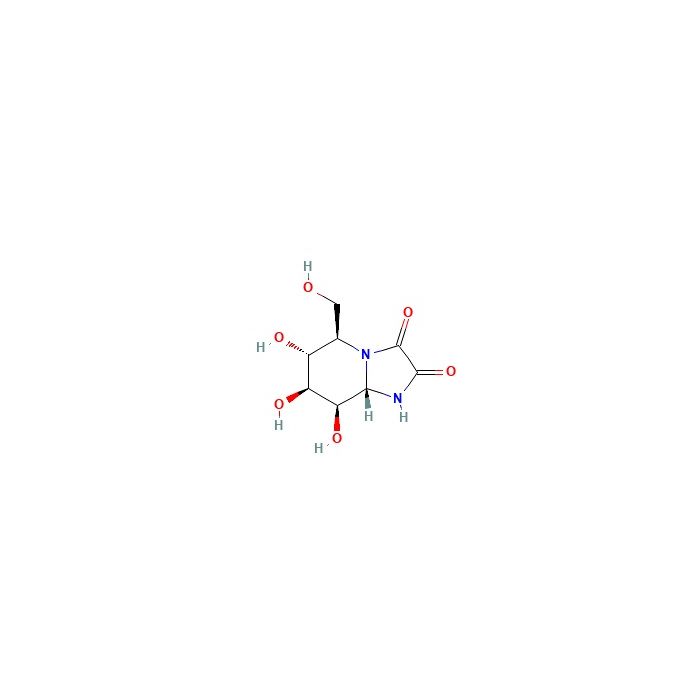
Kifunensine is an effective selective inhibitor of type I α-mannosidases that can be isolated from actinomycetes. It can prevent the trimming of mannose residues on glycoproteins by α-mannosidases I. Kifunensine can inhibit the endoplasmic reticulum-related protein degradation pathway.
Comprehensive hazard, handling, storage, and regulatory compliance document.
Download SDS →Lot-specific quality data. Enter your lot number to retrieve the exact COA.
Look up COA →Full quality attributes and acceptance criteria for this grade.
View spec sheet →Taxonomy Tree
| Kingdom | Organic compounds |
|---|---|
| Superclass | Organic acids and derivatives |
| Class | Carboxylic acids and derivatives |
| Subclass | Amino acids, peptides, and analogues |
| Intermediate Tree Nodes | Amino acids and derivatives |
| Direct Parent | Alpha amino acids and derivatives |
| Alternative Parents | Imidazopyridines Piperidines Imidazolidinones Tertiary carboxylic acid amides Secondary carboxylic acid amides Secondary alcohols Lactams Polyols Azacyclic compounds Primary alcohols Organopnictogen compounds Organonitrogen compounds Organic oxides Hydrocarbon derivatives Carbonyl compounds |
| Molecular Framework | Aliphatic heteropolycyclic compounds |
| Substituents | Alpha-amino acid or derivatives - Imidazopyridine - Imidazolidinone - Piperidine - Imidazolidine - Tertiary carboxylic acid amide - Carboxamide group - Lactam - Secondary carboxylic acid amide - Secondary alcohol - Azacycle - Organoheterocyclic compound - Polyol - Organooxygen compound - Organonitrogen compound - Alcohol - Hydrocarbon derivative - Organic oxide - Organopnictogen compound - Organic oxygen compound - Carbonyl group - Organic nitrogen compound - Primary alcohol - Aliphatic heteropolycyclic compound |
| Description | This compound belongs to the class of organic compounds known as alpha amino acids and derivatives. These are amino acids in which the amino group is attached to the carbon atom immediately adjacent to the carboxylate group (alpha carbon), or a derivative thereof. |
| External Descriptors | Not available |
| Activity Type | Relation | Activity value | Units | Action Type | Journal | PubMed Id | doi | Assay Aladdin ID |
|---|
| Activity Type | Relation | Activity value | Units | Action Type | Journal | PubMed Id | doi | Assay Aladdin ID |
|---|
| Activity Type | Relation | Activity value | Units | Action Type | Journal | PubMed Id | doi | Assay Aladdin ID |
|---|
Find and download the COA for your product by matching the lot number on the packaging.
| Lot Number | Certificate Type | Date | Item |
|---|---|---|---|
 H2624506 | Certificate of Analysis | Aug 13, 2026 | K274698 |
| H2624532 | Certificate of Analysis | Aug 13, 2026 | K274698 |
| G2301601 | Certificate of Analysis | Jul 03, 2026 | K274698 |
| G2301609 | Certificate of Analysis | Jul 03, 2026 | K274698 |
| A2426069 | Certificate of Analysis | May 20, 2026 | K274698 |
| D2630333 | Certificate of Analysis | Mar 26, 2026 | K274698 |
| D2630335 | Certificate of Analysis | Mar 26, 2026 | K274698 |
| I2410406 | Certificate of Analysis | Mar 18, 2026 | K274698 |
| I2410403 | Certificate of Analysis | Jun 11, 2025 | K274698 |
| K2218603 | Certificate of Analysis | Aug 26, 2022 | K274698 |
| K2218605 | Certificate of Analysis | Aug 26, 2022 | K274698 |
| B2223449 | Certificate of Analysis | Jan 26, 2022 | K274698 |
| B2223477 | Certificate of Analysis | Jan 26, 2022 | K274698 |
| Solubility | Soluble in water to 10 mM (with warming) |
|---|---|
| Melt Point(°C) | >208°C (dec.) |
| Molecular Weight | 232.190 g/mol |
| XLogP3 | -2.800 |
| Hydrogen Bond Donor Count | 5 |
| Hydrogen Bond Acceptor Count | 6 |
| Rotatable Bond Count | 1 |
| Exact Mass | 232.07 Da |
| Monoisotopic Mass | 232.07 Da |
| Topological Polar Surface Area | 130.000 Ų |
| Heavy Atom Count | 16 |
| Formal Charge | 0 |
| Complexity | 334.000 |
| Isotope Atom Count | 0 |
| Defined Atom Stereocenter Count | 5 |
| Undefined Atom Stereocenter Count | 0 |
| Defined Bond Stereocenter Count | 0 |
| Undefined Bond Stereocenter Count | 0 |
| The total count of all stereochemical bonds | 0 |
| Covalently-Bonded Unit Count | 1 |
No tested or validated protocols are provided in the Product Data for this SKU.
Context for researchers (literature/general):
Important caveats:
Item-specific biological activity parameters (potency, Ki/IC50, selectivity): Not specified for this item; consult primary literature and perform in-system validation.
This product is not a buffering reagent. However, it is commonly dosed into buffered biological media in research settings.
Practical notes (general):
Item-specific buffer recipes, pH ranges, or concentrations: Not specified for this item; refer to CoA/Spec Sheet and validate in your system.
As a solid bioactive compound used at low concentrations, the “greenness” considerations focus on solvent choice and handling rather than replacing the molecule itself.
Greener handling considerations (general):
Comparison of solvent options (general):
Packaging and storage:
Note: There are no “alternative actives” to kifunensine within this listing; selection of different tool compounds should be based on scientific rationale rather than green chemistry alone.
No excipient or pharmacopeial role is provided for this item.
Regulatory/compendial status:
Any claims of therapeutic benefit are outside the scope of this product and are not made.
Item-specific specifications are not provided in the Product Data. Refer to the CoA/Spec Sheet for definitive values.
General physicochemical profile (literature/general):
What Moligand™ implies (general description):
Stabilizers and additives:
Analytical documentation and suitability:
Practical notes:
This product is primarily a bioactive research compound rather than a synthetic reagent. Accordingly, its laboratory applications are predominantly in chemical biology and glycobiology rather than as a stoichiometric reactant.
Research applications (literature/general):
Assay design notes (general practice):
Synthetic chemistry usage:
Item-specific application claims from manufacturer: none provided beyond Research Use Only.
This compound is not typically used to drive chemical reactions; instead it is dosed as a solution into biological systems. Consequently, there are no standard “reaction conditions” in the synthetic sense for this SKU.
General solution preparation (research practice):
Expected yields, catalysts, or time courses (synthetic context): Not applicable.
Item-specific preparation instructions: Not specified for this item; refer to CoA/Spec Sheet and SDS.
Authoritative safety data must be taken from the product-specific SDS.
General laboratory precautions (good practice):
Shipping/storage risk controls:
Kifunensine is a polar, polyhydroxylated small molecule. Solvent choice is driven by assay compatibility and solubility.
General solvent behavior (literature/general):
Selection guidance:
Quick comparison (general):
Item-specific solubility values: Not specified for this item; refer to CoA/Spec Sheet.
Item-specific conditions (from Product Data):
Reconstitution:
General handling guidance (good practice):
Stability:
Brief description: Kifunensine is a polyhydroxylated, bicyclic indolizidine alkaloid widely used as a research tool compound in glycobiology.
Structural features (literature/general):
Identity notes:
Kifunensine is generally the end product (a bioactive tool compound) rather than a synthetic intermediate or reagent.
Use in synthesis workflows:
Item-specific synthetic specifications (reactivity, protective group strategies, etc.): Not specified for this item; consult primary literature for total synthesis/derivatization methods.
Target/biological specificity details are not provided in the Product Data for this SKU.
Note: Any mechanistic or target discussions elsewhere are general literature context and are not item-specific claims.
Our grade selection guide covers purity, stabilizer status, and application suitability for all variants in our catalog.
View Moligand™ grade guide →