It is an important raw material and intermediate used in organic synthesis, pharmaceuticals, agrochemicals and dyestuff. Also it is a efficient organocatalysts for aldol reactions on water.
This compound belongs to the class of organic compounds known as pyrrolidines. These are compounds containing a pyrrolidine ring, which is a five-membered saturated aliphatic heterocycle with one nitrogen atom and four carbon atoms.
1. Djoumbou Feunang Y, Eisner R, Knox C, Chepelev L, Hastings J, Owen G, Fahy E, Steinbeck C, Subramanian S, Bolton E, Greiner R, and Wishart DS. ClassyFire: Automated Chemical Classification With A Comprehensive, Computable Taxonomy. Journal of Cheminformatics, 2016, 8:61.
Determine the necessary mass, volume, or concentration for preparing a solution.
Dilution Calculator
Determine the dilution needed to prepare a stock solution.
Reconstitution Calculator
Reviews
Customer Reviews
Application Protocols
No assay-specific protocols are validated for this catalog item. As a small-molecule reagent, L-Prolinamide is typically used according to reaction procedures or synthetic routes selected by the researcher.
General usage examples (literature-style guidance)
Organocatalysis: dissolve L-Prolinamide (5–30 mol%) in the chosen solvent, add carbonyl donor and electrophile, and stir at ambient temperature; optionally include a weak acid additive. Monitor by TLC/GC/HPLC.
Peptide coupling: dissolve the peptide acid and L-Prolinamide in DMF (or alternative), add coupling reagent and base at 0–25 °C, and stir until completion; quench and purify by preparative HPLC or crystallization.
Refer to peer-reviewed procedures or internal SOPs; adjust stoichiometry and conditions based on substrate scope and scale.
Biological Roles
Context (general biochemistry)
L-Prolinamide is the carboxamide derivative of the proteinogenic amino acid L-proline. While not a standard metabolite, it retains the pyrrolidine ring and secondary amine that influence conformation and hydrogen-bonding.
Enzyme substrate analog: amide derivatives of amino acids are sometimes used as probes to study enzyme recognition where the carboxylate is replaced by an amide to attenuate charge and modify binding.
Peptidomimetic design: incorporation of prolinamide motifs can modulate backbone conformation, cis/trans amide equilibria, and proteolytic stability in model systems.
Transport and uptake: neutral amide derivatives generally show different membrane permeability relative to zwitterionic amino acids, useful for structure–permeability investigations.
Stereochemical considerations
The L-configuration matches biological chirality of proteins; stereospecific interactions may occur in enzymatic assays, though outcomes are system-dependent.
Note: The above points summarize general biochemical utility and do not imply any medical or clinical application. This product is for research use only.
Buffer Applications
L-Prolinamide is not a conventional buffering agent. It lacks a conjugate acid/base pair with a suitable pKa/pH window and is not used to prepare standard laboratory buffers.
Practical guidance
For buffering near neutral to mildly basic pH, select established systems (e.g., phosphate, HEPES, Tris). If L-Prolinamide is present in solution (e.g., as catalyst or additive), its protonation state may vary with pH, potentially affecting solubility but not providing appreciable buffer capacity.
If pH control is critical during organocatalytic reactions, employ a separate buffer or controlled addition of acid/base and monitor with pH electrode.
Refer to specialized buffering reagents for pH control; see Reaction & Applications and Solvent Selection for more relevant guidance with this compound.
Green Alternatives
When L-Prolinamide is used as an organocatalyst or chiral auxiliary, significant opportunities exist to implement greener conditions.
Solvent greening (literature guidance)
Prefer water, ethanol, or 2-propanol over dipolar aprotics when feasible.
Aqueous micellar media or deep eutectic solvents can enhance rates/selectivity while reducing solvent hazard.
Catalyst choice
L-Proline (parent acid) is a benchmark bio-derived, benign organocatalyst; L-Prolinamide can offer different solubility/H-bonding profiles. Selection should balance performance and environmental impact.
Energy and process intensification
Many enamine-catalyzed reactions proceed at ambient temperature; avoid unnecessary heating.
Solvent-free (“neat”) or high-solids aldol/Mannich reactions are documented, reducing solvent volumes.
Comparison snapshot (general, literature-based)
| Option | Advantages | Trade-offs |
|---|---|---|
| Water/EtOH as solvent | Renewable, low toxicity, easy work-up | May reduce rate/ee for some substrates |
| L-Proline vs L-Prolinamide | Bio-based, minimal processing vs tunable H-bonding, altered solubility | Prolinamide sometimes requires dipolar aprotics; synthesis adds steps |
| Micellar media | Lower solvent use; surfactant enables hydrophobic substrates | Surfactant sourcing and removal considerations |
Waste minimization
Recover catalyst by aqueous extraction/crystallization where possible.
Use high-atom-economy donors (e.g., simple ketones/aldehydes) and avoid stoichiometric chiral auxiliaries when catalytic routes achieve targets.
Adopt a holistic approach: solvent selection, energy input, and catalyst recyclability typically dominate the green profile.
Pharmaceutical Uses
Role in development and manufacturing (general; no therapeutic claims)
Chiral building block: L-Prolinamide serves as a precursor to proline-derived amide fragments in peptidomimetics and small-molecule libraries.
C-terminal amidation: used to introduce a proline-amide terminus in peptide synthesis by coupling prolinamide to a peptide acid, yielding –Pro–CONH2 ends common in bioactive peptide analogs.
Organocatalyst in API intermediate synthesis: enables enantioenriched aldol/Mannich/Michael adducts under metal-free conditions, supporting greener route scouting.
Formulation/excipient status
Not a common excipient and not listed here with any pharmacopeial monograph. Suitability for GMP use must be assessed case-by-case.
Developability considerations (practical)
Salt selection: protonation of the ring nitrogen (e.g., HCl salt) can improve crystallinity and processing if needed.
Analytical controls: chiral purity and residual solvent profiles should be established early; amide integrity can be monitored by IR (amide I/II) and NMR.
This product is provided for research use only and is not intended for human or veterinary use.
Physical Properties
Item-specific specifications
Appearance: Not specified for this item; refer to CoA/Spec Sheet.
Storage and shipping (from Product Data)
Storage: Room temperature
Shipped: Normal
Literature/typical properties (for general reference; not item specifications)
Physical state: typically a crystalline solid (literature)
Taste/odor: odorless to faint (literature)
Acid–base: secondary amine can be protonated (conjugate acid pKa typically ~10–11 range for pyrrolidines); amide is essentially nonbasic (literature, qualitative)
Solubility: generally readily soluble in water; soluble in polar protic/aprotic solvents (e.g., MeOH, EtOH, DMF, DMSO); low solubility in nonpolar hydrocarbons (literature, qualitative)
Hygroscopicity: amino amides can exhibit moisture uptake; handle in a dry environment for analytical work (general guidance)
Optical activity: L-enantiomer exhibits specific rotation in aqueous or alcoholic media (value depends on solvent/concentration; literature)
Numerical values such as melting point, boiling point, density, pKa, logP, refractive index
Not specified for this item; refer to CoA/Spec Sheet.
Practical note: When accurate physical constants are required for method development (e.g., chromatography, crystallization), verify using the product-specific CoA or measure under your lab conditions.
Quality & Grades
Grade/Purity: Not specified for this item; refer to CoA/Spec Sheet.
What grade implies (general guidance)
Research-grade amino-amides are typically assessed for identity (1H/13C NMR), mass, and purity by HPLC/GC, with chiral purity for L-configuration when applicable. If optical purity is critical (e.g., for asymmetric catalysis), confirm enantiomeric excess on the item CoA.
Stabilizers/Additives
No stabilizers are indicated in the Product Data. If present in a specific lot, they will be disclosed on the CoA/Spec Sheet.
Analytical considerations (practical tips)
Optical purity: verify [α]D or chiral HPLC.
Residual solvents/water: Karl Fischer or TGA as needed for precise stoichiometry.
Metal content: typically not critical for organocatalysis, but can be reported on request depending on application.
Item-specific storage from Product Data
Store at room temperature in a tightly closed container. For best shelf-life, protect from prolonged exposure to humidity and light.
For any unlisted parameters (e.g., water content, residual solvents, enantiomeric excess), see the lot CoA or contact Technical Support.
Reaction & Applications
L-Prolinamide is widely used as a chiral organocatalyst and chiral building block. It preserves the key catalytic elements of L-proline while offering altered H-bonding and polarity via the amide, which can tune reactivity and selectivity.
Organocatalysis (literature examples)
Aldol reactions (Hajos–Parrish–Eder–Sauer–Wiechert type): secondary amine forms an enamine with ketones/aldehydes; the amide participates in transition-state H-bonding to enhance enantioselectivity.
Mannich reactions: iminium/enamine catalysis generating β-aminocarbonyls with high enantio- and diastereocontrol in suitable systems.
Michael additions: activation of carbonyl donors toward conjugate addition to nitroolefins or enones under mild conditions.
Cascade sequences: tandem aldol–condensations or cyclizations leveraging dual activation.
Chiral auxiliary/building block
Precursor to peptidomimetic motifs and constrained amide scaffolds.
Convenient source of C-terminally amidated proline fragments in peptide assembly (via coupling onto peptide acids).
Practical tips
Catalyst loadings: commonly 5–30 mol% (literature), adjusted to substrate and solvent.
Additives: weak acids (e.g., benzoic acid, TFA at low mol%) can accelerate enamine formation and improve stereocontrol; water can modulate rate/selectivity.
Solvents: polar protic (EtOH, iPrOH, water/EtOH) or polar aprotic (DMSO, DMF, MeCN) depending on substrate and green chemistry goals.
Work-up: neutral aqueous wash removes catalyst; solid-supported scavengers can assist. Enantiomeric excess assessed by chiral HPLC/GC or derivatization.
All examples above are provided as literature guidance for planning and optimization.
Reaction Conditions
The following parameters summarize literature-style conditions frequently reported with L-proline-derived amide catalysts; they are general guidance, not item specifications.
Aldol reactions (literature typical)
Catalyst loading: 10–30 mol% L-Prolinamide.
Solvent: DMSO, DMF, MeOH/EtOH, water/EtOH mixtures, or neat.
Temperature: 0–25 °C (ambient often sufficient).
Additives: 0–20 mol% weak acid (e.g., benzoic acid) to accelerate; small amounts of water can improve rate/selectivity.
Time/yield: hours to overnight; moderate to high yields with good to excellent ee depending on substrates.
Mannich/Michael additions (literature typical)
Solvent: MeOH, EtOH, iPrOH, MeCN, or DMSO; sometimes biphasic with water.
Temperature: 0–25 °C; cooling can improve diastereocontrol when imines are used.
Additives: acid co-catalysts (e.g., TFA traces) or bases (for donor deprotonation) as needed.
Peptide coupling to install proline amide terminus
Reagents: carbodiimides (EDC/HOBt), HATU/HOAt, or DIC/Oxyma.
Solvent: DMF, NMP, or mixed DMF/DCM; for greener variants use EtOAc/MeCN with soluble coupling systems.
Base: DIPEA or NMM; temperature 0–25 °C.
Consider stereointegrity: racemization at proline α-center is minimal but monitor by chiral HPLC.
Optimization is substrate-dependent; screen solvent, additive, and temperature to balance rate and selectivity.
Safety & Handling
Item-specific hazard information
Signal word: Not specified for this item; refer to SDS.
H-statements: Not specified for this item; refer to SDS.
GHS classification/pictograms: Not specified for this item; refer to SDS.
General laboratory safety (good practice; not a substitute for SDS)
PPE: lab coat, safety glasses, appropriate gloves (e.g., nitrile). Avoid inhalation of dust and contact with skin/eyes.
Engineering controls: handle powders in a fume hood or with local exhaust; avoid generating dust.
First aid (general): if inhaled—move to fresh air; skin/eye contact—rinse with water for several minutes; ingestion—rinse mouth. Seek medical attention per SDS guidance.
Fire safety: organic solids may burn; use water spray, dry chemical, CO2, or foam as appropriate. Combustion may produce nitrogen oxides and carbon oxides.
Incompatibilities (general chemistry knowledge)
Strong oxidizers and strong acids/bases may cause degradation or reaction; avoid contact. Amides are generally stable, but the secondary amine can be protonated by strong acids.
Handling tips specific to amino amides (practical)
For analytical work, minimize moisture uptake; keep container tightly closed. If preparing salt forms (e.g., HCl), account for protonation state in stoichiometry.
Always consult the product SDS for definitive hazard classification, exposure limits, and response procedures.
Solvent Selection
L-Prolinamide is a polar, hydrogen-bonding solid with both H-bond donor (–NH, –CONH2) and acceptor sites (amide C=O, ring N). Solvent choice should reflect its polarity and intended use (substrate, catalyst, or intermediate).
High solubility: water, methanol, ethanol, isopropanol, DMSO, DMF.
Moderate to low: acetonitrile, acetone (depends on temperature and concentration).
Poor: nonpolar hydrocarbons (hexanes, toluene) without cosolvent.
Polarity considerations
As a bifunctional donor/acceptor, it engages in strong solvent–solute H-bonding. Polar protic solvents facilitate dissolution and can influence catalytic activity via hydrogen-bond networks.
When to choose which solvent (practical)
Aqueous or aqueous-alcoholic media: green conditions for organocatalysis (e.g., aldol reactions) and biocompatible transformations.
Alcohols (MeOH/EtOH/iPrOH): good for dissolving both the catalyst and many carbonyl substrates; easy work-up.
DMSO/DMF: maximize solubility for high-concentration reactions or for difficult substrates; consider removal burden.
Mixed solvents: add small amounts of water or alcohol to acetonitrile or dioxane to enhance solubility without over-stabilizing intermediates.
Comparison (general)
Water/EtOH vs DMF/DMSO: greener and easier to remove but may affect rate/selectivity; polar aprotics offer higher rates for some enamine/iminium pathways.
Note: For chromatographic method development, aqueous buffers or polar modifiers (MeOH, ACN) are typically required due to strong retention on normal-phase media.
Storage & Reconstitution
Item-specific storage and shipping
Storage Conditions: Room temperature (from Product Data).
Shipped In: Normal (from Product Data).
Stability and handling (general guidance)
Keep tightly closed in a dry place. For long-term storage, a desiccator is recommended to minimize moisture uptake.
Avoid prolonged exposure to heat and light. Under normal lab conditions, amino amides are stable for extended periods.
Reconstitution and working solutions (literature/general)
Solubility: readily soluble in water and polar organic solvents such as methanol, ethanol, DMF, and DMSO (literature, qualitative).
Preparation: dissolve to the desired concentration with gentle stirring. For water-sensitive applications, use freshly opened anhydrous solvents.
Filtration: 0.2 µm sterile filtration can be used to clarify solutions for biochemical assays.
Storage of solutions: aqueous solutions are best prepared fresh; if needed, refrigerate and use within a few days. Organic solutions can be stored in sealed vials under inert gas at 2–8 °C for short periods.
Notes
No reconstitution buffer or stabilizer is required unless dictated by the application.
For any unlisted parameters (e.g., solubility limits, pH effects), consult the CoA/Spec Sheet or perform a small-scale feasibility test.
Research Use Note: For research use only.
Structure & Identity
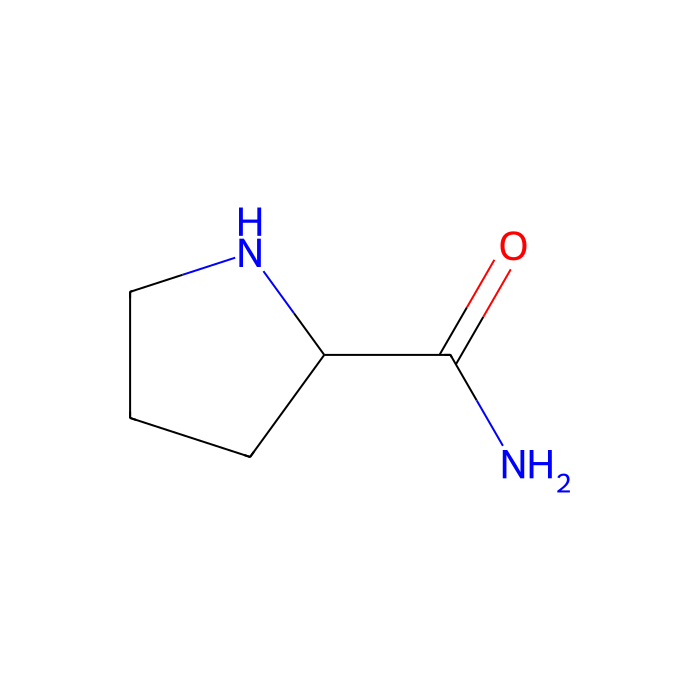
L-Prolinamide is the primary carboxamide of L-proline, retaining the chiral pyrrolidine ring and secondary amine while replacing the carboxylic acid with an amide.
Item-specific identifiers (from Product Data)
CAS: 7531-52-4
CID: 111306
InChIKey: Not specified for this item; refer to CoA/Spec Sheet.
SMILES: Not specified for this item; refer to CoA/Spec Sheet.
Literature identity (typical reference values; not item specifications)
Heterocycle: five-membered saturated pyrrolidine ring containing one secondary amine nitrogen.
Functional groups: secondary amine (ring nitrogen) and primary carboxamide (–CONH2) at C-2.
2D description: a five-membered ring (four carbons and one nitrogen), with the alpha carbon (adjacent to ring nitrogen) bearing the carboxamide substituent; stereochemistry at this alpha carbon is S (L-configuration).
Note: Structural identifiers above marked as “literature” are provided for context only and are not item-specific specifications.
Synthetic Utility
L-Prolinamide integrates a secondary amine and a primary amide within a chiral pyrrolidine framework, providing multiple modes of reactivity and stereocontrol.
Functional-group behavior (general)
Secondary amine: forms enamines/iminium ions with carbonyl partners—key to enantioselective organocatalysis.
Primary amide: strong H-bond donor/acceptor; can engage substrates or transition states; can be derivatized (e.g., N-acylation, activation to imidates) under appropriate conditions.
Enantioselective Mannich and Michael additions using proline-derived catalysts.
Building-block roles
Introduction of constrained proline-amide motifs in peptidomimetic scaffolds to bias secondary structure (turns, β-hairpins).
Access to N-acyl prolinamides and cyclic ureas via intramolecular coupling strategies.
Retrosynthetic leverage
Disconnection at the amide allows late-stage incorporation onto carboxylic acids to furnish C-terminally amidated proline residues.
The chiral center at C-2 can be propagated to adjacent stereocenters through enamine-mediated α-functionalization of carbonyl compounds.
Practical notes
Protecting groups are often unnecessary; however, selective acylation of the amide vs ring nitrogen may require conditions control (e.g., activating agents, solvent polarity, temperature).
For catalysis, small acid additives can tune rate/ee; water often beneficial in aldol chemistry.
Target Specificity
Not applicable. This product is a small-molecule research chemical (L-Prolinamide), not an antibody or affinity reagent. No antigen, epitope, clone, or isotype information applies.
Frequently Asked Questions
What is the purity of this product?
This product is supplied at ≥98% purity (chemical assay). Lot-specific values are stated on the Certificate of Analysis.
How should this product be stored?
Store at room temperature.
How is this product shipped?
This product ships under standard ambient conditions. No temperature-controlled packaging is required.
What are the CAS number, molecular formula and molecular weight?
The CAS Number is 7531-52-4, the molecular formula is C5H10N2O, and the molecular weight is 114.15 g/mol. InChIKey VLJNHYLEOZPXFW-BYPYZUCNSA-N.
What documentation is provided?
Available product documentation, including Certificates of Analysis (COA), Safety Data Sheets (SDS), and specification sheets, is shown in the product document area. Document availability and access follow the current site policy.
We use cookies to ensure the website functions properly and, where permitted, to improve your experience. You can manage your preferences at any time in Settings. Learn more in our Cookie Policy.
Shall we send you a message when we have discounts available?
Remind me later
Thank you! Please check your email inbox to confirm.
Products are supplied to verified businesses, institutions, and qualified professionals for research and development use only. Not for use in humans, animals, diagnosis, or therapy.

 C1802043