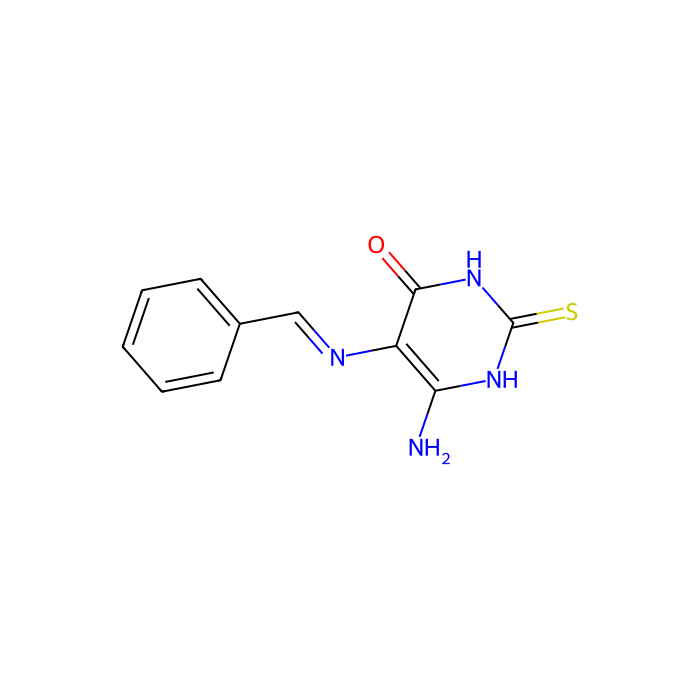
DNA ligase I, III and IV inhibitor (IC50values are 5, 9 and 5μM respectively) that blocks DNA binding (Ki= 5μM for DNA ligase I). Preferentially inhibits step 2 of the ligation reaction, and inhibits base excision repair (BER) and non-homologous end joini
Storage
Store at -20°C
Shipped In
Ice chest + Ice pads
This product requires cold chain shipping. Ground and other economy services are not available.
This compound belongs to the class of organic compounds known as pyrimidones. These are compounds that contain a pyrimidine ring, which bears a ketone. Pyrimidine is a 6-membered ring consisting of four carbon atoms and two nitrogen centers at the 1- and 3- ring positions.
External Descriptors
Not available
1. Djoumbou Feunang Y, Eisner R, Knox C, Chepelev L, Hastings J, Owen G, Fahy E, Steinbeck C, Subramanian S, Bolton E, Greiner R, and Wishart DS. ClassyFire: Automated Chemical Classification With A Comprehensive, Computable Taxonomy. Journal of Cheminformatics, 2016, 8:61.
Determine the necessary mass, volume, or concentration for preparing a solution.
Dilution Calculator
Determine the dilution needed to prepare a stock solution.
Reconstitution Calculator
Reviews
Customer Reviews
Application Protocols
Item-specific validated protocols
Not specified for this item.
General protocols for small-molecule screening compounds (research use only)
Stock solution preparation:
Weigh quickly in a low-humidity environment. Prepare 10 mM stock in anhydrous DMSO; sonicate if needed. Record exact concentration by weight and volume.
Optional: Determine concentration by UV–Vis if chromophore known; otherwise rely on gravimetric preparation.
Aliquoting and storage:
Dispense into single-use aliquots (10–50 µL) in screw-cap, low-bind tubes. Store at −20°C or below, protected from light.
Working solutions:
Dilute into assay buffer with ≤1–2% DMSO final (optimize per assay). Include vehicle controls at matching DMSO content.
Quality control before use:
Check purity/identity by LC–MS. Inspect for precipitation after dilution; if present, reduce concentration or increase co-solvent within assay tolerance.
Record-keeping:
Track freeze–thaw cycles and time at room temperature. Discard aliquots after excessive handling or visible degradation.
Biological Roles
Item-specific
No biological function or target annotation is provided for this item. Do not infer mechanism or target engagement without supporting data.
General considerations for small molecules in research (non-clinical)
Small molecules may act as enzyme inhibitors/activators, receptor ligands, or pathway modulators. Confirm specificity with orthogonal assays and counterscreens to rule out assay artifacts (e.g., PAINS behavior, redox cycling, aggregation).
Evaluate physicochemical properties (once known) for permeability (e.g., cLogP, PSA), solubility, and stability as they affect cellular assays.
For biochemical assays, determine potency (IC50/Ki/EC50) under defined substrate/cofactor conditions and test for time-dependence or covalency if reactive motifs are present.
Documentation
Cite the batch CoA and any internal characterization (LC–MS/NMR) in your lab notebook. If a literature entry exists for CAS 64232-83-3 or CID 824710 in your organization, link it to ensure consistent biological interpretation.
Buffer Applications
Applicability
This product is a small organic compound from a screening/library context and is not a buffering agent. No buffer system, pKa, or buffering range is provided.
Practical note
If required in aqueous buffer for assays, use a co-solvent strategy (e.g., ≤1–2% DMSO or acetonitrile) and adjust pH only if the compound’s ionizable groups are known from the CoA. Avoid claiming buffering capacity or using it as a buffer component.
Green Alternatives
Item-specific
No process-use context or solvent-of-use is specified for this item; green alternatives apply mainly to solvents and large-scale reagents.
General guidance for greener handling of small-molecule screening compounds
Prefer low-toxicity, bio-based, or recyclable solvents for stock preparation and workups when compatible with the molecule and assay (e.g., ethanol over methanol; acetonitrile over dichloromethane in analytics when feasible).
Minimize DMSO waste by preparing concentrated master stocks and aliquoting into microtubes to extend shelf life and reduce disposals.
Use microscale operations, parallel evaporation with solvent recovery, and closed-vial sonication to limit VOC emissions.
Implement analytical methods that reduce solvent usage (UPLC vs. HPLC, shorter columns, aqueous mobile phases with greener modifiers when possible).
Tradeoffs to consider
Some greener solvents can alter solubility or assay interference profiles; always re-qualify assay performance after changing solvent systems.
Stability in aqueous ethanol or bio-based solvents may differ from DMSO; verify by LC–MS over time.
Pharmaceutical Uses
Item-specific
No pharmacopeial status, excipient role, or formulation function is provided for this item.
General guidance (research-only; no clinical use)
Library compounds like L189 can be used in pre-formulation research to assess solubility, stability, and compatibility with common excipients at micro-scale, informing discovery-stage developability assessments.
If proceeding to formulation studies, document solvent residuals and polymorph/salt form (from CoA) and perform forced-degradation screens (pH, light, oxidative) to understand liabilities. These activities remain strictly for research use only.
Compliance note
This product is labeled For research use only and is not intended for human or veterinary use, diagnostic procedures, or as an API/excipient in commercial products.
Physical Properties
Item-specific (from Product Data)
Appearance: Not specified for this item; refer to CoA/Spec Sheet.
Storage: Store at -20°C (per Product Data)
Literature/computed values for this exact CAS: Not available in this listing. Do not assume phase, melting point, boiling point, density, pKa/logP, or refractive index.
General guidance for small-molecule library members (informational)
Physical state can vary (crystalline solid, amorphous solid, or viscous oil). Inspect vial after equilibration to room temperature and record observations.
Solubility strategy:
Prepare a small test dissolution series: DMSO (anhydrous) → DMF → ethanol or isopropanol → acetonitrile → aqueous buffer with co-solvent (≤1–2% DMSO), as compatible with downstream assays.
For ionic species (if known), adjust pH to favor ionization for aqueous solubility, or salt-swap if a salt form is available (check CoA).
Hygroscopicity/volatility: Unknown. Minimize ambient exposure; recap promptly; use desiccant.
Thermal behavior: Unknown. Avoid prolonged heating; keep below room temperature during handling if stability is uncertain.
Note: For definitive specifications (mp, purity by HPLC, water content, residual solvents), refer to the item’s CoA/Spec Sheet.
Quality & Grades
Item-specific (from Product Data)
Grade/Purity: Not specified for this item; refer to CoA/Spec Sheet.
Guidance on interpreting grades for small-molecule libraries (general)
Screening/Research grade: Typically intended for hit discovery, SAR, and in vitro assays; analytical data often include HPLC purity and MS. If grade is stated on the CoA, expect purity by chromatographic assay (e.g., area % at a specified wavelength) and identity by MS/1H NMR.
Stabilizers or counter-ions: If present, these should be disclosed on the CoA. Stabilizers can influence UV background and assay interference; counter-ions impact solubility and pH.
UV cutoffs, metal limits, residual solvent, and water (KF): Unless explicitly listed on the CoA, do not assume specifications.
What to request when qualifying for regulated workflows
Batch-specific CoA with HPLC chromatogram, MS, and, if applicable, NMR.
Impurity profile thresholds relevant to your assay.
Confirmation of salt form/solvate/hydrate, if any.
Statement of storage and shipping conditions (provided here: Store at -20°C; shipped cold).
Reaction & Applications
Item-specific applications (from Product Data)
Manufacturer Applications: Not specified in the listing.
Likely research uses for a library compound (general, non-clinical)
High-throughput screening (HTS) and fragment/lead identification.
Secondary assays, counter-screens, and mechanism-of-action studies following an initial hit.
Structure–activity relationship (SAR) development if analog series data are available.
Reference compound or control in biochemical or cell-based assays when aligned to a known target class (verify via CoA or literature for this CAS if available to your team).
Notes for experimentalists
Prepare DMSO stocks (e.g., 10 mM) and store as aliquots at −20°C to avoid repeated freeze–thaw.
Test for assay interference (auto-fluorescence, aggregation, redox activity) using orthogonal readouts and detergent controls (e.g., 0.01–0.05% Tween-20) where appropriate.
Verify identity/purity in-house by LC–MS prior to critical experiments.
If synthetic elaboration is planned, obtain structural details (functional groups, stereochemistry) from the CoA to design derivatizations judiciously.
Reaction Conditions
Item-specific
No reaction conditions or use-case chemistry are provided for this specific compound.
General guidance (informational only)
If L189 is to be transformed, begin with small-scale scouting in dry, oxygen-free solvents where appropriate (e.g., for air/moisture-sensitive transformations).
Temperature: Start at ambient; escalate cautiously while monitoring stability by TLC/LC–MS.
Catalysis: Choose conditions based on confirmed functional groups (e.g., Pd-catalyzed cross-coupling for aryl halides; reductive amination for carbonyl–amine pairs).
Workup: Favor minimal aqueous workups to avoid losses for highly lipophilic compounds; consider SPE or miniaturized chromatography.
Yields and times: Must be established empirically once structure and reactivity are known—do not assume literature yields for an unidentified scaffold.
Safety & Handling
Item-specific hazard data (from Product Data)
Signal Word: Not specified for this item; refer to SDS.
H-Statements: Not specified for this item; refer to SDS.
GHS Classification/Pictograms: Not specified for this item; refer to SDS.
General laboratory precautions for unknown small-molecule solids/liquids
Treat as potentially harmful. Use in a fume hood with appropriate PPE: lab coat, safety glasses, and disposable nitrile gloves (double-glove for extended handling). Avoid skin/eye contact and inhalation of dust or vapors.
Storage incompatibilities: Keep away from strong oxidizers, strong acids/bases, and sources of ignition until specific compatibility is known. Segregate from peroxidizable solvents unless stability is established.
First aid overview (consult SDS for authoritative guidance):
Inhalation: Move to fresh air; seek medical attention if symptoms persist.
Skin/eye contact: Rinse with plenty of water for ≥15 minutes; remove contaminated clothing; seek medical attention if irritation continues.
Ingestion: Rinse mouth; do not induce vomiting; obtain medical assistance.
Spill response: Contain with inert absorbent; avoid dust generation; dispose per institutional hazardous waste protocols.
Fire-fighting: Use CO2, dry chemical, or foam; combustion may produce CO/CO2 and unknown toxic fumes—firefighters should wear SCBA.
Note: Always defer to the product-specific SDS and CoA for definitive hazard, toxicological, and reactivity information.
Solvent Selection
Item-specific details
Solubility data are not provided for this item. Begin with DMSO stock solutions unless your assay prohibits DMSO.
General strategy for dissolving unknown small molecules
Primary solvent: DMSO (anhydrous) at 10–50 mM; warm gently (≤40°C) and vortex/sonicate. Filter through 0.22 µm if particulate remains.
Secondary options: DMF, NMP for difficult cases; follow with water-miscible co-solvents (acetonitrile, ethanol, isopropanol) as assay permits.
Aqueous work: Use co-solvent ≤1–2% DMSO or ACN; consider pH adjustment if acidic/basic functionality is known from CoA.
Polarity considerations (general)
Without a structure, dielectric/miscibility class cannot be assigned. Empirically bracket with a polarity panel: hexanes, toluene, EtOAc, MeCN, MeOH, water to map solubility profile.
Practical tips
Avoid strong acids/bases unless stability is confirmed.
Record exact preparation: solvent lot, concentration, any pH modifiers. This facilitates reproducibility in screening campaigns.
For light/air-sensitive compounds (unknown), minimize exposure and consider amber vials and inert gas.
Storage & Reconstitution
Item-specific (from Product Data)
Storage Conditions: Store at -20°C.
Shipped In: Ice chest + Ice pads.
Reconstitution (general guidance for small molecules)
Solvent: Use anhydrous DMSO as the default for initial reconstitution unless contraindicated by the CoA. Typical starting concentration: 10–50 mM.
Technique: Allow vial to equilibrate to room temperature in a desiccated environment before opening to avoid condensation. Quickly weigh and re-cap. Vortex/sonicate to fully dissolve; warm gently (≤40°C) if needed.
Filtration: If particulates remain, sterile-filter through 0.22 µm PTFE for cell-based assays; confirm no adsorption losses.
Aliquoting and stability
Prepare single-use aliquots to minimize freeze–thaw. Store aliquots at −20°C or below, protected from light and moisture. Track the date opened and number of freeze–thaw cycles.
Solid-state stability, solution stability, and light sensitivity: Not specified for this item; refer to CoA/Spec Sheet. If unknown, limit cumulative room-temperature exposure and evaluate stability by LC–MS over time.
Compatibility and precautions
Avoid exposure to strong oxidants/acids/bases until compatibility is known. Use amber vials if photolability is suspected. Dispose of unused solutions according to institutional hazardous waste procedures.
Research Use Note
For research use only.
Structure & Identity
Item-specific (from Product Data)
SKU: L288681
Product Name: L189
CAS: 64232-83-3
PubChem CID: 824710
InChIKey: 330830
SMILES: Not specified for this item; refer to CoA/Spec Sheet.
Molecular Formula: Not specified for this item; refer to CoA/Spec Sheet.
Molecular Weight: Not specified for this item; refer to CoA/Spec Sheet.
Structural features
Not specified for this item; refer to CoA/Spec Sheet.
2D structure description (general note)
The precise functional groups, ring systems, and stereochemistry are not provided in the current listing. For accurate structural depiction and any stereochemical annotations, consult the product CoA/Spec Sheet or the primary registry entry corresponding to the CAS number above.
Synthetic Utility
Applicability to this item
The structure and functional group content of L189 are not provided; therefore, specific synthetic transformations or named-reaction roles cannot be assigned.
General considerations if using as a synthetic intermediate
Obtain full structural details (including stereochemistry, salt/solvate state) from the CoA before planning derivatizations.
Map potential handles (e.g., aryl halides for cross-coupling, carbonyls for reductive amination, amines/carboxylic acids for coupling) once the structure is known.
Confirm stability to bases/acids, oxidants/reductants, and heat by micro-scale tests and LC–MS tracking.
If metal-catalyzed couplings are contemplated, assess heteroatom content that could chelate catalysts and adjust ligand/base systems accordingly.
Documentation
Record reaction conditions and characterization of any derivatives to support SAR or property optimization in discovery workflows.
Target Specificity
Item-specific
No target, enzyme, receptor, or pathway specificity is provided for L189. There is no clone/isotype/species information, as this is not a biological reagent or antibody.
Guidance for establishing specificity (general)
Employ orthogonal assay formats (biochemical vs. biophysical vs. cellular) and include key counterscreens (aggregator, redox, fluorescence interference) to validate any apparent activity.
Develop preliminary SAR by testing close analogs to distinguish specific binding from nonspecific effects.
We use cookies to ensure the website functions properly and, where permitted, to improve your experience. You can manage your preferences at any time in Settings. Learn more in our Cookie Policy.
Shall we send you a message when we have discounts available?
Remind me later
Thank you! Please check your email inbox to confirm.
Products are supplied to verified businesses, institutions, and qualified professionals for research and development use only. Not for use in humans, animals, diagnosis, or therapy.

 D2319710