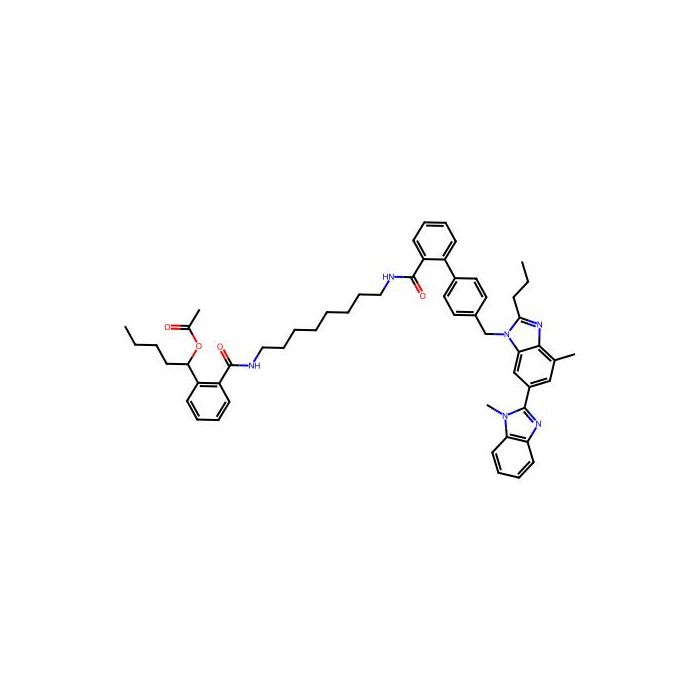
≥97% for sensitive chromatographic and analytical workflows requiring minimal baseline interference.
🌡
Storage & shipping
Store at -20°C Ships Ice chest + Ice pads Check lot-specific COA for exact specifications.
📋
Quality documents
SDS, COA, datasheet, and spec sheet available for download. Lot-specific COA accessible via lot number lookup.
📚
Literature proof
Cited in 0 peer-reviewed publications across chromatography, organic synthesis, and cross-coupling reactions.
Overview
LFHP-1c is an PGAM5 inhibitor with neuroprotective activity in brain ischemic stroke. LFHP-1c protects blood-brain barrier integrity from ischemia-induced injury. LFHP-1c binds to endothelial PGAM5 to inhibit the activity of PGAM5 phosphatase and the interaction of PGAM5 with NRF2. LFHP-1c exhibits in vitro and in vivo protection.
In Vitro
LFHP-1c (1, 2, or 5 μmol/L; 9 h) treatment, and followed by hypoxic treatment, increases NRF2 protein expression and facilitates nuclear translocation of NRF2 in primary rat brain microvascular endothelial cells (rBMECs). MCE has not independently confirmed the accuracy of these methods. They are for reference only. ImmunofluorescenceCell Line: Primary rat brain microvascular endothelial cells (rBMECs) Concentration: 2 μmol/L Incubation Time: 1 h Result: Bound to PGAM5, to facilitate nuclear translocation of NRF2.
In Vivo
LFHP-1c (5 mg/kg; iv; 2 doses) prevents BBB disruption after transient middle cerebral artery occlusion (tMCAO) in rats . LFHP-1c (3 mg/kg, 1 mL/kg; iv; 8 doses) ameliorates brain ischemic injury in tMCAO model of M. fascicularis through PGAM5–NRF2 axis . MCE has not independently confirmed the accuracy of these methods. They are for reference only. Animal Model: Nonhuman primate Macaca fascicularis model with tMCAO Dosage: 3 mg/kg, 1 mL/kg Administration: IV; at 4 h, 1, 2, 3, 4, 5, 6 and 7 days after tMCAO onset. Result: Reduced infarct volume, brain edema and neurological deficits in Transient MCAO model in M. fascicularis. Animal Model: SD rats (230-250 g) Dosage: 1 mg/kg, 5 mg/kg in 0.5 mL volume Administration: IV; injected at 4 or 12 h after ischemia onset, and then injected another time at 24 h post-ischemia Result: Dose-dependently protected rat brains against ischemia/reperfusion injury at 72 h after ischemia onset with a moderate therapeutic window. Prevented BBB disruption and attenuated endothelial inflammation in rat cerebral microvessels at 72 h after ischemia onset.
Form:Solid
Specifications
Specifications & Purity
≥97%
Biochemical and Physiological Mechanisms
LFHP-1c is an PGAM5 inhibitor with neuroprotective activity in brain ischemic stroke. LFHP-1c protects blood-brain barrier integrity from ischemia-induced injury. LFHP-1c binds to endothelial PGAM5 to inhibit the activity of PGAM5 phosphatase and the inte
Storage
Store at -20°C
Shipped In
Ice chest + Ice pads
This product requires cold chain shipping. Ground and other economy services are not available.
Action Type
INHIBITOR
Purity
≥97%
Names and Identifiers
Molecular Weight
873.13
Documentation
📋 Safety Data Sheet (SDS)
Comprehensive hazard, handling, storage, and regulatory compliance document.
Determine the necessary mass, volume, or concentration for preparing a solution.
Dilution Calculator
Determine the dilution needed to prepare a stock solution.
Reconstitution Calculator
Reviews
Customer Reviews
Application Protocols
No tested applications or recommended dilutions are provided for this item.
General protocol frameworks for small-molecule screening (non-item-specific):
Biochemical enzyme inhibition assay
Prepare a 10 mM DMSO stock. Perform 10-point 1:3 serial dilutions (final top dose e.g., 30 µM). Maintain constant DMSO across wells (e.g., 0.3% v/v). Include no-enzyme and vehicle controls. Readout by fluorescence/absorbance/MS as appropriate.
Cell viability/phenotypic assay
Seed cells to desired density (e.g., 3–10×10^3 per well in 96-well format). Treat with compound across a concentration range (e.g., 0.03–30 µM) with ≤0.5% DMSO. Incubate 24–72 h. Assess with a non-interfering viability readout (e.g., resazurin, CTG), confirming no compound fluorescence overlap.
Binding assay (thermal shift/DSF)
Mix purified protein with dye and compound (2–50 µM final). Run melt curves and calculate ΔTm relative to vehicle.
These are templates only; optimize for your biological system. Always perform solubility and interference controls. No warranty of performance is implied.
Biological Roles
Item-specific biological targets, pathways, or modes of action for LFHP-1c are not provided in the product data.
General context for small-molecule library members:
Potential roles
May act as a modulator (inhibitor/antagonist, activator/agonist, or allosteric effector) of enzymes, receptors, transporters, or protein–protein interactions, depending on structure.
Use in discovery
Employed in phenotypic screens to elicit cellular responses that can be deconvoluted to infer pathway involvement (e.g., stress responses, signaling cascades, metabolic shifts).
Target identification strategies (general)
Deploy chemoproteomics (affinity capture with tagged analogs), CRISPR-based modifier screens, thermal profiling (CETSA/TPP), or photoaffinity labeling to map interactions.
ADME/toxicity exploration (early research)
If activity is observed, evaluate permeability (PAMPA/MDCK), microsomal stability, and basic cytotoxicity to contextualize on-target effects.
For verified biological roles, consult primary literature associated with CAS 2102347-47-5 or request the CoA/technical data sheet. No clinical or therapeutic claims are made for this product.
Buffer Applications
LFHP-1c is not a buffering reagent. However, practical considerations for incorporating small molecules into buffered assay systems include:
Vehicle control strategy
Match the final co-solvent concentration (e.g., 0.1–1% v/v DMSO or ethanol) across all wells/samples to control for solvent effects on pH and protein stability.
Order of addition (general)
Add compound stock to buffer under vigorous mixing or with intermediate pre-dilutions to prevent local supersaturation and precipitation.
Additives
For hydrophobic compounds, include 0.01–0.05% non-ionic surfactant (Tween-20 or Pluronic F-127) to discourage aggregation in biochemical assays when compatible.
pH considerations
If the compound is ionizable, apparent solubility and activity can be pH-dependent. Without pKa data for LFHP-1c, screen buffering at pH 6.5–7.5 for enzyme/cell assays as a starting range (general guidance).
Item-specific buffer recipes or pH ranges are not applicable and are not provided.
Green Alternatives
As LFHP-1c is intended for screening and not as a process solvent or reagent, conventional “green replacement” discussions are less applicable. Nevertheless, solvent choices for solution preparation can influence environmental, health, and safety profiles.
Greener solvent considerations for stock and assay preparation (general)
Prefer ethanol or water/co-solvent systems where chemically and biologically compatible; they present lower toxicity and easier waste handling versus DMF or NMP.
Retain DMSO as the primary stock solvent when necessary for solubility; it is relatively low volatility and has manageable EHS characteristics compared with DMF.
Practical trade-offs
Ethanol: Greener profile but reduced solvating power; may require lower stock concentrations or gentle warming to dissolve hydrophobic compounds.
DMSO: Strong solvency and stability for most small molecules; ensure glove selection and minimize dermal exposure due to transdermal transport characteristics.
Mini comparison (general)
DMSO: High solvency, good stability; moderate EHS concerns.
Ethanol: Renewable source options, good EHS; lower solvency and potential assay interference at higher %.
DMF: Strong solvency; higher toxicity and regulatory scrutiny—avoid when possible in biological contexts.
Waste minimization: Prepare only the volume needed for immediate studies and share aliquots across experiments to reduce solvent and compound consumption.
Pharmaceutical Uses
Status: Research use only. Not a drug substance, API, or excipient.
Typical roles in pharma R&D (general, not specific to LFHP-1c)
Tool compound for in vitro/in vivo target validation after appropriate profiling.
Hit/lead candidate in early discovery cascades following SAR optimization.
Benchmark comparator in assay qualification if literature data exist for the same chemotype.
Regulatory and documentation
For GLP or regulated studies, obtain lot-specific CoA, stability data, and impurity profiles; qualify analytical methods for identity/purity confirmation.
Formulation screening (preclinical research context)
Solubilization in lipid-based vehicles, cyclodextrins, or co-solvent systems may be explored if advancing to in vivo research; ensure ethical and regulatory approvals and note that Aladdin provides no clinical guidance.
No pharmacopeial monographs, compendial grades, or clinical uses are claimed or provided for this item.
Physical Properties
Item-specific physical property data are not provided in the current listing.
Appearance: Not specified for this item; refer to CoA/Spec Sheet.
Melting point (literature/typical for library solids): Not specified for this item; refer to CoA/Spec Sheet.
Boiling point: Not applicable/unknown for an undefined structure; refer to CoA/Spec Sheet.
Density: Not specified for this item; refer to CoA/Spec Sheet.
Refractive index: Not applicable unless supplied as a liquid; refer to CoA/Spec Sheet.
LogP, pKa: Not specified for this item; refer to CoA/Spec Sheet.
Solubility guidance (general, literature-based for small-molecule library compounds)
DMSO: Frequently used as a primary stock solvent up to 10–50 mM depending on compound lipophilicity.
Ethanol or methanol: Alternative co-solvents for assays when DMSO intolerance is a concern.
Aqueous buffers: Often require co-solvent (0.1–1% v/v DMSO or EtOH) and surfactant (e.g., 0.01% Tween-20) to maintain clarity for hydrophobic chemotypes.
Hygroscopicity/photolability: Not specified for this item; refer to CoA/Spec Sheet. As a precaution, minimize ambient moisture and light exposure during handling of unknown chemotypes.
Always consult the item’s CoA/SDS for definitive specifications prior to method development.
Quality & Grades
Grade/Purity: Not specified for this item; refer to CoA/Spec Sheet.
What to expect in the CoA/Spec for library compounds (general guidance)
Purity determination method (commonly HPLC/UPLC with UV and/or MS detection) and reported purity percentage for the supplied lot.
Identity confirmation by LC–MS/HRMS and, in some cases, 1H NMR.
Water content (Karl Fischer), residual solvents, and counter-ion information if applicable (for salts) — if tested. For this item: Not specified; refer to CoA/Spec Sheet.
UV cut-off/LC compatibility: Not specified for this item; refer to CoA/Spec Sheet. For chromatography-based assays, request low-UV background data if relevant.
Implications for end-use (general, for screening compounds)
High-purity material (≥95% by HPLC; literature expectation for screening libraries) reduces false positives/negatives in biochemical and cell-based assays. For this item, the actual specification is not provided and should be verified on the CoA.
Batch traceability: Retain lot numbers to correlate biological data with analytical certificates.
Contact Aladdin Scientific to obtain lot-resolved CoAs and detailed specifications prior to critical experiments.
Reaction & Applications
This product is positioned as a small-molecule screening compound rather than a synthetic reagent. No reaction-specific applications are provided for LFHP-1c.
General research applications for library compounds (non-item-specific):
Chemical biology and phenotypic screening
Use as a test article in target-based biochemical assays (enzyme inhibition/activation, binding), or cell-based phenotypic assays to explore pathway modulation.
Probe development workflows
If activity is observed, analog synthesis and SAR can be pursued around the LFHP-1c chemotype (obtain structure from CoA or literature linked to the CAS) to refine potency, selectivity, and DMPK properties.
Mechanistic studies
Orthogonal assays (thermal shift/DSF, CETSA, SPR, ITC) help validate direct binding; chemoproteomics can elucidate targets if the compound contains a handle suitable for derivatization (general strategy).
Assay tips (general)
Keep DMSO ≤0.1–0.5% v/v in sensitive biochemical assays; up to 0.5–1% in many cell assays is often tolerated, but verify empirically.
Include vehicle controls, solubility checks (post-dilution clarity), and counter-screens for aggregation (e.g., detergent-based assays, dynamic light scattering).
No named reactions or synthetic uses are claimed for this item.
Reaction Conditions
Reaction conditions are not applicable to this listing because LFHP-1c is not described as a reagent for carrying out chemical transformations.
General handling/usage conditions for small-molecule screening compounds:
Stock preparation (common practice)
Dissolve to 10–50 mM in anhydrous DMSO; vortex and, if needed, sonicate gently. Filter (0.22 µm PTFE) if particulate remains.
Working solution preparation
Dilute into assay buffer or media to the desired concentration range, keeping final DMSO at the lowest compatible level (commonly ≤0.5% v/v for cells; verify empirically).
Stability checks
Assess short-term solution stability at room temperature and 4°C by LC–MS or HPLC over the assay window; protect from light if chromophores are suspected (general precaution for aromatic scaffolds).
Adsorption/carryover
Use low-binding plasticware or silanized glass for hydrophobic compounds; pre-rinse pipette tips with solution to minimize loss at low nM–µM levels.
Item-specific conditions (solubility limits, solution stability, photolability) are not specified; consult the CoA/SDS.
Safety & Handling
Regulatory status: For research use only (RUO). Not for human or veterinary use.
GHS classification, signal word, pictograms, H-statements: Not specified for this item; refer to SDS.
General laboratory precautions (good practice for small organic molecules of unknown hazard profile)
Work in a certified chemical fume hood; avoid inhalation of dust/aerosols.
Wear appropriate PPE: lab coat, safety glasses, and chemically resistant gloves (e.g., nitrile). Change gloves regularly when working with DMSO solutions.
Avoid skin/eye contact; wash thoroughly after handling.
Incompatibilities: Not specified for this item; refer to SDS. As a conservative approach, segregate from strong oxidizers, strong acids/bases until compatibility is known.
First-aid overview (defer to SDS for authoritative instructions)
Inhalation: Move to fresh air; seek medical attention if symptoms persist.
Skin/Eye contact: Rinse with water for at least 15 minutes; remove contaminated clothing; seek medical attention as needed.
Ingestion: Rinse mouth; do not induce vomiting; obtain medical attention.
Spill/accidental release
Avoid dust; absorb solutions with inert material (vermiculite), collect in a sealed container for disposal.
Fire-fighting
Many organic solids are combustible. Use CO2, dry chemical, or foam; cool containers with water spray.
Waste disposal
Dispose of solids and DMSO/organic solutions as hazardous chemical waste per institutional and local regulations.
Solvent Selection
LFHP-1c is supplied as a small-molecule library member; structure-specific solubility is not provided. The following guidance reflects general best practices for preparing working solutions of research compounds.
Primary stock solvents (general)
DMSO (polar aprotic; dielectric ~47 at 20°C): High solvating power for diverse chemotypes; miscible with water and common assay buffers in small fractions.
DMF (polar aprotic; dielectric ~37): Similar solvency to DMSO but less preferred in bioassays due to cytotoxicity and volatility; consider only if DMSO solubility is inadequate.
Ethanol (polar protic; dielectric ~24): Useful alternative when DMSO-sensitive systems are used; maintain ≤1% v/v in aqueous assays.
Aqueous media
Many hydrophobic compounds require co-solvent (0.1–1% v/v DMSO or EtOH). Add the organic solvent to buffer first, then slowly add the concentrated compound stock with mixing to avoid precipitation.
Practical selection tips
Begin with 10 mM DMSO stocks; evaluate solubility visually and by UV or light scattering.
For higher concentrations, consider gentle warming (≤40°C) and sonication; filter through 0.22 µm if particulate persists.
Comparison snapshot (general)
DMSO: Best solvency; low volatility; broad compatibility.
Ethanol: Better biocompatibility at low %; lower solvency for highly lipophilic molecules.
DMF: Strong solvency; use sparingly in biological contexts due to toxicity.
Always confirm solvent compatibility with your assay system.
Storage & Reconstitution
Item-specific storage and shipping
Storage Conditions: Store at -20°C (per product data).
Stability window (item-specific): Not specified for this item; refer to CoA/Spec Sheet for shelf-life and retest date.
Light/moisture sensitivity: Not specified for this item; as a precaution, protect from light and moisture during handling.
Reconstitution guidance (general best practice for small molecules)
Allow vial to equilibrate to room temperature in a desiccator before opening to minimize condensation.
Prepare a concentrated stock in anhydrous DMSO (e.g., 10–50 mM), vortex to dissolve, and, if needed, sonicate briefly. Document the exact concentration.
Sterile-filter solutions (0.22 µm PTFE) for cell-based work when compatible.
Aliquot stocks into low-binding tubes to avoid repeated freeze–thaw cycles; store aliquots at -20°C to -80°C. Avoid frost-free freezers.
Thaw once on ice or at room temperature, mix gently, and use promptly. Discard aliquots showing precipitation, discoloration, or degradation by LC–MS/HPLC.
Aqueous working solutions: Prepare fresh on the day of use. If stability over the assay period is a concern, validate by analytical testing under your exact conditions.
For lot-specific reconstitution limits and stability, consult the CoA/Spec Sheet and SDS.
Structure & Identity
Item-specific identifiers
SKU: L647857
Product Name: LFHP-1c
CAS: 2102347-47-5
InChIKey: Not specified for this item; refer to CoA/Spec Sheet.
SMILES: Not specified for this item; refer to CoA/Spec Sheet.
Molecular Formula: Not specified for this item; refer to CoA/Spec Sheet.
Molecular Weight: Not specified for this item; refer to CoA/Spec Sheet.
Structural description
Structural features (ring systems, heteroatoms, stereochemistry): Not specified for this item; refer to CoA/Spec Sheet.
2D structure description: Not specified for this item; refer to CoA/Spec Sheet.
Notes for users
LFHP-1c is listed in our small-molecule/compound library category and is intended for research screening and chemical biology studies. For unambiguous identification in databases and ELNs, cross-reference the CAS with your internal registry and request the CoA to obtain the full structure string (SMILES/InChI).
Synthetic Utility
LFHP-1c is offered as a screening compound and is not positioned as a synthetic building block or reagent in this catalog entry. Without structural disclosure, its reactive handles and corresponding transformations cannot be described.
General considerations if derivatization is contemplated post-hit discovery (non-item-specific):
If the chemotype becomes a lead, synthetic campaigns typically focus on
Installing solubilizing groups (e.g., tertiary amines, sulfonamides) or bioisosteres to tune potency and ADME.
Introducing minimal tags/handles (alkynes, azides, primary amines) to enable pull-downs, photoaffinity probes, or fluorophore conjugation.
Parallel synthesis platforms (microwave-assisted, flow) can accelerate SAR once the core scaffold is known.
Protecting-group strategy and late-stage diversification are driven by the functional groups of the scaffold—obtain the structure from the CoA or literature tied to CAS 2102347-47-5 before planning chemistry.
No named reactions or reagent roles are specified for this item.
Target Specificity
Target(s), pathway, and selectivity profile: Not specified for this item; refer to CoA/Spec Sheet and primary literature associated with CAS 2102347-47-5.
Species reactivity, off-targets, and counterscreen data: Not specified for this item; refer to CoA/Spec Sheet.
Guidance for users (general):
If employing LFHP-1c in target-based assays, include orthogonal assays and negative controls to establish on-target activity.
Consider profiling against a relevant panel (kinases, GPCRs, ion channels, or enzyme families as appropriate) once the putative mechanism is hypothesized from screening data.
Frequently Asked Questions
How should this product be stored?
Store at ?20 °C. Freezer storage is required to maintain the specified shelf life.
We use cookies to ensure the website functions properly and, where permitted, to improve your experience. You can manage your preferences at any time in Settings. Learn more in our Cookie Policy.
Shall we send you a message when we have discounts available?
Remind me later
Thank you! Please check your email inbox to confirm.
Products are supplied to verified businesses, institutions, and qualified professionals for research and development use only. Not for use in humans, animals, diagnosis, or therapy.