GRADE & PURITYMoligand™?Moligand™ — Aladdin's line of ligands and bioactive small molecules. Use for receptor, pathway, and binding studies needing defined small-molecule tools.10mM in DMSO
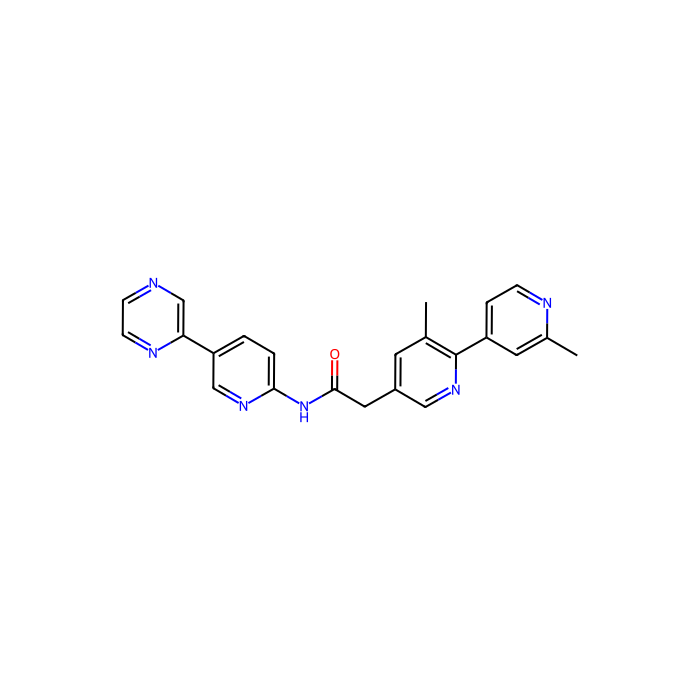
LGK-974 LGK-974 (NVP-LGK974, WNT974) is a potent and specific PORCN inhibitor, and inhibits Wnt signaling with IC50 of 0.4 nM in TM3 cells. Phase 1. In vitro
LGK974 effectively displaces [3H]-GNF-1331 with IC50 of 1 nM in the PORCN radioligand binding assay, and shows no major cytotoxicity in cells up to 20 µM. LGK974 shows comparable inhibitory activities against all tested Wnts with IC50 ranging from 0.05 to 2.4 nM, which is consistent with the genetic loss of PORCN phenotype. LGK974 specifically inhibits the growth of three RNF43-mutant cell lines, HPAF-II, PaTu 8988S, and Capan-2.
In vivo
In a murine MMTV-Wnt1 tumor model and a human head and neck squamous cell carcinoma model (HN30), LGK974 (3 mg/kg) inhibits Wnt signaling in vivo and induces tumor regression without significant body weight loss in the mice. LGK974 (5 mg/kg, p.o., BID) also inhibits tumor growth of RNF43-mutant pancreatic tumors (HPAF-II and Capan-2) in vivo. Cell Data
Determine the necessary mass, volume, or concentration for preparing a solution.
Dilution Calculator
Determine the dilution needed to prepare a stock solution.
Reconstitution Calculator
Reviews
Customer Reviews
Application Protocols
No tested-application protocols are provided in the Product Data for this item.
General starting points (to be adapted and validated in-house):
Stock solution: Prepare 10 mM in anhydrous DMSO. Vortex and, if needed, gently warm to 25–37°C to aid dissolution. Filter (0.22 µm PTFE) if particulate remains.
Cell-based assays: Dilute stock into culture media to the desired final concentration, keeping DMSO constant (e.g., ≤0.1–0.5% v/v). Include vehicle controls. Monitor for precipitation over the dosing period.
Biochemical assays: Ensure assay buffer tolerates the chosen co-solvent; pre-screen for interference (detergent, BSA, or cyclodextrin may help mitigate nonspecific binding/adsorption).
Storage of working plates: If preparing dose–response plates, seal to minimize evaporation; store cold and protected from light as compatible with assay timing.
Important: These are generic research practices for small-molecule tools. Validate all conditions locally and consult the SDS/CoA for any item-specific constraints.
Biological Roles
LGK-974 is widely referenced in the literature as a chemical probe of Wnt ligand processing and secretion, enabling precise interrogation of the Wnt/β-catenin signaling axis in cells and model systems. The compound is typically used to modulate the lipid modification step required for Wnt ligand maturation and extracellular signaling competence.
Applications in modern biology (literature-level, research use only):
Pathway dissection: By perturbing the Wnt ligand biosynthetic route, researchers can assess dependence of cellular phenotypes on upstream Wnt production vs downstream pathway nodes, informing network topology and feedback analysis.
Functional genomics synergy: Combining LGK-974-type chemical perturbation with CRISPR knockouts/activation of pathway components helps distinguish ligand-dependent from ligand-independent signaling.
Developmental and stem cell biology: Wnt signaling is pivotal in fate decisions and self-renewal; chemical probes are used to define windows of pathway sensitivity and to synchronize populations during differentiation protocols (strictly research contexts).
Systems-level profiling: Time-resolved transcriptomics/proteomics under compound exposure elucidates direct and compensatory responses across the pathway.
Caveats:
Off-targets and context dependence should be evaluated with orthogonal chemotypes and genetic tools.
Titration and kinetic profiling are essential, as Wnt pathway responses can be nonlinear and cell-type specific.
This section summarizes common research uses in biochemistry and cell biology; no therapeutic or clinical claims are made.
Buffer Applications
LGK-974 is not a buffering reagent. However, buffer and media conditions affect delivery and stability in biological assays.
Practical guidance:
Vehicle control: Match the final DMSO percentage in all samples (e.g., 0.05–0.5% v/v typical for many cell assays) to isolate compound effects from solvent effects.
Order of addition: Add the DMSO stock last to pre-equilibrated buffer/media with gentle mixing to minimize local supersaturation.
Protein/surfactant carriers: For low aqueous solubility compounds, inclusion of serum proteins (FBS) or minimal non-ionic surfactant can reduce precipitation and adsorption; always validate against your readout.
Adsorption mitigation: Use low-bind plastics and avoid extended pre-incubation in empty wells/tubes.
If your workflow requires specific pH, ionic strength, or additive recipes, follow your assay’s SOPs; LGK-974 itself does not set buffer pH and has no defined buffering capacity.
Green Alternatives
Sustainability considerations for handling bioactive small molecules focus on solvent choice, waste minimization, and energy-efficient storage.
Solvent optimization:
Primary solvent: DMSO is standard for hydrophobic ligands due to high solvency and stability. While not "green" per se, it enables very small-volume stocks (e.g., 10–50 mM), reducing solvent usage and waste.
Alternatives/adjuncts: Where compatible, consider aqueous delivery vehicles that reduce organic content—cyclodextrin inclusion complexes or micellar carriers (e.g., low % polysorbates, Pluronic F-127)—to lower DMSO in final assays. Validate any carrier for biological neutrality.
Waste reduction:
Aliquot concentrated stocks into single-use vials to avoid freeze–thaw cycles and disposal of partially degraded material.
Use microscale dosing (acoustic or pin tools) to minimize DMSO transfers and plastic waste.
Energy use:
This item requires −80°C storage per Product Data; to balance stability with sustainability, consolidate ultra-low freezer space, maintain door seals, and inventory efficiently to limit door-open time.
Balanced perspective:
Greener dissolution systems may reduce organic solvent exposure but can add complexity (surfactants, carriers) and potential biological confounders. Always run vehicle-matched controls and document any excipients.
Note: No change to item-specific storage or handling should be made without verifying stability and compatibility against the CoA/SDS.
Pharmaceutical Uses
This item is supplied strictly for research use only (per Product Data) and is not intended for human or veterinary use.
Context for formulation scientists (general, non-clinical):
Role: Employed as a reference tool compound in preclinical discovery assays, target validation, and mechanistic studies. It may serve as a system control in ADME screening and permeability/solubility assessments.
Typical non-clinical formulations: DMSO concentrates diluted into assay buffers or cell culture media; for in vivo research in laboratories (where permitted and under institutional approvals), co-solvent systems (e.g., PEG-400/saline with minimal DMSO) are sometimes explored, but no item-specific recommendations are provided here.
Pharmacopeial status: No pharmacopoeial monograph known for this research compound.
Compliance reminders:
No claims are made or implied regarding safety, efficacy, or suitability for therapeutic use.
Any non-clinical in vivo use must follow institutional IACUC/ethics approvals and local regulations. Aladdin provides no dosing or regimen guidance.
Physical Properties
Item-specific physicochemical specifications have not been provided in the Product Data.
Melting point (MP): Not specified for this item; refer to CoA/Spec Sheet.
Boiling point (BP): Not applicable/rarely used for characterization of this class; Not specified for this item; refer to CoA/Spec Sheet.
Density: Not specified for this item; refer to CoA/Spec Sheet.
LogP/logD: Not specified for this item; refer to CoA/Spec Sheet.
pKa: Not specified for this item; refer to CoA/Spec Sheet.
UV-Vis λmax / extinction: Not specified for this item; refer to CoA/Spec Sheet.
Water content, residual solvents, metals: Not specified for this item; refer to CoA/Spec Sheet.
General handling guidance (good practice; literature-level for bioactive small molecules):
Solubility: Many hydrophobic screening compounds dissolve readily in anhydrous DMSO to 10–50 mM stock; aqueous solubility is typically limited and can be improved by serial dilution into media containing serum or by using co-solvents (e.g., 0.1–1% DMSO) or solubilizers (e.g., cyclodextrins). Verify solubility empirically for your batch.
Filtration: If particulate is observed after dilution, pass through a 0.22 µm PTFE filter compatible with organic co-solvent systems.
Hygroscopicity/Photostability: Unknown for this specific item; protect from moisture and light as a precaution until item-specific data are reviewed (CoA/SDS).
Important: For quantitative method development (e.g., LC–MS assay), obtain lot-specific purity and extinction data from the CoA.
Quality & Grades
Grade/Purity (from Product Data): Moligand™.
About Moligand™ (general description of the line; not item-specific specs):
Moligand™ denotes inclusion in a curated collection of small-molecule ligands suitable for biochemical/chemical biology screening, target validation, and pathway interrogation. Typical program-level expectations include verified identity (e.g., by LC–MS/HRMS and/or NMR) and screening-suitable purity; however, exact test methods and acceptance criteria vary by item and lot.
What is NOT implied: Specific residual solvent limits, water content, metal content, optical purity, and chromatographic UV cutoffs are not implied unless explicitly stated on the CoA/Spec Sheet.
Practical considerations:
For assay development and SAR studies, consult the lot-specific CoA for purity method (HPLC/UPLC), chromatograms, and identity confirmation.
If your application requires additional controls (e.g., trace metals, endotoxin, TFA-salt content, polymorph), request supporting documentation or consider supplementary purification/characterization in-house.
Stabilizers or salt forms: Not specified for this item; refer to CoA/Spec Sheet.
Documentation:
Retain CoA and SDS with your lab records. Reference the SKU (L409002) and lot number in all reports to ensure traceability and reproducibility.
Reaction & Applications
This product is positioned as a bioactive small molecule for pathway interrogation rather than as a synthetic reagent.
Research applications (general/literature-level for LGK-974-type tools):
Chemical biology and systems pharmacology: Probe-dependent modulation of the Wnt lipidation/secretion machinery is widely used to dissect pathway dependence in cells and organoids. Time-course and concentration–response studies enable mapping of upstream vs downstream pathway effects.
Target/pathway studies: Frequently employed to evaluate Wnt-dependent transcriptional reporters (e.g., TCF/LEF luciferase), Wnt ligand secretion assays, and biomarker modulation in cell-based models. Pairing with orthogonal readouts (qPCR, RNA-seq, proteomics) strengthens conclusions.
Screening workflows: Functions as a positive control/reference inhibitor in panels focusing on developmental signaling cascades. Use in phenotypic screens to deconvolute Wnt contributions to observed phenotypes.
Practical tips:
Prepare fresh working solutions from frozen DMSO stocks immediately before use to minimize degradation and adsorption losses.
Include vehicle-only controls at the identical final DMSO percentage.
Consider pathway selectivity controls (e.g., β-catenin stabilization assays, downstream GSK3β modulators) to localize observed effects within the signaling cascade.
Note: This section discusses research applications. No medical/clinical claims are made. For assay-specific parameters (exposure time, concentration ranges), consult primary literature and perform internal optimization.
Reaction Conditions
Not typically applicable. LGK-974 is supplied as a bioactive tool compound rather than a reagent for chemical transformations.
If used in biological experiments (general guidance):
Concentration ranges: Determine empirically via titration and literature precedent for your specific model; start with a broad range and refine using EC50/IC50-style analyses. No item-specific potency or exposure guidance is provided here.
Exposure time: Optimize per assay kinetics (e.g., hours to days in cell systems for pathway modulation); include time-matched vehicle controls.
Temperature and atmosphere: Standard cell culture or biochemical assay conditions unless otherwise specified by your SOPs.
For any synthetic chemistry application, refer to reagents specifically designed for the desired transformation; LGK-974 lacks defined reaction-condition roles.
Safety & Handling
Safety data specific to this catalog item have not been provided. Always consult the SDS accompanying your shipment for authoritative guidance.
GHS classification, signal word, hazard statements, pictograms: Not specified for this item; refer to SDS.
Primary hazards (general for small-molecule research compounds): May cause skin/eye irritation; effects following inhalation/ingestion are insufficiently characterized—handle as a compound of unknown toxicity.
Good laboratory practice (GLP) recommendations:
Engineering controls: Work in a chemical fume hood; avoid aerosol generation during weighing and aliquoting.
PPE: Lab coat, safety glasses, and appropriate chemically resistant gloves (e.g., nitrile). Consider double-gloving for DMSO solutions.
Handling: Minimize exposure; avoid contact with skin and eyes. Use dedicated, labeled containers for DMSO stocks.
First aid (overview; defer to SDS for specifics):
Skin: Wash with soap and water; remove contaminated clothing.
Eyes: Rinse cautiously with water for several minutes; remove contact lenses if easy.
Inhalation: Move to fresh air; seek medical attention if symptoms occur.
Ingestion: Rinse mouth; seek medical attention.
Incompatibilities: Unknown item-specific incompatibilities; as a precaution, segregate from strong oxidizers, strong acids/bases until SDS review.
Waste: Dispose of solutions and solids as hazardous chemical waste under institutional guidelines.
Transport/Shipping (from Product Data): Shipped on dry ice packs + cold packs to maintain low temperature integrity.
Note: Treat as for research use only; not for human or animal consumption.
Solvent Selection
LGK-974 is supplied as a bioactive small molecule for research use; dissolution strategy is critical for assay reproducibility.
General guidance (literature-level for hydrophobic ligands):
Stock preparation:
Preferred solvent: Anhydrous DMSO (analytical grade) is commonly used to prepare 10–50 mM stocks. Start at a lower target (e.g., 10 mM) and confirm complete dissolution visually and by LC–MS if needed.
Alternatives: DMF or ethanol can be used in some workflows; verify compatibility with cells/enzymes. Co-solvent systems (e.g., DMSO:water or DMSO:buffer) help achieve working concentrations with final DMSO ≤0.1–0.5% v/v in cell-based assays.
Aqueous media:
Direct water/buffer solubility may be limited. Dilute DMSO stocks into pre-warmed media with serum or use carriers (e.g., 0.2–0.5% Pluronic F-127 or cyclodextrins) to mitigate precipitation. Add compound last, with gentle mixing.
Adsorption and losses:
Hydrophobic compounds can adsorb to plastics; use low-bind polypropylene tubes and pre-wet surfaces with working solution.
Filtration:
If turbidity appears after dilution, clarify through 0.22 µm PTFE or PVDF filters validated for your solvent system.
Quick comparison (general):
DMSO: High solvating power; broadly compatible; cell tolerance typically ≤0.1–0.5%.
DMF: Strong solvent; higher cytotoxicity risk; use sparingly.
Ethanol: Lower solvating power for many heteroaromatic inhibitors; often acceptable up to ~0.1–0.5% in cells.
Always confirm solvent choice against your assay’s tolerance and the item’s CoA/SDS.
Storage & Reconstitution
Storage (from Product Data): Store at −80°C.
Shipping (from Product Data): Shipped on dry ice packs + cold packs to preserve material integrity.
Research Use: For research use only.
Aliquoting and stock preparation (good practice for small-molecule tools):
Upon receipt: Allow the sealed container to equilibrate to room temperature in a desiccator before opening to prevent moisture condensation.
Aliquoting: Divide solid or concentrate into single-use portions in low-bind microtubes to avoid repeated freeze–thaw and headspace moisture exposure.
Reconstitution: Prepare a concentrated stock in anhydrous DMSO (e.g., 10 mM). Mix thoroughly; if needed, gently warm to 25–37°C and vortex/sonicate briefly. Confirm complete dissolution before use.
Working solutions: Dilute into buffer/media immediately prior to application, keeping final DMSO within assay tolerance. Use freshly prepared dilutions; discard after use if precipitation or discoloration occurs.
Stability: Item-specific shelf-life and solution stability are Not specified for this item; refer to CoA/Spec Sheet. In absence of item-specific data, store DMSO stocks at −80°C, protected from light, in tightly sealed vials, and avoid more than one freeze–thaw.
Labeling and documentation:
Record concentration, solvent, date, and operator on each aliquot. Cross-reference SKU (L409002) and lot number in your ELN for traceability.
Structure & Identity
LGK-974 (SKU: L409002) is supplied as a research-use small molecule from Aladdin’s Moligand™ collection of bioactive ligands/screening compounds.
Item-specific identifiers (from Product Data):
CAS: 1243244-14-5
CID: 46926973
InChIKey: Not specified for this item; refer to CoA/Spec Sheet.
SMILES: Not specified for this item; refer to CoA/Spec Sheet.
Molecular formula: Not specified for this item; refer to CoA/Spec Sheet.
Molecular weight: Not specified for this item; refer to CoA/Spec Sheet.
Structural features (general/literature-level, not item-specific):
LGK-974 is a synthetically derived, drug-like small molecule commonly described in the literature as a lipidation-pathway modulator targeting Wnt processing machinery (classically studied as a PORCN inhibitor). Exact atom connectivity, functional groups, and stereochemical assignments should be verified against primary references or the item’s CoA before use in regulated workflows.
2D structure description (general, literature):
Reported depictions show a multi-ring, heteroatom-containing scaffold with hydrogen-bond acceptors/donors consistent with bioactive small molecules. Users should consult the authenticated structural file (SDF/Mol) from authoritative databases or the CoA to confirm the precise ring systems and substituent pattern.
Notes: Where exact identifiers (SMILES/InChIKey/formula/MW) are critical for your workflow, please refer to the CoA/Spec Sheet attached to the delivered lot or contact technical support for the structure file under your institution’s license.
Synthetic Utility
LGK-974 is a finished bioactive small molecule and is not typically used as a synthetic building block.
As a reagent: Not commonly applied as a stoichiometric or catalytic reagent in organic synthesis.
As a synthon: The scaffold is not generally deployed for convergent synthesis or diversification unless part of a medicinal chemistry campaign specifically derivatizing the core.
Recommendations for chemists seeking derivatization (general/literature-level):
If SAR exploration is desired, consult the primary literature for disclosed analog series and points of diversification (e.g., heteroaryl substitutions, amide/urea handles, etc.). Establish unambiguous structure confirmation (LC–MS, 1H/13C NMR, HRMS) and purity control for each analog.
Maintain awareness of IP considerations around scaffold modification and use.
For routine laboratory synthesis needs (cross-coupling, oxidations, reductions, etc.), consider dedicated reagents and building blocks from the broader catalog rather than repurposing this tool compound.
Target Specificity
Target/epitope specificity data are generally reserved for biological macromolecules (e.g., antibodies, enzymes). For this small-molecule product, no item-specific target-binding specifications are provided in the Product Data.
Target, selectivity panel, Kd/IC50, species cross-reactivity: Not specified for this item; refer to CoA/Spec Sheet and primary literature.
Researchers commonly consult peer-reviewed sources to understand biochemical selectivity profiles for tool compounds; verify that literature values pertain to the exact structure and context you are using.
Frequently Asked Questions
What is Moligand??
Moligand? is one of Aladdin Scientific's premium product lines, formulated for high-purity applications across multiple workflows. Compared to standard grades in the same workflow, Moligand? products typically offer tighter specifications, more rigorous QC, and stronger lot-to-lot consistency.
How should this product be stored?
Store at ?80 °C. Ultra-low temperature storage is required to maintain the specified shelf life.
How is this product shipped?
This product ships frozen with dry ice and cold packs. Unpack on arrival and transfer it to the storage condition stated above; handle dry ice with insulated gloves in a ventilated area.
What are the CAS number, molecular formula and molecular weight?
The CAS Number is 1243244-14-5, the molecular formula is C23H20N6O, and the molecular weight is 396.4 g/mol.
What documentation is provided?
Available product documentation, including Certificates of Analysis (COA), Safety Data Sheets (SDS), and specification sheets, is shown in the product document area. Document availability and access follow the current site policy.
Need help choosing the grade?
Our grade selection guide covers purity, stabilizer status, and application suitability for all variants in our catalog.
We use cookies to ensure the website functions properly and, where permitted, to improve your experience. You can manage your preferences at any time in Settings. Learn more in our Cookie Policy.
Shall we send you a message when we have discounts available?
Remind me later
Thank you! Please check your email inbox to confirm.
Products are supplied to verified businesses, institutions, and qualified professionals for research and development use only. Not for use in humans, animals, diagnosis, or therapy.