Lornoxicam is a cyclooxygenase inhibitor. Structurally similar to Tenoxicam. An anti-inflammatory and an analgesic. Lornoxicam is an inhibitor of Cox-1 and Cox-2.Potent COX-1 and COX-2 inhibitor (IC 50 = 5 and 8 nM for COX-1 and COX-2, respectively). Inhi
Storage
Store at -20°C
Shipped In
Ice chest + Ice pads
This product requires cold chain shipping. Ground and other economy services are not available.
Action Type
ACTIVATOR
Note
Wherever possible, you should prepare and use solutions on the same day. However, if you need to make up stock solutions in advance, we recommend that you store the solution as aliquots in tightly sealed vials at -20°C. Generally, these will be useable for up to one month. Before use, and prior to opening the vial we recommend that you allow your product to equilibrate to room temperature for at least 1 hour. Toxic, refer to SDS for further information. Need more advice on solubility, usage and handling? Please visit our frequently asked questions (FAQ) page for more details.
This compound belongs to the class of organic compounds known as alpha amino acids and derivatives. These are amino acids in which the amino group is attached to the carbon atom immediately adjacent to the carboxylate group (alpha carbon), or a derivative thereof.
1. Djoumbou Feunang Y, Eisner R, Knox C, Chepelev L, Hastings J, Owen G, Fahy E, Steinbeck C, Subramanian S, Bolton E, Greiner R, and Wishart DS. ClassyFire: Automated Chemical Classification With A Comprehensive, Computable Taxonomy. Journal of Cheminformatics, 2016, 8:61.
Determine the necessary mass, volume, or concentration for preparing a solution.
Dilution Calculator
Determine the dilution needed to prepare a stock solution.
Reconstitution Calculator
Reviews
Customer Reviews
Application Protocols
Not specified for this item. No tested application protocols are provided in the Product Data. General literature practices include preparing concentrated DMSO stocks and diluting into assay or chromatographic media as appropriate. Users should validate conditions for their specific system.
Biological Roles
General biochemical context (literature; no therapeutic claims)
Lornoxicam is an oxicam-class molecule commonly studied as a cyclooxygenase (COX) pathway modulator in vitro. Oxicams interact with the arachidonic acid cascade by inhibiting prostaglandin endoperoxide synthase activity (COX-1/COX-2) in enzyme assays.
Mechanistic features: The enolic/sulfonamide functionality can coordinate within the COX active site, and heteroaromatic substituents contribute to hydrophobic and H-bonding interactions (as reported for oxicams).
Biophysical properties relevant to biology: Moderate lipophilicity and ionizable centers influence membrane permeability and protein binding in serum; these attributes impact observed potency and selectivity in biochemical versus cellular systems.
Research uses
Employed as a positive control or benchmark compound in COX inhibition assays, structure–activity relationship (SAR) studies of oxicam derivatives, and metabolism studies involving Phase I/II pathways (e.g., oxidative and conjugative transformations in microsomes or hepatocytes).
Caveats
Protein binding and limited aqueous solubility can confound assay readouts; use appropriate controls and solvent matching.
Off-target interactions are possible at higher concentrations; orthogonal assays are advised to confirm mechanism.
Buffer Applications
Not typically applicable. Lornoxicam is not a buffering agent and does not serve as a component of classical biochemical buffer systems. For laboratory work involving this compound, select a buffer appropriate to the biological target (e.g., Tris, phosphate, HEPES) and adjust pH to balance target activity and compound solubility. Consider adding a low percentage of organic cosolvent or surfactant to maintain homogeneity.
Green Alternatives
Context: Lornoxicam is an active small molecule; “green alternatives” apply primarily to solvent and process choices during handling or synthesis, not to replacement of the molecule itself.
Greener solvent choices for handling (literature/general)
Prefer ethanol or isopropanol over DMF/NMP for cleaning and low-concentration preparations when solubility allows.
For chromatographic methods, consider methanol or ethanol as partial/complete replacements for acetonitrile where resolution and backpressure permit.
Use aqueous buffered systems and minimize organic content in mobile phases by optimizing column selectivity (e.g., polar-embedded or core–shell phases).
Illustrative comparison (general)
DMSO: High solubility, excellent for stock solutions; poor EHS profile for large-scale use.
Ethanol: Better EHS profile; limited solubility ceiling may restrict concentration.
2-Propanol: Intermediate option; higher viscosity can impact LC backpressure.
Process considerations
Employ microscale reactions/assays and high-throughput screening to reduce solvent consumption.
Utilize closed-vial dissolution and pre-weighed unit doses to reduce waste and exposure.
Trade-offs
Greener solvents may reduce solubility or chemical stability; verify recovery, assay linearity, and sample homogeneity when changing solvent systems.
Pharmaceutical Uses
Item-specific claims or compendial status
Not specified for this item; refer to CoA/Spec Sheet.
General formulation/manufacturing context (literature; no therapeutic claims)
Lornoxicam is widely used as an analytical reference standard in pharmaceutical quality control for identification, assay, and related-substance testing by HPLC/LC–MS.
Employed for method development in stability-indicating assays, dissolution testing, and impurity profiling of oxicam-class materials.
Solid-state considerations: Polymorph and particle size may affect dissolution rate and assay recovery; differential scanning calorimetry (DSC) and XRPD are commonly used to characterize form.
Sample preparation: Stock solutions typically prepared in DMSO, methanol, or acetonitrile for analytical purposes; protect from light and heat.
Regulatory note
When used as a working or reference standard, ensure traceability to a certified primary standard where required and document purity corrections (e.g., water, residual solvents) per pharmacopeial guidance.
Physical Properties
Item-specific specifications
Not specified for this item; refer to CoA/Spec Sheet.
Literature values and general reference data (for planning only; verify against CoA for this batch)
Physical state: crystalline solid (literature)
Melting point: often reported in the mid- to high-200 °C range with decomposition; values vary by polymorph and hydration state (literature).
Boiling point: not applicable (decomposes) (literature)
Aqueous solubility: very low at neutral pH; solubility increases in basic media due to deprotonation of the enolic functionality (literature).
Solubility in organic solvents: soluble in polar aprotic solvents such as DMSO and DMF; sparingly to moderately soluble in ethanol/methanol depending on temperature (literature).
pKa: oxicam-class compounds typically possess an acidic enolic proton (pKa commonly in the 4–6 range) and basic heteroaromatic nitrogen(s); specific values for lornoxicam vary by source (literature).
logP/logD: moderate lipophilicity consistent with limited water solubility; reported values vary across databases (literature).
UV–Vis: conjugated heteroaromatic system exhibits strong UV absorbance in the 250–400 nm region, enabling HPLC-UV detection (literature).
Notes
Polymorphism and tautomerism can influence melting behavior, solubility, and spectral properties. Always confirm key parameters for your specific lot using the CoA/SDS.
Quality & Grades
Item-specific grade/purity
Grade/Purity: Not specified for this item; refer to CoA/Spec Sheet.
Appearance: Not specified for this item; refer to CoA/Spec Sheet.
Guidance on grades (general information)
Reference standard grade: Typically emphasizes high chemical purity, well-characterized polymorph, and assay by HPLC/LC–MS with tight limits on related substances; suitable for calibration, system suitability, and method validation.
Analytical reagent (AR) vs. research grade: AR-grade materials target defined impurity limits and residual solvent specifications. Research grade is often adequate for screening and discovery but may have broader impurity profiles.
Stabilizers: None indicated in Product Data. If stabilizers or hydrates/solvates are present, they will be documented on the CoA and can influence assay and sample preparation.
What to check on receipt
Identity: Verify by HPLC-UV/LC–MS retention time and mass spectrum against a certified reference or literature.
Assay: Review potency on an anhydrous basis if applicable; account for residual solvents/water.
Solid form: Note polymorph/particle size; these can affect dissolution rate and analytical response.
Always consult the CoA for lot-specific purity, related substances, residual solvents, and water content. Do not infer unstated specifications.
Reaction & Applications
This product is typically employed as a reference material and probe, rather than as a synthetic reagent. Relevant applications include:
Analytical applications (literature/general)
Reference standard for method development and validation by HPLC-UV/LC–MS in drug substance/product and biological matrices.
System suitability: UV-rich chromophore supports wavelength selection in the 250–400 nm range; retention tuning via pH/organic modifier.
Stability-indicating methods: Useful for forced degradation studies (acid/base, oxidative, photolytic) to map degradant profiles.
Biochemical applications (literature)
In vitro probe compound in cyclooxygenase (COX) enzyme inhibition assays and mechanistic studies; enables benchmarking of assay performance and inhibitor potency.
Binding and thermodynamics: Suitable for ITC, DSF, or SPR experiments to characterize interaction with target proteins where soluble.
Sample preparation tips
Dry compound thoroughly before weighing; hygroscopic uptake can bias assay results.
Prepare concentrated DMSO stocks and dilute into assay buffers with vigorous mixing to prevent precipitation. Add nonionic surfactants (e.g., 0.01–0.05% Tween-80) if required for solubilization (literature practice).
Notes
If used as an internal or external standard, confirm extinction coefficient and response factors under your exact chromatographic conditions.
Reaction Conditions
Because this product is generally used as a standard or probe rather than a reagent, “reaction conditions” center on dissolution and analytical handling.
Dissolution and assay preparation (literature)
Prepare 10–50 mM stock solutions in dry DMSO. Sonication and gentle warming (≤40 °C) may aid dissolution; avoid prolonged heating.
Dilute into assay buffers slowly with vigorous mixing to minimize precipitation. Final DMSO content of 0.1–1% v/v is commonly tolerated in many biochemical assays.
For HPLC, typical mobile phases include acetonitrile/water or methanol/water with 0.05–0.1% acid modifier (e.g., formic acid) or buffered at pH 3–6 for peak shape control.
Stability (literature)
Protect from light; avoid strong base or oxidants during sample preparation. Conduct stability checks for autosampler residence (e.g., 24–48 h at 4–10 °C) when applicable.
If performing chemical transformations (advanced users)
Cross-coupling on the aryl chloride may require mild catalysts and bases (e.g., Pd catalysts with bulky phosphines, Cs2CO3) at ≤80–100 °C in polar aprotics; monitor for degradation of the oxicam core and consider protecting strategies.
Always confirm specific conditions empirically and consult primary literature for detailed protocols.
Safety & Handling
Item-specific hazard data
GHS Classification: Not specified for this item; refer to SDS.
Signal word: Not specified for this item; refer to SDS.
H-statements: Not specified for this item; refer to SDS.
Pictograms: Not specified for this item; refer to SDS.
General laboratory precautions (literature/good practice)
Handle as a laboratory chemical for research use only. Avoid inhalation of dust and contact with skin/eyes. Use in a chemical fume hood.
Personal protective equipment: lab coat, safety glasses, and suitable chemical-resistant gloves (e.g., nitrile). For powder handling, consider a dust mask/respirator per institutional policy.
First aid overview: If inhaled, move to fresh air; if on skin/eyes, rinse with water for several minutes; if ingested, rinse mouth. Seek medical attention as appropriate. Defer to SDS for detailed measures.
Incompatibilities: Strong oxidizers and strong acids/bases may cause degradation; avoid prolonged exposure to elevated temperatures or UV light.
Environmental precautions: Prevent release to the environment; collect spills with inert absorbent and dispose of according to local regulations.
Thermal/chemical stability
Store at -20°C (per Product Data), tightly closed, desiccated, and protected from light to minimize hydrolysis/oxidation. Allow container to reach room temperature before opening to avoid condensation.
Solvent Selection
Applicability: Lornoxicam is a sparingly water-soluble heteroaromatic solid; solvent choice impacts dissolution, processing, and analytical method development.
General solvent behavior (literature)
Polarity class: Moderately lipophilic; dissolves well in polar aprotics (DMSO, DMF, NMP) and to a lesser extent in lower alcohols.
Aqueous systems: Poor solubility at neutral pH; solubility increases in basic buffers (deprotonated form). Avoid strong bases if hydrolysis is a concern.
Miscibility: DMSO stock solutions are commonly diluted into aqueous media with cosolvents or surfactants to avoid precipitation.
Practical guidance
Stock solutions: Prepare 10–50 mM stocks in anhydrous DMSO or DMF (literature practice). Filter through 0.22 μm PTFE if particulate is present.
HPLC mobile phases: Use acetonitrile or methanol with aqueous buffer (pH control between 3–6 often yields good peak shape for oxicams). Lornoxicam shows strong UV absorbance, enabling UV detection.
Avoid chlorinated solvents for bioassay stocks; if needed for extractions, dichloromethane or ethyl acetate can partition the neutral form (literature).
Comparison (general)
DMSO vs ethanol: DMSO affords higher solubility and stability; ethanol offers lower toxicity but may limit maximum concentration.
DMF/NMP: High solvating power but less desirable for biological systems; reserve for synthetic or analytical sample prep.
Storage & Reconstitution
Item-specific storage and shipping
Storage: Store at -20°C (per Product Data). Keep container tightly closed, desiccated, and protected from light.
Reconstitution/use guidance (literature/good practice; not a specification)
Allow vial to equilibrate to room temperature in a desiccator before opening to prevent condensation.
For analytical or bioassay stocks, dissolve the solid in anhydrous DMSO or DMF to 10–50 mM. For lower-toxicity options, use methanol or ethanol if solubility permits.
Filter sterilize through 0.22 μm PTFE for cell-free assays if particulate is present. Avoid aqueous stock solutions unless pH-adjusted, as neutral water solubility is low.
Aliquot and store solutions at -20°C to minimize freeze–thaw; limit to ≤3 freeze–thaw cycles. Protect solutions from light (amber vials) and air exposure.
Shelf-life
Not specified for this item; refer to CoA/Spec Sheet. Assess potency periodically by HPLC/LC–MS if long-term storage is required.
Research use note
For research use only (per Product Data). Not for human or veterinary use.
Structure & Identity
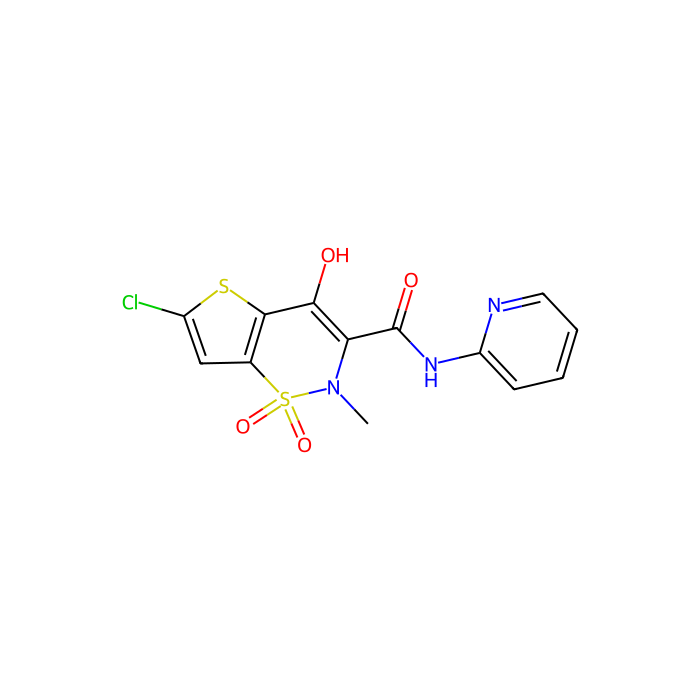
Brief: Lornoxicam is an oxicam-class heteroaromatic carboxamide used widely as a reference standard and biochemical probe in COX-related research.
Item-specific (from Product Data)
SKU: L129341
Product name: Lornoxicam
CAS: 70374-39-9
InChIKey (as provided): 401423
Storage condition: Store at -20°C
Literature/Computed identifiers and descriptors (for reference; not item specifications)
Representative SMILES (literature): O=C(Nc1ccccn1)N2C(=O)C3=NS(=O)(=O)C=C3Sc2Cl with ring fusion and 4-hydroxy tautomer often represented; multiple tautomeric/ionization forms are reported.
Representative InChIKey (literature): commonly reported full-length key differs from the abbreviated key above; consult primary databases (e.g., PubChem CID 54690031) for canonical forms.
Structural features (general)
Fused heteroaromatic system incorporating a thienothiazine ring with a sulfonamide (1,1-dioxide) functionality.
Carboxamide linking to a 2-pyridyl (or related N-heteroaryl) moiety; 6-chloro substitution on the thienyl-fused ring.
2D description: A bicyclic thienothiazine core bearing a chloro substituent and a carbonyl at the 3-position (as carboxamide), the amide nitrogen attached to a pyridyl ring; the thiazine nitrogen is sulfonylated (1,1-dioxide).
Synthetic Utility
While not commonly used as a reagent, understanding lornoxicam’s functional groups is useful for impurity synthesis, metabolite preparation, and analog generation.
Functional group reactivity (general)
Enolic oxicam core: Tautomeric equilibrium influences N/O acylation and metal complexation in derivatization workflows.
Carboxamide: Amenable to isotopic labeling or prodrug formation via N-acylation or activation strategies.
Sulfonamide (SO2–N): Typically inert under mild conditions but can engage in selective N-functionalization under strong activation.
Aryl chloride: Potential handle for cross-coupling (e.g., Suzuki, Buchwald–Hartwig) in scaffold modification for SAR, though reaction conditions must preserve the sensitive oxicam moiety.
Use cases (literature)
Synthesis of stable isotope-labeled internal standards for LC–MS quantitation.
Preparation of forced-degradation products and putative metabolites to support analytical method validation.
Scaffold modification to explore COX-binding SAR in medicinal chemistry campaigns (research-only context).
Target Specificity
Not specified for this item; refer to Product Data/CoA. Note: Target specificity data (e.g., enzyme selectivity profiles) are not provided for this catalog entry. Users typically consult primary literature for COX-isoform activity profiles when employing lornoxicam as a biochemical probe.
Frequently Asked Questions
What is the purity of this product, and how is it determined?
This product is supplied at ≥98% purity, determined by HPLC. Lot-specific values are stated on the Certificate of Analysis.
How should this product be stored?
Store at ?20 °C. Freezer storage is required to maintain the specified shelf life.
How is this product shipped?
This product ships in an insulated container with ice pads. Unpack on arrival and transfer it to the storage condition stated above.
What are the CAS number, molecular formula and molecular weight?
The CAS Number is 70374-39-9, the molecular formula is C13H10ClN3O4S2, and the molecular weight is 371.82 g/mol. InChIKey WLHQHAUOOXYABV-UHFFFAOYSA-N.
What documentation is provided?
Available product documentation, including Certificates of Analysis (COA), Safety Data Sheets (SDS), and specification sheets, is shown in the product document area. Document availability and access follow the current site policy.
We use cookies to ensure the website functions properly and, where permitted, to improve your experience. You can manage your preferences at any time in Settings. Learn more in our Cookie Policy.
Shall we send you a message when we have discounts available?
Remind me later
Thank you! Please check your email inbox to confirm.
Products are supplied to verified businesses, institutions, and qualified professionals for research and development use only. Not for use in humans, animals, diagnosis, or therapy.

 H1517077