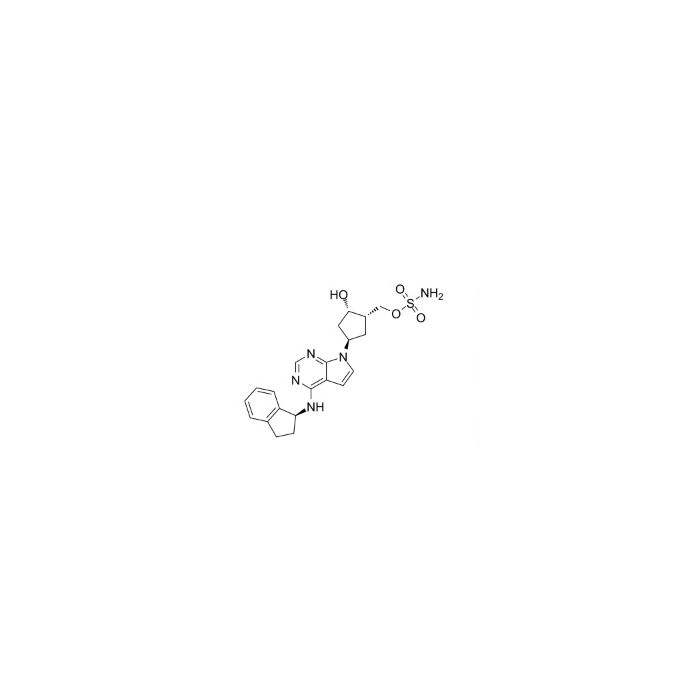
MLN4924 - Moligand™, ≥98% , NEDD8 activating enzyme inhibitor, CAS No.905579-51-3, NEDD8 activating enzyme inhibitor

CAS: 905579-51-3 Cat. No.: M127498 Formula: C21H25N5O4S Molecular Weight: 443.53
AVAILABLE TO ORDER
GRADE & PURITY Moligand™ ? Moligand™ — Aladdin's line of ligands and bioactive small molecules. Use for receptor, pathway, and binding studies needing defined small-molecule tools. ≥98%
Synonyms
Sulfamic acid [(1S,2S,4R)-4-[4-[[(1S)-2,3-dihydro-1H-inden-1-yl]amino]-7H-pyrrolo[2,3-d]pyrimidin-7-yl]-2-hydroxycyclopentyl]methyl ester | Pevonedistat
Storage
Store at -20°C
Shipped In
Ice chest + Ice pads
★
Size
USA
Germany (EU)*
Price
Qty
1mg
M127498-1mg
5 In stock
—
$26.90
5mg
M127498-5mg
1 In stock
—
$84.90
10mg
M127498-10mg
2 In stock
—
$134.90
25mg
M127498-25mg
2 In stock
—
$269.90
50mg
M127498-50mg
1 In stock
—
$429.90
100mg
M127498-100mg
1 In stock
—
$699.90
Enter a quantity for the sizes you want to add.
🧪
Why this grade

Moligand™, ≥98% Moligand™ for sensitive chromatographic and analytical workflows requiring minimal baseline interference.

🌡

Storage & shipping

Store at -20°C Ships Ice chest + Ice pads Check lot-specific COA for exact specifications.

📋

Quality documents

SDS, COA, datasheet, and spec sheet available for download. Lot-specific COA accessible via lot number lookup.

📚

Literature proof

Cited in 1 peer-reviewed publications across chromatography, organic synthesis, and cross-coupling reactions.

Specifications

Synonyms
Sulfamic acid [(1S,2S,4R)-4-[4-[[(1S)-2,3-dihydro-1H-inden-1-yl]amino]-7H-pyrrolo[2,3-d]pyrimidin-7-yl]-2-hydroxycyclopentyl]methyl ester | Pevonedistat
Specifications & Purity
Moligand™, ≥98%
Biochemical and Physiological Mechanisms
MLN4924 (MLN-4924)is a potent and selective small molecule NEDD8-activating enzyme (NAE) inhibitor.
Storage
Store at -20°C
Shipped In
Ice chest + Ice pads
This product requires cold chain shipping. Ground and other economy services are not available.
Grade
Moligand™
Action Type
INHIBITOR
Mechanism of action
NEDD8 activating enzyme inhibitor
Note
Wherever possible, you should prepare and use solutions on the same day. However, if you need to make up stock solutions in advance, we recommend that you store the solution as aliquots in tightly sealed vials at -20°C. Generally, these will be useable for up to one month. Before use, and prior to opening the vial we recommend that you allow your product to equilibrate to room temperature for at least 1 hour. Need more advice on solubility, usage and handling? Please visit our frequently asked questions (FAQ) page for more details.
Purity
≥98%
Product Properties
ALogP1.7
Names and Identifiers
Pubchem Sid488199412
Pubchem Sid Urlhttps://pubchem.ncbi.nlm.nih.gov/substance/488199412
Canonical SmilesC1CC2=CC=CC=C2C1NC3=C4C=CN(C4=NC=N3)C5CC(C(C5)O)COS(=O)(=O)N
IUPAC Name[(1S,2S,4R)-4-[4-[[(1S)-2,3-dihydro-1H-inden-1-yl]amino]pyrrolo[2,3-d]pyrimidin-7-yl]-2-hydroxycyclopentyl]methyl sulfamate
InChIKeyMPUQHZXIXSTTDU-QXGSTGNESA-N
INCHI1S/C21H25N5O4S/c22-31(28,29)30-11-14-9-15(10-19(14)27)26-8-7-17-20(23-12-24-21(17)26)25-18-6-5-13-3-1-2-4-16(13)18/h1-4,7-8,12,14-15,18-19,27H,5-6,9-11H2,(H2,22,28,29)(H,23,24,25)/t14-,15+,18-,19-/m0/s1
Isomeric SMILES C1CC2=CC=CC=C2[C@H]1NC3=C4C=CN(C4=NC=N3)[C@@H]5C[C@H]([C@H](C5)O)COS(=O)(=O)N
Molecular Weight 443.53
Reaxy-Rn 23228808
Reaxys-RN_link_address https://www.reaxys.com/reaxys/secured/hopinto.do?context=S&query=IDE.XRN=23228808&ln=

Documentation

📋 Safety Data Sheet (SDS)

Comprehensive hazard, handling, storage, and regulatory compliance document.

Download SDS →

✅ Certificate of Analysis (COA)

Lot-specific quality data. Enter your lot number to retrieve the exact COA.

Look up COA →

📊 Datasheet

Quick-reference summary of product specifications and applications.

View datasheet →

🔬 Specification Sheet

Full quality attributes and acceptance criteria for this grade.

View spec sheet →

Advanced Data

Taxonomic Classification

Taxonomy Tree

KingdomOrganic compounds
SuperclassBenzenoids
ClassIndanes
SubclassNot available
Intermediate Tree Nodes Not available
Direct ParentIndanes
Alternative Parents Pyrrolo[2,3-d]pyrimidines  Secondary alkylarylamines  Aminopyrimidines and derivatives  Substituted pyrroles  Imidolactams  Cyclopentanols  Organic sulfuric acids and derivatives  Heteroaromatic compounds  Cyclic alcohols and derivatives  Azacyclic compounds  Organopnictogen compounds  Organic oxides  Hydrocarbon derivatives  
Molecular FrameworkAromatic heteropolycyclic compounds
Substituents Pyrrolo[2,3-d]pyrimidine - Indane - Pyrrolopyrimidine - Aminopyrimidine - Secondary aliphatic/aromatic amine - Cyclopentanol - Pyrimidine - Imidolactam - Substituted pyrrole - Cyclic alcohol - Organic sulfuric acid or derivatives - Heteroaromatic compound - Pyrrole - Secondary alcohol - Secondary amine - Organoheterocyclic compound - Azacycle - Organooxygen compound - Organonitrogen compound - Hydrocarbon derivative - Organic oxide - Organopnictogen compound - Organic oxygen compound - Organic nitrogen compound - Amine - Alcohol - Aromatic heteropolycyclic compound
DescriptionThis compound belongs to the class of organic compounds known as indanes. These are compounds containing an indane moiety, which consists of a cyclopentane fused to a benzene ring.
External Descriptors Not available
3D Structure
Interactive Chemical Structure Model


Associated Targets(Human)
NEDD8 Tchem NEDD8 (1 Activities)
Activity TypeActivity Value -log(M)Mechanism of ActionActivity ReferencePublications (PubMed IDs)
UBA3 Tchem NEDD8-activating enzyme E1 catalytic subunit (1 Activities)
Activity TypeActivity Value -log(M)Mechanism of ActionActivity ReferencePublications (PubMed IDs)
NAE1 Tchem NEDD8-activating enzyme E1 regulatory subunit (1 Activities)
Activity TypeActivity Value -log(M)Mechanism of ActionActivity ReferencePublications (PubMed IDs)
KCNH2 Tclin HERG (29587 Activities)
Activity TypeRelationActivity valueUnitsAction TypeJournalPubMed IddoiAssay Aladdin ID
MDM2 Tchem p53-binding protein Mdm-2 (4545 Activities)
Activity TypeRelationActivity valueUnitsAction TypeJournalPubMed IddoiAssay Aladdin ID
Caco-2 (12174 Activities)
Activity TypeRelationActivity valueUnitsAction TypeJournalPubMed IddoiAssay Aladdin ID
CAPAN-1 (772 Activities)
Activity TypeRelationActivity valueUnitsAction TypeJournalPubMed IddoiAssay Aladdin ID
DU-145 (51482 Activities)
Activity TypeRelationActivity valueUnitsAction TypeJournalPubMed IddoiAssay Aladdin ID
HT-29 (80576 Activities)
Activity TypeRelationActivity valueUnitsAction TypeJournalPubMed IddoiAssay Aladdin ID
Huh-7 (12904 Activities)
Activity TypeRelationActivity valueUnitsAction TypeJournalPubMed IddoiAssay Aladdin ID
HuTu80 (255 Activities)
Activity TypeRelationActivity valueUnitsAction TypeJournalPubMed IddoiAssay Aladdin ID
K562 (73714 Activities)
Activity TypeRelationActivity valueUnitsAction TypeJournalPubMed IddoiAssay Aladdin ID
MCF7 (126967 Activities)
Activity TypeRelationActivity valueUnitsAction TypeJournalPubMed IddoiAssay Aladdin ID
MKN-45 (2102 Activities)
Activity TypeRelationActivity valueUnitsAction TypeJournalPubMed IddoiAssay Aladdin ID
PLC (23 Activities)
Activity TypeRelationActivity valueUnitsAction TypeJournalPubMed IddoiAssay Aladdin ID
RKO (1376 Activities)
Activity TypeRelationActivity valueUnitsAction TypeJournalPubMed IddoiAssay Aladdin ID
THP-1 (11052 Activities)
Activity TypeRelationActivity valueUnitsAction TypeJournalPubMed IddoiAssay Aladdin ID
U2OS (164939 Activities)
Activity TypeRelationActivity valueUnitsAction TypeJournalPubMed IddoiAssay Aladdin ID
A549 (127892 Activities)
Activity TypeRelationActivity valueUnitsAction TypeJournalPubMed IddoiAssay Aladdin ID
T47D (39041 Activities)
Activity TypeRelationActivity valueUnitsAction TypeJournalPubMed IddoiAssay Aladdin ID
EKVX (44102 Activities)
Activity TypeRelationActivity valueUnitsAction TypeJournalPubMed IddoiAssay Aladdin ID
NCI-H1299 (3248 Activities)
Activity TypeRelationActivity valueUnitsAction TypeJournalPubMed IddoiAssay Aladdin ID
HCT-116 (91556 Activities)
Activity TypeRelationActivity valueUnitsAction TypeJournalPubMed IddoiAssay Aladdin ID
HepG2 (196354 Activities)
Activity TypeRelationActivity valueUnitsAction TypeJournalPubMed IddoiAssay Aladdin ID
Jurkat (10389 Activities)
Activity TypeRelationActivity valueUnitsAction TypeJournalPubMed IddoiAssay Aladdin ID
MV4-11 (7307 Activities)
Activity TypeRelationActivity valueUnitsAction TypeJournalPubMed IddoiAssay Aladdin ID
TAOK1 Tchem Serine/threonine-protein kinase TAO1 (2019 Activities)
Activity TypeRelationActivity valueUnitsAction TypeJournalPubMed IddoiAssay Aladdin ID
UBA1 Tbio Ubiquitin-like modifier-activating enzyme 1 (57 Activities)
Activity TypeRelationActivity valueUnitsAction TypeJournalPubMed IddoiAssay Aladdin ID
HGC-27 (1452 Activities)
Activity TypeRelationActivity valueUnitsAction TypeJournalPubMed IddoiAssay Aladdin ID
UBA5 Tbio Ubiquitin-like modifier-activating enzyme 5 (22 Activities)
Activity TypeRelationActivity valueUnitsAction TypeJournalPubMed IddoiAssay Aladdin ID
UBA3 Tchem NEDD8-activating enzyme E1 catalytic subunit (128 Activities)
Activity TypeRelationActivity valueUnitsAction TypeJournalPubMed IddoiAssay Aladdin ID
NAE1 Tchem NEDD8-activating enzyme E1 regulatory subunit (121 Activities)
Activity TypeRelationActivity valueUnitsAction TypeJournalPubMed IddoiAssay Aladdin ID
SAE1 Tbio SUMO-activating enzyme (861 Activities)
Activity TypeRelationActivity valueUnitsAction TypeJournalPubMed IddoiAssay Aladdin ID
ATG7 Tchem Ubiquitin-like modifier-activating enzyme ATG7 (562 Activities)
Activity TypeRelationActivity valueUnitsAction TypeJournalPubMed IddoiAssay Aladdin ID
UBA6 Tchem Ubiquitin-like modifier-activating enzyme 6 (5 Activities)
Activity TypeRelationActivity valueUnitsAction TypeJournalPubMed IddoiAssay Aladdin ID
LNCaP-Clone-FGC (157 Activities)
Activity TypeRelationActivity valueUnitsAction TypeJournalPubMed IddoiAssay Aladdin ID
MGC-803 (6426 Activities)
Activity TypeRelationActivity valueUnitsAction TypeJournalPubMed IddoiAssay Aladdin ID
CUL1 Tbio Cullin-1 (10 Activities)
Activity TypeRelationActivity valueUnitsAction TypeJournalPubMed IddoiAssay Aladdin ID
UBA3 Tchem NEDD8 activating enzyme (447 Activities)
Activity TypeRelationActivity valueUnitsAction TypeJournalPubMed IddoiAssay Aladdin ID
DCUN1D1 Tchem DCN1-like protein 1 (571 Activities)
Activity TypeRelationActivity valueUnitsAction TypeJournalPubMed IddoiAssay Aladdin ID
NEDD8 Tchem NEDD8 (1 Activities)
Activity TypeRelationActivity valueUnitsAction TypeJournalPubMed IddoiAssay Aladdin ID
BEAS-2B (690 Activities)
Activity TypeRelationActivity valueUnitsAction TypeJournalPubMed IddoiAssay Aladdin ID
GES1 (603 Activities)
Activity TypeRelationActivity valueUnitsAction TypeJournalPubMed IddoiAssay Aladdin ID
CUL4B Tbio Cullin-4B (16 Activities)
Activity TypeRelationActivity valueUnitsAction TypeJournalPubMed IddoiAssay Aladdin ID
DCUN1D1 Tchem DCN1-like protein 1/NEDD8-conjugating enzyme Ubc12 (236 Activities)
Activity TypeRelationActivity valueUnitsAction TypeJournalPubMed IddoiAssay Aladdin ID
CUL1 Tbio NEDD8/Cullin-1 (16 Activities)
Activity TypeRelationActivity valueUnitsAction TypeJournalPubMed IddoiAssay Aladdin ID
CUL5 Tbio Cullin-5 (5 Activities)
Activity TypeRelationActivity valueUnitsAction TypeJournalPubMed IddoiAssay Aladdin ID
Associated Targets(non-human)
Hdac6 Histone deacetylase 6 (222 Activities)
Activity TypeRelationActivity valueUnitsAction TypeJournalPubMed IddoiAssay Aladdin ID
SARS-CoV-2 (38078 Activities)
Activity TypeRelationActivity valueUnitsAction TypeJournalPubMed IddoiAssay Aladdin ID
Cul4a Cullin-4A (23 Activities)
Activity TypeRelationActivity valueUnitsAction TypeJournalPubMed IddoiAssay Aladdin ID
Mechanisms of Action
Certificates(CoA,COO,BSE/TSE and Analysis Chart)
C of A & Other Certificates(BSE/TSE, COO):
Analytical Chart:

Find and download the COA for your product by matching the lot number on the packaging.

24 results found

Lot NumberCertificate TypeDateItem
J2431420Certificate of AnalysisAug 03, 2026 M127498
J2431419Certificate of AnalysisAug 03, 2026 M127498
D2622633Certificate of AnalysisMar 09, 2026 M127498
D2622632Certificate of AnalysisMar 09, 2026 M127498
D2622631Certificate of AnalysisMar 09, 2026 M127498
D2622625Certificate of AnalysisMar 09, 2026 M127498
D2622618Certificate of AnalysisMar 09, 2026 M127498
L2518041Certificate of AnalysisDec 24, 2025 M127498
D2327138Certificate of AnalysisFeb 07, 2025 M127498
D2327150Certificate of AnalysisFeb 07, 2025 M127498
D2327149Certificate of AnalysisFeb 07, 2025 M127498
D2327147Certificate of AnalysisFeb 07, 2025 M127498
D2327146Certificate of AnalysisFeb 07, 2025 M127498
D2327145Certificate of AnalysisFeb 07, 2025 M127498
D2327144Certificate of AnalysisFeb 07, 2025 M127498
D2327142Certificate of AnalysisFeb 07, 2025 M127498
D2327141Certificate of AnalysisFeb 07, 2025 M127498
D2327134Certificate of AnalysisFeb 07, 2025 M127498
D2526068Certificate of AnalysisOct 22, 2024 M127498
J2431421Certificate of AnalysisOct 22, 2024 M127498
J2431422Certificate of AnalysisOct 22, 2024 M127498
J2431423Certificate of AnalysisOct 22, 2024 M127498
D2327143Certificate of AnalysisApr 21, 2023 M127498
D2327140Certificate of AnalysisApr 21, 2023 M127498
Chemical and Physical Properties
SolubilityDMSO (Slightly), Methanol (Slightly)
SensitivityMoisture sensitive
Melt Point(°C)98°C
Molecular Weight443.500 g/mol
XLogP31.700
Hydrogen Bond Donor Count3
Hydrogen Bond Acceptor Count8
Rotatable Bond Count6
Exact Mass443.163 Da
Monoisotopic Mass443.163 Da
Topological Polar Surface Area141.000 Ų
Heavy Atom Count31
Formal Charge0
Complexity734.000
Isotope Atom Count0
Defined Atom Stereocenter Count4
Undefined Atom Stereocenter Count0
Defined Bond Stereocenter Count0
Undefined Bond Stereocenter Count0
The total count of all stereochemical bonds0
Covalently-Bonded Unit Count1
Documents & Articles
Citations of This Product
Solution Calculators
Reviews

Customer Reviews

Application Protocols

No item-specific, validated protocols are provided for this catalog entry. The following general guidance reflects common practice for small-molecule bioactives in cell-based or biochemical assays.

  • Stock preparation

    • Dissolve in anhydrous DMSO to a convenient concentration (e.g., 10–50 mM depending on solubility). Aliquot into low-bind microtubes to minimize adsorptive losses and freeze–thaw.
  • Cell-based assays (general)

    • Dilute DMSO stock into pre-warmed complete media to the desired final concentration, keeping DMSO constant across all wells (vehicle control included).
    • Typical exposure times range from 1–48 h depending on readout. Confirm compatibility with your cell line and endpoint.
    • Assess pathway engagement via relevant biomarkers (e.g., cullin neddylation status) and include cytotoxicity/viability counterscreens.
  • Biochemical assays (general)

    • Prepare fresh working solutions in assay buffer with minimal DMSO. Pre-incubate compound with enzyme or lysate as required by your protocol.
    • Run concentration–response curves (e.g., 8–12 points, 1:3 serial dilutions) to estimate potency under your assay conditions.
  • Storage of working materials

    • Discard working dilutions after use. Retain frozen DMSO stocks (aliquoted) and track age/number of freeze–thaw cycles in your ELN.

Always adapt to your laboratory’s SOPs and the specific requirements of your biological system.

Biological Roles

Scope: Biological context is provided for research understanding only. No medical or clinical claims are made.

  • Pathway context (literature)

    • MLN4924 is widely reported as a selective inhibitor of the NEDD8-activating enzyme (NAE), a key E1 in the neddylation cascade that modifies cullin scaffolds of cullin–RING ligases (CRLs). Inhibition prevents cullin neddylation, attenuating CRL activity and stabilizing CRL substrates (literature).
    • Consequences of NAE inhibition include modulation of protein turnover, DNA-damage responses, and cell-cycle regulation via accumulation of CRL substrates (literature). These effects are model- and context-dependent.
  • Research utilities (literature/good practice)

    • Tool compound for dissecting ubiquitin-like modifier biology (NEDD8) and its interplay with ubiquitin-mediated proteostasis.
    • Employed in cell-based assays, lysate studies, and biochemical activity assays to probe E1–E2–E3 cascade dependencies.
  • Selectivity notes (literature)

    • Reported to form a covalent adduct with NEDD8 in the NAE active site (mechanism-based) leading to target inhibition; verify selectivity and off-target profiles appropriate to your system from primary sources and perform orthogonal assays where feasible.
  • Practical considerations

    • Effective concentrations vary with cell line, assay design, and exposure time. Always include vehicle controls and verify pathway engagement using target-relevant biomarkers (e.g., cullin neddylation status) appropriate to your lab’s methods.
Buffer Applications

This item is not a buffer reagent. However, it is commonly used in biological assays that employ standard buffers/media.

  • Practical notes (good practice)

    • Stock preparation: Dissolve in DMSO to a convenient concentration (e.g., 10–50 mM depending on solubility), then dilute into assay buffer or cell culture media immediately before use.
    • Compatibility: Maintain final DMSO at a level compatible with your system (often ≤0.1–1% v/v in cell-based assays). Titrate to find the maximum solvent level that shows no effect in vehicle controls.
    • Order of addition: Add the DMSO stock last with mixing to reduce local supersaturation and precipitation. Pre-warm buffers/media to room temperature for consistent solubility behavior.
    • Filtration: If sterile conditions are required, sterile-filter the working solution via 0.22 µm PTFE or PES filters that tolerate DMSO.
  • Common buffer systems for downstream assays (general)

    • Phosphate-buffered saline (PBS), HEPES- or Tris-based buffers for biochemical assays, and complete growth media (e.g., DMEM, RPMI) for cell-based experiments. Optimize pH/ionic strength for your specific readouts.

For detailed buffer recipes and additive compatibility, follow your assay SOPs; this product does not define or require a particular buffer system.

Green Alternatives

Context: As a bioactive small molecule, MLN4924 is not a process solvent or bulk reagent; its “green” profile is mainly governed by handling practices (solvent choice for stocks, waste minimization) rather than substitutable chemistry.

  • Greener handling strategies (good practice)

    • Prefer DMSO over DMF/NMP when compatible with your assay due to better toxicity profile and lower regulatory burden in many labs.
    • Use minimal organic solvent volumes; prepare the highest practical stock concentration to reduce total solvent waste, then dilute immediately before use.
    • Employ microscale assay formats (e.g., 96-/384-well) to minimize compound and solvent usage.
    • Consolidate waste streams and label clearly; avoid chlorinated solvents unless analytically required.
  • Illustrative comparison (general)

    • DMSO vs DMF/NMP: DMSO is less volatile, less odorous, and broadly accepted in bioassays; DMF/NMP can improve solubility for challenging molecules but carry higher hazard classifications. Adopt DMSO-first strategies; escalate only if justified by solubility/performance data.
  • Supplier considerations

    • Use lot-specific CoA to confirm that no stabilizers or additives complicate waste handling. If you must formulate for long-term storage or in vivo models, conduct an EHS review tailored to the final matrix (note: product is for research use only).
Pharmaceutical Uses

This product is supplied strictly for research use only. No medical, diagnostic, or therapeutic uses are intended or implied.

  • Relevance to pharmaceutical R&D (general)

    • MLN4924 is a reference tool compound in discovery biology targeting the neddylation pathway (NAE). In preclinical settings, such compounds can aid in target validation, mechanism-of-action studies, and benchmark comparisons during lead optimization (literature context).
    • It may serve as a positive control in in vitro assays measuring E1 enzyme activity or cullin neddylation status, and as a comparator for chemotypes addressing ubiquitin-like modifier pathways.
  • Excipient/formulation status

    • No pharmacopeial excipient status is applicable to this active small molecule.
  • Manufacturing/quality notes

    • For any use beyond basic research (e.g., formulation feasibility or stability modeling), consult internal QA for additional characterization (solid-state form, polymorphism, water content, stability-indicating methods). Such attributes are not specified in this catalog entry and must be established independently if required.
  • Regulatory disclaimer

    • Any application in humans or diagnostic procedures is prohibited. Obtain all necessary institutional approvals for in vivo research (if applicable to your program) and adhere to local regulations. This listing provides no authorization for clinical use.
Physical Properties

Item-specific specifications

  • Molecular formula: Not specified for this item; refer to CoA/Spec Sheet.
  • Molecular weight: Not specified for this item; refer to CoA/Spec Sheet.
  • Appearance (solid/liquid): Not specified for this item; refer to CoA/Spec Sheet.
  • Melting point / boiling point / density / refractive index: Not specified for this item; refer to CoA/Spec Sheet.

General handling-relevant properties for small-molecule inhibitors (literature/good practice; not product specifications)

  • Solubility profile: Such chemotypes are typically prepared as concentrated stocks in DMSO (e.g., 10–50 mM) due to limited aqueous solubility. Aqueous working dilutions are commonly made into assay buffers immediately prior to use to minimize precipitation (literature/good practice).
  • pKa/logP: Reported values vary across sources for MLN4924; verify against primary databases and your method requirements. Do not assume without confirming against the item’s CoA or validated references (guidance).
  • Hygroscopicity/photostability: Many bioactives can be moisture- and/or light-sensitive; handle under low-moisture conditions and protect from strong light as a precaution unless your CoA indicates otherwise (good practice).

Notes for users

  • For property-critical applications (e.g., LC method development, formulation, or quantitative thermodynamic studies), please rely on the lot-specific CoA and/or replicate literature measurements under your lab conditions.
  • If preparing aqueous solutions, consider co-solvent strategies (≤1–2% DMSO in final assays when compatible) and surfactants (e.g., 0.01% nonionic) to maintain homogeneity, as appropriate for your biology/assay system.
Quality & Grades
  • Grade/Purity designation: Moligand™. This designation indicates inclusion in Aladdin’s small-molecule/ligand-oriented collection suitable for discovery biology, target validation, and screening workflows. It emphasizes identity confirmation and suitability for research assays.

  • What Moligand™ typically implies (general description)

    • Emphasis on bioactive-relevant quality attributes: structural identity, impurity control aligned with screening use, and stable storage format for repeated assay deployment.
    • Practical packaging: Often supplied in screening-friendly pack sizes to support stock solution preparation and minimize freeze–thaw cycles (general practice).
  • Item-specific notes

    • Purity percentage, stabilizers, water/peroxide/metal limits, and chromatographic cutoffs: Not specified for this item; refer to CoA/Spec Sheet.
    • Appearance and assay: Not specified for this item; refer to CoA/Spec Sheet.
  • Recommendations for end-users

    • On receipt, verify identity via the supplied CoA and, if mission-critical, perform orthogonal checks (e.g., LC–MS, 1H NMR).
    • For screening, track stock age, freeze–thaw count, and assay drift. For SAR/medchem or quantitative biology, consider additional in-house purity/identity confirmation.
    • If using in photometric or LC-based readouts, determine the compound’s baseline UV/Vis profile under your exact solvent system before quantitative use.
Reaction & Applications

This product is primarily intended as a research bioactive (screening/chemical biology). It is not typically used as a commodity reagent or solvent in synthetic reactions.

  • Research applications (general, literature-informed)

    • Chemical biology tool: Widely cited as a first-in-class inhibitor of the NEDD8-activating enzyme (NAE), enabling modulation of cullin–RING ligase neddylation for pathway interrogation in cells and lysates (literature). Use cases include target validation, pathway mapping, and phenotypic screening.
    • Proteostasis/ubiquitin–proteasome system studies: Facilitates conditional inhibition of neddylation-dependent E3 ligase activity to study substrate stabilization and downstream signaling (literature).
  • Practical assay tips (good practice)

    • Prepare concentrated DMSO stocks and aliquot to minimize freeze–thaw. Thaw on ice and return unused portions promptly to cold storage.
    • Validate effective concentration ranges de novo in your biological model; replicate across passages/batches to confirm robustness.
    • Include vehicle (DMSO) controls matched to the highest solvent content in treated samples.
  • Not typical for synthetic transformations

    • Named reactions, catalysis, or building-block roles are not generally applicable to this item. If synthetic modification/derivatization is intended (e.g., for probe development), treat as a specialized medicinal chemistry effort with appropriate route scouting and IP review.
Reaction Conditions

Not typically applicable: MLN4924 is a target-focused bioactive rather than a general-purpose reagent or catalyst. No standard synthetic “reaction conditions” are defined for its use as a reagent.

  • Assay preparation conditions (good practice)

    • Stock solutions: Prepare in anhydrous DMSO at a convenient concentration (e.g., 10–50 mM, as solubility allows). Vortex and, if needed, gently warm to room temperature to aid dissolution. Avoid prolonged heating.
    • Working solutions: Dilute stocks into assay buffers or media immediately before use. Typical final DMSO levels are kept low (≤0.1–1% v/v) depending on biological tolerance. Mix thoroughly to avoid localized precipitation.
    • Stability checks: For multi-hour assays, confirm solution stability under your assay conditions (temperature, light exposure, protein content). Use fresh preparations where possible.
  • Analytical method setup (general)

    • LC method development can start with water–acetonitrile (or methanol) gradients with 0.1% formic acid. Monitor one or more characteristic ions by MS for quantitation. Validate linearity and carryover at your working concentrations.

For any chemical transformations of MLN4924 (e.g., probe synthesis), consult primary literature for route-specific conditions; such conditions are beyond the scope of this listing.

Safety & Handling

GHS/SDS information

  • Signal word: Not specified for this item; refer to SDS.
  • Hazard statements (H-codes): Not specified for this item; refer to SDS.
  • GHS classification and pictograms: Not specified for this item; refer to SDS.

General laboratory precautions (good practice)

  • PPE: Wear lab coat, safety glasses, and appropriate chemical-resistant gloves (e.g., nitrile). Use in a fume hood to avoid inhalation of dust/aerosols.
  • Avoid exposure: Prevent skin/eye contact and inhalation. Wash thoroughly after handling. Do not eat, drink, or smoke when using this product.
  • Spill/accidental release: For small quantities, absorb on inert material, collect in a suitable waste container, and decontaminate surfaces per your institutional SOPs. Avoid creating dust.
  • Incompatibilities: Until specific data are confirmed by SDS/CoA, avoid strong oxidizers and strong acids/bases. Segregate from food and incompatible materials.
  • Waste disposal: Dispose of contents/container in accordance with local/regional/national regulations for organic laboratory chemicals.

First aid overview (consult SDS for authoritative guidance)

  • Inhalation: Move to fresh air. Seek medical advice if symptoms persist.
  • Skin contact: Wash with soap and water. Remove contaminated clothing.
  • Eye contact: Rinse cautiously with water for several minutes; remove contact lenses if present and easy to do. Seek medical advice if irritation persists.
  • Ingestion: Rinse mouth. Do not induce vomiting unless directed by medical personnel. Seek medical advice.

Special notes

  • This is a research-use-only small molecule; handle as a substance of unknown toxicity. Implement appropriate containment and risk assessment based on your use-case.
Solvent Selection

Applicability: MLN4924 is a bioactive small molecule typically handled as a concentrated organic stock for biological assays rather than as a bulk reaction solvent.

  • Practical solvent choices for stock solutions (good practice)

    • DMSO: Primary choice for bioactives; supports high-concentration stocks (e.g., 10–50 mM depending on solubility). Low volatility and broad assay compatibility.
    • DMF or NMP: Alternative co-solvents if DMSO solubility is limited; verify biocompatibility for your assay. Typically less preferred than DMSO for cell-based work.
    • Aqueous buffers: Working dilutions are usually prepared immediately prior to use by diluting a DMSO stock into buffer/media, keeping final DMSO low (e.g., ≤0.1–1% v/v as assay permits).
  • General miscibility and polarity context (literature/good practice)

    • MLN4924’s heteroatom-rich scaffold suggests appreciable polarity and hydrogen-bonding capacity, favoring polar aprotic solvents. Actual solubility limits should be checked empirically or via CoA.
  • Comparison guidance (when to adjust)

    • If precipitation occurs upon aqueous dilution, increase dilution rate, add stock more slowly with vortexing, warm gently (room temp), or include a small amount of co-solvent/surfactant compatible with your assay.
    • For LC/UPLC analytics, mobile phases with water–acetonitrile or water–methanol and 0.1% formic acid are commonly effective starting points; verify retention and ionization performance empirically.
Storage & Reconstitution
  • Storage conditions (from Product Data)

    • Store at -20°C.
    • Shipped in an ice chest with ice pads to maintain a cold chain.
  • Stability notes

    • Appearance, stabilizer content, and specific stability limits are not specified for this item; refer to CoA/Spec Sheet.
    • As general good practice for small-molecule bioactives, protect from moisture and excessive light. Keep container tightly closed when not in use.
  • Reconstitution/stock preparation (good practice)

    • Allow vial to equilibrate to room temperature in a desiccated environment before opening to prevent moisture condensation.
    • Dissolve in anhydrous DMSO to prepare a concentrated stock (e.g., 10–50 mM subject to solubility). Vortex to mix thoroughly. If needed, brief sonication or gentle warming to room temperature can help dissolution. Avoid prolonged heating.
    • Aliquot stocks into single-use vials or low-bind tubes to minimize freeze–thaw. Label with concentration, solvent, date, and lot.
  • In-use and long-term handling

    • Store aliquots at -20°C (or below) as per product guidance. Avoid repeated freeze–thaw cycles; thaw on ice and return unused portions promptly to cold storage.
    • For aqueous working solutions, prepare immediately before use and discard after the experiment. Verify compatibility with your assay matrix.
  • Research Use Note

    • For research use only. Not for human or animal therapeutic or diagnostic use.
Structure & Identity

Brief overview: MLN4924 (also known in the literature as pevonedistat) is a well-known, bioactive small molecule included in screening libraries for modulation of the NEDD8-activating enzyme (NAE) pathway. This listing is for research use only.

  • Item-specific identifiers (from Product Data)

    • SKU: M127498
    • Product Name: MLN4924
    • CAS: 905579-51-3
    • PubChem CID: 16720766
    • InChIKey: 225467 (as provided; format appears truncated; see literature note below)
    • SMILES: Not specified for this item; refer to CoA/Spec Sheet.
  • Structure description (general/literature)

    • Functional class: Small-molecule NEDD8-activating enzyme (NAE) inhibitor (literature).
    • Core features (literature): Heteroatom-rich scaffold with amide/urea-like functionality and a sulfamide/sulfonamide-like moiety reported across sources; multiple hydrogen-bond donors/acceptors consistent with enzyme-binding pharmacophores. Aromatic/non-aromatic mixed framework supporting polar interactions and hydrophobic anchoring in the NAE active site (literature, conceptual).
    • Common synonyms: MLN-4924; Pevonedistat (literature).
  • Complete structural identifiers (SMILES, full InChI, definitive InChIKey, molecular formula) are not specified for this catalog entry. For authoritative identity confirmation, consult the item’s CoA/Specification Sheet. Where needed for cheminformatics, users may source literature identifiers for MLN4924 (CAS 905579-51-3) from primary databases (e.g., PubChem, ChEMBL) and cross-verify with the supplied CoA for this specific lot.

Synthetic Utility

MLN4924 is not typically employed as a synthetic building block or reagent. Its value lies in its role as a characterized bioactive small molecule.

  • If derivatization is pursued (general medicinal chemistry considerations)

    • Functional-group manipulations would likely target peripheral substituents to modulate potency, solubility, and ADME properties while retaining NAE engagement. Potential vectors may include amide/sulfonamide nitrogen substitution, heteroaryl appendages, or bioisosteric replacements (conceptual; consult primary literature).
    • Protecting-group strategies and chemoselective methods may be required due to multiple heteroatoms and potential acid/base sensitivity; route scouting should address solubility and crystallinity for purification.
  • Analytical characterization

    • LC–MS with ESI is typically effective for heteroatom-rich bioactives. Orthogonal methods (1H/13C NMR, HRMS, and purity by HPLC or UPLC) are recommended when preparing analogs.
  • Bottom line

    • Treat MLN4924 as an endpoint tool compound for biology rather than a modular synthon. For synthetic campaigns, source primary patents/literature for routes to the scaffold and ensure IP compliance.
Target Specificity

Item-specific, experimentally verified target data are not provided in this listing.

  • Product Data

    • Target, KD/IC50, mode of action, species selectivity, and off-target profiles: Not specified for this item; refer to CoA/Spec Sheet or primary literature.
  • Literature context (for user orientation; verify independently)

    • MLN4924 is widely reported as a selective inhibitor of the NEDD8-activating enzyme (NAE), impacting cullin neddylation and cullin–RING ligase activity. Quantitative potency metrics vary by assay and conditions; consult primary sources and reproduce key measurements under your protocols.
  • Recommendations

    • Confirm target engagement in your system using orthogonal readouts (e.g., loss of cullin neddylation by immunoblot, E1 activity assays) and include appropriate positive/negative controls.
    • Validate concentration–response relationships and potential cytotoxicity in the relevant cell types to avoid confounding results.

Shall we send you a message when we have discounts available?

Remind me later

Thank you! Please check your email inbox to confirm.

Oops! Notifications are disabled.