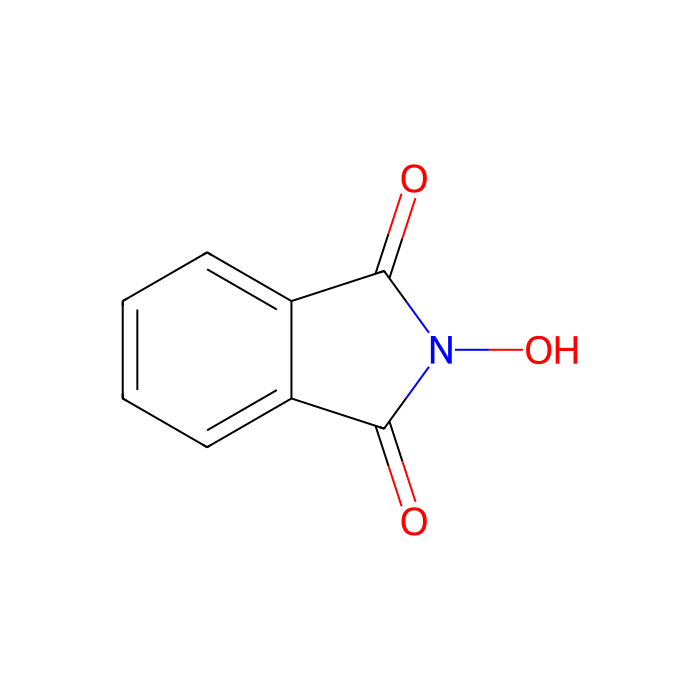
This compound belongs to the class of organic compounds known as phthalimides. These are aromatic heterocyclic compounds containing a 1,3-dioxoisoindoline moiety. They are imide derivatives of phthalic anhydrides.
External Descriptors
Not available
1. Djoumbou Feunang Y, Eisner R, Knox C, Chepelev L, Hastings J, Owen G, Fahy E, Steinbeck C, Subramanian S, Bolton E, Greiner R, and Wishart DS. ClassyFire: Automated Chemical Classification With A Comprehensive, Computable Taxonomy. Journal of Cheminformatics, 2016, 8:61.
Determine the necessary mass, volume, or concentration for preparing a solution.
Dilution Calculator
Determine the dilution needed to prepare a stock solution.
Reconstitution Calculator
Reviews
Customer Reviews
Application Protocols
No assay-specific (WB, IHC, IF, FC) protocols apply to this small-molecule reagent.
For synthetic applications, see representative procedures under Reaction Conditions and Synthetic Utility.
General lab protocol snippets (literature)
Preparation of NHP ester: To a stirred solution of carboxylic acid (1.0 eq) and NHPI (1.1 eq) in dry DCM at 0 °C, add DCC (1.1 eq) dropwise. Warm to rt for 2 h. Filter off DCU, concentrate, and recrystallize from EtOAc/hexane.
Aerobic oxidation: Charge substrate and NHPI (10 mol%) in MeCN, add Co(acac)2 (1 mol%). Sparge with O2 10 min, then heat to 85 °C under an O2 balloon for 8 h. Monitor by GC or NMR.
Biological Roles
Item-specific biological role data: Not specified for this item; refer to CoA/Spec Sheet.
General notes (literature)
NHPI is a synthetic organic reagent and is not known as a natural metabolite or cofactor in biological systems.
The phthalimide motif appears in various synthetic ligands and materials, but NHPI itself has no established endogenous role.
NHP esters are widely used in chemical biology and bioconjugation method development as redox-active acyl transfer/radical precursors; however, NHS esters (not NHPI) are the dominant choice for amine bioconjugation due to faster amide-forming kinetics at physiological pH.
Practical implication
NHPI and its esters are employed in medicinal chemistry and chemical biology research workflows as synthetic intermediates and radical precursors, not as biological buffers or cofactors.
Buffer Applications
NHPI is not a buffering reagent and is not typically used to prepare buffer solutions.
If your workflow involves NHPI-derived reactions in aqueous systems, select an appropriate buffer based on the reaction chemistry (e.g., acetate for mildly acidic conditions), keeping in mind that basic buffers can deprotonate/deactivate NHPI.
For bioconjugation, NHS (not NHPI) esters are commonly used in amine-labeling buffers (pH 7.5–8.5).
Green Alternatives
NHPI often enables greener oxidations by using O2/air as the terminal oxidant, but solvent and co-catalyst choice matter. Consider the following comparisons (literature-based):
Mediators for oxidation
NHPI vs. TEMPO/ABNO: TEMPO excels for alcohol → carbonyl under mild conditions; NHPI is stronger for benzylic/C–H oxidations. TEMPO is often more expensive; NHPI compatible with O2 and inexpensive metals (Co/Mn).
Electrochemical NHPI: Replaces metal co-catalysts and stoichiometric oxidants with electricity; minimizes waste and improves safety.
Solvent choices
Prefer MeCN/EtOAc/2-MeTHF over chlorinated solvents (DCM) where feasible. Ethyl acetate balances performance and benignity; MeCN offers rate but is less green.
Coupling to make NHP esters
EDCI or CDI in EtOAc/2-MeTHF reduce halogenated solvent use versus DCC in DCM; aqueous workups simpler with EDCI (water-soluble urea byproducts).
Comparison snapshot (general)
Criterion: Waste profile
NHPI + O2: Water/benign byproducts; minimal metal load
Traditional Cr(VI)/MnO2 oxidants: Heavy-metal waste; poor atom economy
Criterion: Energy use
Electrochemical/photochemical NHPI: Ambient T; low energy
Thermal oxidations: Elevated T; higher energy
Tradeoffs
NHPI systems may require transition-metal co-catalysts (unless electrochemical), and radical pathways can reduce selectivity; careful optimization mitigates these issues.
Pharmaceutical Uses
Item-specific pharmacopeial/excipient status: Not specified for this item; refer to CoA/Spec Sheet.
General, non-clinical context (literature)
NHPI is a research reagent rather than a pharmaceutical excipient. It finds use in medicinal chemistry as:
A precursor to NHP esters that activate carboxylic acids for amide formation or for decarboxylative cross-coupling in library synthesis.
An oxidation mediator for late-stage functionalization under aerobic conditions, aiding SAR exploration.
No therapeutic or clinical claims are associated with NHPI; it is for research and manufacturing development only.
Quality considerations for pharma R&D
Control of residual NHPI and phthalimide impurities is important in APIs due to potential nitrosation/impurity profiles; standard ICH impurity limits and risk assessments apply.
For GMP settings, ensure supplier qualification, validated analytical methods (HPLC, NMR), and traceability of lot-specific data (CoA, SDS).
Physical Properties
Item-specific specs for this lot
Appearance: Not specified for this item; refer to CoA/Spec Sheet.
Grade/Purity: Not specified for this item; refer to CoA/Spec Sheet.
Literature/typical values (for reference only; not product specifications)
Physical state: White to off-white crystalline solid (literature)
Melting point: ~196–201 °C (literature, varies with source)
Boiling point: Not applicable (decomposes before boiling; literature)
Density: ~1.5–1.6 g/cm³ at 20 °C (literature, indicative)
Solubility: Sparingly soluble in water; soluble in polar aprotic organics (acetone, acetonitrile, ethyl acetate, DMF, DMSO); moderate in alcohols (literature)
pKa (N–OH): ~7–8 (literature, method-dependent)
LogP (estimated): low to moderate polarity; cLogP near 0–1 (literature/estimates)
UV-Vis: No strong chromophore beyond aromatic ring; moderate UV absorbance in 200–280 nm region (literature)
Practical notes
Crystalline hydrates are uncommon; material is typically non-hygroscopic but can retain residual solvent from recrystallization.
Thermal decomposition can generate NOx-containing species; avoid prolonged heating above mp without inert atmosphere.
Quality & Grades
Item-specific quality information
Grade/Purity: Not specified for this item; refer to CoA/Spec Sheet.
General guidance on grades for this compound type
Common offerings include research grade (suitable for synthesis), ≥98–99% purity for catalytic and coupling applications, and low-trace-metal variants for radical/cross-coupling workflows sensitive to metals.
For photoredox and aerobic oxidation catalysis, low levels of peroxides and residual solvents are preferred to ensure reproducibility; these are typically reported on the CoA.
Stabilizers: NHPI is usually supplied without stabilizers. If stabilizers are declared on a specific lot, consider their impact on oxidation catalysis and remove by recrystallization if necessary.
Documentation best practices
Verify melting range and HPLC/GC purity on the lot-specific CoA.
If using for NHP-ester formation destined for cross-coupling, check for water content and residual amines/acids; these can be critical to coupling efficiency.
For trace analysis or sensitive catalysis, request specifications such as residual metals and loss on drying; if not present, perform in-house QA.
Reaction & Applications
NHPI is a versatile mediator and building-block reagent.
Aerobic/C–H oxidations (literature)
Forms the phthalimide N-oxyl (PINO) radical under O2 in the presence of Co/Mn/Cu catalysts or under electrochemical/photochemical conditions.
Promotes selective oxidation of benzylic, allylic, and tertiary C–H bonds to alcohols/ketones; can further oxidize alcohols to carbonyls/acids.
Typical catalyst systems: NHPI (5–20 mol%), Co(acac)2 or Mn(OAc)3 (0.5–5 mol%), O2/air, 60–100 °C in MeCN or PhCN. Alternative initiators: AIBN, NBS, azobisisobutyronitrile, or electrochemical anodic generation of PINO.
Electrosynthesis and photoredox (literature)
Anodic oxidation of NHPI generates PINO for metal-free oxidations at ambient temperature.
Photoredox catalysts (e.g., Ru(bpy)3, organic dyes) can couple with NHPI to enable benzylic oxidations under visible light.
NHP esters as radical precursors (literature)
Activation of carboxylic acids using NHPI (e.g., via DCC/EDC/CDI) furnishes redox-active NHP esters.
These esters undergo decarboxylative cross-coupling (Negishi, Suzuki variants), Giese additions to Michael acceptors, borylation, and arylation under Ni/photoredox dual catalysis.
Other uses (literature)
Mediator in oxidation of hydrocarbons to ketones/acids using O2 (green oxidant).
Co-catalyst in aerobic oxidation of alcohols and aldehydes; useful in late-stage oxidations in complex settings.
Practical notes
Maintain dissolved oxygen; use O2 sparging or oxygen balloon for reproducibility.
Control acidity/base: strong base deactivates NHPI by deprotonation; mild acids (AcOH) often beneficial.
For NHP ester formation, remove urea byproducts (from DCC) by filtration prior to purification.
Reaction Conditions
The following are literature-guideline conditions; they are not product specifications and should be optimized for each substrate.
Aerobic benzylic oxidation (typical)
Substrate: ethylbenzene-type
Catalysts: NHPI 10 mol%, Co(acac)2 1–2 mol%
Solvent: acetonitrile (0.2–0.5 M)
Oxidant: O2 (balloon or sparge); alternatively, air under pressure
Temperature/time: 80–90 °C, 6–18 h
Outcome: acetophenone or 1-phenylethanol/acetophenone mixture; 50–90% yields reported depending on substitution
Electrochemical oxidation (metal-free)
Cell: undivided; graphite anode, Pt/C cathode
Electrolyte: n-Bu4NBF4 (0.1 M) in MeCN
Loading: NHPI 5–10 mol%
Current: constant current (e.g., 5–15 mA/cm²)
Temp: rt to 40 °C; O2 not required (anodic generation of PINO)
Base: Cs2CO3 or i-Pr2NEt; Solvent: DMA/MeCN; Blue LEDs; rt–40 °C; 6–24 h
Products: cross-coupled motifs via radical decarboxylation.
Safety & Handling
Item-specific hazard data
GHS Classification: Not specified for this item; refer to SDS.
Signal Word: Not specified for this item; refer to SDS.
H-Statements/Pictograms: Not specified for this item; refer to SDS.
General safety information (literature/typical for NHPI)
Hazards: May cause skin/eye irritation and respiratory irritation as a fine particulate. Dust may be combustible in air.
Oxidation behavior: NHPI itself is not a strong oxidizer, but under catalytic conditions it forms the PINO radical; avoid contact with strong reducing agents.
Handling recommendations
PPE: Laboratory coat, safety glasses, nitrile gloves. Use a dust mask or handle in a fume hood to avoid inhalation of particulates.
Engineering controls: Handle and weigh in a ventilated hood. Use anti-static measures when transferring fine powders.
Incompatibilities: Strong bases (can deprotonate N–OH), strong reducing agents, strong oxidizing agents (may cause exotherm), and reactive acylating agents without control.
First aid overview (non-exhaustive; defer to SDS)
Inhalation: Move to fresh air; seek medical advice if symptoms persist.
Skin/eye contact: Rinse with water for at least 15 minutes; remove contaminated clothing; obtain medical attention if irritation develops.
Ingestion: Rinse mouth; do not induce vomiting; seek medical advice.
Storage & stability
Store tightly closed at room temperature, dry, away from light and incompatible reagents. Consult SDS for full guidance.
Solvent Selection
NHPI is a polar, hydrogen-bond-donating/accepting organic solid. Solvent choice depends on application (oxidation catalysis vs. NHP ester synthesis):
Polarity and miscibility (general)
Prefers polar aprotic solvents: acetonitrile, acetone, ethyl acetate, DMF, DMSO. Moderately soluble in alcohols (MeOH, EtOH). Poorly soluble in hydrocarbons and water.
Application-driven choices
Aerobic oxidations (PINO-mediated): Acetonitrile or benzonitrile often give good NHPI solubility and oxygen transfer; ethyl acetate or acetone are greener alternatives with tradeoffs in rate.
NHP ester formation: Dichloromethane (DCM), THF, acetonitrile, or DMF are common for DCC/EDC/DMAP couplings. For greener practice, ethyl acetate or 2-MeTHF can work with CDI or EDCI.
Purification: NHP esters often crystallize from ethyl acetate/hexane mixtures; NHPI itself recrystallizes well from ethanol or ethyl acetate.
Practical tips
Ensure complete dissolution of NHPI before initiating oxidations to minimize mass-transfer limitations.
Benzo-/acetonitrile vs. DMF/DMSO: DMF/DMSO maximize solubility but can complicate workup and sustainability.
Storage & Reconstitution
Item-specific storage
Storage Conditions: Room temperature (per Product Data).
Shipped In: Normal (ambient) conditions.
General guidance (literature/best practice)
Store in a tightly sealed container, dry, away from strong bases, reducing agents, and oxidizers. Protect from excessive heat and direct light.
If moisture uptake occurs, dry under vacuum at ambient to 40 °C before use. Avoid prolonged heating above the melting range to prevent decomposition.
For solution use, prepare fresh stock solutions in dry solvents (e.g., MeCN, DCM, EtOAc, DMF, DMSO). Solutions are generally stable for hours to days at room temperature under inert atmosphere; verify by TLC/HPLC before critical runs.
Do not freeze–thaw solid repeatedly in humid environments; equilibrate to room temperature before opening to minimize condensation.
Specifications not provided in Product Data
Water content, residual solvent limits, and stabilizers: Not specified for this item; refer to CoA/Spec Sheet.
Structure & Identity
N-Hydroxyphthalimide (NHPI) is a phthalimide bearing an N–OH group; a crystalline, heteroatom-rich aromatic imide frequently used as an oxidation mediator and as a precursor to N‑hydroxyphthalimidyl (NHP) esters.
Item-specific (from Product Data)
CAS: 524-38-9
CID: 10665
InChIKey: 42904 (as provided)
Storage Conditions: Room temperature
Shipped In: Normal
Research Use: For research use only
Literature structural identity (for reference; not item-specific specs)
Decarboxylative borylation, silylation, and alkynylation
Aerobic oxidations of benzylic/allylic C–H bonds to carbonyls/acids with Co/Mn catalysts or electrochemistry.
Oxidation of alcohols and aldehydes under O2 with catalytic NHPI improving rates and selectivity.
Retrosynthetic value
Carboxylic acids can be converted to NHP esters as redox-active “handles,” opening radical pathways orthogonal to classic two-electron tactics.
Practical considerations
For ester formation: Employ mild base (e.g., DMAP) with carbodiimides; remove dicyclohexylurea by filtration. Keep water low to avoid hydrolysis.
For oxidations: Maintain O2 availability and control temperature to balance rate vs. over-oxidation; small acid co-solvents (AcOH) can stabilize catalytic cycles.
Target Specificity
This product is a small-molecule reagent, not a biological targeting agent.
No antigen/epitope, clone, isotype, or species reactivity data apply.
For application-specific selectivity in chemical reactions (e.g., benzylic vs. aliphatic C–H oxidation), see Reaction & Applications and Reaction Conditions sections.
We use cookies to ensure the website functions properly and, where permitted, to improve your experience. You can manage your preferences at any time in Settings. Learn more in our Cookie Policy.
Shall we send you a message when we have discounts available?
Remind me later
Thank you! Please check your email inbox to confirm.
Products are supplied to verified businesses, institutions, and qualified professionals for research and development use only. Not for use in humans, animals, diagnosis, or therapy.

 A2210201