≥99% for sensitive chromatographic and analytical workflows requiring minimal baseline interference.
🌡
Storage & shipping
Store at 2-8°C,Protected from light,Desiccated Ships Wet ice Check lot-specific COA for exact specifications.
📋
Quality documents
SDS, COA, datasheet, and spec sheet available for download. Lot-specific COA accessible via lot number lookup.
📚
Literature proof
Cited in 0 peer-reviewed publications across chromatography, organic synthesis, and cross-coupling reactions.
Overview
Nasunin, an antioxidant anthocyanin, possesses antiangiogenic activity.
In Vitro
Nasunin at higher 10 µM suppresses microvessel outgrowth in an ex vivo angiogenesis assay using a rat aortic ring. Nasunin suppresses HUVEC proliferation in a dose-dependent manner (50-200 µM). Nasunin diminishes LPS-induced nuclear factor-κB (NF-κB) activation by suppressing the\ndegradation of inhibitor of κB-α and nuclear translocation of p65 subunit of NF-κB. Nasunin also attenuates the phosphorylation of Akt and p38, signaling molecules involved in pro-inflammatory mediator production. MCE has not independently confirmed the accuracy of these methods. They are for reference only.
Form:Solid
Specifications
Specifications & Purity
≥99%
Biochemical and Physiological Mechanisms
Nasunin, an antioxidant anthocyanin, possesses antiangiogenic activity.
Storage
Store at 2-8°C,Protected from light,Desiccated
Shipped In
Wet ice
This product requires cold chain shipping. Ground and other economy services are not available.
Determine the necessary mass, volume, or concentration for preparing a solution.
Dilution Calculator
Determine the dilution needed to prepare a stock solution.
Reconstitution Calculator
Reviews
Customer Reviews
Application Protocols
No tested or validated application protocols are provided for this item in the product data. For research use, users typically develop in-house methods (e.g., HPLC–DAD/ESI–MS quantification in botanical matrices, pH-dependent spectrophotometry), but such procedures are literature examples and not product-validated. Consult the primary literature and your lab’s SOPs for method specifics.
Biological Roles
General literature context (no therapeutic claims):
Plant metabolism/pigmentation: Nasunin is an acylated delphinidin glycoside contributing to the purple coloration of eggplant peels. Anthocyanins are end-products of the phenylpropanoid/flavonoid pathway and localize in vacuoles, where acylation and glycosylation modulate color stability and vacuolar transport.
Metal complexation: Polyphenolic oxo/hydroxy groups can chelate transition metals; nasunin–metal complexes have been studied for their spectroscopic shifts and potential roles in pigment stabilization and metal homeostasis in planta.
Antioxidant chemistry: As with many anthocyanins, nasunin participates in redox and radical-scavenging reactions in vitro; these features underpin its frequent use as a model compound in analytical antioxidant assays (e.g., DPPH, ABTS), without implying biological efficacy in vivo.
pH-dependent forms: The flavylium cation (acidic pH) interconverts with quinoidal bases and hydrated/chalcone species as pH rises; this equilibrium governs visible color and stability and is routinely explored in biochemistry/food chemistry studies.
Transport and modification: Glycosyltransferases and acyltransferases produce nasunin-type structures; vacuolar transporters (e.g., MATE/ABC families) contribute to compartmentalization of anthocyanins in plant tissues (literature).
Item-specific biological data are not provided; consult primary literature when using nasunin as a reference phytochemical in biochemical assays.
Buffer Applications
Nasunin is not a buffer reagent and is not typically used to control pH. However, anthocyanins display pronounced pH-dependent color transitions, which can be leveraged for instructional or analytical demonstrations (literature):
pH indicator behavior (literature):
Acidic (pH < ~3): vivid purple to magenta (flavylium cation).
Near-neutral: color shifts toward blue/violet (quinoidal bases) with reduced stability.
Alkaline: rapid loss of color due to hydration/chalcone formation and degradation.
Practical notes:
For any colorimetric applications, do not rely on nasunin to buffer; instead use standard buffers (e.g., citrate, acetate, phosphate) and add nasunin as a pH-sensitive probe under low-light, chilled conditions.
Avoid prolonged exposure to basic buffers; prepare fresh solutions immediately before use.
Item-specific buffer recipes, pH ranges, or buffering capacities are not applicable and are not provided for this product.
Green Alternatives
Greenness considerations center on solvent choice and stabilization, as nasunin itself is a naturally occurring pigment.
Preferred greener solvents (literature/practice):
Ethanol–water with low levels of food-compatible acids (citric or acetic) for extraction/preparative work, instead of methanol–HCl.
Formic acid as an LC modifier instead of TFA or HCl for MS compatibility and lower environmental impact.
Energy/light management:
Store and process at 2–8°C and protect from light (per product data) to reduce degradative waste and re-preparations.
Avoidance of halogenated solvents:
Analytical and prep workflows can be designed using ACN/H2O or EtOH/H2O systems without chlorinated solvents.
Illustrative comparison (literature):
Acidified methanol (traditional) vs ethanol–water (greener)
Health/environment: EtOH–H2O has lower toxicity and environmental burden.
Performance: MeOH can yield slightly higher solubility and sharper peaks; EtOH may require method optimization (temperature, gradient) to match resolution.
MS compatibility: Both are acceptable; avoid high HCl levels. Prefer 0.1% formic acid.
Note: No item-specific solvent restrictions are provided; the above are general, literature-based sustainability suggestions that can be adapted to your analytical goals.
Pharmaceutical Uses
No pharmacopeial status, excipient role, or formulation specifications are provided for this item. This product is for research use only.
General, non-clinical context (literature/practice):
Nasunin can serve as a reference standard for analytical method development in botanical ingredient characterization (e.g., identity/purity testing of eggplant-derived materials) using LC–DAD/LC–MS.
As an anthocyanin pigment, it is conceptually related to natural colorants; however, specific regulatory approvals and grade requirements for use as a food/pharma colorant vary by jurisdiction and are not implied for this item.
Stability considerations important to formulation science (literature):
Requires acidic environment and light/oxygen protection to maintain chromophore integrity.
Co-pigmentation (self-association or with phenolic acids) and metal complexation can modulate hue and stability, relevant to designing analytical stability studies but not implying product use in medicines.
For any regulated application or QC reference use, obtain and review the certificate of analysis, including purity, counterion/water content, and analytical traceability. No therapeutic or clinical uses are claimed or supported for this product.
Physical Properties
Item-specific specifications are not provided in the product data. Where useful, general/literature properties of anthocyanins like nasunin are summarized and clearly labeled.
Appearance: Not specified for this item; refer to CoA/Spec Sheet.
Molecular weight: Not specified for this item; refer to CoA/Spec Sheet.
Molecular formula: Not specified for this item; refer to CoA/Spec Sheet.
Melting point/decomposition: Not specified for this item; refer to CoA/Spec Sheet. (Anthocyanins typically char/decompose rather than show a sharp MP; literature.)
Boiling point: Not applicable for nonvolatile polyphenolic glycosides (literature).
Density: Not specified for this item; refer to CoA/Spec Sheet.
Refractive index: Not applicable/Not measured for solids; refer to CoA/Spec Sheet.
Solubility (literature): Anthocyanins are generally soluble in water and polar protic organic solvents (e.g., methanol, ethanol) when slightly acidified (e.g., 0.1% HCl), sparingly soluble in nonpolar solvents; stability decreases in basic aqueous media.
LogP: Typically very low (highly polar, glycosylated; literature); item-specific value Not specified.
pKa/pH behavior (literature): The flavylium cation predominates under acidic conditions (approx. pH < 3), while hydration, tautomerization, and color shifts occur with increasing pH (quinoidal bases, chalcone forms), leading to reduced stability under alkaline conditions.
UV–Vis (literature): Strong visible absorption in the 520–550 nm region for delphinidin-type anthocyanins under acidic conditions; exact λmax for this item Not specified.
Quality & Grades
Grade/purity: Not specified for this item; refer to CoA/Spec Sheet.
Context for professional users:
Anthocyanin standards may be offered as analytical reference materials (e.g., HPLC/LC–MS reference grade) featuring tightly controlled purity and water content to ensure quantitative assay performance. In absence of a stated grade, confirm the intended use (e.g., qualitative vs. quantitative) with the CoA.
Purity reporting: For pigments like nasunin, purity is often assessed by HPLC with photodiode array and/or MS. Minor co-extracted anthocyanins, sugars, or phenolic acids may be present if not highly purified; check chromatograms in the CoA.
Counterion/form: The salt form (e.g., chloride) and water of hydration can affect assay response, extinction coefficients, and gravimetric calculations. If the form is unspecified, determine empirically by titration/HRMS or consult the Spec Sheet.
Stabilizers: Some anthocyanin preparations are blended with small amounts of food-grade acids (e.g., citric) to stabilize color. No stabilizer is specified for this item; refer to CoA/Spec Sheet before assuming additive-free material.
Light/oxygen controls: For high-accuracy analytical work, verify that packaging is light-resistant and under inert atmosphere or desiccant; this item is specified to be desiccated and protected from light during storage.
Reaction & Applications
While nasunin is primarily used as a pigment standard and phytochemical research analyte, it also serves as a model polyphenolic system for studying acylated anthocyanins (literature). Key application areas include:
Analytical standards:
Method development/validation for quantifying acylated delphinidin glycosides in botanicals (HPLC–DAD/ESI–MS). Used to establish retention windows, fragmentation patterns (e.g., neutral loss of sugars and p-coumaroyl), and response factors.
Spectroscopic studies of pH-dependent equilibria of the flavylium system (colorimetric/pH-probe behavior).
Coordination/chelation studies (literature):
Investigations of anthocyanin–metal complexes (e.g., Fe3+, Al3+), relevant to plant pigmentation and stability mechanisms; complexation often shifts λmax and stabilizes quinoidal forms.
Reactivity/probing chemistry (literature):
Acid-catalyzed acyl migration or hydrolysis of the p-coumaroyl group; enzymatic or chemical deglycosylation to the delphinidin aglycone.
Oxidation kinetics of polyphenols under air/light; radical-scavenging assays (e.g., DPPH, ABTS) using nasunin as a reference analyte in method development (no biological/clinical claims).
Practical tips:
Maintain pH < 3 to preserve the flavylium form during handling and HPLC sample prep; prepare fresh solutions.
Minimize light exposure (amber vials) and oxygen headspace; store chilled as specified for this item.
For LC–MS, prefer formic acid (0.05–0.1%) modifiers and gentle source temperatures to limit in-source fragmentation of glycosidic bonds.
Reaction Conditions
No reaction-condition specifications are provided for this catalog item. The following general, literature-based conditions are commonly applied to anthocyanins like nasunin for analytical or structural work (not product specifications):
Preparation of stock solutions (analytical):
Dissolve in MeOH or EtOH containing ~0.05–0.1% formic acid (or trace HCl) at cold temperature; typical concentrations 0.1–1.0 mg/mL. Use amber vials.
Hydrolysis studies:
Deglycosylation (to aglycone): hot aqueous acid (e.g., 0.1–1 M HCl, 60–90°C) for short durations, followed by rapid cooling; expect concurrent degradation if over-exposed.
Ester cleavage (p-coumaroyl): mild basic methanolysis or specific esterases at low temperature and short times; strictly control pH to minimize chromophore loss.
LC–MS analysis:
Mobile phases: H2O/ACN or H2O/MeOH with 0.05–0.1% formic acid; column temps 25–35°C; detection at 520–540 nm plus MS (ESI+); minimize dwell time to reduce on-column degradation.
Metal complexation assays:
Prepare anthocyanin in mildly acidic aqueous buffer; titrate metal salts (e.g., Fe3+) while monitoring visible spectra; avoid excess base.
Yields and kinetics vary widely with pH, temperature, and light. Always conduct small-scale trials and validate with orthogonal analytics (HPLC–DAD and MS).
Safety & Handling
Authoritative safety information must be taken from the SDS for this catalog item.
GHS classification: Not specified for this item; refer to SDS.
Signal word, hazard statements, pictograms: Not specified for this item; refer to SDS.
General handling guidance (literature/practice for polyphenolic pigments):
PPE: Wear lab coat, safety glasses, and suitable gloves (e.g., nitrile). Avoid inhalation of dust and contact with skin/eyes.
Engineering controls: Use in a fume hood when weighing powders or preparing solutions, especially when using acidic organic solvents (e.g., MeOH/HCl) for dissolution.
Stability concerns: Anthocyanins are light-, heat-, and base-sensitive. Protect from light and avoid elevated temperatures and alkaline conditions. Oxygen may promote oxidative degradation of phenolic groups; minimize air exposure for solutions.
Incompatibilities (general): Strong bases and oxidizers; metal ions may complex with anthocyanins and alter color/behavior.
First aid (overview; defer to SDS): If inhaled—move to fresh air; if on skin/eyes—rinse with water; if ingested—rinse mouth. Seek medical attention if irritation persists.
Waste: Dispose of solutions/solids according to local regulations. Acidified alcoholic solutions should be collected as halogen-free organic waste if applicable.
Storage per product data: 2–8°C, protected from light, desiccated. Shipped on wet ice.
Solvent Selection
Nasunin is a highly polar, glycosylated anthocyanin; dissolution and stability are strongly pH- and solvent-dependent (literature guidance).
Water acidified to pH ~1–3 (e.g., 0.01–0.1% HCl) to maintain the flavylium cation and color stability.
Methanol or ethanol containing 0.1% HCl for HPLC stock solutions; switch to aqueous mobile phases prior to injection when needed.
Avoid strong bases and neutral/basic aqueous buffers which promote hydration/chalcone formation and fading.
Miscibility profile (literature): Fully miscible in water/alcohol mixtures under acidic conditions; insoluble in nonpolar solvents (hexane, toluene).
Analytical use scenarios:
LC–DAD/LC–MS: Acidified H2O/MeOH or H2O/ACN with 0.1% formic acid or HCOOH is common for retention and ionization control.
Spectrophotometry: Prepare fresh acidic solutions to minimize drift from hydration/polymerization.
Comparison (literature):
Acidified MeOH vs acidified EtOH: MeOH often provides better solubility and sharper HPLC peaks; EtOH is greener and suitable for preparative work. For LC–MS, avoid excessive inorganic acids; formic acid is MS-friendly compared to HCl.
Note: Item-specific solubility limits are not provided; verify concentration empirically and consult the CoA/Spec Sheet.
Storage & Reconstitution
Storage conditions (per product data): Store at 2–8°C, protected from light, desiccated.
Shipping: Shipped on wet ice.
Reconstitution: Not specified for this item; refer to CoA/Spec Sheet.
Notes:
Follow the storage guidance precisely to minimize degradation of anthocyanins. Do not infer additional handling steps beyond those stated without consulting the CoA/SDS.
Research use only, as stated in the product data.
Structure & Identity
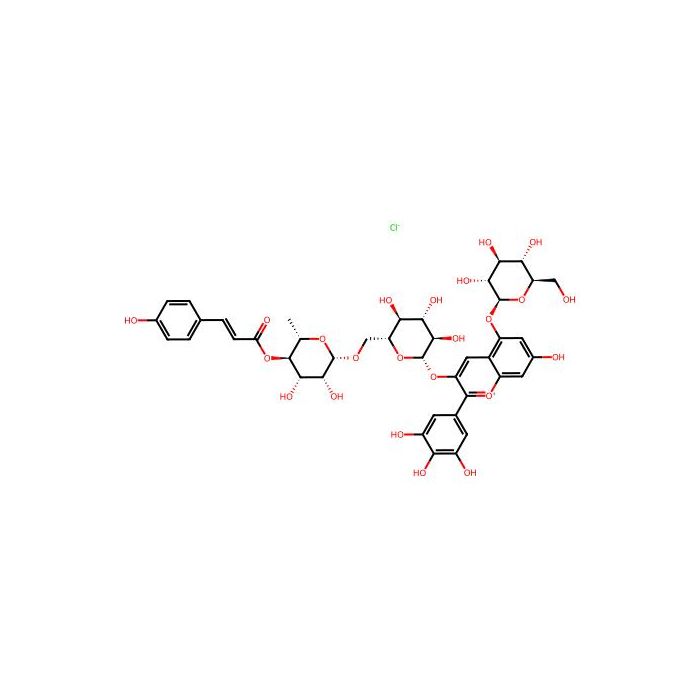
Brief overview: Nasunin is an anthocyanin pigment predominantly found in eggplant (Solanum melongena) peels, commonly described in the literature as an acylated, tri-glycosylated delphinidin derivative.
Product name: Nasunin (SKU: N651506)
CAS: 28463-30-1
Category: Small molecules and compound library (research use only)
Molecular formula: Not specified for this item; refer to CoA/Spec Sheet.
Molecular weight: Not specified for this item; refer to CoA/Spec Sheet.
SMILES: Not specified for this item; refer to CoA/Spec Sheet.
InChIKey: Not specified for this item; refer to CoA/Spec Sheet.
Structural features (literature description):
Core chromophore: delphinidin-type flavylium cation (anthocyanidin) featuring a 2-phenylbenzopyrylium scaffold with three phenolic hydroxyls on the B-ring (trihydroxylated catechol/pyrogallol motif).
Glycosylation: typically 3-O-rutinoside (rhamnose–glucose disaccharide) and 5-O-glucoside on the flavylium core.
Acylation: the 3-O-rutinoside is commonly acylated with p-coumaric acid (p-coumaroyl group), yielding an acylated rutinoside.
Counterion/state: often isolated/handled as a chloride salt of the flavylium cation in acidic media (literature), though the specific counterion for this item is not specified.
2D structural description (literature):
A central cationic pyran ring fused to a benzene ring (C-ring/A-ring) bearing multiple phenolic OH groups; a pendant phenyl (B-ring) with 3′,4′,5′-trihydroxylation; sugar chains attached at C-3 and C-5; one sugar chain acylated by a trans-p-coumaroyl moiety.
Synthetic Utility
Nasunin is not a common synthetic building block, but it is valuable in methodology, characterization, and mechanistic studies of complex natural products (literature):
O-glycosidic linkages (3-O-rutinoside; 5-O-glucoside) and an ester-linked p-coumaroyl acyl group.
Transformations used in structural elucidation:
Acid- or enzyme-catalyzed deglycosylation to the aglycone (delphinidin) and sequential sugar identification.
Ester hydrolysis of the p-coumaroyl group under mild base or specific esterases (careful to avoid chromophore degradation).
Metal-complexation studies to probe binding sites and electronic effects.
Analytical method development:
Benchmarking chromatographic selectivity for acylated versus non-acylated anthocyanins.
Tandem MS fragmentation mapping (neutral loss of 162/146/308 Da units typical for hexose/rhamnose/rutinoside, literature) to assist in dereplication of related pigments.
Retrosynthetic interest:
Highlights challenges in site-selective glycosylation and acylation on polyhydroxy aromatics; serves as a reference case for biomimetic acyltransferase-mediated modifications (literature).
Given its lability to base, most manipulations are done under acidic, low-light, low-temperature conditions. Item-specific reactivity data are not provided; adapt general anthocyanin practices to your workflow.
Target Specificity
Not applicable. This product is a small-molecule anthocyanin pigment, not a biological targeting reagent or antibody. No antigen, epitope, species reactivity, clone, or isotype information applies.
We use cookies to ensure the website functions properly and, where permitted, to improve your experience. You can manage your preferences at any time in Settings. Learn more in our Cookie Policy.
Shall we send you a message when we have discounts available?
Remind me later
Thank you! Please check your email inbox to confirm.
Products are supplied to verified businesses, institutions, and qualified professionals for research and development use only. Not for use in humans, animals, diagnosis, or therapy.