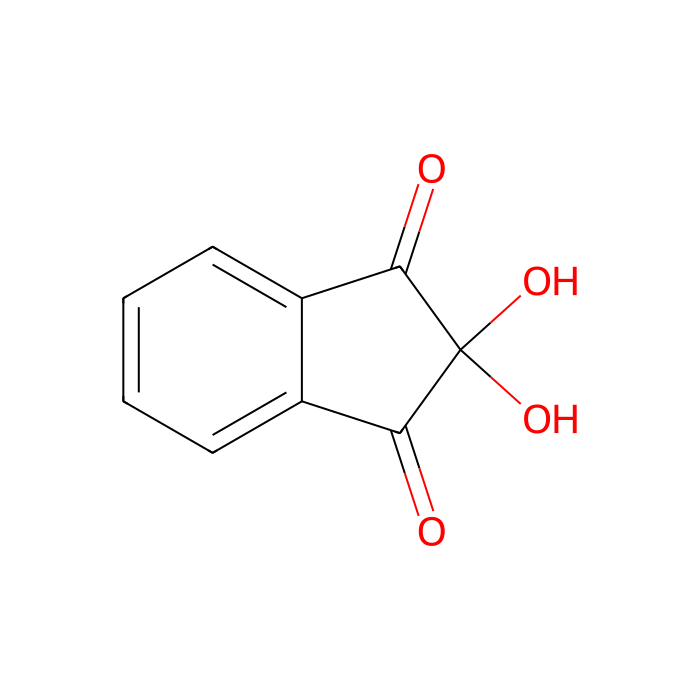
Ninhydrin - ACS, ≥98% , CAS No.485-47-2

CAS: 485-47-2 Cat. No.: N105630 Formula: C9H6O4 Molecular Weight: 178.14 Beilstein Registry Number: 1910963 EC Number: 207-618-1
AVAILABLE TO ORDER
GRADE & PURITY ACS ? ACS grade — meets American Chemical Society specifications, the analytical benchmark in the US. Use for analytical and QC work needing ACS-defined purity. ≥98%
Synonyms
1,2,3-Indantrione monohydrate | Ninhydrin hydrate
Storage
Store at 2-8°C,Argon charged,Desiccated
Shipped In
Wet ice
★
Size
USA
Germany (EU)*
Price
Qty
5g
N105630-5g
In stock ≥10
—
$22.90
25g
N105630-25g
4 In stock
—
$78.90
100g
N105630-100g
3 In stock
—
$199.90
500g
N105630-500g
1 In stock
—
$539.90
Enter a quantity for the sizes you want to add.
🧪
Why this grade

ACS, ≥98% ACS for sensitive chromatographic and analytical workflows requiring minimal baseline interference.

🌡

Storage & shipping

Store at 2-8°C,Argon charged,Desiccated Ships Wet ice Check lot-specific COA for exact specifications.

📋

Quality documents

SDS, COA, datasheet, and spec sheet available for download. Lot-specific COA accessible via lot number lookup.

📚

Literature proof

Cited in 66 peer-reviewed publications across chromatography, organic synthesis, and cross-coupling reactions.

Overview

Used in the detection and assay of peptides, amino acids, amines, and amino sugars yielding highly fluorescent ternary compounds with aldehydes and primary amines. Reaction with sarcosine or proline gives azomethine ylides.

Application:

It can be used for the detection of peptides, amino acids, amino acids and amino sugars, and can produce strong fluorescent ternary compounds with aldehydes and primary amines. Reacts with sarcosine or proline to form methylimine Ylide.
Ninhydrin (ninhydrin hydrate) can be used as a reagent for the determination of amino acids and peptides by photometry and colorimetry. It can also be used to prepare ninhydrin reagents by mixing ninhydrin with hydroninhydrin (reduced form of ninhydrin) in dimethyl sulfoxide. This reagent can be used for the manual ninhydrin method to quantify amino acids.
It can be used to detect free amino groups in amino acids, peptides and proteins.

Specifications

Synonyms
1,2,3-Indantrione monohydrate | Ninhydrin hydrate
Specifications & Purity
ACS, ≥98%
Biochemical and Physiological Mechanisms
Ninhydrin reacts with primary and secondary amines producing a blue or purple reaction product (diketohydrindylidene-diketohydrindamine). Ninhydrin is commonly used for the development of fingermarks on porous surfaces and is often used in comparison with
Storage
Store at 2-8°C,Argon charged,Desiccated
Shipped In
Wet ice
This product requires cold chain shipping. Ground and other economy services are not available.
Grade
ACS
Note
Wherever possible, you should prepare and use solutions on the same day. However, if you need to make up stock solutions in advance, we recommend that you store the solution as aliquots in tightly sealed vials at -20°C. Generally, these will be useable for up to one month. Before use, and prior to opening the vial we recommend that you allow your product to equilibrate to room temperature for at least 1 hour. Need more advice on solubility, usage and handling? Please visit our frequently asked questions (FAQ) page for more details.
Purity
≥98%
Names and Identifiers
Pubchem Sid
Pubchem Sid Url
https://pubchem.ncbi.nlm.nih.gov/substance/504751919
Canonical Smiles
C1=CC=C2C(=C1)C(=O)C(C2=O)(O)O
IUPAC Name
2,2-dihydroxyindene-1,3-dione
InChIKey
FEMOMIGRRWSMCU-UHFFFAOYSA-N
INCHI
1S/C9H6O4/c10-7-5-3-1-2-4-6(5)8(11)9(7,12)13/h1-4,12-13H
Isomeric SMILES
C1=CC=C2C(=C1)C(=O)C(C2=O)(O)O
WGK Germany
3
RTECS
NK5425000
Molecular Weight
178.14
Beilstein
1910963
Reaxy-Rn
1910963
Reaxys-RN_link_address
https://www.reaxys.com/reaxys/secured/hopinto.do?context=S&query=IDE.XRN=1910963&ln=

Documentation

📋 Safety Data Sheet (SDS)

Comprehensive hazard, handling, storage, and regulatory compliance document.

Download SDS →

✅ Certificate of Analysis (COA)

Lot-specific quality data. Enter your lot number to retrieve the exact COA.

Look up COA →

📊 Datasheet

Quick-reference summary of product specifications and applications.

View datasheet →

🔬 Specification Sheet

Full quality attributes and acceptance criteria for this grade.

View spec sheet →

Advanced Data

Taxonomic Classification

Taxonomy Tree

KingdomOrganic compounds
SuperclassBenzenoids
ClassIndanes
SubclassIndanones
Intermediate Tree Nodes Not available
Direct ParentIndanediones
Alternative Parents Aryl alkyl ketones  Carbonyl hydrates  Organic oxides  Hydrocarbon derivatives  
Molecular FrameworkAromatic homopolycyclic compounds
Substituents Indanedione - Aryl alkyl ketone - Aryl ketone - Ketone - Carbonyl hydrate - Organic oxygen compound - Organic oxide - Hydrocarbon derivative - Organooxygen compound - Aromatic homopolycyclic compound
DescriptionThis compound belongs to the class of organic compounds known as indanediones. These are compounds containing an indane ring bearing two ketone groups.
External Descriptors a small molecule
3D Structure
Interactive Chemical Structure Model


Associated Targets(Human)
CA7 Tclin Carbonic anhydrase 7 (1 Activities)
Activity TypeActivity Value -log(M)Mechanism of ActionActivity ReferencePublications (PubMed IDs)
CA2 Tclin Carbonic anhydrase II (17698 Activities)
Activity TypeRelationActivity valueUnitsAction TypeJournalPubMed IddoiAssay Aladdin ID
NR3C1 Tclin Glucocorticoid receptor (14987 Activities)
Activity TypeRelationActivity valueUnitsAction TypeJournalPubMed IddoiAssay Aladdin ID
AR Tclin Androgen Receptor (11781 Activities)
Activity TypeRelationActivity valueUnitsAction TypeJournalPubMed IddoiAssay Aladdin ID
TSHR Tclin Thyroid stimulating hormone receptor (29986 Activities)
Activity TypeRelationActivity valueUnitsAction TypeJournalPubMed IddoiAssay Aladdin ID
CA1 Tclin Carbonic anhydrase I (13240 Activities)
Activity TypeRelationActivity valueUnitsAction TypeJournalPubMed IddoiAssay Aladdin ID
ALOX15B Tchem Arachidonate 15-lipoxygenase, type II (7244 Activities)
Activity TypeRelationActivity valueUnitsAction TypeJournalPubMed IddoiAssay Aladdin ID
ALDH1A1 Tchem Aldehyde dehydrogenase 1A1 (77053 Activities)
Activity TypeRelationActivity valueUnitsAction TypeJournalPubMed IddoiAssay Aladdin ID
ALOX12 Tchem Arachidonate 12-lipoxygenase (3262 Activities)
Activity TypeRelationActivity valueUnitsAction TypeJournalPubMed IddoiAssay Aladdin ID
CASP1 Tchem Caspase-1 (6235 Activities)
Activity TypeRelationActivity valueUnitsAction TypeJournalPubMed IddoiAssay Aladdin ID
BACE1 Tchem Beta-secretase 1 (15641 Activities)
Activity TypeRelationActivity valueUnitsAction TypeJournalPubMed IddoiAssay Aladdin ID
CA9 Tclin Carbonic anhydrase IX (8255 Activities)
Activity TypeRelationActivity valueUnitsAction TypeJournalPubMed IddoiAssay Aladdin ID
TP53 Tchem Cellular tumor antigen p53 (48468 Activities)
Activity TypeRelationActivity valueUnitsAction TypeJournalPubMed IddoiAssay Aladdin ID
Lymphoblastoid cell (5959 Activities)
Activity TypeRelationActivity valueUnitsAction TypeJournalPubMed IddoiAssay Aladdin ID
IDO1 Tchem Indoleamine 2,3-dioxygenase (6650 Activities)
Activity TypeRelationActivity valueUnitsAction TypeJournalPubMed IddoiAssay Aladdin ID
APEX1 Tchem DNA-(apurinic or apyrimidinic site) lyase (38016 Activities)
Activity TypeRelationActivity valueUnitsAction TypeJournalPubMed IddoiAssay Aladdin ID
EHMT1 Tchem Histone-lysine N-methyltransferase, H3 lysine-9 specific 5 (407 Activities)
Activity TypeRelationActivity valueUnitsAction TypeJournalPubMed IddoiAssay Aladdin ID
EHMT2 Tchem Histone-lysine N-methyltransferase, H3 lysine-9 specific 3 (93046 Activities)
Activity TypeRelationActivity valueUnitsAction TypeJournalPubMed IddoiAssay Aladdin ID
L3MBTL1 Tchem Lethal(3)malignant brain tumor-like protein 1 (14536 Activities)
Activity TypeRelationActivity valueUnitsAction TypeJournalPubMed IddoiAssay Aladdin ID
Associated Targets(non-human)
Ca7 Carbonic anhydrase VII (3 Activities)
Activity TypeRelationActivity valueUnitsAction TypeJournalPubMed IddoiAssay Aladdin ID
CA4 Carbonic anhydrase IV (1713 Activities)
Activity TypeRelationActivity valueUnitsAction TypeJournalPubMed IddoiAssay Aladdin ID
Mapk1 MAP kinase ERK2 (650 Activities)
Activity TypeRelationActivity valueUnitsAction TypeJournalPubMed IddoiAssay Aladdin ID
Plasmodium falciparum (966862 Activities)
Activity TypeRelationActivity valueUnitsAction TypeJournalPubMed IddoiAssay Aladdin ID
pfk 6-phospho-1-fructokinase (7870 Activities)
Activity TypeRelationActivity valueUnitsAction TypeJournalPubMed IddoiAssay Aladdin ID
Nfe2l2 Nuclear factor erythroid 2-related factor 2 (214 Activities)
Activity TypeRelationActivity valueUnitsAction TypeJournalPubMed IddoiAssay Aladdin ID
Rorc Nuclear receptor ROR-gamma (89407 Activities)
Activity TypeRelationActivity valueUnitsAction TypeJournalPubMed IddoiAssay Aladdin ID
Mechanisms of Action
Certificates(CoA,COO,BSE/TSE and Analysis Chart)
C of A & Other Certificates(BSE/TSE, COO):
Analytical Chart:

Find and download the COA for your product by matching the lot number on the packaging.

42 results found

Lot NumberCertificate TypeDateItem
I2616837Certificate of AnalysisSep 04, 2026 N105630
I2616902Certificate of AnalysisSep 04, 2026 N105630
I2616903Certificate of AnalysisSep 04, 2026 N105630
H2628068Certificate of AnalysisSep 04, 2026 N105630
D2623376Certificate of AnalysisApr 08, 2026 N105630
D2623384Certificate of AnalysisApr 08, 2026 N105630
D2623385Certificate of AnalysisApr 08, 2026 N105630
D2623392Certificate of AnalysisApr 08, 2026 N105630
D2623393Certificate of AnalysisApr 08, 2026 N105630
J2523607Certificate of AnalysisSep 29, 2025 N105630
J2523596Certificate of AnalysisSep 29, 2025 N105630
J2523597Certificate of AnalysisSep 29, 2025 N105630
E2506397Certificate of AnalysisApr 17, 2025 N105630
E2506398Certificate of AnalysisApr 17, 2025 N105630
E2506426Certificate of AnalysisApr 17, 2025 N105630
L2410630Certificate of AnalysisNov 30, 2024 N105630
L2410631Certificate of AnalysisNov 30, 2024 N105630
L2410632Certificate of AnalysisNov 30, 2024 N105630
J2416616Certificate of AnalysisSep 20, 2024 N105630
J2416614Certificate of AnalysisSep 20, 2024 N105630
L2420536Certificate of AnalysisJul 01, 2024 N105630
L2420537Certificate of AnalysisJul 01, 2024 N105630
L2420538Certificate of AnalysisJul 01, 2024 N105630
F2417282Certificate of AnalysisMay 31, 2024 N105630
F2417303Certificate of AnalysisMay 31, 2024 N105630
F2417304Certificate of AnalysisMay 31, 2024 N105630
E2410322Certificate of AnalysisMar 29, 2024 N105630
E2410321Certificate of AnalysisMar 29, 2024 N105630
E2410323Certificate of AnalysisMar 29, 2024 N105630
E2410324Certificate of AnalysisMar 29, 2024 N105630
E2410325Certificate of AnalysisMar 29, 2024 N105630
E2305558Certificate of AnalysisApr 03, 2023 N105630
E2305519Certificate of AnalysisApr 03, 2023 N105630
E2305515Certificate of AnalysisApr 03, 2023 N105630
B2318076Certificate of AnalysisDec 13, 2022 N105630
B2318349Certificate of AnalysisDec 13, 2022 N105630
B2318154Certificate of AnalysisDec 13, 2022 N105630
B2318144Certificate of AnalysisDec 13, 2022 N105630
B2318132Certificate of AnalysisDec 13, 2022 N105630
J22111305Certificate of AnalysisSep 17, 2022 N105630
J22111304Certificate of AnalysisSep 17, 2022 N105630
J22111265Certificate of AnalysisSep 17, 2022 N105630
Chemical and Physical Properties
Sensitivitylight&air sensitive
Melt Point(°C)250°C
Molecular Weight178.140 g/mol
XLogP30.100
Hydrogen Bond Donor Count2
Hydrogen Bond Acceptor Count4
Rotatable Bond Count0
Exact Mass178.027 Da
Monoisotopic Mass178.027 Da
Topological Polar Surface Area74.600 Ų
Heavy Atom Count13
Formal Charge0
Complexity243.000
Isotope Atom Count0
Defined Atom Stereocenter Count0
Undefined Atom Stereocenter Count0
Defined Bond Stereocenter Count0
Undefined Bond Stereocenter Count0
The total count of all stereochemical bonds0
Covalently-Bonded Unit Count1
Documents & Articles
Functions and Significance of Common Physiological and Biochemical Indices in Animals and Plants
Review of the Principles, Common Methods, and Key Application Considerations for the Determination of Glycerol and Triglyceride Contents
Roles of the Carboxypeptidase Family in Protein C-Terminal Processing and Experimental Analysis
Methods and Applications for the Determination of Amino Acid Content and Composition
What Is “Plant Collagen”? Distinguishing Ingredient Types, Structural Differences, Production Methods, and Skincare Effects
Citations of This Product
Solution Calculators
Reviews

Customer Reviews

Application Protocols

No vendor-validated protocols are specified for this catalog item. The following are literature-style, general procedures (for research use only):

  • TLC visualization protocol (typical):

    • Prepare 0.3% w/v ninhydrin in acetone containing 3% v/v acetic acid.
    • Spray plate evenly in a fume hood; allow solvent to evaporate.
    • Heat at 105 °C for 7 minutes. Observe purple spots for primary amines; document immediately.
  • Simple colorimetric assay for free amino groups:

    • Prepare standards (e.g., 0–200 µM glycine) and samples in matched solvent system.
    • Add equal volume of 0.5% w/v ninhydrin reagent; heat at 100 °C for 10 minutes.
    • Cool to room temperature; measure A560–570 nm against a reagent blank; construct a calibration curve for quantitation.
  • Fingerprint development on porous substrates (overview):

    • Apply 1% w/v ninhydrin in ethanol by spray or dip; air dry.
    • Cure at 90 °C for 10 minutes or at ambient temperature under elevated humidity until ridge detail appears; photograph under visible light.

Note: Optimize parameters for your matrix and instrumentation. Always perform small-scale tests and follow institutional safety guidelines.

Biological Roles

Ninhydrin is not a biomolecule and has no native physiological role. This section summarizes how it interfaces with biological molecules in analytical contexts.

  • Literature perspective:

    • Reactivity toward primary amino groups allows selective visualization/quantitation of amino acids, peptides (free N-termini), amino sugars, and proteinaceous residues (e.g., in fingerprints).
    • The reaction consumes the amine (oxidative deamination/decarboxylation for α-amino acids), so it is destructive to the analyte.
    • Color development kinetics and intensity depend on the microenvironment (pH, moisture, temperature) and the nature of the amine (primary vs secondary; aliphatic vs aromatic).
  • Biochemical applications (analytical):

    • Qualitative amino acid spot tests and TLC visualization in teaching and research labs.
    • Sample preparation QA: confirming presence of free amines after deprotection steps in peptide synthesis.
    • Protein/peptide hydrolysate assays where chromophore intensity correlates with total free amino content (requires calibration and controlled conditions).
  • Limitations:

    • Poor sensitivity for secondary amines; background from matrix components can occur.
    • Not suitable for living systems or in vivo assays; reaction is irreversible and not biocompatible.
Buffer Applications

Ninhydrin is not a buffering agent and is not used to prepare biological or analytical buffers.

  • Practical note:
    • If buffer is needed for downstream analysis, prepare standard systems (e.g., phosphate, acetate) independently. Ninhydrin derivatization is typically carried out in organic solvents or aqueous–organic media and then developed thermally rather than by pH control.
Green Alternatives

Consider environmental, health, and safety aspects of the derivatization system as a whole (reagent + solvent + processing).

  • Greener reagent or workflow options (literature):

    • Fluorescamine: non-fluorescent until reacting with primary amines to yield fluorescent products; used at very low concentrations; avoids high-temperature development but requires fluorimetry.
    • o-Phthalaldehyde (OPA) with thiol co-reagent: rapid room-temperature fluorescence derivatization for primary amines; widely used in HPLC; sensitive but light/oxygen sensitive.
    • TNBS (trinitrobenzenesulfonic acid): aqueous-compatible colorimetric reagent; avoids organic solvents but introduces energetic nitroaromatic handling considerations.
  • Solvent substitutions for ninhydrin working solutions (literature):

    • Replace acetone with ethanol or isopropanol where substrate compatibility and emission controls demand lower VOC reactivity.
    • Employ water–alcohol mixtures to reduce VOC load, acknowledging slower drying and potential background changes.
  • Comparative overview (typical literature experience):

    • Ninhydrin/acetone: simple, robust, high-contrast color; requires heating and VOCs; waste streams are organic-rich.
    • OPA/thiol in aqueous buffer: highly sensitive, no heating; requires fluorescence detection and fresh reagent prep; thiol odor/toxicity management.
    • Fluorescamine in acetonitrile/buffer: ultra-low reagent usage; fluorescence instrumentation required.
  • Trade-offs:

    • Colorimetric ninhydrin remains attractive for low-cost visualization; greener alternatives may reduce energy (no heating) and solvent impacts but increase instrument dependence or introduce new hazards.
Pharmaceutical Uses

No therapeutic or clinical claims. For research and laboratory use only (per Product Data).

  • Literature/industry practice (non-clinical, non-therapeutic):
    • Quality control reagent for detecting residual primary amines, amino acid impurities, or assessing amino end-group content in polymers associated with device or packaging materials.
    • Visualization reagent in TLC/HPTLC identity tests for amino-containing APIs, excipients (e.g., amino sugars), and intermediates.
    • Not recognized as an excipient; not used in finished formulations. Any pharmacopeial relevance would be as a reagent in compendial identification/limit tests, not as a component of dosage forms.
Physical Properties
  • Item-specific (from Product Data):

    • Appearance: Not specified for this item; refer to CoA/Spec Sheet.
  • Literature/typical properties (reference values; not specifications for this item):

    • Physical state/color: Off-white to pale yellow crystalline solid (literature)
    • Melting/decomposition: ~248–252 °C with decomposition (literature)
    • Solubility: Moderately soluble in polar organic solvents (ethanol, acetone); sparingly to moderately soluble in water; essentially insoluble in nonpolar solvents (literature)
    • pKa: acidic character associated with the 1,3-dicarbonyl/hydrate system; reported pKa values vary by tautomer and medium (literature; consult primary data for method-specific numbers)
    • LogP: low; consistent with polar, hydrogen-bonding solid (qualitative, literature)
    • UV–Vis: forms a strong chromophore only after reaction with primary amines (Ruhemann’s purple; λmax commonly reported near 560–570 nm depending on solvent and conditions; literature)
    • Odor: Odorless to faint (literature)
  • Practical notes for use (general):

    • Working solutions are commonly prepared at 0.1–0.5% w/v in acetone, ethanol, or isopropanol, often with a small amount of acetic acid to enhance color development (literature guidance).
    • Thermal development of chromophore typically at 80–110 °C for several minutes depending on substrate (literature).
Quality & Grades
  • Item-specific (from Product Data):

    • Grade/Purity: ACS
  • What ACS grade implies (general explanation):

    • ACS grade typically meets or exceeds the purity and testing requirements specified by the American Chemical Society for general laboratory reagents. For ninhydrin, this usually means low levels of inorganic contaminants and organic impurities suitable for analytical colorimetric applications, TLC visualization, and bench-scale derivatization.
    • UV absorbance background and trace-metal content are not standardized across all vendors for this material; where such attributes are critical (e.g., quantitative amino acid analysis), consult the product’s CoA/Specification Sheet.
  • Stabilizers/additives:

    • Not specified for this item; refer to CoA/Spec Sheet.
  • Why this matters for use:

    • Colorimetric sensitivity is affected by trace impurities and moisture content. ACS-grade material helps ensure reproducible background and consistent development of Ruhemann’s purple.
    • For high-precision analytical workflows, verify lot-specific performance (blank background, baseline coloration, and solution stability) with a small pilot test.
Reaction & Applications

Core application: chromogenic detection and quantitation of primary amines (especially amino acids, peptides with free N-termini, and amino sugars) via formation of Ruhemann’s purple after heating.

  • Reaction families and mechanisms (literature):

    • Ninhydrin reaction with primary amines: nucleophilic addition to the carbonyl center followed by oxidative deamination and decarboxylation (for α-amino acids), yielding an aldehyde (with one fewer carbon), CO2, ammonia, and the intensely colored diketohydrindylidene–diketohydrindamine (Ruhemann’s purple) chromophore (λmax ~560–570 nm depending on medium).
    • Secondary amines: form yellow–orange products (Schiff base-like adducts), typically less intense and unsuitable for sensitive quantitation compared to primary amines.
  • Analytical/functional uses (literature):

    • TLC visualization of amino acids/peptides: spray with 0.2–0.5% w/v ninhydrin in acetone or ethanol; heat 100–110 °C for 5–10 min.
    • Post-column or off-line derivatization for colorimetric amino acid assays in food, polymer (e.g., amino end-groups in nylons), and biochemical samples.
    • Forensic latent fingerprint development on porous substrates (paper, cardboard) where amino acid residues are present; development at elevated temperature/humidity or by oven curing.
  • Practical tips (literature):

    • Prepare fresh solutions; ninhydrin slowly degrades in solution, increasing background.
    • Add 1–5% acetic acid to improve color yield; avoid strong bases and prolonged exposure to light/air.
    • For quantitation, construct calibration curves with known amino acid standards; maintain consistent development time and temperature.
    • Use glass sprayers or PTFE-compatible equipment; acetone can attack certain plastics.
Reaction Conditions

General laboratory guidance from literature for common ninhydrin applications (not product specifications):

  • TLC visualization of amino acids/peptides:

    • Reagent: 0.2–0.5% w/v ninhydrin in acetone or ethanol; optionally 1–5% v/v acetic acid.
    • Application: Spray evenly; allow solvent to evaporate briefly.
    • Development: Heat plate at 100–110 °C for 5–10 min. Spots of primary amines develop purple; secondary amines yellow.
  • Forensic fingerprint development on paper:

    • Reagent: 0.5–2% w/v in ethanol, isopropanol, or mixed solvents; small acid content may be included.
    • Processing: Dip or spray; air dry; cure at 80–100 °C for 10–20 min or under controlled humidity to enhance contrast. Photographic documentation under visible light.
  • Colorimetric amino acid assay (batch):

    • Mix sample containing primary amines with ninhydrin solution; heat (e.g., 100 °C) for defined time; cool; measure absorbance of Ruhemann’s purple at ~560–570 nm. Construct calibration with standards (e.g., leucine, glycine). Reaction time, solvent composition, and acidity critically affect sensitivity and linearity.
  • Tips for reproducibility:

    • Prepare fresh reagent daily or weekly depending on solvent; store in amber glass at 2–8 °C when not in use.
    • Maintain consistent development temperature/time; overdevelopment can raise background.
    • Avoid strong bases and high water content in the working solution, which may diminish sensitivity.
Safety & Handling
  • Item-specific (from Product Data):

    • Storage Conditions: Store at 2–8 °C, under argon, desiccated
    • Shipped in: Wet ice
    • Hazard Information (Signal word, H-statements, GHS classification, pictograms): Not specified for this item; refer to SDS.
  • Literature-based safety overview (for general guidance only; always defer to the product SDS):

    • GHS expectations: Often classified as causing skin and eye irritation; harmful if swallowed; dust may cause respiratory irritation (literature). Exact classification varies by jurisdiction/vendor.
    • Incompatibilities: Strong bases (can promote degradation), strong oxidizers/reductants (uncontrolled reactions), and moisture (promotes hydrate state changes and lumping). Avoid strong alkali in storage and contact with reactive metals.
    • Special risks: Fine dust may form combustible dust–air mixtures; avoid dust generation and ignition sources. Thermal decomposition can yield irritating fumes.
    • Recommended PPE: Lab coat, nitrile gloves, splash goggles; use a dust mask or respirator if dust generation cannot be controlled. Handle solutions in a chemical fume hood.
    • First aid (overview):
      • Inhalation: Move to fresh air; seek medical attention if symptoms persist.
      • Skin/eye contact: Rinse with copious water for 15 minutes; remove contaminated clothing; obtain medical advice for persistent irritation.
      • Ingestion: Rinse mouth; do not induce vomiting; seek medical attention.
  • Handling tips:

    • Minimize exposure to ambient humidity; cap containers promptly. Purge headspace with inert gas if possible after each use.
    • Prepare fresh working solutions; discard if significant background coloration or precipitation develops.
Solvent Selection

Ninhydrin is a solid reagent rather than a solvent. Solvent selection pertains to formulating working solutions for analytical development.

  • Literature guidance on vehicles (not item specifications):

    • Polar protic and aprotic solvents dissolve ninhydrin adequately: acetone, ethanol, isopropanol, and methanol are commonly used. Acetone-based formulations produce rapid drying on TLC plates or porous substrates (paper, latent fingerprints).
    • Water alone often gives slower dissolution and less uniform deposition; mixed aqueous–organic systems can be used when substrate compatibility requires.
    • Small additions (1–5% v/v) of acetic acid are frequently included to enhance color development and reduce background in amino-acid visualization.
  • Practical selection tips:

    • Choose acetone or ethanol for fast-evaporating spray reagents on TLC and forensic substrates.
    • For polymer or sensitive surfaces, test isopropanol or ethanol to reduce aggressiveness.
    • Avoid highly basic solvents or additives that can degrade ninhydrin or interfere with the chromophore formation.
  • Typical comparison (literature):

    • Acetone: fastest drying, strong solvency; can be aggressive to some plastics.
    • Ethanol: good solvency, gentler on substrates, slower drying.
    • Isopropanol: similar to ethanol but slower evaporation; often used in field kits.
    • Water or aqueous alcohols: lowest volatility; may improve penetration into porous matrices at the expense of drying time.
Storage & Reconstitution
  • Item-specific (from Product Data):

    • Storage Conditions: Store at 2–8 °C, under argon, desiccated.
    • Shipped in: Wet ice.
  • General handling guidance (literature/best practice):

    • Keep container tightly closed in a dry, inert atmosphere. Ninhydrin is moisture sensitive; exposure to humidity can cause caking and performance drift.
    • Minimize light and oxygen exposure to reduce slow degradation; purge headspace with argon or nitrogen after use.
    • If clumping occurs due to moisture, avoid grinding vigorously (dust risk); instead, dry under vacuum at ambient to mildly elevated temperature if appropriate for your QA system.
  • Preparing working solutions (literature):

    • Dissolve required amount in acetone, ethanol, or isopropanol to 0.1–2% w/v depending on application; add 1–5% v/v acetic acid if enhanced color yield is desired.
    • Filter through a PTFE syringe filter if particulates are present.
    • Store solutions in amber glass at 2–8 °C, preferably under inert gas; use within days to weeks depending on solvent and background checks. Discard if baseline coloration increases or precipitate forms.
  • Stability notes:

    • Not specified for this item; refer to CoA/Spec Sheet.
  • Research Use Note: For research use only (per Product Data).

Structure & Identity

Brief overview: Ninhydrin is the classic chromogenic reagent for detecting primary amines (notably amino acids), forming Ruhemann’s purple upon reaction and mild heating.

  • Item-specific (from Product Data):

    • SKU: N105630
    • Product Name: Ninhydrin
    • CAS: 485-47-2
    • PubChem CID: 10236
    • InChIKey: 80676 (as provided)
    • Grade: ACS
  • Literature/computed identifiers and structural description (for reference; not item specifications):

    • Synonyms: 2,2-dihydroxy-1H-indene-1,3(2H)-dione; triketohydrindene hydrate; 1,2,3-indantrione monohydrate (common name “ninhydrin”)
    • Molecular formula (literature): C9H6O4
    • Molecular weight (literature): ~178.14 g/mol
    • 2D structural features: an indane (benzofused five-membered) framework bearing a 1,3-dicarbonyl system; the bridgehead carbon (C-2) is hydrative (geminal diol in the hydrate form), enabling nucleophilic addition of primary amines and subsequent oxidative decarboxylation producing the purple chromophore.
    • Functional groups: cyclic 1,3-diketone (activated methine), geminal diol (hydrate), conjugated aromatic ring; no stereocenters.
    • SMILES/InChIKey (literature): Not specified here to avoid transcription errors; consult authoritative databases (e.g., PubChem CID 10236) for exact strings.
  • Notes:

    • Ninhydrin exists as a hydrate; tautomeric forms (keto–enol/hydrate) contribute to reactivity toward amines.
Synthetic Utility

While best known as an analytical reagent, ninhydrin’s electrophilic 1,3-dicarbonyl/hydrate framework enables selective reactions with amines that can be exploited synthetically.

  • Functional reactivity (literature):

    • Condensation with primary amines to form iminium/enamine-type adducts that evolve to highly conjugated dyes (e.g., Ruhemann’s purple). This reaction underpins colorimetric sensing but also provides access to indanone-based dye scaffolds.
    • Secondary amines give distinct yellow adducts; steric/electronic effects modulate the outcome.
    • Under reducing conditions, adducts may be stabilized and isolated; conversely, oxidative conditions drive chromophore formation.
  • Retrosynthetic considerations:

    • Ninhydrin can serve as a masked indantrione building block for constructing indanone and isoindole-like frameworks through condensation and annulation with N-nucleophiles.
    • The activated carbonyl positions facilitate C–N bond formation without harsh catalysts; subsequent dehydration/oxidation steps elaborate the chromophore.
  • Limitations:

    • Strong basic media promote degradation/polymerization.
    • The hydrate/tautomer equilibrium can complicate selectivity; controlling solvent and temperature is key for isolable adducts versus in situ chromogens.
Target Specificity

Not an antibody or affinity reagent; no antigen/epitope specificity applies.

  • Functional selectivity (literature, analytical context):
    • Selectively forms intensely colored products with primary amines (e.g., α-amino acids) under heating, providing high contrast in mixtures. Secondary amines yield weaker yellow adducts; tertiary amines are generally unreactive under standard conditions.

Shall we send you a message when we have discounts available?

Remind me later

Thank you! Please check your email inbox to confirm.

Oops! Notifications are disabled.