This compound belongs to the class of organic compounds known as piperazines. These are compounds containing a piperazine ring, which is a saturated aliphatic six-member heterocyclic with two nitrogen atoms at positions 1 and 4, as well as four carbon atoms.
External Descriptors
piperazinium salt - organoammonium phosphate
1. Djoumbou Feunang Y, Eisner R, Knox C, Chepelev L, Hastings J, Owen G, Fahy E, Steinbeck C, Subramanian S, Bolton E, Greiner R, and Wishart DS. ClassyFire: Automated Chemical Classification With A Comprehensive, Computable Taxonomy. Journal of Cheminformatics, 2016, 8:61.
Determine the necessary mass, volume, or concentration for preparing a solution.
Dilution Calculator
Determine the dilution needed to prepare a stock solution.
Reconstitution Calculator
Reviews
Customer Reviews
Application Protocols
No manufacturer protocols are provided for this SKU. As a general buffer component, application involves dissolution in water and pH adjustment as required by the user’s assay or process. See the Buffer Applications and Reaction Conditions sections for detailed, practical guidance on preparing and using aqueous buffers with Piperazine Phosphate Monohydrate.
Tested applications, recommended dilutions, positive controls: Not applicable for this item; refer to method-specific SOPs in your laboratory.
Biological Roles
This product is intended strictly for research use; the following notes describe general biochemical relevance of its components (literature), not item-specific performance or clinical properties.
Phosphate: Central inorganic anion in biology, participating in energy metabolism (ATP/ADP/AMP), nucleic acid backbones, and phosphorylation signaling. The H2PO4−/HPO42− conjugate pair buffers intracellular and extracellular fluids near neutral pH. Phosphate can coordinate metal ions and influence enzyme active sites, sometimes acting as an inhibitor or mimic of phosphorylated intermediates.
Piperazine: A simple diamine; in biological contexts, tertiary/secondary amines can influence pH and ionic strength but piperazine itself is not a native metabolite. In salts, protonated piperazine contributes cationic charge and can interact electrostatically with polyanions. It is structurally related to several synthetic buffer families (e.g., PIPES is a sulfonated piperazine derivative) known for minimal biological reactivity.
Combined salt: In aqueous buffers, piperazine phosphate provides phosphate-based buffering capacity near neutrality. The presence of a diammonium cation can modulate ionic strength and, to a minor extent, the activity coefficients of biomolecules. Compatibility with biomolecules is generally good where phosphate is acceptable; however, phosphate can precipitate with divalent cations (Ca2+, Mg2+) and interfere with metalloproteins. Verify specific assay compatibility before use.
Research Use Note (from Product Data): For research use only.
Buffer Applications
Piperazine Phosphate Monohydrate is well-suited for preparing aqueous buffers where phosphate buffering near neutral pH is desired, with the added ionic contribution of a diamine cation.
Target pH ranges (literature):
Phosphate buffer capacity is strongest near pH ~7.2 (H2PO4−/HPO42−). Usable range ~6.2–8.2.
Piperazine conjugate acids have pKa values ~5.6 and ~9.8, offering supplemental buffering outside the phosphate maximum when present.
Practical preparation (general guidance):
Dissolve the calculated amount of Piperazine Phosphate Monohydrate in CO2-free, deionized water to the desired molarity.
Adjust pH at the working temperature using small aliquots of phosphoric acid or sodium/potassium hydroxide. Measure pH after temperature equilibration; phosphate pKa is temperature- and ionic strength-dependent.
Typical working concentrations: 10–100 mM for routine biochemical assays; up to 200–500 mM for high-capacity needs (verify solubility and osmolarity constraints).
Filter sterilize (0.22 μm) for cell-free biochemical use; for cell-related work, confirm that phosphate concentration and total ionic strength meet system constraints.
Compatibility notes:
Phosphate can precipitate with Ca2+/Mg2+; avoid high divalent cation concentrations or substitute alternative buffers (e.g., HEPES, MOPS) when necessary.
Not recommended for LC–MS due to non-volatility; suitable for UV or electrochemical detection where phosphate is compatible.
Item-specific buffer specs (UV cutoff, metal content, endotoxin): Not specified for this item; refer to CoA/Spec Sheet.
Green Alternatives
Assessment relative to greener chemistry principles (general):
Benignity: Composed of common ions (piperazine and phosphate) and water; non-volatile and generally low acute hazard—favorable for worker exposure and emissions.
Solvent footprint: Enables fully aqueous media, obviating organic solvents in many workflows—aligns with green solvent selection.
Persistence: Phosphate contributes to eutrophication concerns if released to wastewater in significant quantities; manage disposal responsibly.
Alternatives and tradeoffs (literature/general):
Option: Good’s buffers (HEPES, MOPS, PIPES)
Pros: Minimal metal binding; stable over a range of temperatures; low biological reactivity.
Cons: Typically higher cost; some are less biodegradable; may have UV absorbance considerations.
Option: Carbonate/Bicarbonate
Pros: Abundant, inexpensive, CO2-compatible.
Cons: CO2 exchange can drift pH; not ideal for open systems and some biological assays.
Option: TRIS (tris(hydroxymethyl)aminomethane)
Pros: Effective near pH 7–9; good buffering capacity.
Cons: Temperature-dependent pKa; interacts with some enzymes and aldehydes.
Option: Ammonium formate/acetate (for LC–MS)
Pros: Volatile, MS-compatible.
Cons: Limited buffering near neutral pH; lower buffer capacity; volatility can change composition.
Summary guidance:
Choose Piperazine Phosphate Monohydrate for straightforward, aqueous, non-volatile buffering when phosphate is compatible and waste streams are managed. Opt for Good’s buffers or volatile salts when metal interaction or MS compatibility is critical.
Pharmaceutical Uses
No medical or therapeutic claims are made. The information below addresses general formulation roles (literature/general) and is not specific to this SKU unless stated.
Role as excipient: Phosphate-based buffers are widely used as pH adjusters and buffering agents in non-sterile and sterile formulations (solutions, suspensions). A piperazine counterion can provide alternative cation chemistry compared to sodium/potassium, potentially influencing tonicity and compatibility in specialized research formulations.
Manufacturing considerations:
Non-volatile, high aqueous solubility supports robust pH control during solution processing.
Potential interactions: Phosphate can form insoluble salts with multivalent cations (e.g., Ca2+, Al3+); avoid co-formulation if precipitation is a concern.
Analytical methods: Phosphate buffers can interfere with some spectrophotometric assays for metals and with certain chromatographic methods utilizing MS detection.
Compendial status: Item-specific pharmacopeial compliance (e.g., USP/EP) is Not specified for this item; refer to CoA/Spec Sheet.
Sterility/endotoxin: If sterile or low-endotoxin buffer components are required for research formulation, source materials designated and tested accordingly. For this SKU, such attributes are Not specified for this item; refer to CoA/Spec Sheet.
In all cases, this product is for research use only and not for human or veterinary use.
Physical Properties
Appearance: Not specified for this item; refer to CoA/Spec Sheet.
Grade/Purity: Not specified for this item; refer to CoA/Spec Sheet.
Molecular weight: Not specified for this item; refer to CoA/Spec Sheet.
Literature/general properties for piperazine phosphate salts (non-item-specific):
Physical state: Typically a crystalline, non-volatile ionic solid (literature).
Hygroscopicity: Many amine phosphate salts show mild hygroscopicity due to ion pairing and hydrogen bonding (literature). Store in a tightly closed container.
Solubility: High solubility in water; negligible solubility in most nonpolar organic solvents. Miscible with water at typical buffer concentrations (literature).
pKa considerations: Relevant equilibria arise from phosphate (pKa2 ~7.2; pKa1 ~2.15; pKa3 ~12.35, literature) and piperazine (conjugate acid pKa values ~5.6 and ~9.8, literature). Practical buffering can be achieved near physiological pH using the phosphate couple; the piperazine cation can provide secondary buffering around mildly acidic/basic ranges.
Partitioning: Effectively non-volatile and non-partitioning into organic phases; logP not meaningful for ionic salts (literature).
Melting/decomposition: Many phosphate salts decompose or lose water of hydration upon heating rather than exhibiting a sharp melt; specific transition temperatures vary (literature). Item-specific MP: Not specified for this item; refer to CoA/Spec Sheet.
Density and refractive index: Typically not reported for hydrates of ionic buffer salts; Not specified for this item; refer to CoA/Spec Sheet.
All numerical specifications for this SKU should be taken from the CoA/Spec Sheet for the delivered lot.
Quality & Grades
Grade/Purity (item-specific): Not specified for this item; refer to CoA/Spec Sheet.
Interpreting common grades (general guidance):
Analytical/Reagent (AR) grade: Intended for general analytical use; impurities are controlled to support common wet-chemistry methods.
Biochemical/Biotechnology grade: Tested for parameters important to biological assays (e.g., endotoxin, bioburden, heavy metals). Useful when buffer components must not interfere with enzymes, nucleic acids, or cells.
Buffer/Chromatography grade: Low UV absorbance and low trace metal content to minimize background in spectroscopic detection and to avoid metal-catalyzed degradation.
What matters for Piperazine Phosphate Monohydrate:
UV transparency: If employing UV detection (e.g., HPLC mobile phases), request low-UV background specifications.
Conductivity/ionic background: For electrophoresis or LC applications, consistent ionic strength is critical; lot-to-lot reproducibility should be supported by CoA.
Water of hydration: This product is a monohydrate; assay and formula weight calculations depend on the hydration state. Confirm hydration via CoA and adjust molarity calculations accordingly.
Bioburden/endotoxin: For sensitive biochemical workloads, prefer material tested for low bioburden and endotoxin. If not specified, consider sterile filtration of prepared buffers.
Documentation: For this SKU, definitive impurity limits, assay, and stabilization are Not specified for this item; refer to CoA/Spec Sheet.
Reaction & Applications
While primarily used as a buffer component, Piperazine Phosphate Monohydrate can serve several roles in laboratory workflows.
Buffering and aqueous media (primary use):
Phosphate couple (H2PO4−/HPO42−) provides strong buffering near pH ~7.2 (literature), suitable for biochemical assays, protein handling, and general lab buffers.
The piperazine cation contributes additional acid–base capacity via its conjugate acid pKa values (~5.6 and ~9.8, literature), potentially broadening the effective buffering window in mixed systems.
Sample preparation and separations:
Aqueous ionic strength modifier in chromatography or electrophoresis where phosphate buffering is compatible with detection. Ensure compatibility with metal-sensitive columns or MS detection (phosphate is non-volatile and typically avoided in ESI-MS).
General synthetic context (secondary use):
Aqueous-phase base/acid scavenging: Proton sponge behavior is modest; piperazine counterion may help stabilize pH during extractions or workups in water-rich systems.
Crystallization/templating: Amine–phosphate salts can participate in hydrogen-bonding networks useful in co-crystallization studies (literature reports), though this is specialized.
Practical tips:
For reproducible pH, standardize ionic strength and temperature; phosphate pKa shifts with ionic strength and temperature.
Avoid phosphate buffers in reactions involving precipitation with alkaline earth/transition metal cations (risk of insoluble phosphates) and in enzymology where phosphate acts as an inhibitor.
For LC applications, avoid when interfacing with MS; consider volatile buffers instead.
Reaction Conditions
Because this product functions primarily as an aqueous buffer component, “reaction conditions” pertain to buffer preparation and use in water-rich media (general literature guidance):
Solvent: Deionized water (CO2-free for precise pH). Organic cosolvents (MeOH, EtOH, ACN) can be added in modest fractions; monitor for salt precipitation.
Concentration: 10–100 mM for most biochemical assays; up to several hundred mM for higher buffer capacity (subject to solubility and osmolarity limits).
Temperature: Effective from 4–37 °C and above; note that phosphate pKa decreases with increasing temperature (~0.002–0.003 pH units/°C, literature). Calibrate pH at the intended working temperature.
Ionic strength: Adjust with inert salts (e.g., NaCl, KCl) if needed. Account for the intrinsic ionic contribution of the piperazine phosphate itself.
Metal ions: Avoid high levels of Ca2+, Mg2+, or transition metals to prevent phosphate precipitation or enzyme inhibition.
Sterility: For sensitive applications, prepare under aseptic conditions and filter through 0.22 μm membranes. Consider autoclaving only after verifying buffer stability and desired pH post-sterilization (autoclaving can shift pH and concentrate solutions via evaporation).
Illustrative example workflow (non-item-specific):
Dissolve calculated grams of Piperazine Phosphate Monohydrate to achieve 50 mM in water; bring to ~90% volume; adjust pH to 7.2 with NaOH or H3PO4; bring to final volume; verify pH at 25 °C; filter 0.22 μm.
Item-specific constraints (UV cutoff, trace metals, peroxide content): Not specified for this item; refer to CoA/Spec Sheet.
Safety & Handling
GHS classification, signal word, pictograms, H-statements: Not specified for this item; refer to the product SDS for authoritative hazard information.
General laboratory safety guidance for amine–phosphate salts (literature/practice):
Expected hazards: Low volatility; low inhalation risk under normal handling. May cause irritation to eyes, skin, and respiratory tract as a generic property of basic/ionic materials. Avoid dust generation.
PPE: Wear safety glasses with side shields, lab coat, and appropriate chemically resistant gloves (e.g., nitrile). Use in a well-ventilated area or fume hood when weighing powders.
Incompatibilities: Avoid mixing with strong oxidizers. Contact with strong acids or bases will shift protonation equilibria and may liberate heat. Dehydrating agents can remove crystal water.
First aid overview (consult SDS):
Eye contact: Rinse cautiously with water for several minutes; remove contact lenses if present and easy to do; seek medical attention if irritation persists.
Skin contact: Wash with soap and water; remove contaminated clothing.
Inhalation: Move to fresh air; seek medical attention if symptoms occur.
Ingestion: Rinse mouth; do not induce vomiting; seek medical attention.
Handling tips:
Minimize exposure to ambient moisture; reseal promptly after use to maintain composition of the monohydrate.
Prepare aqueous solutions with deionized water; filter if particulates are present.
For buffer use, adjust pH slowly while monitoring temperature (neutralization can be exothermic).
Always defer to the SDS and your institution’s EHS protocols for risk assessment and controls.
Solvent Selection
Piperazine Phosphate Monohydrate is an ionic salt optimized for aqueous use.
Polarity class: Highly polar, ionic; best handled in water.
Dielectric considerations: Dissolves readily in high-dielectric media (water). Solubility drops sharply in alcohols beyond low percentages and is negligible in aprotic organics (literature).
Miscibility profile (literature/general):
Water: Freely soluble at typical buffer strengths (e.g., 10–500 mM).
Alcohol–water mixtures: Remains soluble up to modest alcohol fractions; precipitation may occur at high organic content.
Aqueous systems requiring phosphate buffering near neutral pH, where an additional diamine counterion is acceptable or desirable (e.g., to moderate buffer capacity across a wider pH window).
Enzymatic or biochemical assays compatible with phosphate; note that phosphate can inhibit certain metalloenzymes—verify compatibility.
Alternatives if incompatibilities arise:
If phosphate is problematic (e.g., metal-catalyzed reactions, calcium-sensitive systems), consider Good’s buffers (HEPES, MOPS, PIPES) or carbonate/bicarbonate, TRIS, or acetate buffers depending on pH.
If high organic content is required (e.g., LC with >50% ACN/MeOH), consider volatile buffers (ammonium formate/acetate) or zwitterionic buffers with better organic tolerance.
Practical tip: Prepare stock solutions in water, then blend with organic solvent as needed while monitoring for precipitation. Filter through 0.22 μm if clarity is critical.
Keep container tightly closed in a dry, well-ventilated place. Minimize exposure to ambient humidity to preserve the defined monohydrate state. If available, store with a desiccant.
Protect from contamination; do not return unused material to the original container.
Aqueous solutions (general guidance):
Prepare solutions with high-purity water. Adjust pH as needed with phosphoric acid or sodium/potassium hydroxide.
Working solutions are typically stable for days to weeks at 2–8 °C when microbially controlled (e.g., sterile-filtered, prepared aseptically). Monitor for microbial growth, pH drift, and precipitation.
For long-term storage, prepare fresh as needed or aliquot and store refrigerated. Avoid repeated freeze–thaw of concentrated solutions unless validated; freezing may change hydration/ionic speciation.
Specifications such as assay, water content, and impurity limits for this SKU are Not specified for this item; refer to CoA/Spec Sheet.
Research Use Note (from Product Data): For research use only.
Structure & Identity
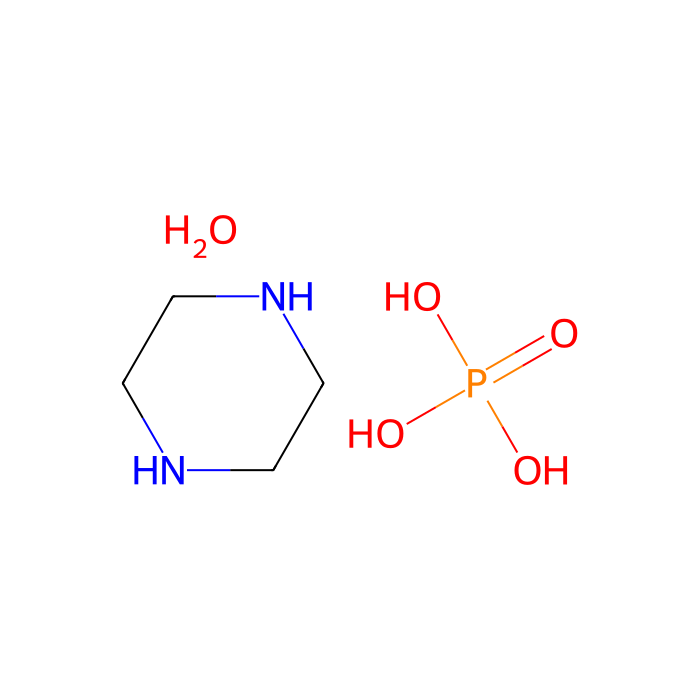
Piperazine Phosphate Monohydrate is an inorganic–organic salt comprising the diamine piperazine and phosphoric acid with one equivalent of crystalline water. It is typically encountered as a water-soluble, ionic solid used for aqueous buffer preparation and pH control in laboratories.
Item-specific identifiers (from Product Data):
CAS: 18534-18-4
PubChem CID: 443965
InChIKey: Not specified for this item; refer to CoA/Spec Sheet.
SMILES: Not specified for this item; refer to CoA/Spec Sheet.
Molecular formula: Not specified for this item; refer to CoA/Spec Sheet.
Molecular weight: Not specified for this item; refer to CoA/Spec Sheet.
Structural features (general/literature description):
Counterions: Protonated piperazine cation(s) paired with a phosphate anion; exact protonation state depends on stoichiometry of the salt as defined for this CAS (literature).
Functional groups: Secondary diammonium (from piperazine) and tetrahedral phosphate (PO4) unit; presence of a lattice water molecule (monohydrate).
Ring system: Piperazine is a saturated six-membered heterocycle containing two opposite ring nitrogens (–NH–CH2–CH2–NH– repeats). No stereocenters.
2D structure in words (general):
The cationic component is a chair-like six-membered ring with two nitrogens at the 1,4-positions, each bearing hydrogen(s) and capable of protonation. The anionic component is a phosphate tetrahedron (P=O with three P–O bonds, variably protonated). Ionic pairing and hydrogen bonding to the monohydrate water stabilize the crystal lattice.
Note: Exact stoichiometry details, definitive SMILES and InChIKey for this specific salt form should be confirmed from the item’s CoA/Spec Sheet.
Synthetic Utility
As an ionic buffer salt, Piperazine Phosphate Monohydrate is not commonly employed as a stoichiometric reagent for bond-forming organic reactions. Its main value in synthesis is indirect, by providing controlled aqueous environments and pH stability.
Functional groups and reactivity (general):
Piperazine (as a protonated diamine) exhibits Brønsted basicity when deprotonated, but in this salt it primarily serves as a counterion under neutral conditions.
Phosphate is a conjugate base of phosphoric acid and does not function as a nucleophile under typical buffering conditions.
Typical uses in synthetic workflows:
Aqueous workups: Maintain a defined pH during quench or extraction steps to control speciation of amines, acids, and phenols.
Biocatalysis media: Provide stable pH for enzyme-catalyzed transformations where phosphate is tolerated and MS compatibility is not required.
Crystallization medium: Ionic strength modulation and hydrogen bonding can influence crystallization of polar compounds and co-crystals (specialized applications).
Not typically applicable:
As a ligand, catalyst, or coupling partner in cross-coupling, carbonyl activation, or radical chemistry. For such roles, use dedicated amine bases (e.g., DIPEA, TEA) or buffer systems designed for organic media.
Practical notes:
Confirm that phosphate will not precipitate metal catalysts or substrates.
When pH-sensitive substrates are present, calibrate buffers at reaction temperature and ionic strength to maintain target speciation throughout the reaction.
Target Specificity
Not applicable. This SKU is a small-molecule buffer salt, not an antibody, probe, or biological ligand with defined target specificity. No antigen/epitope, clone, isotype, or species reactivity information applies.
Frequently Asked Questions
What is the purity of this product?
This product is supplied at ≥97% purity (chemical assay). Lot-specific values are stated on the Certificate of Analysis.
How should this product be stored?
Store at room temperature.
How is this product shipped?
This product ships under standard ambient conditions. No temperature-controlled packaging is required.
What are the CAS number, molecular formula and molecular weight?
The CAS Number is 18534-18-4, the molecular formula is C4H15N2O5P, and the molecular weight is 202.15 g/mol. InChIKey PMGABIJVFLPSLS-UHFFFAOYSA-N.
What documentation is provided?
Available product documentation, including Certificates of Analysis (COA), Safety Data Sheets (SDS), and specification sheets, is shown in the product document area. Document availability and access follow the current site policy.
We use cookies to ensure the website functions properly and, where permitted, to improve your experience. You can manage your preferences at any time in Settings. Learn more in our Cookie Policy.
Shall we send you a message when we have discounts available?
Remind me later
Thank you! Please check your email inbox to confirm.
Products are supplied to verified businesses, institutions, and qualified professionals for research and development use only. Not for use in humans, animals, diagnosis, or therapy.

 C2112130