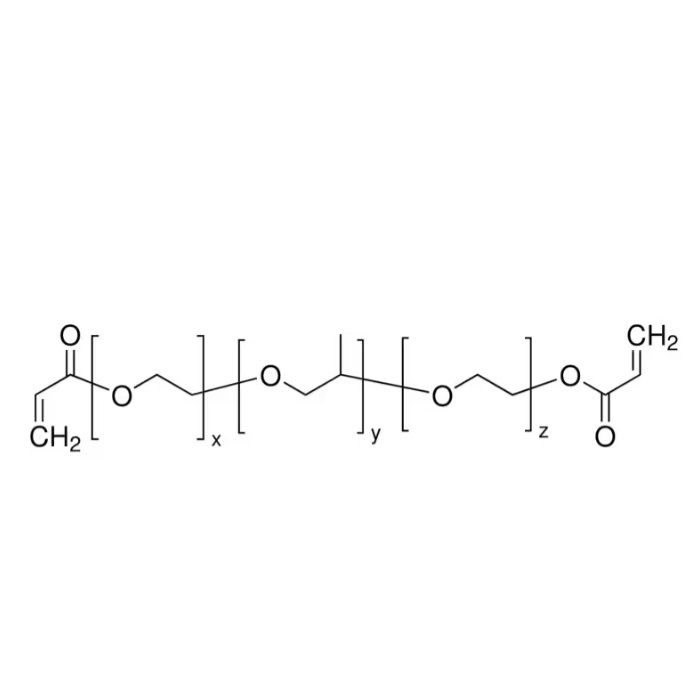
Poly(ethylene glycol)-block-poly(propylene glycol)-block-poly(ethylene glycol) diacrylate - average Mw~15kDa , CAS No.P477925

CAS: P477925 Cat. No.: P477925
AVAILABLE TO ORDER
GRADE & PURITY average Mw~15kDa
Synonyms
Poloxamer F127 diacrylate, PEG-PPG-PEG
Storage
Protected from light,Store at -20°C,Argon charged
Shipped In
Ice chest + Ice pads
 ·  off list, applied to all prices below.
Size
Status
Price
Qty
250mg
P477925-250mg
8-12 wks(?) Production requires sourcing of materials. We appreciate your patience and understanding.
$162.90
1g
P477925-1g
1
$499.90
Enter a quantity for the sizes you want to add.
🧪

Why this grade

average Mw~15kDa for sensitive chromatographic and analytical workflows requiring minimal baseline interference.

🌡

Storage & shipping

Protected from light,Store at -20°C,Argon charged Ships Ice chest + Ice pads Check lot-specific COA for exact specifications.

📋

Quality documents

SDS, COA, datasheet, and spec sheet available for download. Lot-specific COA accessible via lot number lookup.

📚

Literature proof

Cited in 2 peer-reviewed publications across chromatography, organic synthesis, and cross-coupling reactions.

Overview

Polyether F127 diacrylate (P477925) is a double bond modified polyethylene glycol polypropylene glycol polyethylene glycol triblock copolymer, which can be quickly crosslinked and cured into a gel by UV and visible light under the action of photoinitiators. F127 has excellent thermotropic gel (heating gel) characteristics and good biosafety. The material system based on F127 can be used in the biomedical field, such as as drug carrier, wound dressing, cell carrier shear protector, biological 3D printing, etc.
Application:
Polyethylene glycol block polypropylene glycol block polyethylene glycol diacrylate (PEG-PPG-PEG) is an amphiphilic triblock copolymer based on bifunctional acrylate, which can be used in pharmaceuticals, biopharmaceuticals, and personal care products. It can also be used for synthesizing alternating block polyurethanes for drug delivery.
Storage and transportation:
Dry set: room temperature, 3 months; 4 ℃, 12 months- 20 ℃, 18 months. Sterile solution: protected from light at 4 ° C for 7 days- Avoid light at 20 ℃ for 6 months. Repeated freezing and thawing of the solution can affect product performance, so it is recommended to prepare and use it as soon as possible.
Solution preparation:
1. Prepare a 0.25% (w/v) initiator standard solution
(1) Take 20mL PBS and add it to a brown bottle containing initiator LAP (containing 0.05g of LAP);
(2) Heat and dissolve in a 40-50 ℃ water bath for 15 minutes, during which manually or vortex oscillate 2-3 times for 5-10 seconds each time.
This LAP standard solution can be stored for 12 months under dark conditions at 4 ° C.
2. Prepare P477925 solution (the recommended concentration of P477925 is 5~30% w/v, and below 5% is suitable for combination with other hydrogels for 3D cell culture)
(1) Take the required mass of P477925 and place it in a centrifuge tube.
(2) Take the standard solution of the initiator and add it to the centrifuge tube mentioned above.
(3) Dissolve at 2-8 ℃ for 30 minutes, with 2-3 manual or vortex oscillations for 5-10 seconds each time (concentration<20% can be dissolved by stirring at room temperature).
Curing use:
Irradiate the above P477925 solution containing initiator with 405nm light source, and it can be cured into gel within 10-30s. In order to obtain higher strength hydrogel, the light duration can be extended as appropriate.
Explanation:
P477925 solution has thermally induced gel characteristics (heating up gel). During solution preparation, cooling is conducive to dissolution. It is recommended to let the solution dissolve at 2-8 ℃ and shake several times with a vortex mixer during this period.
P477925 solution with a concentration ≥ 20% will appear gel when it stands at room temperature. The higher the concentration is, the easier it is to gel. At this time, the gel is a physically reversible gel. When the temperature drops to 2~8 ℃, the solution will resume its state.
Kind reminder: Do not look directly at the curing light source.

Semi finished kit:
Component A: F127DA, white powder, 1g/bottle or 5g/bottle: stored in a dark place
Component B: Photoinitiator LAP, white powder, 0.05g/bottle * (1 or 5): stored in a dark place

Specifications

Synonyms
Poloxamer F127 diacrylate, PEG-PPG-PEG
Specifications & Purity
average Mw~15kDa
Storage
Protected from light, Store at -20°C, Argon charged
Shipped In
Ice chest + Ice pads
This product requires cold chain shipping. Ground and other economy services are not available.

Documentation

📋 Safety Data Sheet (SDS)

Comprehensive hazard, handling, storage, and regulatory compliance document.

Download SDS →

✅ Certificate of Analysis (COA)

Lot-specific quality data. Enter your lot number to retrieve the exact COA.

Look up COA →

📊 Datasheet

Quick-reference summary of product specifications and applications.

View datasheet →

🔬 Specification Sheet

Full quality attributes and acceptance criteria for this grade.

View spec sheet →

Advanced Data

Certificates(CoA,COO,BSE/TSE and Analysis Chart)
C of A & Other Certificates(BSE/TSE, COO):
Analytical Chart:

Find and download the COA for your product by matching the lot number on the packaging.

4 results found

Lot NumberCertificate TypeDateItem
H2519402Certificate of AnalysisJul 04, 2025 P477925
A2404580Certificate of AnalysisApr 18, 2025 P477925
I2414285Certificate of AnalysisAug 29, 2024 P477925
A2404568Certificate of AnalysisDec 13, 2023 P477925
Chemical and Physical Properties
SensitivityLight sensitive; Moisture sensitive; Air sensitive; Heat sensitive
Documents & Articles
Citations of This Product
References
1. Tong Qi, Xiao Wang, Jiamei Zhang, Maling Gou, Chengqi He.  (2025)  Percutaneous electrical stimulation combined with conductive nerve guidance conduits for peripheral nerve regeneration.  CHEMICAL ENGINEERING JOURNAL,      [PMID:] [10.1016/j.cej.2025.162124]
2. Tuo Zhang, Zhiyi Sheng, Jixian Zhang, Heng Zhang, Yan Zhang, Yunpeng Du, Xiangxin Liu, Zhu Hu, Qiyuan Luo, Guoqiang Xu, Yuan Gao, Meina He, Tengxiang Chen.  (2025)  Targeting granulosa cells with engineered DFO nanoparticles for the treatment of chemotherapy-induced premature ovarian failure.  Theranostics,  15  (15): (7820).  [PMID:40756354] [10.7150/thno.115416]
Solution Calculators
Reviews

Customer Reviews

Shall we send you a message when we have discounts available?

Remind me later

Thank you! Please check your email inbox to confirm.

Oops! Notifications are disabled.