GRADE & PURITYMoligand™?Moligand™ — Aladdin's line of ligands and bioactive small molecules. Use for receptor, pathway, and binding studies needing defined small-molecule tools.≥98%
Moligand™, ≥98% Moligand™ for sensitive chromatographic and analytical workflows requiring minimal baseline interference.
🌡
Storage & shipping
Protected from light,Store at -20°C Ships Ice chest + Ice pads Check lot-specific COA for exact specifications.
📋
Quality documents
SDS, COA, datasheet, and spec sheet available for download. Lot-specific COA accessible via lot number lookup.
📚
Literature proof
Cited in 0 peer-reviewed publications across chromatography, organic synthesis, and cross-coupling reactions.
Overview
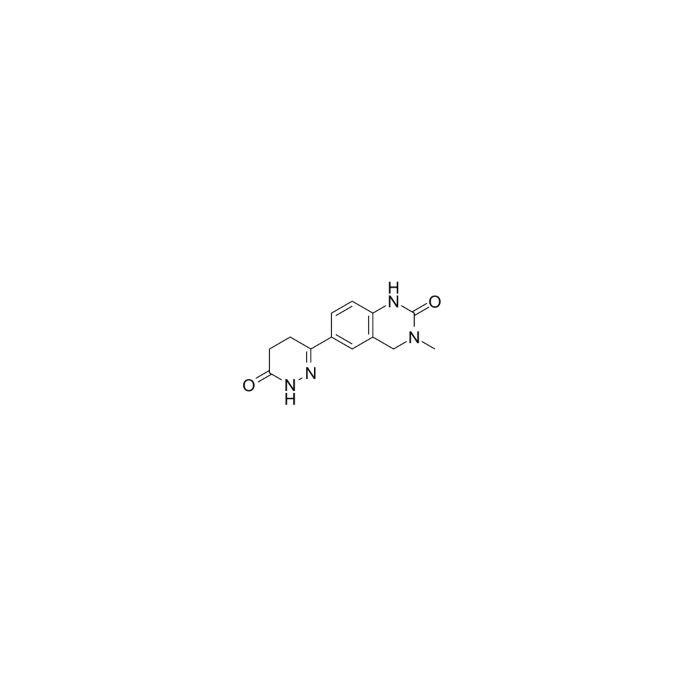
Prinoxodan (RGW2938) is a phosphodiesterase inhibitor.
In Vitro
Prinoxodan (RG W-2938) is an orally effective positive inotropic/vasodilator agent. Prinoxodan is a new nonglycoside, noncatecholamine cardiotonic/vasodilator agent is examined in vitro in isolated guinea pig hearts; in the latter, Prinoxodan 5 nmol-5 μmol increases contractility in a dose-related fashion. MCE has not independently confirmed the accuracy of these methods. They are for reference only.
In Vivo
Prinoxodan (RG W-2938) is a new nonglycoside, noncatecholamine cardiotonic/vasodilator agent is examined in vivo in anesthetized and conscious dogs. Prinoxodan 30-300 μg/kg administered intravenously (i.v.) to anesthetized dogs increases contractile force while decreasing arterial pressure and total peripheral resistance (TPR) in a dose-related manner. Heart rate (HR) is only slightly increased, and aortic flow is not appreciably altered. A single oral dose of Prinoxodan 0.3 mg/kg administered to conscious chronically instrumented dogs produces a marked and sustained increase in contractility 15-240 min after treatment while only slightly increasing HR. The effects of Prinoxodan 30-300 μg/kg, i.v. are studied in a mecamylamine-propranolol-induced model of heart failure. Prinoxodan effectively reverses the drug-induced heart failure by increasing myocardial contractility and decreasing arterial pressure while only slightly affecting HR. MCE has not independently confirmed the accuracy of these methods. They are for reference only.
This compound belongs to the class of organic compounds known as quinazolines. These are compounds containing a quinazoline moiety, which is made up of two fused six-member aromatic rings, a benzene ring and a pyrimidine ring.
External Descriptors
Not available
1. Djoumbou Feunang Y, Eisner R, Knox C, Chepelev L, Hastings J, Owen G, Fahy E, Steinbeck C, Subramanian S, Bolton E, Greiner R, and Wishart DS. ClassyFire: Automated Chemical Classification With A Comprehensive, Computable Taxonomy. Journal of Cheminformatics, 2016, 8:61.
We use cookies to ensure the website functions properly and, where permitted, to improve your experience. You can manage your preferences at any time in Settings. Learn more in our Cookie Policy.
Shall we send you a message when we have discounts available?
Remind me later
Thank you! Please check your email inbox to confirm.
Products are supplied to verified businesses, institutions, and qualified professionals for research and development use only. Not for use in humans, animals, diagnosis, or therapy.

 G2514478