Determine the necessary mass, volume, or concentration for preparing a solution.
Taxonomy Tree
| Kingdom | Organic compounds |
|---|---|
| Superclass | Organoheterocyclic compounds |
| Class | Tetrapyrroles and derivatives |
| Subclass | Not available |
| Intermediate Tree Nodes | Not available |
| Direct Parent | Tetrapyrroles and derivatives |
| Alternative Parents | Delta amino acids and derivatives Pyrrolidines Ketimines Amino acids Propargyl-type 1,3-dipolar organic compounds Monocarboxylic acids and derivatives Enols Enamines Dialkylamines Carboxylic acids Azacyclic compounds Organopnictogen compounds Organic oxides Hydrocarbon derivatives Carbonyl compounds |
| Molecular Framework | Aliphatic heteropolycyclic compounds |
| Substituents | Tetrapyrrole skeleton - Delta amino acid or derivatives - Pyrrolidine - Amino acid - Ketimine - Amino acid or derivatives - Azacycle - Organic 1,3-dipolar compound - Propargyl-type 1,3-dipolar organic compound - Secondary amine - Monocarboxylic acid or derivatives - Enol - Enamine - Secondary aliphatic amine - Carboxylic acid - Carboxylic acid derivative - Organic nitrogen compound - Organic oxygen compound - Organopnictogen compound - Organic oxide - Hydrocarbon derivative - Organooxygen compound - Organonitrogen compound - Imine - Carbonyl group - Amine - Aliphatic heteropolycyclic compound |
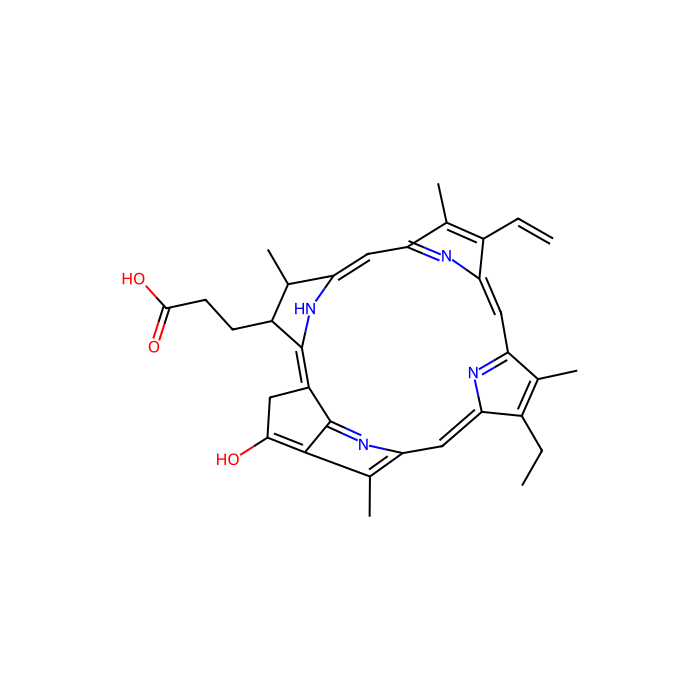
| Description | This compound belongs to the class of organic compounds known as tetrapyrroles and derivatives. These are polycyclic aromatic compounds containing four pyrrole rings joined by one-carbon units linking position 2 of one pyrrole ring to position 5 of the next. |
| External Descriptors | Not available |
| Solubility | Soluble in concentrated HCl, DMF, pyridine, and ammoniacal methanol. |
|---|---|
| Sensitivity | Light sensitive |
| Refractive Index | n20D1.64 (Predicted) |
| Boil Point | ~1006.4° C at 760 mmHg (Predicted) |
| Molecular Weight | 534.6 |
| XLogP3 | 2.600 |
| Hydrogen Bond Donor Count | 3 |
| Hydrogen Bond Acceptor Count | 7 |
| Rotatable Bond Count | 5 |
| Exact Mass | 534.263 Da |
| Monoisotopic Mass | 534.263 Da |
| Topological Polar Surface Area | 107.000 Ų |
| Heavy Atom Count | 40 |
| Formal Charge | 0 |
| Complexity | 1660.000 |
| Isotope Atom Count | 0 |
| Defined Atom Stereocenter Count | 2 |
| Undefined Atom Stereocenter Count | 0 |
| Defined Bond Stereocenter Count | 0 |
| Undefined Bond Stereocenter Count | 0 |
| The total count of all stereochemical bonds | 0 |
| Covalently-Bonded Unit Count | 1 |
H315:Causes skin irritation
H319:Causes serious eye irritation
H335:May cause respiratory irritation
P261:Avoid breathing dust/fume/gas/mist/vapors/spray.
P264:Wash hands [and …] thoroughly after handling.
P271:Use only outdoors or in a well-ventilated area.
P280:Wear protective gloves/protective clothing/eye protection/face protection.
P321:Specific treatment (see ... on this label).
P302+P352:IF ON SKIN: wash with plenty of water.
P304+P340:IF INHALED: Remove person to fresh air and keep comfortable for breathing.
P305+P351+P338:IF IN EYES: Rinse cautiously with water for several minutes. Remove contact lenses if present and easy to do - continue rinsing.
P362+P364:Take off contaminated clothing and wash it before reuse.
P405:Store locked up.
P403+P233:Store in a well-ventilated place. Keep container tightly closed.
P501:Dispose of contents/container to an approved waste disposal plant.
P264+P265:Wash hands [and …] thoroughly after handling. Do not touch eyes.
P337+P317:If eye irritation persists: Get medical help.
P332+P317:If skin irritation occurs: Get medical help.
P319:Get medical help if you feel unwell.
Our grade selection guide covers purity, stabilizer status, and application suitability for all variants in our catalog.
View Moligand™ grade guide →