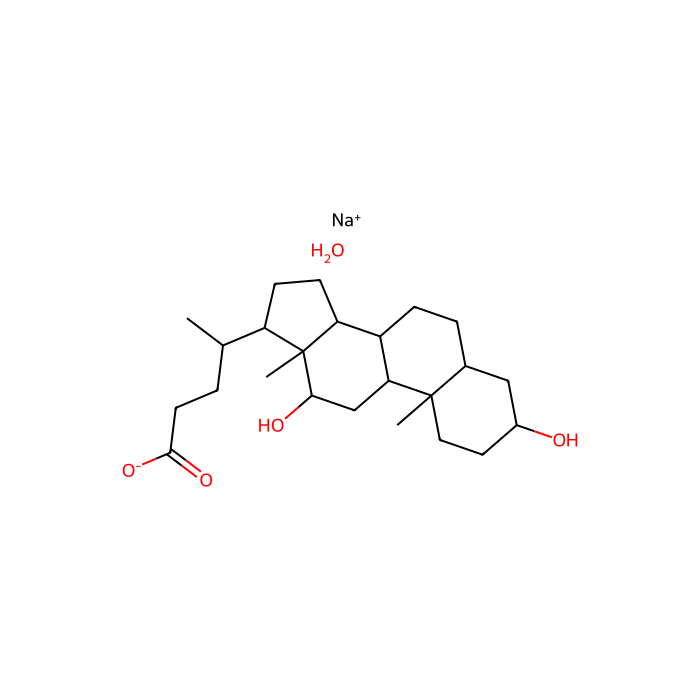
Sodium deoxycholate monohydrate is a lipid bile salt used in drug delivery systems. Powerful solubilization agent; used in the solubilization of estrogen synthetase from human placental microsomes.
Specifications
Synonyms
sodium (4R)-4-[(1R,3aS,3bR,5aR,7R,9aS,9bS,11S,11aR)-7,11-dihydroxy-9a,11a-dimethyl-hexadecahydro-1H-cyclopenta[a]phenanthren-1-yl]pentanoate hydrate | Deoxycholic acid sodium salt monohydrate | Sodium deoxycholate monohydrate | Deoxycholic acid (sodium hydrate) | Sodium (3alpha,5beta,12alpha)-3,12-dihydroxycholan-24-oate--water (1/1/1) | Show more
Dihydroxy bile acid, alcohol, or derivatives - 3-hydroxysteroid - 12-hydroxysteroid - Hydroxysteroid - 3-alpha-hydroxysteroid - Cyclic alcohol - Carboxylic acid salt - Secondary alcohol - Carboxylic acid derivative - Carboxylic acid - Organic alkali metal salt - Monocarboxylic acid or derivatives - Organic sodium salt - Hydrocarbon derivative - Alcohol - Organic oxide - Organic oxygen compound - Organic salt - Carbonyl group - Organooxygen compound - Organic zwitterion - Aliphatic homopolycyclic compound
Description
This compound belongs to the class of organic compounds known as dihydroxy bile acids, alcohols and derivatives. These are compounds containing or derived from a bile acid or alcohol, and which bears exactly two carboxylic acid groups.
External Descriptors
Not available
1. Djoumbou Feunang Y, Eisner R, Knox C, Chepelev L, Hastings J, Owen G, Fahy E, Steinbeck C, Subramanian S, Bolton E, Greiner R, and Wishart DS. ClassyFire: Automated Chemical Classification With A Comprehensive, Computable Taxonomy. Journal of Cheminformatics, 2016, 8:61.
Determine the necessary mass, volume, or concentration for preparing a solution.
Dilution Calculator
Determine the dilution needed to prepare a stock solution.
Reconstitution Calculator
Reviews
Customer Reviews
Application Protocols
The following literature-based example protocols illustrate common uses of sodium deoxycholate. They are provided as general guidance and should be optimized per sample/system.
Procedure: Wash cells with cold PBS; add 5–10 volumes of ice-cold lysis buffer per cell pellet volume; incubate 10–20 min on ice with occasional mixing; clear lysate by centrifugation (12,000–16,000 × g, 10–15 min, 4 °C).
SDC-assisted in-solution tryptic digestion for LC–MS:
Denature/reduce/alkylate protein in 50–100 mM TEAB or ammonium bicarbonate with 0.1–1.0% w/v SDC; add trypsin at 1:50–1:100 (w/w); incubate 4–16 h at 37 °C.
Removal: Acidify to pH ≤2 with formic or TFA to precipitate SDC; centrifuge. Optionally perform ethyl acetate phase transfer to extract residual SDC; dry peptides and reconstitute for LC–MS.
Membrane protein extraction:
Buffer: 20–50 mM HEPES pH 7.5–8.0, 100–150 mM NaCl, 10% glycerol, 0.5–2.0% w/v SDC.
Procedure: Homogenize tissue/cells; incubate 30–60 min at 4–25 °C with rotation; clarify by ultracentrifugation as needed; proceed to affinity or size-exclusion steps. Exchange detergent by dialysis or adsorbents if required.
Note: Verify compatibility with downstream assays (e.g., avoid residual SDC in colorimetric protein assays).
Biological Roles
Sodium deoxycholate corresponds to the sodium salt of deoxycholic acid, a secondary bile acid generated by gut microbiota via 7α-dehydroxylation of cholic acid. In vivo, deoxycholate functions as a natural surfactant that emulsifies dietary lipids and facilitates absorption of cholesterol, fatty acids, and fat-soluble vitamins. The monohydrate form pertains to the solid-state; in aqueous environments, the active species is the deoxycholate anion.
Biochemical features (literature):
Amphiphilic steroid structure self-associates into micelles above the CMC, solubilizing lipids and cholesterol.
Interacts with phospholipid bilayers, disrupting membrane packing and permeability at sufficient concentrations.
Participates in enterohepatic circulation; conjugation (e.g., glycine/taurine) modulates pKa and critical aggregation thresholds.
Bile acid signaling: bile acids, including deoxycholate, act as endogenous ligands for nuclear receptors (e.g., FXR) and GPCRs (e.g., TGR5), influencing metabolic pathways; these insights guide research tool use. No clinical claims are implied.
Implications for laboratory use:
Strong capacity to unfold proteins via hydrophobic interactions while maintaining the possibility of refolding after removal.
Compatibility with numerous enzymes at sub-denaturing levels enables its utility in proteomics digestions where other detergents can suppress MS ionization or resist removal.
Buffer Applications
Sodium deoxycholate is widely used to formulate robust lysis, extraction, and digestion buffers.
Typical buffer systems (literature, examples):
RIPA-like lysis buffer:
50 mM Tris-HCl, pH 7.4–8.0; 150 mM NaCl; 1% NP-40 or Triton alternative; 0.1–0.5% w/v sodium deoxycholate; 0.1% SDS; protease/phosphatase inhibitors as needed.
Proteomics digestion buffer:
50–100 mM ammonium bicarbonate or Tris pH 8.0; 0.1–1.0% w/v SDC; reduction/alkylation reagents as appropriate. After digestion, acidify to pH ≤2 to precipitate SDC, then remove by centrifugation and/or ethyl acetate phase transfer.
Membrane protein extraction:
20–50 mM HEPES or Tris, pH 7.5–8.0; 100–150 mM NaCl; 0.5–2.0% w/v SDC; add glycerol (5–10%) for stability.
Practical notes:
Stock solutions: 10% w/v in water or buffer dissolve readily with gentle warming and stirring; filter-sterilize (0.22 µm) if required.
pH dependence: Maintain pH ≥7 for consistent anionic form; below pH ~6, decreased ionization alters solubilization and can increase precipitation upon dilution.
Compatibility: Avoid quaternary ammonium surfactants (charge–charge interactions). Chelators and salts can modulate micelle properties; optimize for target proteins.
These are general, literature-based examples; adjust concentrations based on sample load, lipid content, and downstream assay compatibility.
Green Alternatives
From a green chemistry perspective, bile salt detergents such as sodium deoxycholate (SDC) are derived from steroidal frameworks that are biodegradable and can be viewed as more environmentally benign than certain petrochemical nonionic surfactants (e.g., alkylphenol ethoxylates). Selection should still weigh toxicity, persistence, and process ease-of-removal.
Comparison (literature-based, general):
SDC (this product)
Origin/biodegradability: Bile acid–derived; readily biodegradable
Performance: Strong membrane solubilizer; removable by acid precipitation
Drawbacks: Can denature some proteins at higher concentrations; anionic charge may interfere with certain assays
Sodium cholate
Slightly higher hydrophilicity; sometimes milder toward proteins
Similar biodegradability profile
CHAPS/CHAPSO (zwitterionic, steroidal)
Mild, MS-friendly; good for preserving activity
Typically more expensive; removal may require dialysis/gel filtration
Some legacy products have environmental/regulatory concerns; newer “Triton-free” alternatives exist
Greener practice tips:
Use minimal effective concentrations; recover and treat aqueous waste to reduce chemical oxygen demand.
Prefer bile salt or sugar-based detergents when feasible.
Design workflows enabling detergent removal (acid precipitation or phase-transfer) to minimize downstream emissions.
Pharmaceutical Uses
No therapeutic or clinical claims are made for this product; for research use only.
Formulation and manufacturing context (literature/general):
Solubilizer/absorption aid: Bile salts, including sodium deoxycholate, are used as excipients to enhance solubility of hydrophobic actives, form mixed micelles with phospholipids, and improve wetting in oral and some non-parenteral formulations.
Permeation enhancement (research): Investigated as a component in nasal, buccal, or transdermal delivery systems where controlled, reversible membrane perturbation is desired; applicability depends on concentration and formulation excipients.
Process aid: Utilized in certain virus inactivation steps in bioprocessing contexts for enveloped viruses due to membrane-disruptive properties (process validation required).
Complexation: Forms inclusion-like mixed aggregates with cholesterol and lipophilic APIs, potentially stabilizing supersaturated states.
Regulatory/quality notes:
Pharmacopeial monographs may exist for related bile salts; verify compendial status for sodium deoxycholate in your jurisdiction if targeting GMP manufacturing.
Residual detergent removal and acceptable daily exposure (ADE/PDE) assessments are critical in drug product/process development.
For specific acceptance criteria (e.g., endotoxin, bioburden, trace impurities), consult the CoA/Spec Sheet for this SKU.
Physical Properties
Item-specific measured physico-chemical specifications are not provided in the Product Data. The following values are typical literature descriptions for sodium deoxycholate (SDC); treat them as general guidance, not specifications for this SKU.
Appearance: Not specified for this item; refer to CoA/Spec Sheet.
State: Solid (literature)
Solubility (literature):
Water: highly soluble; forms micelles above the CMC
Alcohols (methanol/ethanol): moderate solubility
Nonpolar solvents: essentially insoluble
Critical micelle concentration (CMC, literature): ~2–6 mM in water at 20–25 °C (ionic strength and pH dependent), corresponding to roughly 0.08–0.25% w/v
Micelle size (literature): hydrodynamic diameter typically 3–8 nm depending on conditions
pKa (deoxycholic acid, literature): ~5.0–6.0 for the carboxyl; as sodium salt, largely deprotonated above pH ~6
LogP (parent acid, literature): high; salt behaves as an amphiphile
Density, melting/decomposition point, refractive index: Not specified for this item; refer to CoA/Spec Sheet.
Notes for use (literature):
Solution behavior is strongly influenced by pH, ionic strength, and temperature. Buffering near neutral pH and controlling salt concentration (e.g., 50–150 mM NaCl) yields reproducible micellization.
The monohydrate increases formula mass by ~18.0 g/mol relative to the anhydrous salt; account for this when preparing % molar solutions.
Quality & Grades
Grade/Purity: Not specified for this item; refer to CoA/Spec Sheet.
Interpretation and typical expectations (general guidance):
Research grade detergents are typically suitable for protein biochemistry, cell lysis, and membrane protein work. When purity is specified (e.g., ≥98%), it refers to organic purity of the bile salt; trace inorganic content and residual solvents may also be limited in a detailed spec.
Low-UV/biochemical grade can be preferred for spectroscopy or proteomics to minimize background at 214–280 nm. For mass spectrometry, volatile counterions and low non-volatile residues are desirable.
Hydration state: This listing specifies the monohydrate. When preparing molar solutions, use the monohydrate formula mass (literature ~432.6 g/mol) to avoid under-dosing relative to the anhydrous salt.
Lot-specific documentation: For parameters such as water content (KF), residual solvents, microbial limits, endotoxin, or trace metals, consult the CoA/Spec Sheet. If ultra-low endotoxin is required (e.g., for cell stimulation assays), confirm with the lot documentation.
Stabilizers: Not applicable; anionic bile salts are generally self-stable as solids when protected from moisture. No stabilizer is indicated in the Product Data.
Reaction & Applications
This product is primarily used in life-science workflows rather than as a reagent in classical organic synthesis. Key laboratory applications (literature/practice):
Protein solubilization and membrane extraction:
Efficiently disrupts lipid bilayers and extracts integral membrane proteins while maintaining activity for many targets upon detergent exchange or removal.
Proteomics sample prep:
SDC-assisted tryptic digestion enhances denaturation and accessibility of hydrophobic proteins/peptides. Acid precipitation enables straightforward removal prior to LC–MS (e.g., acidify to pH ≤2, centrifuge, collect supernatant, or perform phase transfer with ethyl acetate).
Cell lysis buffers:
Component of RIPA and similar buffers (often 0.1–0.5% w/v) to achieve robust lysis and solubilization of nuclear and membrane proteins.
Virus and lipid-enveloped particle inactivation (laboratory/disinfection context):
Disrupts envelopes via solubilization of membrane lipids; used in process and assay decontamination steps (non-sterilizing; validate for your system).
Electrophoresis/precipitation protocols:
Aids in removing lipids or releasing membrane fractions; compatible with many downstream assays after removal/dilution.
Practical considerations:
CMC- and temperature-dependent behavior; ionic strength (e.g., 100–150 mM NaCl) can compact micelles and change critical aggregation concentrations.
Removal methods: acid precipitation, ultrafiltration, hydrophobic adsorption, or phase-transfer. Verify protein recovery and activity after removal.
Enzyme compatibility: Many proteases (e.g., trypsin) tolerate 0.1–1% SDC; confirm for your enzyme and desired end-point.
Reaction Conditions
As a detergent rather than a reactive reagent, sodium deoxycholate is used by setting solution conditions that control its aggregation state and compatibility with biomolecules.
General solution conditions (literature guidance):
Concentration: 0.05–2% w/v for protein solubilization; 0.1–1% w/v for proteomics digestion buffers; adjust to remain at or above CMC for effective micellization.
pH: 7.0–8.5 is common for stability and consistent anionic form; acidify to pH ≤2 to precipitate for removal post-digestion.
Ionic strength: 50–150 mM NaCl typical; higher ionic strength can compact micelles and influence extraction efficiency.
Temperature: Ambient (20–25 °C) for routine work; 37 °C may accelerate dissolution/digestion steps. Avoid prolonged heating that can promote protein degradation rather than detergent decomposition.
Additives: Reducing agents (DTT/TCEP) and alkylators (IAA/CAA) are compatible; organic solvents (10–30% acetonitrile or methanol) are commonly used in proteomics and generally compatible.
Expected outcomes (literature):
Enhanced recovery of hydrophobic/membrane proteins compared to nonionic detergents alone.
Efficient tryptic digestions with improved peptide coverage; facile detergent removal by acid precipitation or phase transfer prior to LC–MS.
These are general conditions; optimize for your sample type and downstream assays. They are not product specifications.
Safety & Handling
Safety details specific to this item (GHS classification, hazard statements, pictograms) are not provided in the Product Data. Always consult the SDS for authoritative information.
General laboratory guidance for bile salt detergents (literature/best practice):
Likely hazards: may cause skin, eye, and respiratory irritation; avoid creating dust and inhalation.
Personal protective equipment (PPE): lab coat, safety glasses, and suitable gloves (e.g., nitrile). Use a dust mask or work in a fume hood when weighing powders.
Handling: prepare solutions gently to minimize aerosol formation; add powder slowly to stirred buffer. Avoid contact with strong acids (which can protonate the carboxylate and alter performance) and strong oxidizers.
Incompatibilities: strong acids/bases (can change aggregation state), strong oxidizers. Avoid prolonged exposure to CO2-rich humid air to limit pH drift in unbuffered aqueous solutions.
First aid (overview; see SDS):
Eyes: rinse cautiously with water for several minutes; remove contact lenses; seek medical attention if irritation persists.
Skin: wash with soap and water; remove contaminated clothing.
Inhalation: move to fresh air; seek attention if symptoms occur.
Ingestion: rinse mouth; seek medical advice.
Environmental: prevent uncontrolled release to drains; bile salts are biodegradable but can impact aquatic organisms at high concentrations.
Storage conditions for this SKU: Room temperature, Argon charged (per Product Data). Ship: Normal. Keep container tightly closed to minimize moisture uptake.
Solvent Selection
Sodium deoxycholate (SDC) is an anionic amphiphile designed for aqueous media.
Polarity/class: Ionic surfactant; functions as a detergent in water and buffered saline.
Aqueous behavior (literature):
Below CMC: exists as monomers/oligomers; above CMC: forms micelles that solubilize hydrophobes and membrane lipids/proteins.
Efficient in neutral to basic buffers (e.g., PBS, TBS, Tris, HEPES).
General handling recommendations (literature/good practice):
Keep container tightly closed to minimize moisture uptake; the monohydrate is less sensitive than anhydrous forms but the solid remains hygroscopic.
Protect from prolonged exposure to ambient humidity and laboratory atmospheres rich in CO2 if solutions are unbuffered, as this can shift pH.
Reconstitution/preparation:
Prepare stock solutions at 5–10% w/v in water or desired buffer; dissolve with gentle stirring and, if needed, mild warming (to ~30–37 °C).
Filter-sterilize through 0.22 µm PES filters for sterile applications.
For exact molar concentrations, account for the monohydrate formula mass (literature ~432.6 g/mol).
Working solution stability (literature):
Aqueous buffered solutions are generally stable for weeks at 2–8 °C; prepare fresh for proteomics workflows to minimize bioburden and ensure consistent performance.
Avoid repeated freeze–thaw of concentrated stocks; aliquot if storing at 2–8 °C.
For any unspecified item-specific limits (e.g., water content, microbial limits, heavy metals), Not specified for this item; refer to CoA/Spec Sheet. Always defer to the product SDS/CoA for authoritative instructions.
Structure & Identity
Sodium deoxycholate monohydrate is an anionic bile salt detergent derived from the secondary bile acid deoxycholic acid; the monohydrate contains one equivalent of water of crystallization.
SKU: S101405
Product Name: Sodium deoxycholate monohydrate
CAS: 145224-92-6
PubChem CID: 23679071
InChIKey: 235916 (as provided in Product Data)
SMILES: Not specified for this item; refer to CoA/Spec Sheet.
Steroid nucleus with four fused rings (A/B/C/D: trans-fused), typical cholane framework
Carboxylate at C-24 present as sodium salt (anionic headgroup)
Hydroxyl substituents at 3α and 12α positions (deoxy at C-7 vs cholic acid)
Amphiphilic architecture: hydrophobic steroidal face opposite polar hydroxyl/carboxylate face
2D description in words:
A rigid tetracyclic cyclopentanoperhydrophenanthrene core bearing two axial-equatorial hydroxyls and a short carboxylate-terminated side chain at C-17; the sodium cation counterbalances the single carboxylate charge; one water molecule is associated in the crystal (monohydrate).
Synthetic Utility
Sodium deoxycholate is not commonly employed as a building block in small-molecule synthesis. Its primary value in a synthetic/analytical laboratory is as an amphiphilic medium modifier and surfactant.
Potential utilities (literature):
Micellar catalysis: Bile salt micelles can enhance rates/selectivities of certain aqueous organic reactions by hydrophobic compartmentalization (e.g., nucleophilic substitutions, oxidations) though 2°/3° structure may complicate isolation.
Phase-transfer-like effects: At or above the CMC, SDC can solubilize hydrophobic substrates in water, enabling greener aqueous reactions; however, downstream separation of detergent may be nontrivial.
Crystallization/media modulation: Its ability to bind lipids/cholesterol can be exploited to disassemble membrane fragments, isolate lipid components, or precondition surfaces.
Limitations:
The bulky, steroidal, polyanisotropic structure is not a versatile synthon for general transformations.
Strong interactions with proteins and hydrophobes can complicate purification; plan for removal (acid precipitation, ultrafiltration, adsorption).
For most synthetic needs, simpler surfactants (e.g., SDS, CTAB) or specialized micellar catalysts (e.g., TPGS-750-M) may be preferable; choose SDC when bile salt-specific aggregation behavior is advantageous.
Target Specificity
Not applicable. This product is a small-molecule detergent, not a biological targeting reagent (e.g., antibody, ligand, or probe). It exhibits broad physicochemical interactions with lipids and hydrophobic protein surfaces rather than specific molecular target binding.
Frequently Asked Questions
What is the purity of this product?
This product is supplied at ≥99% purity (chemical assay). Lot-specific values are stated on the Certificate of Analysis.
How should this product be stored?
Store at room temperature under argon. It is supplied under an argon blanket; reseal under inert gas after each use.
How is this product shipped?
This product ships under standard ambient conditions. No temperature-controlled packaging is required.
What are the CAS number, molecular formula and molecular weight?
The CAS Number is 145224-92-6, the molecular formula is C24H39NaO4 · H2O, and the molecular weight is 432.57 g/mol. InChIKey NDVHNZISGVSFMP-WTCAICSISA-M.
What documentation is provided?
Available product documentation, including Certificates of Analysis (COA), Safety Data Sheets (SDS), and specification sheets, is shown in the product document area. Document availability and access follow the current site policy.
We use cookies to ensure the website functions properly and, where permitted, to improve your experience. You can manage your preferences at any time in Settings. Learn more in our Cookie Policy.
Shall we send you a message when we have discounts available?
Remind me later
Thank you! Please check your email inbox to confirm.
Products are supplied to verified businesses, institutions, and qualified professionals for research and development use only. Not for use in humans, animals, diagnosis, or therapy.

 D2509070