Secondary alcohol - Carboxylic acid salt - Organic alkali metal salt - Monocarboxylic acid or derivatives - Carboxylic acid - Organic oxygen compound - Organic oxide - Hydrocarbon derivative - Organic sodium salt - Organic salt - Organic zwitterion - Organooxygen compound - Carbonyl group - Alcohol - Aliphatic acyclic compound
Description
This compound belongs to the class of organic compounds known as carboxylic acid salts. These are ionic derivatives of carboxylic acid.
External Descriptors
Not available
1. Djoumbou Feunang Y, Eisner R, Knox C, Chepelev L, Hastings J, Owen G, Fahy E, Steinbeck C, Subramanian S, Bolton E, Greiner R, and Wishart DS. ClassyFire: Automated Chemical Classification With A Comprehensive, Computable Taxonomy. Journal of Cheminformatics, 2016, 8:61.
Determine the necessary mass, volume, or concentration for preparing a solution.
Dilution Calculator
Determine the dilution needed to prepare a stock solution.
Reconstitution Calculator
Reviews
Customer Reviews
Application Protocols
No tested application protocols are provided in the Product Data for this SKU. The following are general, example workflows using sodium lactate; adjust to your requirements and validate in your lab.
Preparing a 1.0 M sodium lactate stock (literature/general):
If supplied as solid: Calculate required mass using MW 112.06 g/mol (literature). Dissolve 112.1 g in water and dilute to 1 L. If supplied as a solution, determine assay (% w/w) and density, then compute the volume needed to achieve 1 mol.
Filter (0.22 µm) if sterility is required; store at ambient or refrigerated according to stability needs.
Making pH 4.0 lactate buffer, 100 mM:
Combine ~80 mM sodium lactate with ~20 mM lactic acid, measure pH, and fine‑tune with small additions of either component. Confirm ionic strength and temperature.
Metal complexation test solution:
Dissolve sodium lactate to 0.1 M in water; add metal salt to achieve desired M:L ratio (e.g., 1:2). Adjust pH as appropriate for the metal; record spectra.
Enzymatic lactate assay calibration standards:
Prepare a dilution series (e.g., 0, 0.5, 1, 2, 5, 10 mM) from a verified stock. Use appropriate matrix and include blanks. Note: This product is not certified as an analytical standard; verify by independent assay.
Item-specific instructions (concentration, sterile filtration, preservatives): Not specified for this item; refer to CoA/Spec Sheet.
Biological Roles
The following describes the biological chemistry of lactate (literature/general). This section does not imply any medical or clinical use and is for research context only.
Metabolic role:
Lactate is the conjugate base of lactic acid, produced from pyruvate via lactate dehydrogenase during anaerobic glycolysis. It shuttles carbon between tissues (Cori cycle) and serves as a gluconeogenic substrate in liver.
In many cells, lactate is not merely a waste product; it is oxidized in mitochondria (lactate oxidation complex) and participates in cell–cell metabolic coupling.
Transport and signaling:
Transmembrane transport occurs via monocarboxylate transporters (MCTs), coupling proton and lactate flux.
Extracellular lactate can act via the G‑protein–coupled receptor HCAR1 (GPR81) to modulate cAMP in certain contexts (research interest in metabolic signaling).
Acid–base buffering:
The lactate/lactic acid pair buffers near pH ~3.9; in biological matrices, its buffering is secondary to phosphate/bicarbonate but relevant in acidic niches.
Metal complexation and enzyme interactions:
As an α‑hydroxycarboxylate, lactate can chelate Ca2+, Mg2+, and Fe3+ to varying extents, influencing enzyme cofactor availability in vitro.
Isotopic and enantiomeric aspects:
D- and L-lactate are resolved and quantified in metabolomics; isotopically labeled lactate (e.g., [U‑13C3]) is used to trace flux through glycolysis/TCA.
Item-specific biological testing or suitability for any particular assay: Not specified for this item; refer to CoA/Spec Sheet.
Buffer Applications
Sodium lactate is widely used to formulate lactate buffers with lactic acid. The following guidance is literature/general and should be adjusted to your exact concentration and purity; it is not a specification for this item.
Buffer range and chemistry:
Conjugate acid pKa (lactic acid): ~3.86 at 25 °C.
Effective buffering window: pH ~3.0–5.0 (best near 3.5–4.5).
Typical recipes (examples):
100 mM lactate buffer, pH 4.0: Dissolve 100 mmol total lactate species per liter by combining sodium lactate and lactic acid to reach target pH (e.g., start with ~100 mL of 1 M sodium lactate, titrate with ~1 M lactic acid to pH 4.0, then QS to volume). Exact volumes depend on ionic strength and temperature.
Low-ionic-strength option: 10–25 mM lactate buffer for enzyme assays where salt sensitivity is a concern.
Practical tips:
Use CO2-free, DI water; calibrate the pH meter at low pH standards (pH 4.00 and 7.00) and measure at the working temperature.
Ionic strength and temperature shift the pKa; verify pH after dilution and temperature equilibration.
Lactate can weakly complex metals; if that perturbs your system, consider acetate or MES buffers.
Compatibility:
Compatible with many proteins and enzymes requiring mildly acidic conditions; avoid with systems highly sensitive to monovalent salts or to α‑hydroxycarboxylate complexation.
Item-specific concentration (if supplied as solution), assay, and preparation instructions: Not specified for this item; refer to CoA/Spec Sheet.
Green Alternatives
Sodium lactate itself is widely regarded as a benign, water‑compatible reagent derived from renewable lactic acid (fermentation). Still, selection of buffer systems and correlates can further improve process greenness.
Comparison of aqueous buffer choices (literature/general):
Metal interactions: Lactate chelates some metals moderately; acetate typically chelates less—better when minimal metal binding is desired.
Biodegradability: Both readily biodegradable; low aquatic toxicity at typical lab concentrations.
Lactate vs citrate:
pH range: Citrate offers multiprotic buffering (pH 3–6.2 depending on ratio) but is a stronger chelator, which can hinder metal-catalyzed steps.
Salt load: Citrate introduces higher ionic strength at equal buffering capacity due to triprotic nature; lactate can minimize salt burden when mild buffering suffices.
Using lactate to replace organic acids in organics:
Where possible, replacing non-aqueous acidic media (e.g., TFA in organic solvent) with aqueous lactate buffer reduces VOCs and corrosivity, albeit at a different pH regime and with limited volatility.
Green practice tips:
Prepare buffers at the minimum ionic strength to meet performance needs.
Use deionized water and avoid unnecessary organic cosolvents.
Capture/reuse lactate-containing aqueous streams via biological treatment where facility capabilities permit.
Item-specific green certifications or sourcing details: Not specified for this item; refer to CoA/Spec Sheet.
Pharmaceutical Uses
No therapeutic claims are made. The following are literature/general notes on roles sodium lactate may play in pharmaceutical research and manufacturing contexts; they are not item-specific specifications.
Excipient roles (literature/general):
Buffering agent in the acidic range (with lactic acid) for formulations requiring pH control around 3.5–5.0.
pH adjuster and counterion for actives forming lactate salts to enhance solubility or stability in aqueous vehicles.
Osmolality contributor in aqueous systems; concentrated sodium lactate solutions are used industrially to modulate ionic strength.
Processing considerations:
Low volatility and high aqueous solubility make it suitable for high‑solids aqueous processes with minimal VOC emissions.
Potential for metal chelation should be considered during processing with metal catalysts/equipment; passivation or chelator control may be necessary.
Standards and compendia:
Pharmacopeial monographs exist for sodium lactate in certain jurisdictions (e.g., as solution); compliance status for this item is not provided. Verify required monographs and tests (e.g., assay, pH, impurities, heavy metals, endotoxin for parenteral-grade solutions) for regulated work.
Item-specific grade, endotoxin/bioburden limits, residual solvent profile, and compliance statements: Not specified for this item; refer to CoA/Spec Sheet.
Physical Properties
Item-specific specifications are not provided in the Product Data for this SKU. The following are literature/general properties for sodium lactate; do not treat as this item’s specifications.
Physical state/appearance: Not specified for this item; refer to CoA/Spec Sheet. (Sodium lactate is often supplied as an aqueous solution or as a hygroscopic solid in literature.)
Molecular formula and weight (literature): C3H5NaO3; 112.06 g/mol.
Melting point (literature): Reports vary with hydration; solid forms can soften/decompose on heating rather than show a sharp mp. Representative values for anhydrous/hydrated materials range broadly; verify on CoA for this lot.
Boiling point (literature): Not applicable for the salt; aqueous solutions boil near 100 °C depending on concentration.
Density (literature): Concentrated aqueous solutions (e.g., 50–60% w/w) have densities ~1.30–1.35 g/mL at 20 °C; exact value depends on concentration. Not specified for this item; refer to CoA/Spec Sheet.
Solubility (literature): Highly soluble in water; practically insoluble in nonpolar organic solvents. Miscible with water at all practical concentrations (for solutions).
pKa (conjugate acid, lactic acid; literature): pKa ≈ 3.86 at 25 °C (ionic strength dependent). Governs lactate/lactic acid buffer behavior.
Partition behavior (literature): Not meaningful for the ionic salt; logP pertains to the neutral acid/esters.
Refractive index (literature): Relevant for defined w/w solutions only; typical nD20≈1.39–1.41 for ~60% w/w solution; item-specific value not specified.
Always consult the CoA/SDS for lot-specific physical data.
Quality & Grades
Grade/purity: Not specified for this item; refer to CoA/Spec Sheet.
What grade implies (general guidance):
Reagent or analytical grades typically control inorganic impurities (e.g., metals), organic residues, and define assay by neutralization or ion chromatography. For chromatography or biochemistry grades, additional specifications may include low UV absorbance, bioburden, endotoxin, or defined water content for solids/solutions.
Stabilizers/antioxidants: None specified for this item. Sodium lactate commonly requires no stabilizer; if supplied as an aqueous solution, antimicrobial preservatives may or may not be present—verify on CoA/SDS.
Hydration/concentration:
Sodium lactate is frequently supplied as a defined w/w aqueous solution (e.g., ~60%); alternatively as an anhydrous or hydrated solid. Since this item’s form is not specified, confirm the exact state (solution vs solid), concentration (if a solution), and hydration level (if a solid) on the CoA to ensure accurate stoichiometry in your work.
Quality considerations for typical applications (general):
For metal-sensitive catalysis or speciation studies, consider trace metals specifications.
For bio-related workflows (cell culture research, protein work), low bioburden/endotoxin and precise pH/conductivity of solutions are important.
For quantitative acid–base or buffer preparation, verify assay basis (as Na-lactate %) and water content to compute molarity accurately.
Reaction & Applications
Sodium lactate’s α‑hydroxycarboxylate functionality enables distinct roles in aqueous and coordination chemistry. The following are literature/general applications; no specific applications were supplied in the Product Data.
Buffering and pH control (literature): With lactic acid (pKa ~3.86), sodium lactate forms lactate buffers effective around pH 3.0–5.0. Common in analytical methods where phosphate or Tris is unsuitable (e.g., low-pH protein handling, enzymology requiring mild acidity).
Coordination/complexation (literature): The vicinal –OH/–COO– motif chelates metals (bidentate), modulating redox potentials and solubility of metal salts (e.g., Fe, Al, Ca). Useful in homogeneous catalysis development, speciation studies, and as a masking agent in titrations.
Chiral source/auxiliary (literature): Although sodium lactate is often racemic, enantioenriched lactate salts are precursors to chiral building blocks (e.g., reduction to propanediols, formation of lactide/PLA monomers via lactic acid). For asymmetric synthesis, optically pure lactate (not specified here) may be required.
Organic transformations (aqueous phase):
Nucleophilicity of lactate is low; however, lactate can undergo esterification (after acidification) to methyl/ethyl lactate—green solvents/building blocks.
Under dehydrative/oxidative conditions, lactate participates in transformations to pyruvate or acrylates (via lactic acid), relevant to biomass upgrading.
Electrochemistry/bioprocess research (literature): Serves as a conductive counterion and carbon source in microbial fuel cell studies and fermentation research; also as an internal standard in NMR of biofluids (D/L-lactate discrimination with chiral derivatization).
Practical notes:
Account for hygroscopicity and exact assay when computing molarity.
Consider metal complexation when designing metal-catalyzed reactions—use competing ligands or alternative buffers as needed.
Reaction Conditions
No item-specific reaction condition data are provided. The following literature/general conditions illustrate how sodium lactate (or the lactate system) is employed; adapt to your system and verify experimentally.
Buffer preparation:
Concentration: 10–200 mM typical; adjust based on buffering capacity required.
pH: 3.0–5.0 using lactic acid/sodium lactate ratios; measure at working temperature.
Esterification to alkyl lactates (via lactic acid intermediate):
Convert sodium lactate to lactic acid with a slight excess of a strong cation exchanger (H+ form) or by acidification and extraction.
Esterify lactic acid with methanol/ethanol using acid catalysis (e.g., H2SO4, p‑TsOH, or solid acid resins) at 40–70 °C; continuous removal of water/alcohol improves yield. Typical yields for methyl/ethyl lactate: 70–95% (literature), catalyst and conditions dependent.
Metal complexation studies:
Prepare metal–lactate complexes in aqueous solution at pH 4–8 (depending on metal) with stoichiometric or slight excess lactate. Monitor by UV–vis, NMR, or potentiometry; ionic strength control (e.g., 0.1 M NaClO4) improves reproducibility.
Biocatalytic/enzymatic assays:
Enzymatic oxidation of lactate (e.g., with lactate oxidase or dehydrogenase) is typically run in 50–100 mM lactate buffer at 25–37 °C; include cofactors as required. Detection via NADH (340 nm) or peroxidase-coupled colorimetry.
Note: Exact times, catalysts, and yields are system-specific. Avoid relying on these general values for regulated processes without validation.
Safety & Handling
GHS classification, signal word, pictograms, and H-statements: Not specified for this item in the Product Data. Consult the SDS for authoritative hazard information.
General hazards (literature/general): Sodium lactate is generally regarded as low hazard, but concentrated solutions can be irritating to eyes/skin. The solid is hygroscopic/deliquescent; handle to minimize moisture uptake.
PPE (good laboratory practice):
Safety glasses with side shields, laboratory coat, and appropriate chemically resistant gloves (e.g., nitrile).
Use in a well-ventilated area; avoid aerosol generation and contact with eyes/skin.
Handling notes:
Avoid contact with strong acids (neutralization releases lactic acid and heat) and strong oxidizers.
For analytical or moisture‑critical applications, limit exposure to air to prevent water uptake. If preparing defined-concentration solutions, use volumetric techniques and account for hygroscopicity.
First aid (overview; defer to SDS):
Inhalation: Move to fresh air; seek medical attention if symptoms persist.
Skin contact: Wash with soap and water; remove contaminated clothing.
Eye contact: Rinse cautiously with water for several minutes; seek medical attention if irritation continues.
Ingestion: Rinse mouth; do not induce vomiting; obtain medical advice.
Fire and reactivity:
Not combustible as an aqueous solution; the organic anion can char on strong heating. Use extinguishing media suitable for surrounding fire.
Thermal decomposition may produce irritating fumes. Store away from heat sources for best stability.
Always review the current SDS prior to use.
Solvent Selection
This product is an ionic organic salt rather than a conventional organic solvent; solvent selection pertains to dissolving/using sodium lactate in solution.
Solubility profile (literature/general):
Water: Freely soluble; complete miscibility at practical concentrations. Lactate buffers are routinely prepared at 10–500 mM.
Alcohols: Miscible at low concentrations in short-chain alcohol–water mixtures; limited solubility in anhydrous alcohols.
As a fully dissociated electrolyte in water, sodium lactate substantially increases ionic strength and conductivity; useful for electrochemistry or when controlling activity coefficients in aqueous reactions.
Choosing among aqueous media (general):
For buffering near pH 3–5, lactate/lactic acid can be selected (pKa ~3.86) where phosphate is less effective.
Where chelation to metals is a concern, note that α‑hydroxycarboxylates can complex certain metal ions (e.g., Fe3+, Al3+, Ca2+), affecting availability/speciation; consider alternative buffers (acetate, MES) if metal complexation is undesirable.
Comparison (literature/general):
Acetate (pKa 4.76): Weaker acid; broader compatibility with some enzymes but less metal chelation than lactate.
Citrate (pKa2 4.76): Stronger multi-dentate chelator; better for metal sequestration but may perturb metal-catalyzed reactions more strongly.
Recommendation: Use high-purity water (18 MΩ·cm) and, if needed, co-solvents only in minor fractions to maintain full dissolution and predictable pH.
Container considerations (general): Use tightly sealed, chemically resistant containers. For hygroscopic solids or concentrated solutions, headspace control and desiccation (for solids) limit water uptake and concentration drift.
Stability (literature/general): Sodium lactate is stable in neutral to mildly basic aqueous solutions and as a solid when protected from moisture and contamination. Prolonged exposure to air can change concentration of solutions via evaporation/absorption.
Reconstitution/preparation:
Form, assay, and hydration state for this item are not specified; refer to CoA/Spec Sheet.
If supplied as a solid: Bring to room temperature in a desiccator before opening to minimize moisture uptake. Dissolve in high‑purity water to the desired molarity (e.g., 0.1–1.0 M), mixing until fully dissolved. Adjust pH with lactic acid or NaOH as needed.
If supplied as a solution: Mix thoroughly before use. Verify concentration by density or titration if critical. Avoid microbial contamination; sterile-filter if sterility is required.
Freeze–thaw guidance: Not typically required. If long-term storage of solutions is needed, aliquot and refrigerate to minimize bioburden; avoid repeated freeze–thaw unless stability data support it.
Incompatibilities: Avoid strong acids (exothermic neutralization to lactic acid) and strong oxidizers.
For definitive shelf life, assay basis, and preservatives (if any), consult the item’s CoA and SDS.
Structure & Identity
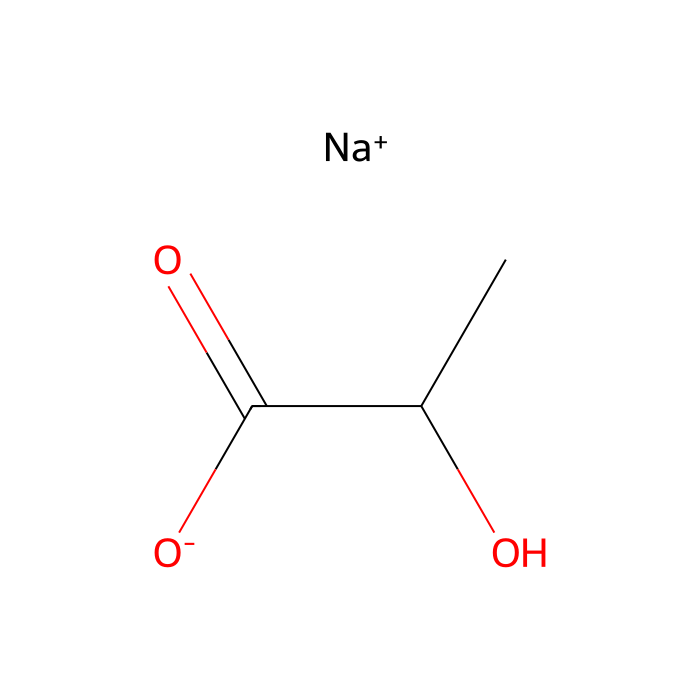
Sodium lactate is the sodium salt of lactic acid (2-hydroxypropanoic acid), consisting of a lactate anion paired with a sodium cation.
Item identifiers (from Product Data):
CAS: 867-56-1
CID: 23664767
InChIKey: 238099 (as listed; note: format appears non-standard for an InChIKey)
Structure identifiers (literature/general):
Preferred IUPAC name (literature): sodium 2-hydroxypropanoate
Contains a chiral center at C2 of the propanoate backbone (racemic material is common unless specified). The lactate anion bears a secondary alcohol (–CHOH–) β to a carboxylate (–COO–), enabling bidentate chelation to metals via the α-hydroxycarboxylate motif.
As an ionic compound, it is typically present as a contact ion pair in the solid state or dissociated in aqueous media.
2D depiction in words: a three‑carbon chain where C1 is a carboxylate carbonyl (C(=O)O–), C2 bears a hydroxyl substituent (–OH) and a methyl group (–CH3), with Na+ as the counterion.
Note: Exact stereochemical composition, hydration state, and any stabilizers are not specified for this item; refer to CoA/Spec Sheet.
Synthetic Utility
From a synthetic chemistry perspective (literature/general), sodium lactate functions as a versatile α‑hydroxycarboxylate source and aqueous-phase reagent rather than a typical organic nucleophile.
Functional group handle:
The α‑hydroxycarboxylate can be protonated (to lactic acid) and esterified to alkyl lactates (e.g., Me/Et lactate), which are valuable green solvents and intermediates.
Oxidation/dehydrogenation of lactic acid derivatives affords pyruvic acid/pyruvates; dehydration can lead to acrylic derivatives under suitable conditions.
Chiral pool access:
Enantiopure lactate (not specified here) feeds into syntheses of chiral auxiliaries and polymers (e.g., lactide → polylactide). The sodium salt can be a convenient, nonvolatile reservoir for the lactate anion during workup and transfer.
Coordination and phase behavior:
Lactate forms soluble complexes with many metal ions, aiding in homogeneous catalysis or separations in aqueous media (e.g., lactate-assisted leaching or electrodeposition studies).
Titrimetric/analytical utility:
As a primary component in buffer standards around pH 4 and as an analyte or standard for enzymatic lactate assays (after appropriate calibration), sodium lactate contributes to method development.
Limitations and tips:
In nonaqueous organic synthesis, the ionic salt has poor solubility; convert to lactic acid or alkyl lactate esters for organic-phase transformations.
Control water content and exact assay (solid vs solution) to ensure accurate stoichiometry.
Be mindful of lactate’s ability to sequester metals—beneficial in some contexts, detrimental in metal-catalyzed C–C/C–X couplings.
Target Specificity
This product is a small-molecule salt, not an antibody or targeted bioreagent. Target specificity parameters (antigen, epitope, species reactivity, clone, isotype) are not applicable.
Item-specific antibody/target data: Not applicable.
For biochemical targeting studies involving lactate (e.g., transporter assays, receptor binding to HCAR1), use appropriate validated bioassays and controls; this product does not include such validation.
We use cookies to ensure the website functions properly and, where permitted, to improve your experience. You can manage your preferences at any time in Settings. Learn more in our Cookie Policy.
Shall we send you a message when we have discounts available?
Remind me later
Thank you! Please check your email inbox to confirm.
Products are supplied to verified businesses, institutions, and qualified professionals for research and development use only. Not for use in humans, animals, diagnosis, or therapy.

 J2622768