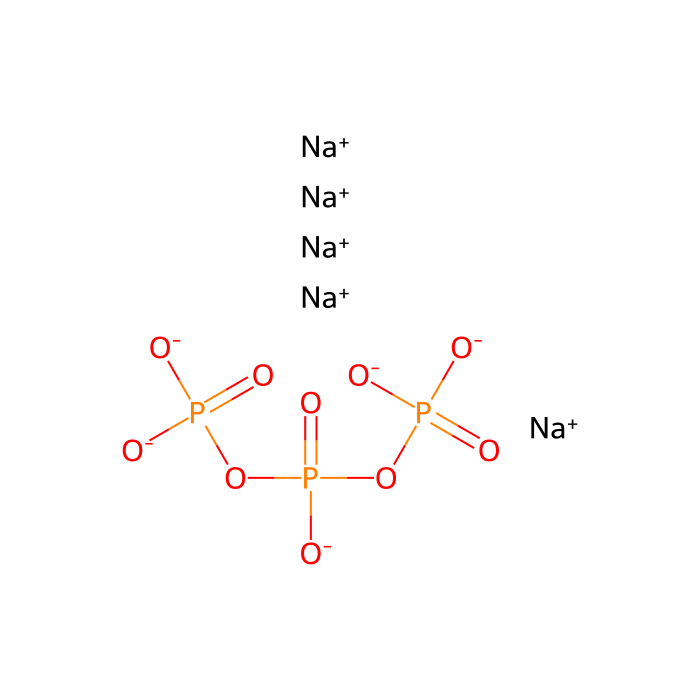
Sodium triphosphate pentabasic - purum p.a., ≥98%(T) , CAS No.7758-29-4

CAS: 7758-29-4 Cat. No.: S475703 Formula: Na5P3O10 Molecular Weight: 367.86 EC Number: 231-838-7
AVAILABLE TO ORDER
GRADE & PURITY purum p.a. ? Purum pro analysi — pure grade meeting analytical specifications. Use for analytical applications where purum-level purity is validated for analysis. ≥98%(T)
Synonyms
Sodium triphosphate (Na5P3O10)|Pentasodium triphosphate|Sodium triphosphate (Na5(P3O10))|STPP|TRIPHOSPHORIC ACID, SODIUM SALT|Armofos|Triphosphoric acid, pentasodium salt|Triphosphoric acid, sodium salt (1:5)|Rhodiaphos LV|Sodium phosphate (Na5P3O10)|pentasodium;[oxido(phosphonatooxy)phosphoryl] phosphate|PENTASODIUM TRIPHOSPHATE [INCI]|Empiphos stp-D|Sodium triphosphate|Thermphos SPR|Thermphos N|Thermphos L 50
Storage
Room temperature
★
Size
USA
Germany (EU)*
Price
Qty
100g
S475703-100g
Made to order · 8–12 wks
$107.90
500g
S475703-500g
Made to order · 8–12 wks
$379.90
Enter a quantity for the sizes you want to add.

Overview

Description

for the determination of BSB acc. to DIN 38409-H 51

Specifications

Synonyms
Sodium triphosphate (Na5P3O10) | Pentasodium triphosphate | Sodium triphosphate (Na5(P3O10)) | STPP | TRIPHOSPHORIC ACID, SODIUM SALT | Armofos | Triphosphoric acid, pentasodium salt | Triphosphoric acid, sodium salt (1:5) | Rhodiaphos LV | Sodium phosphate (Na5P3O10) | pentasodium;[oxido(phosphonatooxy)phosphoryl] phosphate | PENTASODIUM Show more
Specifications & Purity
purum p.a., ≥98%(T)
Storage
Room temperature
Grade
purum p.a.
Purity
≥98%(T)
Names and Identifiers
Canonical Smiles
[O-]P(=O)([O-])OP(=O)([O-])OP(=O)([O-])[O-].[Na+].[Na+].[Na+].[Na+].[Na+]
IUPAC Name
pentasodium;[oxido(phosphonatooxy)phosphoryl] phosphate
InChIKey
HWGNBUXHKFFFIH-UHFFFAOYSA-I
INCHI
1S/5Na.H5O10P3/c;;;;;1-11(2,3)9-13(7,8)10-12(4,5)6/h;;;;;(H,7,8)(H2,1,2,3)(H2,4,5,6)/q5*+1;/p-5
Isomeric SMILES
[O-]P(=O)([O-])OP(=O)([O-])OP(=O)([O-])[O-].[Na+].[Na+].[Na+].[Na+].[Na+]
WGK Germany
1
RTECS
YK4570000
Alternate CAS
15091-98-2
Molecular Weight
367.86

Advanced Data

Taxonomic Classification

Taxonomy Tree

KingdomInorganic compounds
SuperclassMixed metal/non-metal compounds
ClassAlkali metal oxoanionic compounds
SubclassAlkali metal phosphates
Intermediate Tree Nodes Not available
Direct ParentAlkali metal phosphates
Alternative Parents Inorganic sodium salts  Inorganic oxides  
Molecular FrameworkNot available
Substituents Alkali metal phosphate - Inorganic sodium salt - Inorganic oxide - Inorganic salt
DescriptionThis compound belongs to the class of inorganic compounds known as alkali metal phosphates. These are inorganic compounds in which the largest oxoanion is phosphate, and in which the heaviest atom not in an oxoanion is an alkali metal.
External Descriptors Not available
3D Structure
Interactive Chemical Structure Model


Certificates (CoA,COO,BSE/TSE and Analysis Chart)
C of A & Other Certificates(BSE/TSE, COO):
Analytical Chart:
Chemical and Physical Properties
Solubility water: soluble 148g/L at20°C
Melt Point(°C)622°C
Molecular Weight367.860 g/mol
XLogP3
Hydrogen Bond Donor Count0
Hydrogen Bond Acceptor Count10
Rotatable Bond Count2
Exact Mass367.819 Da
Monoisotopic Mass367.819 Da
Topological Polar Surface Area185.000 Ų
Heavy Atom Count18
Formal Charge0
Complexity241.000
Isotope Atom Count0
Defined Atom Stereocenter Count0
Undefined Atom Stereocenter Count0
Defined Bond Stereocenter Count0
Undefined Bond Stereocenter Count0
The total count of all stereochemical bonds0
Covalently-Bonded Unit Count6
Documents & Articles
A Practical Guide to Fragrance Compositions: Turning a Black-Box Formula into an Engineerable System—Compatibility, Stability, Controlled Release, Traceability, and Selection
Key Judgments in Medical Hydrogel R&D: From Polymer Source and Crosslinking Strategy to Sterilization Planning, Scale-Up Feasibility, and Quality Control
Why LABSA (Sulfonic Acid) Is Commonly Used in Household Cleaning Formulations: Neutralization Mechanism, Detergency Action, and Formulation Application Points
Differences, Mechanisms of Action, and Selection of Sodium Metasilicate and Sodium Tripolyphosphate in Detergent and Cleaning Formulations
The Role, Selection, and Validation of Chelating Agents in Daily Chemical Formulations
Differences, Functions, and Selection Guidelines for Sodium Hydroxide Flakes, Granules, Liquid Caustic Soda, and Caustic Soda in Household and Personal Care Product Manufacturing: The Functional and Application Logic of Sodium Hydroxide
Why Daily Chemical Formulations Need Alkaline Ingredients: From pH Adjustment and Saponification to Detergency Boosting and Selection Logic
How Can Sodium Tripolyphosphate (STPP) Be Replaced? From Detergency Mechanisms to Formulation Choices for Low-Phosphorus/Phosphorus-Free Builder Systems
What Are the Differences Among Sodium Dodecylbenzenesulfonate/SDBS, LAS, and Sodium α-Olefin Sulfonate/AOS: A Comparative Overview of Synthesis, Structure, Mechanism of Action, and Formulation Selection
Sodium Metasilicate in Cleaning Applications: Hydration-Form Differences, Mechanisms of Action, and Selection Logic
Analysis of the Foaming Performance Differences Between K12 and AOS: Structure, Acid–Base Stability, and Formulation Selection
Structure, Properties, and Mechanisms of Powdered Fragrances and Fragrance Delivery Materials: Stability, Release Mechanisms, and Selection Logic
Key Variable in the Long-Term Stability of Waterborne Pigment Concentrates: How Dispersant Molecular Weight Distribution (MWD) Affects Pigment Dispersion, Surface Adsorption-Layer Formation, and Storage Stability
Influencing Factors and Control Strategies for Blistering in Neutral Wall Putty: An Experimental Analysis Based on HPMC Dosage, Viscosity, and Ground Calcium Carbonate Fineness
Differences and Application Selection of Cassava- and Corn-Based Pregelatinized Starch in Neutral Putty Formulations
The Role, Selection, Cracking Risk Analysis, and Dosage Control of Bentonite in Neutral Putty
What Grade Is Purum? From Grade Meaning and Specification Interpretation to Reagent Selection
How Arbutin Regulates Melanin Production: α/β Anomeric Configuration and Tyrosinase Action
Citations of This Product
Solution Calculators
Reviews

Customer Reviews

Frequently Asked Questions

What does purum p.a. mean?
purum p.a. is a defined analytical purity tier suitable for general analytical and reagent applications. It specifies a minimum assay percentage, controlled limits on common impurities (water, heavy metals, residue on ignition), and lot-to-lot consistency. purum p.a. is one of several purity tiers — choose based on the sensitivity and regulatory requirements of your method.
How should this product be stored?
Store at room temperature.
What are the CAS number, molecular formula and molecular weight?
The CAS Number is 7758-29-4, the molecular formula is Na5P3O10, and the molecular weight is 367.86 g/mol. InChIKey HWGNBUXHKFFFIH-UHFFFAOYSA-I.
What documentation is provided?
Available product documentation, including Certificates of Analysis (COA), Safety Data Sheets (SDS), and specification sheets, is shown in the product document area. Document availability and access follow the current site policy.

Shall we send you a message when we have discounts available?

Remind me later

Thank you! Please check your email inbox to confirm.

Oops! Notifications are disabled.