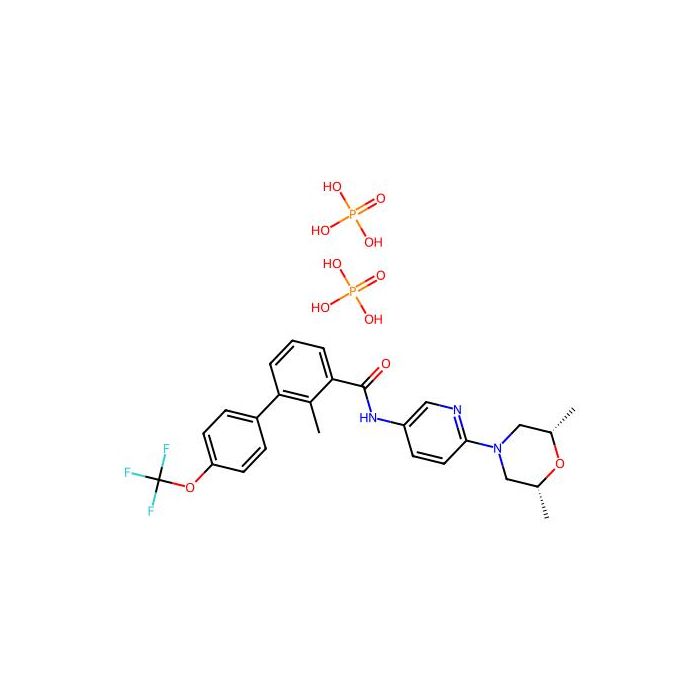
Sonidegib diphosphate - 10mM in DMSO , Smoothened homolog inhibitor, CAS No.1218778-77-8, Smoothened homolog inhibitor

CAS: 1218778-77-8 Cat. No.: S655786 Formula: C26H32F3N3O11P2 Molecular Weight: 681.5 PubChem CID: 45138699
AVAILABLE TO ORDER
GRADE & PURITY 10mM in DMSO
Storage
Desiccated,Store at -80°C
Shipped In
Dry ice packs + Cold packs
★
Size
USA
Germany (EU)*
Price
Qty
1ml
S655786-1ml
Made to order · 8–12 wks
$150.90
Enter a quantity for the sizes you want to add.
🧪
Why this grade

10mM in DMSO for sensitive chromatographic and analytical workflows requiring minimal baseline interference.

🌡

Storage & shipping

Desiccated,Store at -80°C Ships Dry ice packs + Cold packs Check lot-specific COA for exact specifications.

📋

Quality documents

SDS, COA, datasheet, and spec sheet available for download. Lot-specific COA accessible via lot number lookup.

📚

Literature proof

Cited in 0 peer-reviewed publications across chromatography, organic synthesis, and cross-coupling reactions.

Overview

Sonidegib diphosphate (Erismodegib diphosphate) is a potent and selective Smo antagonist with IC 50 of 1.3 nM and 2.5 nM for mouse and human Smo in binding assay, respectively

In Vitro

The IC 50 values for Sonidegib (NVP-LDE225) for the major human CYP450 drug metabolizing enzymes is greater than 10 μM. Sonidegib (LDE225), a small molecule, clinically investigated SMO inhibitor, used alone and in combination with Nilotinib, inhibits the Hh pathway in CD34 + chronic phase (CP)-chronic myeloid leukaemia (CML) cells, reducing the number and self-renewal capacity of CML leukaemia stem cell (LSC). Sonidegib interacts directly with SMO, in a similar fashion to cyclopamine, to reduce expression of downstream Hh signaling targets. Primary CD34 + CP-CML cells are cultured in serum free media (SFM)±Sonidegib for 6, 24 and 72 hours (h). At 72 h, while there is variability between the biological samples, GLI1 is significantly downregulated following exposure to Sonidegib (10 nM; 0.78-fold and 100 nM; 0.73-fold, respectively (p<0.01). MCE has not independently confirmed the accuracy of these methods. They are for reference only.

In Vivo

Sonidegib (NVP-LDE225) is a weak base with a measured pK a of 4.2 and exhibits relatively poor aqueous solubility. In the subcutaneous Ptch +/- p53 -/- medulloblastoma allograft mouse model, Sonidegib demonstrates dose-related antitumor activity after 10 days of oral administration of a suspension of the diphosphate salt. At a dose of 5 mg/kg/day qd, Sonidegib significantly inhibits tumor growth, corresponding to a T/C value of 33% (p<0.05 as compared to vehicle controls). When dosed at 10 and 20 mg/kg/day qd, Sonidegib affords 51 and 83% regression, respectively . Bone marrow cells and spleen cells from a subset of treated mice are transplanted into secondary recipient mice. Transplantation of either bone marrow (BM) or spleen cells from mice treated with Sonidegib (LDE225)+Nilotinib results in reduced white cell count (WCC) and reduces leukaemia development in secondary recipients compared to Sonidegib or Nilotinib alone. MCE has not independently confirmed the accuracy of these methods. They are for reference only.

Cell Assay

CD34 + CP-CML cells are seeded in SFM alone±Sonidegib±Nilotinib and cultured for 24-72 h prior to assessment. Proliferation is measured using colorimetric assessment of BrDU incorporation. Proportion of viable cells versus those in early and late apoptosis is assessed by flow cytometry using annexin V-FITC and 7-amino-actinomycin D (7-AAD, Via-Probe solution). Cell cycle status is assessed using Ki67 (FITC) expression and 7-AAD incorporation. MCE has not independently confirmed the accuracy of these methods. They are for reference only.

Animal administration

Mice The transgenic EGFP + /SCLtTA/TRE-BCR-ABL mouse model is used to investigate the effect of Sonidegib treatment on CML LSC in vivo. Scl-tTa-BCR-ABL mice in the FVB/N background are crossed with transgenic GFP-expressing mice. Bone marrow cells are obtained 4 weeks post induction, GFP + cells are selected by flow cytometry and transplanted by tail vein injection (10 6 cells/mouse) into wild-type FVB/N recipient mice, irradiated at 900 cGy, generating a large cohort of mice with similar time of onset of leukemia. Blood samples obtained 4 weeks post transplantation confirmed a neutrophilic leukocytosis in recipient mice. Mice are treated with Nilotinib (50 mg/kg by gavage, daily), Sonidegib (80 mg/kg by gavage, daily), Sonidegib+Nilotinib, or with vehicle alone (control). After 3 weeks of treatment, animals are euthanised and marrow content of femurs and tibiae, spleen cells and blood obtained. Total white cell count (WCC), GFP-expressing WCC, myeloid cells, and GFP+ progenitors and stem cells are measured by flow cytometry. Survival is assessed in a subset of mice for 120d post discontinuation of treatment. Spleen and BM cells from a subset of mice in each arm are pooled and 5×10 6 cells/mouse (8 mice/condition) are transplanted into wild-type FVB/N recipient mice irradiated at 900 cGy. Engraftment is monitored by drawing peripheral blood (PB) every 4 weeks. The percentage of GFP + cells in PB is analyzed by flow cytometry. aladdin has not independently confirmed the accuracy of these methods. They are for reference only.

IC50& Target:IC50: 1.3 nM (mSmo), 2.5 nM (hSmo)

Specifications

Specifications & Purity
10mM in DMSO
Biochemical and Physiological Mechanisms
Sonidegib diphosphate (Erismodegib diphosphate) is a potent and selective Smo antagonist with IC 50 of 1.3 nM and 2.5 nM for mouse and human Smo in binding assay, respectively.
Storage
Desiccated,Store at -80°C
Shipped In
Dry ice packs + Cold packs
This product requires cold chain shipping. Ground and other economy services are not available.
Action Type
INHIBITOR
Mechanism of action
Smoothened homolog inhibitor
Names and Identifiers
Isomeric SMILES
C[C@@H]1CN(C[C@@H](O1)C)C2=NC=C(C=C2)NC(=O)C3=CC=CC(=C3C)C4=CC=C(C=C4)OC(F)(F)F.OP(=O)(O)O.OP(=O)(O)O
PubChem CID
45138699
Molecular Weight
681.5

Documentation

📋 Safety Data Sheet (SDS)

Comprehensive hazard, handling, storage, and regulatory compliance document.

Download SDS →

✅ Certificate of Analysis (COA)

Lot-specific quality data. Enter your lot number to retrieve the exact COA.

Look up COA →

📊 Datasheet

Quick-reference summary of product specifications and applications.

View datasheet →

🔬 Specification Sheet

Full quality attributes and acceptance criteria for this grade.

View spec sheet →

Advanced Data

Certificates(CoA,COO,BSE/TSE and Analysis Chart)
C of A & Other Certificates(BSE/TSE, COO):
Analytical Chart:
Documents & Articles
Solution Calculators
Reviews

Customer Reviews

Application Protocols

No tested application protocols are provided in the Product Data for this item.

  • General note: Researchers commonly prepare concentrated DMSO stocks and perform serial dilutions into assay media with matched vehicle controls for small-molecule probes. Optimize concentration ranges, exposure times, and readouts (e.g., GLI-reporter assays) according to your internal SOPs.

For any protocol-specific parameters (e.g., stock concentration, incubation time), refer to your validated methods or primary literature. This product is supplied for research use only.

Biological Roles

Literature/general context: Sonidegib is a well-characterized small-molecule antagonist of the Smoothened (SMO) receptor, a central transmembrane component of the Hedgehog (Hh) signaling pathway.

  • Mechanistic role (research context):
    • By binding to SMO, sonidegib blocks downstream signaling to GLI transcription factors, enabling researchers to suppress Hh pathway activity experimentally and dissect pathway-dependent processes such as developmental signaling, stem cell maintenance, and certain oncogenic signaling axes (strictly research context; no clinical claims).
  • Use cases in biology labs:
    • Probe Hh pathway dependence in cell lines using reporter assays (e.g., GLI-luciferase) and quantitative gene expression readouts.
    • Evaluate pathway crosstalk by combining with agonists (e.g., SAG, purmorphamine) to generate inhibition curves and mechanistic insights (general approach).
  • Considerations:
    • Salt form (diphosphate) may aid aqueous dosing in cell culture workflows. Verify cytotoxicity and off-target profiles in your specific model system; effects can vary by cell type and exposure window.
    • Vehicle controls and time-course studies are important to distinguish acute pathway modulation from secondary effects.

Note: This product is for research use only and not for any diagnostic or therapeutic application.

Buffer Applications

As a small-molecule research tool, this compound is not a buffering agent. However, buffer choice influences its handling and assay performance:

  • Suitable buffers (general guidance):
    • Phosphate-buffered saline (PBS) or HEPES-buffered saline at pH 7.2–7.4 are commonly used for diluting DMSO stocks to working concentrations for cell assays. The diphosphate counterion is compatible with typical biological buffers.
    • For biochemistry assays, low ionic strength buffers (e.g., 10–50 mM HEPES, pH 7.4) can reduce nonspecific interactions.
  • Practical tips:
    • Avoid high-pH buffers (>8) that may deprotonate the cation and reduce solubility.
    • Filter-sterilize working solutions if sterility is required; prepare fresh before use to minimize hydrolysis or adsorption losses.

No formal buffering capacity or pKa specifications are provided for this item; refer to your assay’s validated buffer system.

Green Alternatives

Greener practice considerations focus on solvent choices and waste minimization during handling of this small-molecule library compound.

  • Preferred solvents for stock solutions:
    • Water or buffered aqueous media (where soluble) minimize VOC use and reduce hazardous waste.
    • When organic solvent is required, DMSO is often favored over chlorinated solvents due to lower volatility and persistence in the environment (general green chemistry guidance).

Comparison (general; not item-specific specs):

  • Water/buffer: Highest EHS profile; constrained by intrinsic solubility and pH-dependence of the salt.
  • DMSO: Good EHS profile relative to DMF/NMP and chlorinated solvents; viscous and hygroscopic, but widely accepted for bioassays.
  • 2-MeTHF/CPME vs. THF/Et2O (synthetic contexts): If conducting any ancillary synthesis or scaffold modification, 2-MeTHF or CPME may offer greener alternatives to traditional ethers while maintaining solvency for many aromatic amines.

Operational tips:

  • Use minimal volumes, prepare concentrated stocks, and aliquot to avoid repeated freeze–thaw cycles that generate waste.
  • Opt for aqueous workups and ethanol/water cleaning where compatible, reserving stronger solvents only when necessary.
  • Consolidate waste streams and follow institutional green lab protocols.
Pharmaceutical Uses

This product is supplied strictly for research use. No medical or clinical claims are made or implied.

  • Formulation research (general):
    • The diphosphate salt form is relevant to preformulation studies, enabling exploration of aqueous solubility, pH-dependent stability, and excipient compatibility for small, basic, aromatic molecules. Researchers may examine salt-to-free-base interconversion, hygroscopicity, and polymorphism under stress conditions.
  • Analytical and QC use:
    • Can serve as a reference material in method development (e.g., LC–MS/MS quantitation in in vitro matrices) to support pharmacology or ADME experiments in preclinical settings (research only).
  • Regulatory/compendial status:
    • No pharmacopeial monograph is indicated for this item. Any use in GMP contexts requires independent qualification of identity, purity, and stability according to your quality system.

All uses must remain within the scope of laboratory research; not for human or veterinary use, diagnostic procedures, or clinical applications.

Physical Properties

Item-specific physical constants are not provided in the Product Data. Where helpful, general/literature context is provided for planning purposes; do not treat as specifications.

  • Appearance: Not specified for this item; refer to CoA/Spec Sheet.
  • Molecular formula and molecular weight: Not specified for this item; refer to CoA/Spec Sheet. Note that salt form and possible hydrate state affect MW (general note).
  • Melting point, boiling point, density, refractive index: Not specified for this item; refer to CoA/Spec Sheet.
  • Solubility (general guidance):
    • Diphosphate salts of basic, aromatic small molecules typically show improved water solubility compared to the free base; aqueous buffers (pH 2–7) or sterile water can often be used for primary dissolution, while high-strength DMSO stocks are commonly prepared for screening (general chemistry/lab practice). Actual solubility depends on counterion stoichiometry and hydration; verify experimentally.
  • pKa/logP (literature/general for the free base class):
    • Sonidegib’s scaffold contains at least one basic amine; protonation under physiological pH is expected. Neutral free bases of similar scaffolds exhibit high cLogP; salt formation increases apparent aqueous compatibility.
  • Hygroscopicity: Phosphate salts can be hygroscopic; the specified desiccated storage is consistent with minimizing moisture uptake (general handling rationale).

For authoritative, lot-specific physical data (including any hydrate content and exact counterion ratio), consult the CoA/Spec Sheet.

Quality & Grades
  • Grade/purity: Not specified for this item; refer to CoA/Spec Sheet for assay, residual solvents, and impurity profile.
  • Library compound context: This material is offered under the “small molecules and compound library” category, where emphasis is on identity, stability, and reproducible performance in screening assays rather than analytical-grade solvent specifications.
  • What to expect in documentation:
    • CoA/Spec Sheet typically provides identity confirmation (e.g., HPLC/LC–MS, NMR), salt stoichiometry, and lot-specific purity. For phosphate salts, specification may also indicate water content or hydration where applicable (documentation varies by lot).
  • Stabilizers: None stated for this item. If no stabilizer is indicated on the CoA, avoid prolonged exposure to light/heat/humidity to maintain integrity.
  • UV/LC attributes: If HPLC purity and UV profile are relevant to your application (e.g., bioassay QC), rely on the supplied CoA/Spec Sheet rather than assuming typical values.
  • Suitability: Intended for research use only. Not for human or veterinary use, diagnostic procedures, or clinical applications.
Reaction & Applications

This product is supplied as a finished small-molecule research tool rather than a synthetic reagent. As such, it is not typically used as a substrate, catalyst, or solvent in chemical reactions. Instead, its applications lie in chemical biology and screening.

  • Research application context (general):
    • Widely used as a chemical probe of the Hedgehog signaling pathway via antagonism of the Smoothened (SMO) receptor. Commonly employed in cell-based reporter assays, pathway modulation studies, and target engagement experiments to elucidate Hedgehog-dependent biology.
    • Suitable for high-throughput screening, dose–response characterization, and comparative profiling against other SMO ligands.
  • Assay setup notes:
    • Prepare concentrated DMSO stock and serially dilute into assay media, keeping vehicle controls matched. Account for potential adsorption to plastics for hydrophobic scaffolds; preconditioning plates or using low-bind labware can improve reproducibility (general practice).
  • Analytical support:
    • LC–MS or HPLC-UV can be used to monitor solution stability and to confirm concentration in working stocks. Phosphate counterions are compatible with most reversed-phase methods; consider volatile buffers if coupling to MS (general guidance).

For any use in chemical synthesis or derivatization, consult primary literature on sonidegib scaffold modifications; this is outside the typical scope of this library material.

Reaction Conditions

Not typically applicable: this product is supplied as a final small-molecule probe, not a reagent employed under classical synthetic reaction conditions.

  • Assay preparation conditions (general guidance):
    • Stock solutions: Commonly 10–50 mM in DMSO; verify solubility experimentally. Store aliquots at ≤−20°C or as directed under Storage & Reconstitution.
    • Working solutions: Dilute into assay buffer or media immediately before use, maintaining consistent vehicle (e.g., ≤0.1–0.5% DMSO v/v). Gently mix to avoid foaming and adsorption losses.
    • Temperature: Prepare and handle at ambient temperature; avoid extended exposure to elevated temperatures or strong light.
  • Analytical confirmation:
    • Confirm concentration by UV or LC–MS where critical, particularly after long storage or multiple freeze–thaw cycles.

For genuine reaction-condition data (solvents, catalysts, yields) in synthetic transformations of the sonidegib scaffold, consult the primary synthesis literature; such conditions are beyond the intended use of this item.

Safety & Handling
  • GHS classification, pictograms, signal word, and H-statements: Not specified for this item; consult the SDS for authoritative safety information.
  • General laboratory precautions (good practice):
    • Handle in a chemical fume hood or well-ventilated area, avoiding inhalation of powders and contact with skin or eyes.
    • Wear appropriate PPE: lab coat, safety glasses, and suitable chemical-resistant gloves. Use respiratory protection if dusts/aerosols may form.
    • Avoid generating dust. Use antistatic and low-shear tools for weighing microgram–milligram quantities typical of screening libraries.
  • Incompatibilities and reactivity (general):
    • Phosphate salts are typically compatible with most aqueous buffers. Avoid strong oxidizers and strong bases/acids that could alter ionization state or degrade the organic cation.
  • First aid (overview; defer to SDS):
    • Skin/eye contact: Rinse with water for at least 15 minutes; remove contaminated clothing.
    • Inhalation: Move to fresh air; seek medical attention if symptoms persist.
    • Ingestion: Rinse mouth; do not induce vomiting unless directed by medical personnel.
  • Environmental precautions: Prevent release to drains and the environment. Collect spills with inert absorbent; dispose per institutional and local regulations.
  • Storage-related safety: Store desiccated at -80°C as specified. Warm to room temperature in a sealed container before opening to avoid condensation.
Solvent Selection

Choosing a solvent for Sonidegib diphosphate stocks depends on assay format, target concentration, and compatibility.

  • Aqueous handling (general guidance):
    • Diphosphate salts often dissolve in water and low- to moderate-ionic-strength buffers (pH 2–7). If solubility is limited, gentle warming and sonication can help. Avoid high-pH buffers that deprotonate the cation, potentially reducing solubility.
  • Organic cosolvents:
    • DMSO is typically preferred for preparing concentrated screening stocks (e.g., 10–50 mM) due to broad solvency and compatibility with microtiter formats. DMF or 1-methyl-2-pyrrolidone (NMP) are alternatives when higher concentration is required, noting increased hygroscopicity and assay interference potential (general practice).
  • Mixed systems:
    • For sensitive biological assays, prepare a DMSO concentrate and dilute into aqueous media to a final DMSO content ≤0.1–0.5% v/v to minimize vehicle effects.
  • Practical tips:
    • Filter-sterilize aqueous working solutions through 0.22 µm PVDF/PTFE if sterility is needed. Verify solution clarity and stability over the assay time course.
  • Comparison guidance (general):
    • Water/buffer: Highest biocompatibility; concentration limited by intrinsic solubility.
    • DMSO: Highest solvency; watch for freeze–thaw precipitation and DMSO content in assays.
    • MeOH/EtOH: Less preferred for biological assays; potential for membrane perturbation.
Storage & Reconstitution
  • Storage conditions (from Product Data):
    • Store desiccated at -80°C.
    • Shipped on dry ice packs plus cold packs to maintain low temperature during transit.
  • Stability notes (general guidance):
    • Minimize exposure to moisture, heat, and light. Allow vials to equilibrate to room temperature in a sealed container before opening to prevent condensation.
    • For long-term stability, keep material in the original, tightly closed container; purge with inert gas before re-sealing if possible.
  • Reconstitution (not item-specific; verify experimentally):
    • Aqueous: Attempt dissolution in sterile water or appropriate buffer (pH 2–7) for immediate use when feasible.
    • Organic: Prepare concentrated stocks in anhydrous DMSO for storage and dosing; typical working concentrates are 10–50 mM, subject to solubility.
    • Filter-sterilize solutions if sterility is required. Prepare single-use aliquots to avoid repeated freeze–thaw.
  • Solution storage (general):
    • DMSO stocks: Store at ≤−20°C, protected from moisture and light. Inspect for precipitation upon thawing and redissolve by gentle warming if needed.
    • Aqueous solutions: Use promptly; if short-term storage is necessary, keep at 2–8°C and discard if turbidity or degradation is observed.

For lot-specific reconstitution guidance (including exact solubility limits), refer to the CoA/Spec Sheet.

Structure & Identity

Sonidegib diphosphate is the diphosphate salt form of the small-molecule Hedgehog pathway tool compound sonidegib, supplied here as a research-use-only library member.

  • Item-specific identifiers (from Product Data):
    • Product name: Sonidegib diphosphate (SKU: S655786)
    • CAS: 1218778-77-8
    • PubChem CID: 45138699
    • InChIKey: Not specified for this item; refer to CoA/Spec Sheet.
    • SMILES: Not specified for this item; refer to CoA/Spec Sheet.
  • Salt form and ionization:
    • The "diphosphate" designation indicates the protonated base is paired with two phosphate counterions (typically dihydrogen phosphate anions). This salt form is commonly chosen to improve aqueous handling relative to the neutral free base (general chemistry knowledge).
  • Structural features (literature/general):
    • Sonidegib is a nitrogen-containing, multi-aromatic small molecule designed to antagonize Smoothened (SMO) within the Hedgehog signaling pathway. It bears a basic amine center that is protonated in the diphosphate salt. The core features multiple aromatic rings and heteroatoms (N, O), consistent with a drug-like scaffold.
  • Composition notes:
    • Molecular formula and exact molecular weight for the diphosphate salt are not specified in the provided Product Data and may vary with hydration state; refer to CoA/Spec Sheet for definitive values.
Synthetic Utility

This listing is a finished small-molecule library compound rather than a building block; it is not typically used as a reagent or intermediate in routine synthesis.

  • If derivatization is of interest (general literature perspective):
    • Sonidegib’s scaffold includes a basic amine and multiple aromatic/heteroaromatic motifs, offering potential vectors for structure–activity relationship (SAR) studies through N-alkylation/acylation, ring substitution, or linker installation. Such work is outside the scope of this product’s intended use.
  • Purification and analysis considerations (general):
    • Reversed-phase HPLC with aqueous-organic gradients (ACN or MeOH with volatile buffers) is commonly used to purify or analyze related scaffolds, with detection at 210–280 nm depending on chromophores.
  • Stability considerations:
    • As with many polyaromatic amines, avoid strong oxidants and prolonged high-temperature exposure. Maintain neutral to mildly acidic conditions during manipulations to preserve the protonated form when aqueous solubility is desired.

For access to functionalized precursors or building blocks, consider sourcing simpler intermediates rather than modifying the final probe itself.

Target Specificity

Not applicable to this product type. Target specificity data (e.g., antigen/epitope, clone, isotype, species reactivity) are relevant to antibodies/biologics, not to small-molecule research compounds. For biochemical targeting context, see the Biological Roles section.

Frequently Asked Questions

How should this product be stored?
Store at ?80 °C, desiccated. Keep the container tightly closed with desiccant — the material is moisture-sensitive.
How is this product shipped?
This product ships frozen with dry ice and cold packs. Unpack on arrival and transfer it to the storage condition stated above; handle dry ice with insulated gloves in a ventilated area.
What are the CAS number, molecular formula and molecular weight?
The CAS Number is 1218778-77-8, the molecular formula is C26H32F3N3O11P2, and the molecular weight is 681.5 g/mol.
What documentation is provided?
Available product documentation, including Certificates of Analysis (COA), Safety Data Sheets (SDS), and specification sheets, is shown in the product document area. Document availability and access follow the current site policy.

Shall we send you a message when we have discounts available?

Remind me later

Thank you! Please check your email inbox to confirm.

Oops! Notifications are disabled.