GRADE & PURITYMoligand™?Moligand™ — Aladdin's line of ligands and bioactive small molecules. Use for receptor, pathway, and binding studies needing defined small-molecule tools.≥99%
Moligand™, ≥99% Moligand™ for sensitive chromatographic and analytical workflows requiring minimal baseline interference.
🌡
Storage & shipping
Store at -20°C Ships Ice chest + Ice pads Check lot-specific COA for exact specifications.
📋
Quality documents
SDS, COA, datasheet, and spec sheet available for download. Lot-specific COA accessible via lot number lookup.
📚
Literature proof
Cited in 0 peer-reviewed publications across chromatography, organic synthesis, and cross-coupling reactions.
Overview
TXB2 (Thromboxane B2) is a stable metabolite of thromboxane A2 in platelets which may be released during anaphylaxis. Reportedly possesses chemotactic properties. Often used to measure arachidonic acid metabolism. It is a prostaglandin derivative that is released during anaphylaxis, which induces arterial contraction and platelet aggregation by stimulating TP-α receptors. A stable metabolite of thromboxane B2.
Prostaglandin derivative that is released during anaphylaxis; induces arterial contraction and platelet aggregation. Review of endogenous thromboxane B2 in risk analysis for development of thrombogenic disorders.
Storage
Store at -20°C
Shipped In
Ice chest + Ice pads
This product requires cold chain shipping. Ground and other economy services are not available.
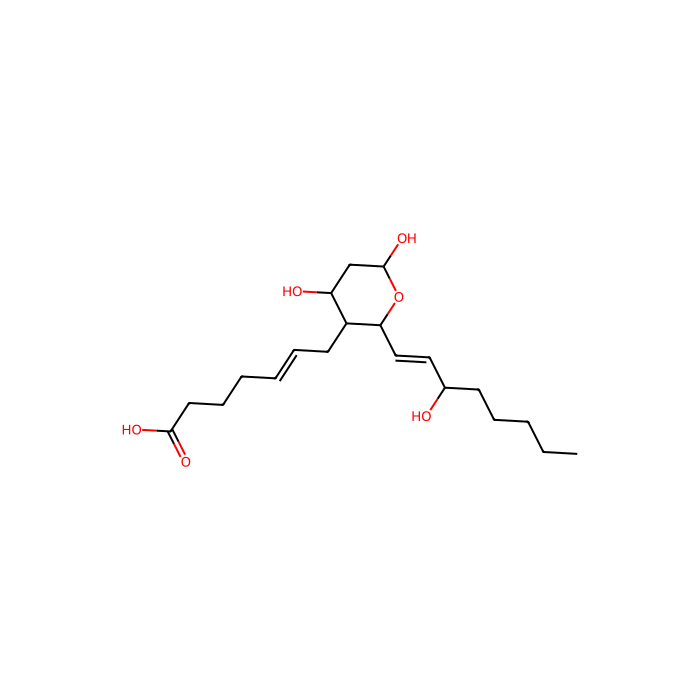
This compound belongs to the class of organic compounds known as thromboxanes. These are eicosanoids structurally characterized by the presence of a 6-member ether containing ring.
External Descriptors
Thromboxanes
1. Djoumbou Feunang Y, Eisner R, Knox C, Chepelev L, Hastings J, Owen G, Fahy E, Steinbeck C, Subramanian S, Bolton E, Greiner R, and Wishart DS. ClassyFire: Automated Chemical Classification With A Comprehensive, Computable Taxonomy. Journal of Cheminformatics, 2016, 8:61.
Soluble in ethanol (~100 mg/ml), ethyl acetate, PBS pH7.2 (~100 μg/ml), and methyl acetate (~10 mg/ml). Insoluble in water.
Molecular Weight
370.500 g/mol
XLogP3
2.400
Hydrogen Bond Donor Count
4
Hydrogen Bond Acceptor Count
6
Rotatable Bond Count
12
Exact Mass
370.236 Da
Monoisotopic Mass
370.236 Da
Topological Polar Surface Area
107.000 Ų
Heavy Atom Count
26
Formal Charge
0
Complexity
448.000
Isotope Atom Count
0
Defined Atom Stereocenter Count
4
Undefined Atom Stereocenter Count
1
Defined Bond Stereocenter Count
2
Undefined Bond Stereocenter Count
0
The total count of all stereochemical bonds
2
Covalently-Bonded Unit Count
1
Solution Calculators
Molarity Calculator
Determine the necessary mass, volume, or concentration for preparing a solution.
Dilution Calculator
Determine the dilution needed to prepare a stock solution.
Reconstitution Calculator
Reviews
Customer Reviews
Application Protocols
No validated, item-specific application protocols are provided for this product. Refer to CoA/Spec Sheet.
General examples from literature (for planning only; not item specifications)
LC–MS/MS calibration: Prepare serial dilutions of TXB2 in 50:50 MeOH:water with 0.1% formic acid; include a deuterated internal standard; construct 6–8 point calibration curves; evaluate linearity, LOD/LOQ, and matrix effects.
Immunoassay spike-recovery: Prepare DMSO or ethanol stock; spike into assay buffer to ≤1% organic; perform recovery at low/mid/high QC levels; assess precision/accuracy across plates.
Sample extraction (solid phase): Condition C18 SPE; load acidified sample; wash with water; elute with MeOH; dry under N2 at ≤30°C; reconstitute for LC–MS.
For regulated or critical studies, adopt validated SOPs and consult the SDS/CoA for any handling and storage constraints.
Biological Roles
Pathway context (literature)
TXB2 is the stable hydrolysis product of thromboxane A2 (TXA2), a cyclooxygenase (COX)-derived eicosanoid from arachidonic acid via prostaglandin H2 (PGH2). TXA2 spontaneously rearranges to TXB2 in aqueous environments.
Function and behavior (literature, research context)
While TXA2 is the principal receptor agonist for TP (thromboxane–prostanoid) receptors, TXB2 itself exhibits greatly reduced agonist activity. Consequently, TXB2 is predominantly used as a surrogate marker of TXA2 generation rather than as a potent effector molecule.
TXB2 is routinely quantified in biological matrices (e.g., plasma, urine, tissue homogenates) to assess COX activity and downstream thromboxane pathway flux in research models.
Analytical significance (literature)
Its relative chemical stability versus TXA2 enables robust analytical workflows (ELISA, LC–MS/MS). Deuterated internal standards are commonly employed for accurate quantitation.
Notes and limitations
Concentrations in complex matrices may be low; careful sample preparation (antioxidants, low temperature, rapid processing) enhances data quality.
Matrix effects and isobaric eicosanoids necessitate chromatographic resolution or immunoassay validation.
For research use only. No medical or diagnostic claims are made.
Buffer Applications
TXB2 is not a buffering agent and does not define a practical buffering range. Accordingly, classic buffer-system recipes (e.g., phosphate, Tris, HEPES) do not apply.
Practical guidance (general)
When formulating TXB2 in aqueous buffers for assays, solubility improves upon partial neutralization to its sodium salt or inclusion of a small percentage of co-solvent (e.g., ethanol or DMSO).
Maintain physiologically relevant pH (e.g., 7.2–7.6) to limit acid-catalyzed rearrangements and to ensure compatibility with proteins/enzymes.
For actual buffer preparation, use conventional buffering agents and add TXB2 as a solute or spike after preparing concentrated organic stock solutions.
Green Alternatives
TXB2 is a target analyte/ligand rather than a process solvent or bulk reagent. “Greener alternatives” primarily concern the choice of handling solvents and analytical workflows.
Solvent choices (general, greener practice)
Favor ethanol or water (salt form) where feasible over halogenated solvents.
Use methanol instead of acetonitrile when LC performance allows, to reduce ACN consumption.
Minimize DMSO final concentration in bioassays; when required, keep ≤0.1–1% v/v.
Sample preparation
Prefer solid-phase extraction (SPE) with aqueous-compatible elution to reduce organic solvent volumes.
Batch miniaturization and 96‑well SPE can reduce waste.
Comparison (illustrative, literature)
Ethanol vs. DMSO: Ethanol is renewable and biodegradable but may destabilize some enzymes at lower thresholds; DMSO offers superior solvency but is less “green.”
MeOH vs. ACN for LC–MS: MeOH is generally considered greener; ACN can provide sharper peaks for some prostanoids—validate selectivity and sensitivity trade-offs.
Operational best practices
Work at the smallest feasible scale, use closed containers to limit evaporative emissions, and segregate lipid-containing waste for appropriate disposal.
These recommendations are general sustainability guidelines; they do not modify any item-specific specifications.
Pharmaceutical Uses
No therapeutic or clinical claims are made for this material.
Formulation/analytical roles (literature/general)
Used as a reference standard in quality-control and analytical method development (e.g., LC–MS/MS calibration) related to eicosanoid profiling in research and manufacturing environments.
Potential role as a system-suitability or process-control spike in bioanalytical assays to verify extraction efficiency and chromatographic performance.
Compendial status
Pharmacopeial listings, if any, are Not specified for this item; refer to CoA/Spec Sheet and relevant pharmacopeias.
Practical considerations
For regulated environments, use certified reference materials where required and document lot, purity basis, and storage conditions.
Validate stability in the chosen diluent and container closure (adsorption to plastics can be non-negligible for lipidic analytes).
For research use only. Not for human or veterinary use.
Physical Properties
Item-specific specifications
Molecular formula: Not specified for this item; refer to CoA/Spec Sheet.
Molecular weight: Not specified for this item; refer to CoA/Spec Sheet.
Appearance: Not specified for this item; refer to CoA/Spec Sheet.
Literature/typical characteristics (for reference only; not item specifications)
Chemical class: Amphiphilic fatty-acid derivative (eicosanoid) with a carboxylic acid and a bicyclic ether/alcohol motif
Acid–base: Weak acid due to the terminal carboxyl; pKa for prostanoid carboxylates typically in the 4–5 range (literature, class-based)
Solubility: Sparingly soluble in water at neutral pH; readily soluble in polar aprotic organics (e.g., DMSO, DMF) and alcohols; solubility in aqueous media increases upon conversion to salts (e.g., Na+ salt) (literature)
Partitioning: Moderately lipophilic compared to simple fatty acids due to multiple oxygen functions; often handled in DMSO or ethanol stock solutions for bioassays (literature)
Stability: TXB2 is the hydrolytically stable ring-opened analog of TXA2; relatively stable under neutral conditions but can isomerize/oxidize upon extended exposure to light/air; prefer low-temperature, oxygen- and light-minimized handling (literature)
Practical handling implications (general)
Prepare concentrated stocks in anhydrous DMSO or ethanol, then dilute into buffered media with vigorous mixing.
For aqueous work, adjust pH or pre-form the sodium salt to improve solubility.
Always consult the specific CoA/SDS for authoritative physicochemical data on the supplied lot.
What Moligand™ generally implies (brand/program context; not a specification)
Curated small-molecule ligand offering intended for research, screening, and biochemical studies.
Emphasis on structural identity and suitability for ligand-receptor/biochemical workflows. Final acceptance criteria, analytical methods, and purity cutoffs can vary by item; always verify on the item’s CoA/Spec Sheet.
Analytical expectations (general guidance)
Identity typically confirmed by spectroscopic/analytical means (e.g., NMR, MS, and/or HPLC). However, specific methods and thresholds are Not specified for this item; refer to CoA/Spec Sheet.
UV cutoffs, residual solvents, water/peroxide/metal limits: Not specified for this item; refer to CoA/Spec Sheet.
Stabilizers/format
Any stabilizers, salt form, or counterions used: Not specified for this item; refer to CoA/Spec Sheet.
Practical guidance for users
For structure–activity studies, document the exact lot, reported purity basis (area vs. weight), and any salt/solvate content to ensure reproducibility.
If your application is chromatography-sensitive (e.g., LC–MS quantitation), review the CoA for UV background and impurity profile, and consider performing a quick system-suitability check with your method.
Reaction & Applications
This product is primarily a bioactive small-molecule standard rather than a synthetic reagent. Accordingly, its most relevant “applications” are biochemical and analytical.
Research applications (literature/general)
Biomarker of thromboxane A2 (TXA2) biosynthesis: TXB2 forms non-enzymatically from TXA2 and is widely monitored in biological matrices as a stable surrogate.
Ligand/standard in receptor pharmacology: Used as a reference analyte in studies of thromboxane/prostanoid pathways and prostanoid metabolism.
Analytical standard: Calibration and QC spikes for LC–MS/MS or immunoassays (e.g., TXB2 ELISA kits) in plasma, serum, urine, tissue extracts.
Method-development tips (general)
LC–MS: Employ reversed-phase C18 with aqueous ammonium formate/acetate and MeOH/ACN organic phases; include an internal standard (e.g., deuterated TXB2) to correct recovery/ion suppression.
Sample stabilization: Keep samples cold; add antioxidant (e.g., BHT) during lipid extraction where compatible; minimize light exposure.
Derivatization (optional): Form methyl/trimethylsilyl derivatives for GC-based workflows if needed; validate recovery and hydrolysis artifacts.
Not typically used for
Stoichiometric reagents, catalysts, or general organic transformations; for such needs, see the Synthetic Utility section for limited derivatization chemistry.
Note: No medical or diagnostic claims are made; for research use only.
Reaction Conditions
Because TXB2 is usually handled as an analyte/standard rather than a reagent, the “reaction conditions” most relevant are those for gentle derivatization used in analytics (literature/general):
Esterification (for GC or solubility modulation)
Solvent: Anhydrous MeOH or EtOH
Catalyst: HCl(g)/MeOH or H2SO4 (cat.) at 0–25°C; or use non-acidic esterification (e.g., diazomethane—extreme caution) to avoid side reactions.
Time/notes: 15–120 min depending on method; quench neutralize and extract promptly.
Extraction: SPE (C18 or mixed-mode), cold conditions, antioxidant where compatible.
Mobile phases: Aqueous ammonium formate/acetate (pH ~3.5–6) and MeOH/ACN; column temp 30–40°C.
These are general literature guidelines; optimize per matrix and assay. No item-specific conditions are implied.
Safety & Handling
Item-specific hazard data
Signal word: Not specified for this item; refer to SDS.
H-statements: Not specified for this item; refer to SDS.
GHS classification/pictograms: Not specified for this item; refer to SDS.
General laboratory precautions (literature/good practice)
PPE: Lab coat, safety glasses, and appropriate chemical-resistant gloves (e.g., nitrile). Handle powders/films in a fume hood to avoid inhalation of aerosols.
Avoid contact with skin/eyes; wash thoroughly after handling. Prevent ingestion and inhalation of dust or aerosols.
TXB2 is a bioactive lipid derivative; minimize exposure and avoid accidental introduction into biological systems.
Incompatibilities and stability (general)
Avoid strong oxidizers and bases/acids that could induce degradation or ester/ether cleavage under forcing conditions.
Protect from light and air when feasible; store under inert atmosphere for long-term stability if repeatedly opened.
First-aid overview (consult SDS for details)
Inhalation: Move to fresh air; seek medical attention if symptoms occur.
Skin/eye contact: Rinse with plenty of water for several minutes; remove contaminated clothing; obtain medical advice if irritation persists.
Ingestion: Rinse mouth; seek medical attention.
Always defer to the product’s SDS for definitive hazard, toxicological, and first-aid information.
Solvent Selection
TXB2 is an amphiphilic eicosanoid carboxylic acid; solvent choice drives successful handling and assay performance.
Polarity and miscibility (literature/general)
Best solvents for stock solutions: Anhydrous DMSO or ethanol due to good solvating power for oxygenated lipids.
Moderate solubility in methanol, isopropanol; limited solubility in acetonitrile alone; poor solubility in nonpolar hydrocarbons at room temperature.
Aqueous media: Low solubility at neutral pH; significantly improved upon conversion to the sodium salt or at mildly basic pH (e.g., pH 7.4–8.0) with controlled titration.
Practical preparation strategies
Prepare concentrated stocks (e.g., 10–50 mM in DMSO/EtOH), then dilute into buffer with vigorous vortexing and immediate use to limit adsorption.
For purely aqueous systems, pre-neutralize a measured aliquot with NaOH or prepare the sodium salt; filter (0.2 µm) if required for cell-free assays.
To minimize adsorption losses to plastics, use low-bind polypropylene or glass vials and include 0.1% carrier (BSA or ethanol) where compatible.
When to choose alternatives
For bioassays sensitive to DMSO, favor ethanol stocks and limit final EtOH ≤1–2% v/v.
For LC–MS workflows, DMSO or MeOH-water mixtures offer robust injection compatibility; avoid high-ethanol content in ESI unless method is validated.
Quick comparison (general)
DMSO: Highest solvency; broadly compatible for small volumes.
Ethanol/MeOH: Good solvency; easier volatility; better for enzyme assays intolerant to DMSO.
Buffers (neutral): Poor unless salt form or co-solvent used.
Storage & Reconstitution
Item-specific storage and shipping
Storage conditions: Store at -20°C (per Product Data).
Not specified for this item; refer to CoA/Spec Sheet.
General guidance (literature/best practice; not item specifications)
Upon receipt, allow container to equilibrate to room temperature in a desiccated environment before opening to prevent moisture condensation.
Prepare concentrated stock solutions in anhydrous DMSO or ethanol; aliquot into low-bind vials to avoid repeated freeze–thaw cycles.
Store aliquots at -20°C (or colder) protected from light and air; for long-term storage, consider inert gas backfill.
Avoid multiple freeze–thaw events; thaw on ice and use promptly. Discard solutions showing precipitation, discoloration, or evident degradation.
For aqueous work, adjust pH to form the sodium salt or use minimal co-solvent to aid dissolution; filter through 0.2 µm if needed for cell-free assays.
Always consult the product CoA and SDS for lot-specific stability data, recommended solvents, and concentration limits.
Structure & Identity
Thromboxane B2 (TXB2) is a stable, hydrolysis-derived metabolite of thromboxane A2 in the eicosanoid (C20 lipid) family. It retains the prostanoid carbon skeleton and features a bicyclic ether (oxane) ring and a terminal carboxylic acid.
Item-specific identifiers (from Product Data)
Product name: Thromboxane B2 (TXB2)
CAS: 54397-85-2
PubChem CID: 5283137
InChIKey: Not specified for this item; refer to CoA/Spec Sheet. (Provided value appears truncated.)
SMILES: Not specified for this item; refer to CoA/Spec Sheet.
Literature structural features (for reference only)
Class: Prostanoid/eicosanoid; non-aromatic, aliphatic framework with a bicyclic oxane ring fused to an alkyl chain
Stereochemistry: Multiple defined stereocenters typical of natural prostanoid biosynthesis (configuration varies by biosynthetic origin; consult specific reference standard data)
2D description in words (literature): A 20‑carbon chain folded into a bicyclic tetrahydropyran (oxane) system bearing hydroxyl substituents and a pendant ω‑chain terminating in a carboxylic acid.
Notes: Structural strings (SMILES/InChI) and exact stereochemical descriptors should be taken from an authoritative database record (e.g., PubChem CID 5283137) or the product CoA for the specific lot.
Synthetic Utility
TXB2 is primarily a target analyte; however, limited derivatization chemistry is common in analytical and immunochemical workflows (literature/general):
Common transformations
Esterification of the carboxylic acid to form methyl/ethyl esters (e.g., with acidic methanol or alternative esterification methods) to enhance volatility for GC or to modulate solubility.
Formation of stable amide/ester conjugates to carrier proteins (e.g., BSA) for immunogen/hapten preparation, typically via activated ester chemistry (e.g., NHS ester using carbodiimide coupling).
Silylation (e.g., TMS derivatives) of hydroxy groups for GC analysis.
Strategic considerations
Maintain stereochemical integrity; avoid conditions that promote epimerization or ring opening of the bicyclic ether.
Use mild, anhydrous conditions and oxygen/light protection to limit oxidative degradation.
Retrosynthetic perspective
TXB2 is not commonly employed as a building block for complex synthesis; rather, it is an endpoint molecule derived from prostanoid synthetic routes. As such, its value in synthesis is mainly as a standard or as a precursor to analytical derivatives.
All transformations above are general literature practices and are not item-specific specifications.
Target Specificity
Not an antibody or biologic. No antigen/epitope, species reactivity, clone, or isotype applies to this small-molecule product.
If used in receptor pharmacology, TXB2 serves as a small-molecule analyte/ligand in studies of thromboxane/prostanoid pathways; no immunological target metadata are applicable.
Need help choosing the grade?
Our grade selection guide covers purity, stabilizer status, and application suitability for all variants in our catalog.
We use cookies to ensure the website functions properly and, where permitted, to improve your experience. You can manage your preferences at any time in Settings. Learn more in our Cookie Policy.
Shall we send you a message when we have discounts available?
Remind me later
Thank you! Please check your email inbox to confirm.
Products are supplied to verified businesses, institutions, and qualified professionals for research and development use only. Not for use in humans, animals, diagnosis, or therapy.

 D2622488