Determine the necessary mass, volume, or concentration for preparing a solution.
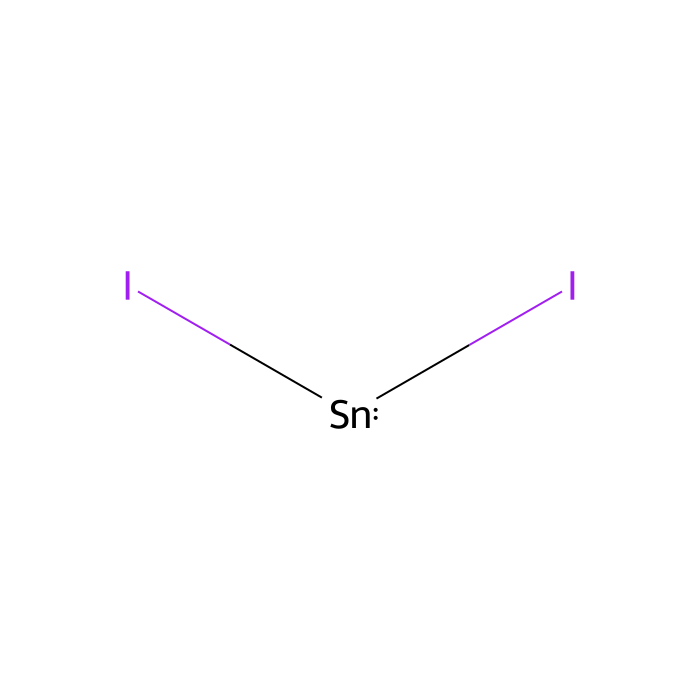
Tin(II) iodide is used to prepare organic-inorganic perovskite thin films which exhibit uniform surfaces and strong photoluminescence. It finds application as an analytical reagent in the determination of rhodium and iridium by spectrophotometry. It is also involved in the synthesis of CH3(CH2)11NH3]SnI3 which is a hybrid semiconductor with MoO3 type tin(II) iodide layers.
Taxonomy Tree
| Kingdom | Inorganic compounds |
|---|---|
| Superclass | Mixed metal/non-metal compounds |
| Class | Post-transition metal salts |
| Subclass | Post-transition metal iodides |
| Intermediate Tree Nodes | Not available |
| Direct Parent | Post-transition metal iodides |
| Alternative Parents | Inorganic tin salts |
| Molecular Framework | Not available |
| Substituents | Post-transition metal iodide - Inorganic tin salt - Inorganic salt |
| Description | This compound belongs to the class of inorganic compounds known as post-transition metal iodides. These are inorganic compounds in which the largest halogen atom is Iodine, and the heaviest metal atom is a post-transition metal. |
| External Descriptors | Not available |
Find and download the COA for your product by matching the lot number on the packaging.
| Lot Number | Certificate Type | Date | Item |
|---|---|---|---|
| Certificate of Analysis | Oct 31, 2026 | T292327 | |
| Certificate of Analysis | Oct 31, 2026 | T292327 | |
| Certificate of Analysis | Oct 31, 2026 | T292327 | |
| Certificate of Analysis | Sep 22, 2026 | T292327 | |
| Certificate of Analysis | Sep 22, 2026 | T292327 | |
| Certificate of Analysis | Sep 22, 2026 | T292327 | |
| Certificate of Analysis | Apr 13, 2026 | T292327 | |
| Certificate of Analysis | Aug 29, 2025 | T292327 | |
| Certificate of Analysis | May 13, 2025 | T292327 | |
| Certificate of Analysis | Feb 10, 2023 | T292327 |
| Solubility | Soluble in benzene, carbon disulfide, chloroform, and solutions of alkali chlorides and iodides. |
|---|---|
| Sensitivity | Moisture Sensitive. Air Sensitive. |
| Boil Point | 720 °C |
| Melt Point | 320° |
| Molecular Weight | 372.52 |
| XLogP3 | |
| Hydrogen Bond Donor Count | 0 |
| Hydrogen Bond Acceptor Count | 0 |
| Rotatable Bond Count | 0 |
| Exact Mass | 373.711 Da |
| Monoisotopic Mass | 373.711 Da |
| Topological Polar Surface Area | 0.000 Ų |
| Heavy Atom Count | 3 |
| Formal Charge | 0 |
| Complexity | 2.800 |
| Isotope Atom Count | 0 |
| Defined Atom Stereocenter Count | 0 |
| Undefined Atom Stereocenter Count | 0 |
| Defined Bond Stereocenter Count | 0 |
| Undefined Bond Stereocenter Count | 0 |
| The total count of all stereochemical bonds | 0 |
| Covalently-Bonded Unit Count | 1 |
H302:Harmful if swallowed
H312:Harmful in contact with skin
H314:Causes severe skin burns and eye damage
H315:Causes skin irritation
H317:May cause an allergic skin reaction
H319:Causes serious eye irritation
H332:Harmful if inhaled
H335:May cause respiratory irritation
H360:May damage fertility or the unborn child
P260:Do not breathe dust/fume/gas/mist/vapors/spray.
P261:Avoid breathing dust/fume/gas/mist/vapors/spray.
P264:Wash hands [and …] thoroughly after handling.
P270:Do not eat, drink or smoke when using this product.
P271:Use only outdoors or in a well-ventilated area.
P272:Contaminated work clothing should not be allowed out of the workplace.
P280:Wear protective gloves/protective clothing/eye protection/face protection.
P321:Specific treatment (see ... on this label).
P330:Rinse mouth.
P363:Wash contaminated clothing before reuse.
P301+P330+P331:IF SWALLOWED: Rinse mouth. Do NOT induce vomiting.
P302+P352:IF ON SKIN: wash with plenty of water.
P304+P340:IF INHALED: Remove person to fresh air and keep comfortable for breathing.
P305+P351+P338:IF IN EYES: Rinse cautiously with water for several minutes. Remove contact lenses if present and easy to do - continue rinsing.
P333+P313:IF SKIN irritation or rash occurs: Get medical advice/attention.
P362+P364:Take off contaminated clothing and wash it before reuse.
P405:Store locked up.
P403+P233:Store in a well-ventilated place. Keep container tightly closed.
P501:Dispose of contents/container to an approved waste disposal plant.
P203:Obtain, read and follow all safety instructions before use.
P264+P265:Wash hands [and …] thoroughly after handling. Do not touch eyes.
P301+P317:IF SWALLOWED: Get medical help.
P305+P354+P338:IF IN EYES: Immediately rinse with water for several minutes. Remove contact lenses if present and easy to do. Continue rinsing.
P318:if exposed or concerned, get medical advice.
P317:Get emergency medical help.
P337+P317:If eye irritation persists: Get medical help.
P332+P317:If skin irritation occurs: Get medical help.
P302+P361+P354:IF ON SKIN: Take off Immediately all contaminated clothing. Immediately rinse with water for several minutes.
P316:Get emergency medical help immediately.
P319:Get medical help if you feel unwell.
Our grade selection guide covers purity, stabilizer status, and application suitability for all variants in our catalog.
View PrimorTrace™ grade guide → View Ultra dry grade guide →