Determine the necessary mass, volume, or concentration for preparing a solution.
Taxonomy Tree
| Kingdom | Organic compounds |
|---|---|
| Superclass | Organic salts |
| Class | Organic metal salts |
| Subclass | Organic post-transition metal salts |
| Intermediate Tree Nodes | Organic tin salts |
| Direct Parent | Triorganotin halide salts |
| Alternative Parents | Trialkyltins Organic metal bromide salts Metal alkyl halides Organic bromide salts Hydrocarbon derivatives |
| Molecular Framework | Aliphatic acyclic compounds |
| Substituents | Triorganotin halide salt - Trialkyltin - Metal alkyl halide - Organic metal bromide salt - Hydrocarbon derivative - Organic bromide salt - Organotin compound - Organometallic compound - Organic post-transition metal moeity - Aliphatic acyclic compound |
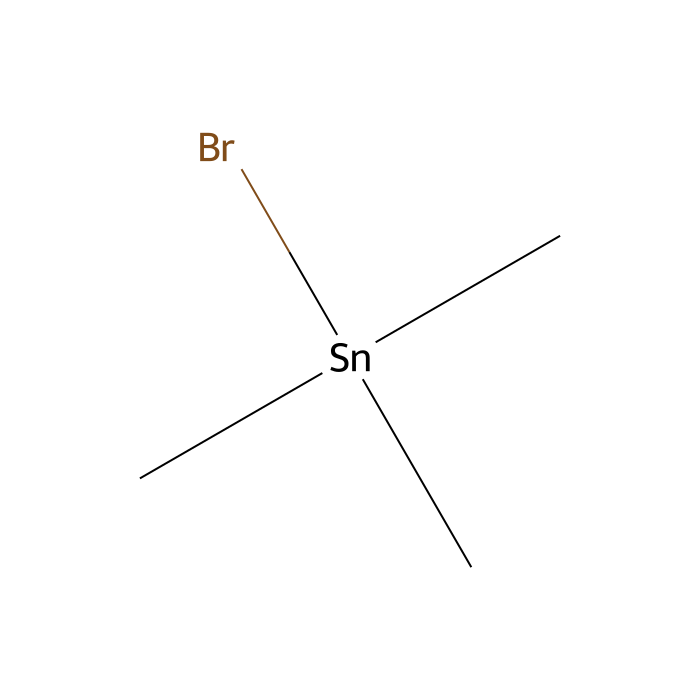
| Description | This compound belongs to the class of organic compounds known as triorganotin halide salts. These are organic compounds containing a tin atom bonded to three carbon atoms and a halogen atom. |
| External Descriptors | Not available |
| Sensitivity | moisture sensitive |
|---|---|
| Flash Point | 235.4 °F |
| Flash Point | 113 °C |
| Molecular Weight | 243.72 |
| XLogP3 | |
| Hydrogen Bond Donor Count | 0 |
| Hydrogen Bond Acceptor Count | 0 |
| Rotatable Bond Count | 0 |
| Exact Mass | 243.891 Da |
| Monoisotopic Mass | 243.891 Da |
| Topological Polar Surface Area | 0.000 Ų |
| Heavy Atom Count | 5 |
| Formal Charge | 0 |
| Complexity | 28.400 |
| Isotope Atom Count | 0 |
| Defined Atom Stereocenter Count | 0 |
| Undefined Atom Stereocenter Count | 0 |
| Defined Bond Stereocenter Count | 0 |
| Undefined Bond Stereocenter Count | 0 |
| The total count of all stereochemical bonds | 0 |
| Covalently-Bonded Unit Count | 1 |
H300:Fatal if swallowed
H301:Toxic if swallowed
H310:Fatal in contact with skin
H312:Harmful in contact with skin
H315:Causes skin irritation
H319:Causes serious eye irritation
H330:Fatal if inhaled
H372:Causes damage to organs through prolonged or repeated exposure
H400:Very toxic to aquatic life
H410:Very toxic to aquatic life with long lasting effects
H300+H310+H330:Fatal if swallowed, in contact with skin or if inhaled
P260:Do not breathe dust/fume/gas/mist/vapors/spray.
P262:Do not get in eyes, on skin, or on clothing.
P264:Wash hands [and …] thoroughly after handling.
P270:Do not eat, drink or smoke when using this product.
P271:Use only outdoors or in a well-ventilated area.
P273:Avoid release to the environment.
P280:Wear protective gloves/protective clothing/eye protection/face protection.
P284:[In case of inadequate ventilation] Wear respiratory protection.
P320:Specific treatment is urgent (see ... on this label).
P321:Specific treatment (see ... on this label).
P330:Rinse mouth.
P391:Collect spillage.
P302+P352:IF ON SKIN: wash with plenty of water.
P304+P340:IF INHALED: Remove person to fresh air and keep comfortable for breathing.
P305+P351+P338:IF IN EYES: Rinse cautiously with water for several minutes. Remove contact lenses if present and easy to do - continue rinsing.
P361+P364:Take off immediately all contaminated clothing and wash it before reuse.
P362+P364:Take off contaminated clothing and wash it before reuse.
P405:Store locked up.
P403+P233:Store in a well-ventilated place. Keep container tightly closed.
P501:Dispose of contents/container to an approved waste disposal plant.
P264+P265:Wash hands [and …] thoroughly after handling. Do not touch eyes.
P301+P316:IF SWALLOWED: Get emergency medical help immediately.
P317:Get emergency medical help.
P337+P317:If eye irritation persists: Get medical help.
P332+P317:If skin irritation occurs: Get medical help.
P316:Get emergency medical help immediately.
P319:Get medical help if you feel unwell.
Not specified for this item.
Item-specific biological information
General/literature perspective
Not typically applicable.
Context
Alternatives to organotin pathways (literature)
Greener solvent choices (typical)
Comparison snapshot (general)
Not typically applicable as a formulated excipient.
Item-specific specifications
Literature/general properties (typical values; not item specifications)
Notes for practitioners
Item-specific
Guidance on grades (general)
Stabilizers
Documentation
Manufacturer Applications
Representative applications (literature)
Practical notes
General guidance from literature (not item specifications)
Note: Optimize stoichiometry and temperature per substrate; consult primary literature for specific systems.
Item-specific hazard information
General safety (organotin halides; literature guidance)
Applicability
General solvent behavior (literature)
Selection guidance
Comparison (typical)
Item-specific storage
General handling/storage guidance (literature)
Reconstitution
Stability notes
Item-specific (from Product Data)
Literature/computed identity details (for reference only; not item specifications)
General structural features
Key functional elements
Typical transformations (literature)
Advantages
Considerations
Not applicable.