Determine the necessary mass, volume, or concentration for preparing a solution.
≥99% for sensitive chromatographic and analytical workflows requiring minimal baseline interference.
Room temperature Ships Normal Check lot-specific COA for exact specifications.
SDS, COA, datasheet, and spec sheet available for download. Lot-specific COA accessible via lot number lookup.
Cited in 5 peer-reviewed publications across chromatography, organic synthesis, and cross-coupling reactions.
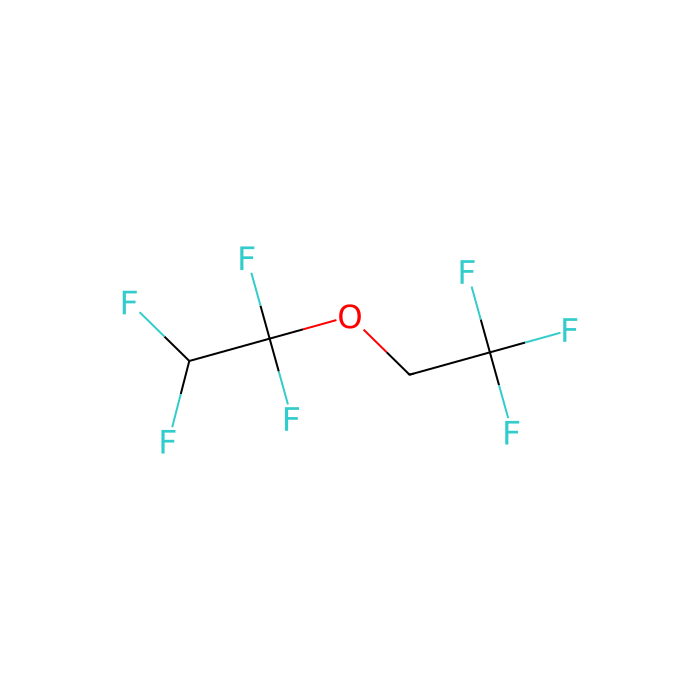
1,1,2,2-Tetrafluoroethyl 2,2,2-trifluoroethyl ether (TFTFE) is a fluorinated ether that finds extensive use as an electrolyte solvent and diluent in various battery technologies. TFTFE has a low viscosity, low freezing point (-94 °C lit.), low dielectric constant (~6.7), and high electrochemical stability, making it an ideal candidate for use in lithium-ion batteries, lithium-sulfur batteries, and other battery systems. TFTFE is miscible with many polar organic solvents, including carbonates typically used in battery electrolytes. With a minimum purity level of 99% and free from acid impurities, our TFTFE is a reliable and safe solution for critical battery applications.
Purpose:
Battery-grade 1,1,2,2-tetrafluoroethyl 2,2,2-trifluoroethyl ether (TFTFE) is a versatile co-solvent and additive for various battery systems. In lithium-metal batteries, TFTFE helps to suppress dendrites without raising the interfacial impedance. It also supports the stable cycling of NMC and lithium metal phosphate cathodes by forming a highly fluorinated interphase, which inhibits oxidation and transition metal dissolution.Because of its stability and low viscosity, TFTFE is commonly added in localized high-concentration electrolytes (LHCE) as a diluent and flame-retardant. In lithium-sulfur batteries, TFTFE plays a key role as both a polysulfide-restraining solvent and a film-forming agent, addressing the polysulfide shuttle (PSS) effect and improving battery performance.Additionally, TFTFE plays a critical role in cell systems with solvate ionic liquids (SIL) as an ionic conduction-enhancing ingredient, particularly for high-rate cycle environments.Our high-purity, anhydrous TFTFE is an ideal battery-grade additive for advanced battery technology.
| Pubchem Sid | 488188369 |
|---|---|
| Pubchem Sid Url | https://pubchem.ncbi.nlm.nih.gov/substance/488188369 |
| Canonical Smiles | C(C(F)(F)F)OC(C(F)F)(F)F |
| IUPAC Name | 1,1,2,2-tetrafluoro-1-(2,2,2-trifluoroethoxy)ethane |
| InChIKey | CWIFAKBLLXGZIC-UHFFFAOYSA-N |
| INCHI | 1S/C4H3F7O/c5-2(6)4(10,11)12-1-3(7,8)9/h2H,1H2 |
| Isomeric SMILES | C(C(F)(F)F)OC(C(F)F)(F)F |
| PubChem CID | 164596 |
| UN Number | 3271 |
| Packing Group | II |
| Molecular Weight | 200.06 |
| Reaxy-Rn | 1762056 |
Comprehensive hazard, handling, storage, and regulatory compliance document.
Download SDS →Lot-specific quality data. Enter your lot number to retrieve the exact COA.
Look up COA →Full quality attributes and acceptance criteria for this grade.
View spec sheet →Taxonomy Tree
| Kingdom | Organic compounds |
|---|---|
| Superclass | Organic oxygen compounds |
| Class | Organooxygen compounds |
| Subclass | Ethers |
| Intermediate Tree Nodes | Not available |
| Direct Parent | Dialkyl ethers |
| Alternative Parents | Organofluorides Hydrocarbon derivatives Alkyl fluorides |
| Molecular Framework | Aliphatic acyclic compounds |
| Substituents | Dialkyl ether - Hydrocarbon derivative - Organofluoride - Organohalogen compound - Alkyl halide - Alkyl fluoride - Aliphatic acyclic compound |
| Description | This compound belongs to the class of organic compounds known as dialkyl ethers. These are organic compounds containing the dialkyl ether functional group, with the formula ROR', where R and R' are alkyl groups. |
| External Descriptors | Not available |
Find and download the COA for your product by matching the lot number on the packaging.
| Lot Number | Certificate Type | Date | Item |
|---|---|---|---|
| Certificate of Analysis | Nov 26, 2025 | T162708 | |
| Certificate of Analysis | Nov 26, 2025 | T162708 | |
| Certificate of Analysis | Nov 26, 2025 | T162708 | |
| Certificate of Analysis | Jan 11, 2025 | T162708 | |
| Certificate of Analysis | Jan 11, 2025 | T162708 | |
| Certificate of Analysis | Jan 11, 2025 | T162708 | |
| Certificate of Analysis | Jan 11, 2025 | T162708 | |
| Certificate of Analysis | Jan 11, 2025 | T162708 | |
| Certificate of Analysis | Jan 11, 2025 | T162708 | |
| Certificate of Analysis | Oct 10, 2024 | T162708 | |
| Certificate of Analysis | Oct 10, 2024 | T162708 | |
| Certificate of Analysis | Oct 10, 2024 | T162708 | |
| Certificate of Analysis | Oct 10, 2024 | T162708 | |
| Certificate of Analysis | Oct 10, 2024 | T162708 | |
| Certificate of Analysis | Sep 18, 2023 | T162708 | |
| Certificate of Analysis | Sep 18, 2023 | T162708 | |
| Certificate of Analysis | Sep 18, 2023 | T162708 | |
| Certificate of Analysis | Sep 18, 2023 | T162708 | |
| Certificate of Analysis | Sep 18, 2023 | T162708 | |
| Certificate of Analysis | Sep 18, 2023 | T162708 | |
| Certificate of Analysis | Sep 18, 2023 | T162708 | |
| Certificate of Analysis | Dec 14, 2021 | T162708 | |
| Certificate of Analysis | Dec 14, 2021 | T162708 | |
| Certificate of Analysis | Dec 14, 2021 | T162708 | |
| Certificate of Analysis | Dec 14, 2021 | T162708 | |
| Certificate of Analysis | Dec 14, 2021 | T162708 | |
| Certificate of Analysis | Dec 14, 2021 | T162708 | |
| Certificate of Analysis | Dec 14, 2021 | T162708 |
| Sensitivity | Hygroscopic |
|---|---|
| Refractive Index | 1.27 |
| Flash Point(°C) | -7 °C |
| Boil Point(°C) | 56°C |
| Molecular Weight | 200.050 g/mol |
| XLogP3 | 2.800 |
| Hydrogen Bond Donor Count | 0 |
| Hydrogen Bond Acceptor Count | 8 |
| Rotatable Bond Count | 3 |
| Exact Mass | 200.007 Da |
| Monoisotopic Mass | 200.007 Da |
| Topological Polar Surface Area | 9.200 Ų |
| Heavy Atom Count | 12 |
| Formal Charge | 0 |
| Complexity | 139.000 |
| Isotope Atom Count | 0 |
| Defined Atom Stereocenter Count | 0 |
| Undefined Atom Stereocenter Count | 0 |
| Defined Bond Stereocenter Count | 0 |
| Undefined Bond Stereocenter Count | 0 |
| The total count of all stereochemical bonds | 0 |
| Covalently-Bonded Unit Count | 1 |
| 1. Yueteng Gao, Wei Li, Boning Ou, Shuhua Zhang, Huwei Wang, Junyang Hu, Feiyu Kang, Dengyun Zhai. (2023) A Dilute Fluorinated Phosphate Electrolyte Enables 4.9 V-Class Potassium Ion Full Batteries. ADVANCED FUNCTIONAL MATERIALS, 33 (47): (2305829). [PMID:] [10.1002/adfm.202305829] |
| 2. Dichang Guan, Guorong Hu, Zhongdong Peng, Yanbing Cao, Zhanggen Gan, Xudong Zhang, Ke Du. (2022) Designing Low-Concentration Propylene Carbonate-based Electrolyte by Manipulating Lithium+-Solvation Structure for Graphite Anode. Batteries & Supercaps, 5 (10): (e202200257). [PMID:] [10.1002/batt.202200257] |
| 3. Xiaojuan Chen, Yan Meng, Dan Xiao, Lei Qin. (2024) Empowering the Potassium–Sulfur Battery with Commendable Reaction Kinetics and Capacity Output by Localized High-Concentration Electrolytes. ACS Applied Materials & Interfaces, [PMID:38710103] [10.1021/acsami.3c19583] |
| 4. Zhanlin Yang, Guolin Hu, Chenyu Wang, Yuansheng Lin, Zhichao Shi, Jianhui Chen, Yongchuan Liu, Jie Shen, Cuilian Wen, Xiangxin Zhang, Yuanqiang Chen, Baisheng Sa. (2024) Solvation layer effects on lithium migration in localized High-Concentration Electrolytes: Analyzing the diverse antisolvent Contributions. JOURNAL OF COLLOID AND INTERFACE SCIENCE, [PMID:39752931] [10.1016/j.jcis.2024.12.217] |
| 5. Ruan Digen, Chen Shunqiang, Guo Jiasen, Wang Dazhuang, Zhu Weiduo, Huang Bing, Li Yuan, Ma Jun, Ma Zhihao, Wang Zihong, Zhu Zhongliang, Cao Ruiguo, Jiao Shuhong, Wu Yiying, Xu Kang, Ren Xiaodi. (2026) Molecularly aligned electron channels for ultrafast-charging practical lithium-metal batteries. Nature Energy, [PMID:] [10.1038/s41560-025-01961-z] |