Determine the necessary mass, volume, or concentration for preparing a solution.
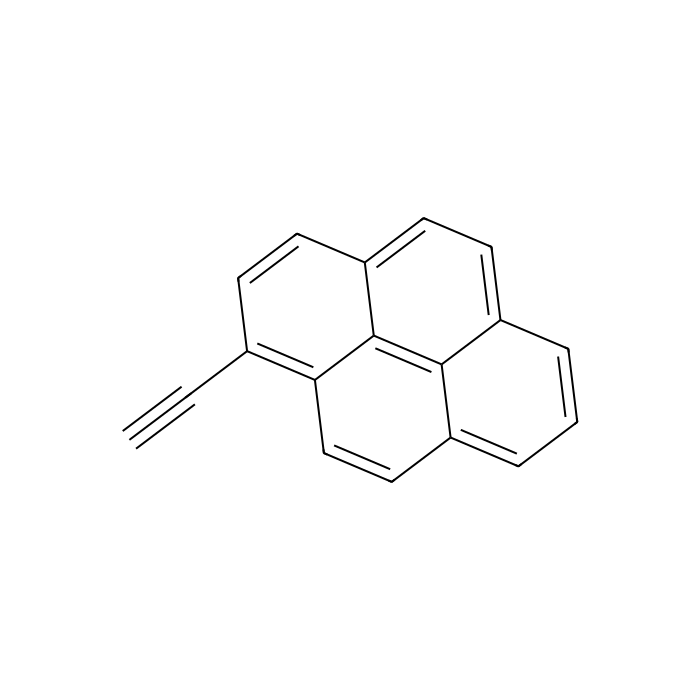
Pyrene is one of the simplest polyaromatic hydrocarbons (PAHs). Pyrene derivatives are known for their ability to intercalate dsDNA.
Pyrene possesses intrinsic fluorescence. When two pyrene residues are located in close proximity, excimer formation can be observed by fluorescence spectroscopy. Pyrene has been therefore used to probe structures of biomolecules.
Ethynylpyrene molecule contains terminal triple bond fragment for Click Chemistry, as well as other coupling reactions such as Sonogashira coupling.
Taxonomy Tree
| Kingdom | Organic compounds |
|---|---|
| Superclass | Benzenoids |
| Class | Pyrenes |
| Subclass | Not available |
| Intermediate Tree Nodes | Not available |
| Direct Parent | Pyrenes |
| Alternative Parents | Phenanthrenes and derivatives Naphthalenes Aromatic hydrocarbons Polycyclic hydrocarbons Acetylides Acetylenes |
| Molecular Framework | Aromatic homopolycyclic compounds |
| Substituents | Pyrene - Phenanthrene - Naphthalene - Aromatic hydrocarbon - Polycyclic hydrocarbon - Acetylide - Unsaturated hydrocarbon - Acetylene - Hydrocarbon - Aromatic homopolycyclic compound |
| Description | This compound belongs to the class of organic compounds known as pyrenes. These are compounds containing a pyrene moiety, which consists four fused benzene rings, resulting in a flat aromatic system. |
| External Descriptors | Not available |
Find and download the COA for your product by matching the lot number on the packaging.
| Lot Number | Certificate Type | Date | Item |
|---|---|---|---|
| Certificate of Analysis | Mar 27, 2026 | E171440 | |
| Certificate of Analysis | Jun 17, 2024 | E171440 | |
| Certificate of Analysis | Jun 17, 2024 | E171440 | |
| Certificate of Analysis | Jun 17, 2024 | E171440 | |
| Certificate of Analysis | Mar 09, 2022 | E171440 | |
| Certificate of Analysis | Mar 09, 2022 | E171440 | |
| Certificate of Analysis | Mar 09, 2022 | E171440 | |
| Certificate of Analysis | Mar 09, 2022 | E171440 | |
| Certificate of Analysis | Mar 09, 2022 | E171440 |
| Solubility | Soluble in Toluene |
|---|---|
| Sensitivity | light sensitive |
| Melt Point | 115.0 - 119.0 °C |
| Molecular Weight | 226.3 |
| XLogP3 | 5.300 |
| Hydrogen Bond Donor Count | 0 |
| Hydrogen Bond Acceptor Count | 0 |
| Rotatable Bond Count | 1 |
| Exact Mass | 226.078 Da |
| Monoisotopic Mass | 226.078 Da |
| Topological Polar Surface Area | 0.000 Ų |
| Heavy Atom Count | 18 |
| Formal Charge | 0 |
| Complexity | 373.000 |
| Isotope Atom Count | 0 |
| Defined Atom Stereocenter Count | 0 |
| Undefined Atom Stereocenter Count | 0 |
| Defined Bond Stereocenter Count | 0 |
| Undefined Bond Stereocenter Count | 0 |
| The total count of all stereochemical bonds | 0 |
| Covalently-Bonded Unit Count | 1 |
H302:Harmful if swallowed
H315:Causes skin irritation
H319:Causes serious eye irritation
H335:May cause respiratory irritation
H400:Very toxic to aquatic life
H410:Very toxic to aquatic life with long lasting effects
P261:Avoid breathing dust/fume/gas/mist/vapors/spray.
P273:Avoid release to the environment.
P391:Collect spillage.
P305+P351+P338:IF IN EYES: Rinse cautiously with water for several minutes. Remove contact lenses if present and easy to do - continue rinsing.
P501:Dispose of contents/container to an approved waste disposal plant.